
Window Placement Guide for Indian Homes (2026): Where Windows Should Go
The planning pillar for where windows go: orientation, the inlet-outlet pair, daylight reach, sill heights, WWR balance and a room-by-room checklist for Indian homes.
Where you put a window matters more than what you spend on it. A perfectly specified uPVC casement on the wrong wall still bakes the room in the afternoon, while a modest opening on the right wall delivers a breeze, even daylight and a view for free. This is the planning pillar for the Studio Matrx window cluster: it answers where windows go in an Indian home, in what size band, at what sill, and which way they face. Once you know where the opening belongs, the companion guide Types of Home Windows helps you choose which window fills it — placement decides the slot, the type fills it.
Numbers below are indicative for Indian homes. Confirm sizes and openable area against your local building bye-laws and a fabricator's window schedule.
Start with orientation: which wall the sun hits
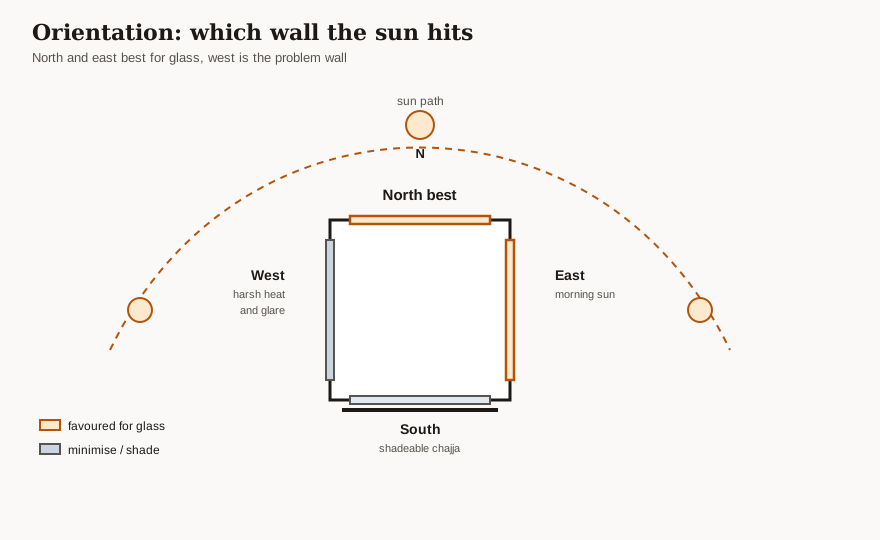
In India (Northern Hemisphere) the sun swings through the south, so each wall behaves differently. Get this right and shading, glare and cooling load mostly take care of themselves.
| Wall | Sun and light | Placement verdict |
|---|---|---|
| North | Soft, even, glare-free, almost no direct sun and little heat | Best wall for big glass — studies, studios, living, steady work light |
| East | Gentle low-angle morning sun, pleasant at dawn, manageable heat | Bedrooms, breakfast nook, pooja; low sun is hard to shade — use verticals or blinds |
| South | High midday sun, easiest to shade with a horizontal chajja or overhang | Good controllable daylight and winter warmth; large glass works with shading and low-SHGC glass |
| West | Harsh low-angle afternoon sun, most heat and glare | The problem wall — minimise glass, use low-SHGC or reflective glazing, vertical fins, deciduous trees |
The happy accident: north and east are also the coolest light, so building science and vastu broadly agree (more on that below). The deep-dive per wall lives in North-Facing Window Design, East-Facing Window Design, South-Facing Window Design and West-Facing Window Design. These are about the window on the wall; for whole-house orientation see East-Facing House Plan and South-Facing House Design.
The inlet-outlet pair: place windows so air moves
A single window ventilates poorly. Air needs an inlet and an outlet on different — ideally opposite — walls, so the breeze enters on the windward (high-pressure) side and exits on the leeward (suction) side. A room with windows on only one wall has no through-path.
- Put the inlet low on the windward wall, the outlet on the opposite or adjacent leeward wall.
- Make the outlet at least as large as the inlet — a smaller inlet feeding a larger outlet speeds the breeze (venturi effect).
- Keep the flow path across the room unobstructed by tall furniture or partitions.
- For hot air, add a high outlet (clerestory or high vent) so stack ventilation flushes heat upward.
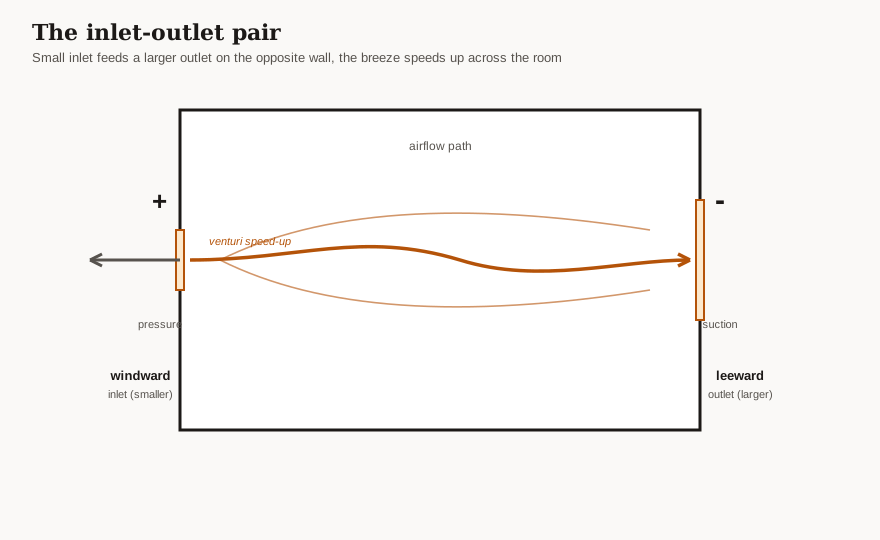
This is the placement angle. The airflow physics — wind pressure, venturi, the Cross-Ventilation Analyzer tool — sit in the science guide Cross-Ventilation in Indian Homes. The window-specific design lives in Window Design for Cross Ventilation, and the cooling levers (night purge, stack effect, shading) in Passive Cooling Through Windows, which differentiates from the whole-building Passive Cooling Strategies.
How deep daylight reaches
Daylight from a side window reaches roughly 2 to 2.5 times the window head height into a room. A head at 2.1 m lights about 4.2 to 5.25 m of depth — beyond that the room goes gloomy. Two consequences for placement:
- Tall windows light deeper than wide ones. Raise the head, not just the width, to push light to the back wall.
- Deep rooms need a second light source — a clerestory high on the far wall, a skylight, a light shelf, or windows on a second wall (dual-aspect).
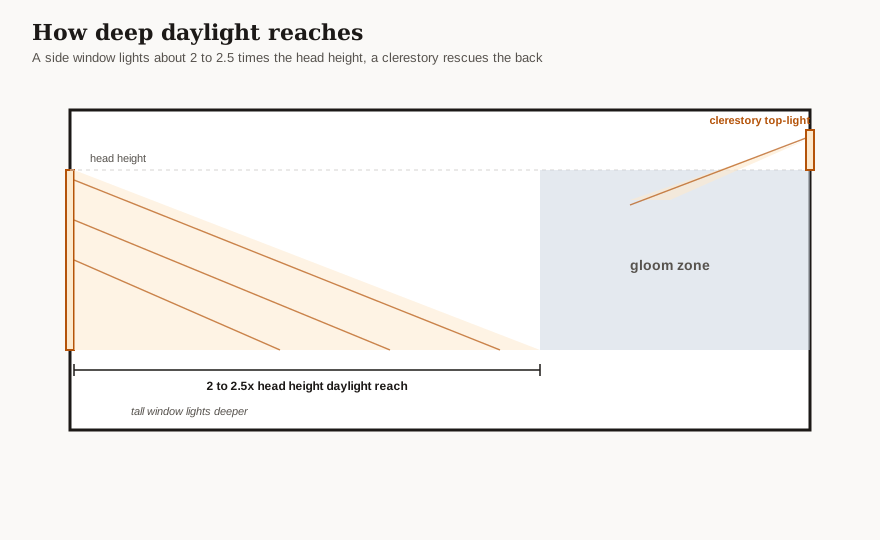
A dual-aspect room — windows on two different walls — is the single best placement move for both light and air: it lights the room evenly, kills the dark back corner, and gives the inlet-outlet pair for cross ventilation. The daylight-quality choices (glazing VLT, bouncing light off pale walls) are in Window Design for Natural Light; the daylighting technique and Daylight Factor maths (per IS 2440) are in Daylighting Design with Windows and the science guides Natural Light Planning and Daylight Factor.
Sill heights: place the opening at the right level
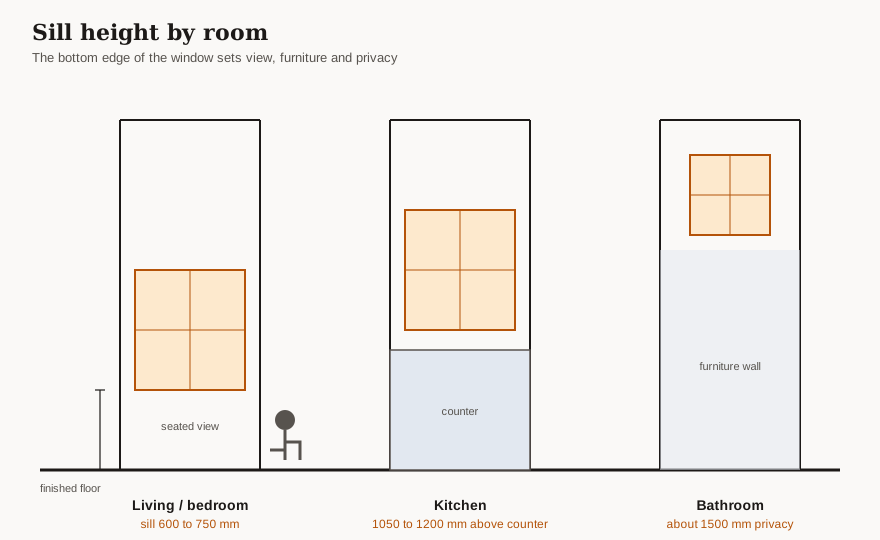
Sill height decides whether a window gives a view, a furniture wall, or privacy. The standard bands for Indian homes:
| Room | Sill height | Why |
|---|---|---|
| Living / bedroom | 600 to 750 mm (2 to 2.5 ft) | Low enough for a seated view, high enough to clear furniture |
| Kitchen | 1050 to 1200 mm (3.5 to 4 ft) | Sits above the counter and backsplash |
| Bathroom | about 1500 mm (5 ft) | Privacy while still venting and lighting |
Ceiling clear height should be at least 2750 mm per NBC. Lower sills give seated views and reach (important for seniors and wheelchair users); higher sills create a usable furniture wall below the window and protect privacy on street-facing rooms.
Privacy, street-facing walls and furniture
Don't place a low, large window where it stares straight at a neighbour or the street. Levers: raise the sill, use a clerestory above eye level, fit a jali or louvred screen, or place the opening on the wall facing your own courtyard. Also place windows knowing the furniture wall you need — a bedroom needs an uninterrupted wall for the wardrobe and bed-head, so concentrate glass on the other walls.
Balancing window-to-wall ratio (WWR)
WWR is glazed area divided by external wall area. More glass means more light and view but more heat — and the Eco-Niwas Samhita (ENS) then demands lower-SHGC glazing and a minimum VLT, with RETV held to 15 W/m2 or less. The minimum VLT tightens as WWR rises:
| WWR band | Minimum VLT (ENS) |
|---|---|
| 0 to 0.30 | 0.27 |
| 0.31 to 0.40 | 0.20 |
| 0.41 to 0.50 | 0.16 |
| 0.51 to 0.60 | 0.13 |
| 0.61 to 0.70 | 0.11 |
The sweet spot for most Indian rooms is about 20 to 40 per cent WWR with good glass and external shading. The full ratio logic is in Window-to-Wall Ratio, and standard opening sizes in Window Size Standards.
Vastu, harmonised with the sun-path
Vastu favours bigger windows on the north, east and northeast, medium on northwest and southeast, small on west and south, and ideally none in the southwest. Because north and east light is also the coolest and glare-free, vastu and building science largely agree — and the west caution matches the heat reality. Treat it as guidance reconciled with the sun-path, not a separate rulebook. The dedicated treatment is in Vastu for Home Windows; whole-home vastu is in Vastu for Modern Homes and Vastu House Plan.
Placement by home type and for everyone
- Narrow plots: sides sit on the boundary, so light and air come from the front and rear only — use tall front and rear windows plus a clerestory, skylight or light-well over the deep middle. See Window Design for Narrow Plots and Compact Urban Home Planning.
- Apartments: you usually cannot change the openings — work with the given windows, balcony glazing, mesh and retrofit films. See Window Design for Apartments.
- Villas: freedom on all four sides for feature windows, dual-aspect rooms and double-height stairwell glazing. See Window Design for Villas.
- Courtyard houses: windows face inward to the court for light, cross and stack ventilation and privacy without facing the street. See Windows for Courtyard Houses and Courtyard Homes.
- Seniors and all abilities: lower sills (around 450 to 600 mm) for a seated and wheelchair view, lever handles reachable at 800 to 1000 mm, low-force or motorised operation, and safe glazing — see Senior-Friendly Window Design, Universal Design Windows and Accessible Home Design.
Room-by-room placement checklist
| Room | Best wall | Sill | Placement note |
|---|---|---|---|
| Living | North or east; south if shaded | 600 to 750 mm | Dual-aspect for light and a breeze path; pair with operable openings |
| Master bedroom | East or north | 600 to 750 mm | Keep a clear furniture wall for the wardrobe and bed-head |
| Kitchen | East (vastu and morning light) | 1050 to 1200 mm | Window plus exhaust over the counter; avoid west heat near the cooking zone |
| Bathroom | Any; awning or louvre | about 1500 mm | High sill for privacy, ventilates in light rain |
| Study or studio | North | 600 to 750 mm | North glass gives glare-free, steady work light |
| Stairwell / deep core | Top-light | High | Clerestory or skylight for stack ventilation and deep daylight |
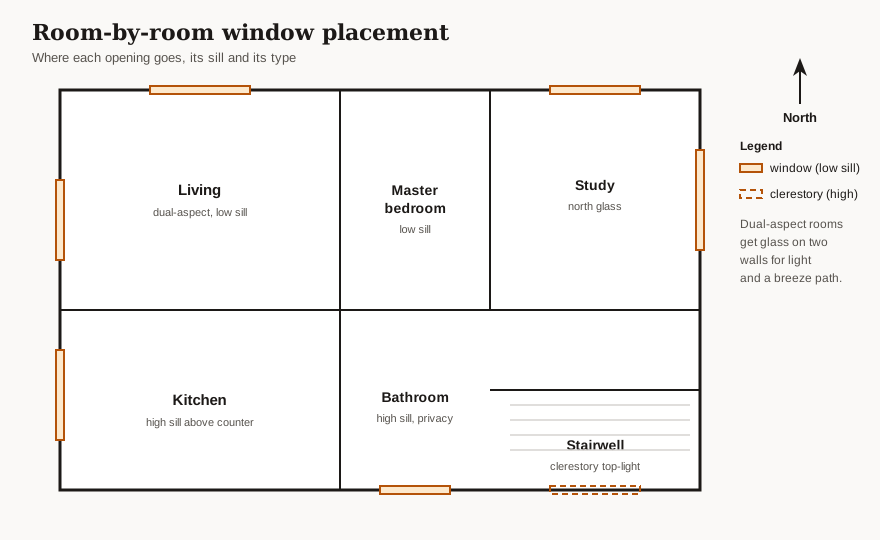
Draw a window schedule (W1, W2, W3...) on your plans early, fixing the wall, size, sill and opening type for each. It is the cheapest design decision you will ever make and the most expensive to change later.
References
- BIS Guide for Using NBC 2016: https://www.bis.gov.in/wp-content/uploads/2022/08/Booklet-Guide-for-Using-NBC-2016.pdf
- Eco-Niwas Samhita 2018 (BEE/ECBC): https://ecbc.in/econiwas.html
- IS 3362 natural ventilation of residential buildings: https://law.resource.org/pub/in/bis/S03/is.3362.1977.pdf
- Standard door and window sizes in India (HouseYog): https://www.houseyog.com/blog/standard-door-window-sizes-india-schedule/
- Vastu for doors and windows (Livspace): https://www.livspace.com/in/magazine/vastu-for-house-doors-windows
- CPWD Harmonised Guidelines (barrier-free): https://www.cpwd.gov.in/Publication/Harmonisedguidelinesdreleasedon23rdMarch2016.pdf
Export this guide
Related Guides — Deep-dive reading
Window Design for Villas (India): Using the Freedom of All Four Sides
With walls free on all four sides, you can tune every window to its sun: north light for studies, east for bedrooms, shaded south for living, minimal west, plus feature windows, dual-aspect rooms and stairwell glazing.
Windows & GlazingNorth-Facing Window Design (India): The Best Light With the Least Heat
Why the north wall gives soft, even, glare-free daylight with almost no heat, and how to design large, high-VLT windows that make the most of it.
Windows & GlazingWindow Design for Cross Ventilation (India): Inlet, Outlet and the Path of the Breeze
How to size, place and choose windows so a breeze actually crosses the room, windward inlet to leeward outlet, with the right window types and a clear flow path.
Windows & GlazingRelated Tools — Try Free
Cross-Ventilation Analyzer
Estimate airflow and air changes per hour (ACH) from room size, window areas, layout, and local wind — with NBC 2016 Part 8 compliance check.
Ventilation CalculatorBrise-Soleil Visualizer
Interactive horizontal-louvre cut-off angle calculator — sun altitude, louvre depth, and spacing inputs with a live shadow preview. Computes θ = arctan(spacing/depth) for façade shading, ECBC envelope compliance, hospital daylight design, and tropical sun-control detailing.
Sun Shading ToolWindow Orientation Planner
Pick the best window type, glass and shading by wall direction — north, east, south and west.
Window Tool