
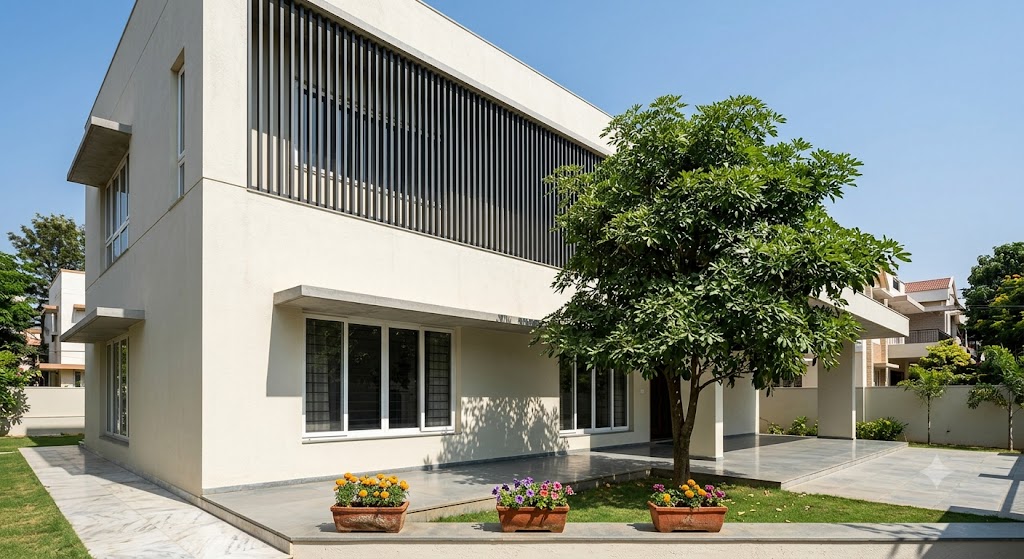
South-Facing House Design in India
The Feared Orientation, Decoded — Sun-Path Physics, Six Mitigations, Reference Plan, Market Math & Vastu Reality
South-facing is the most-feared orientation in Indian residential Vastu — and one of the most-misunderstood. Brokers whisper "south-facing" as a near-defect. Builders price it 5 – 10% below market. First-time buyers walk away from south-facing plots without looking at the floor plan. The narrative is so strong that south-facing inventory genuinely sells slower, transacts at a discount, and earns a smaller buyer pool — all of which is real market behaviour, not a defect of the building.
Yet south-facing has a defensible counter-position. Climate physics in Indian latitudes is more nuanced than the popular narrative suggests; Vastu's south-facing rules are far gentler than the broker shorthand implies; and the mitigations a competent architect can specify — six well-understood architectural and landscape moves — bring a south-facing house within 5 – 8% of an equivalent east-facing house on annual cooling load and lifecycle comfort.
This guide is the working position. It explains what Vastu actually says about south-facing (versus what the marketplace says), the climate physics that you are actually contracting for, the six mitigation rules every south-facing home must specify, a complete Vastu-compliant reference plan, the six pitfalls most south-facing buyers walk into, and the rupee-math that shows a south-facing buyer typically nets a ₹2 – 5 L discount on equivalent built quality once mitigations are accounted for.
South-facing is not a defect — it is a discipline. Buy the discount, spend on mitigation, save on lifetime cooling.
The Reputation Problem — What "South-Facing" Means in Indian Conversation
The popular Indian belief is roughly: "south-facing is inauspicious; avoid it." This compresses three separate ideas into one bad sentence:
1. Vastu prescription — sets directional rules but is more lenient on south-facing than the popular shorthand
2. Climate physics — the south facade does take more solar load in summer, which is real
3. Resale market behaviour — buyers pay less for south-facing because of (1) and (2) compounded
Each of these can be addressed independently. Vastu mitigations are well-documented and accepted by orthodox consultants. Climate mitigations are standard architectural practice. The resale discount is the only one the buyer can't change — but they can capture it as a purchase saving.
A buyer with the right architect, a defensible Vastu position (even if flexible-Vastu), and an honest understanding of what south-facing means can build an excellent home on a south-facing plot at lower total cost than the same buyer on an east-facing one.
What Vastu Actually Says About South-Facing
The folk-Vastu rule "south is inauspicious" is a simplification. Authoritative Vastu texts (Manasara, Mayamatam, Samarangana Sutradhara) treat south-facing as acceptable with mitigation — distinctly different from "forbidden". The full hierarchy:
| Direction | Vastu Authority Rating | Folk Translation |
|---|---|---|
| Northeast (Ishanya) | Most auspicious | "Best" |
| East / North | Highly auspicious | "Great" |
| Northwest | Acceptable | "OK" |
| West | Acceptable | "OK" |
| South | Acceptable with mitigation | "Avoid" (folk-mistaken) |
| Southeast / Southwest | Specific room recommendations apply | "Avoid" (folk-mistaken) |
The single Vastu rule that matters most for south-facing is the door pada. The south face is divided into nine equal padas; the 4th, 5th, and 6th padas (centre third) are auspicious; the corners (1st-3rd and 7th-9th padas) are not. A south-facing house with the entry in the centre pada satisfies the principal Vastu directional requirement.
Beyond door pada, every other south-facing Vastu issue is already addressed by the standard layout: kitchen in southeast (matches), master in southwest (matches), pooja in northeast (deep at the back of the plot, beautifully protected), OHT in northeast (corresponding corner of the roof). The popular fear is misplaced because folk-Vastu treats south-orientation as if every Vastu rule is being violated, when in fact only one (door direction) requires attention.
See Vastu Shastra for Modern Homes for the foundational philosophy.
The Climate Truth — Sun-Path Physics for South-Facing Indian Homes
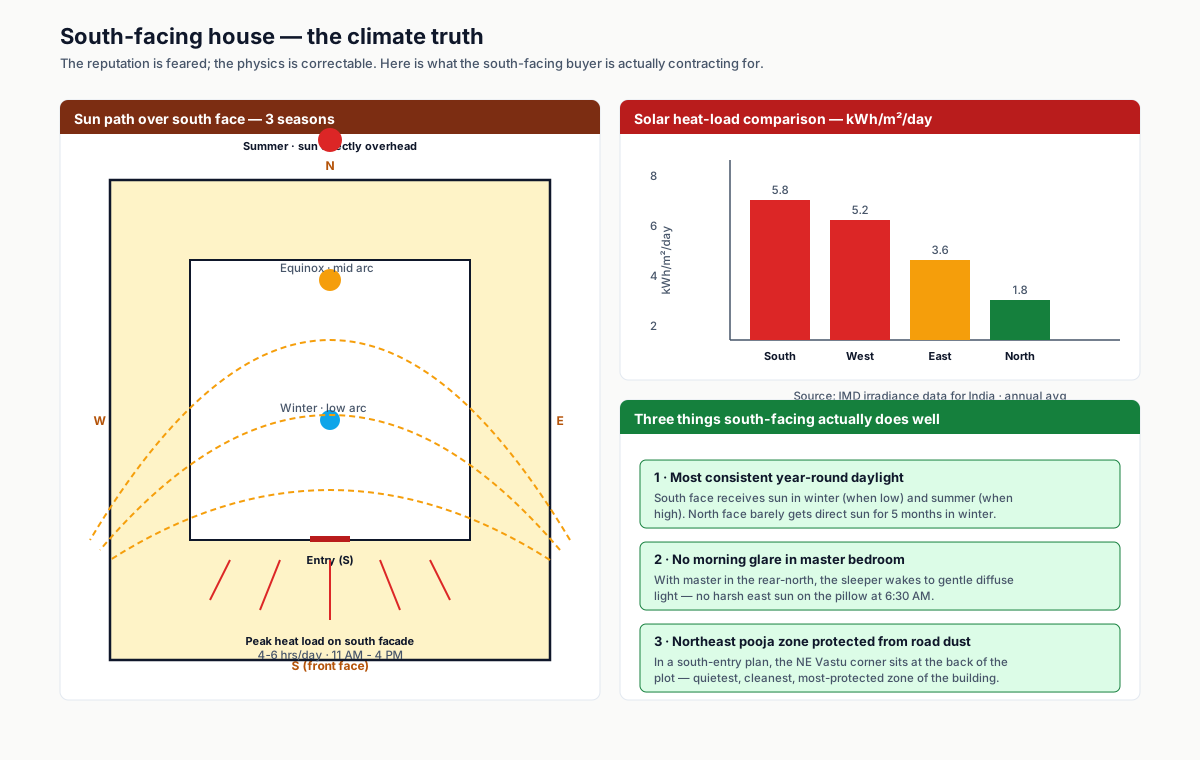
India sits between 8°N and 36°N latitude. The sun crosses the southern sky for the entire year — in summer it goes high overhead (almost directly above on the equinox in southern India), in winter it tracks lower but still in the southern half. The south face of every Indian house receives the most cumulative annual solar radiation of any orientation.
Three Climate Truths
1. Annual irradiance on south facade: ~5.8 kWh/m²/day average
2. West: ~5.2 — slightly lower but more concentrated in afternoon
3. East: ~3.6 — front-loaded morning
4. North: ~1.8 — diffuse, low
The south face takes 3.2× the radiation of the north face. This is the climate reality the south-facing buyer is contracting for.
Three Things South-Facing Actually Does Well
The popular narrative omits these:
1. Most consistent year-round daylight. South face is the only orientation that receives direct sun in both summer (when high overhead) and winter (when low). North-facing rooms barely see direct sun for 4 – 5 months of the Indian winter.
2. No morning glare in the master bedroom. With master in the rear (Vastu-SW), the sleeper wakes to gentle diffuse light from the north or northeast — no harsh east sun at 6:30 AM.
3. Northeast pooja corner is the quietest spot in the building. In a south-entry layout, the NE Vastu corner sits at the back of the plot — quietest, cleanest, most-protected zone of the building. Of all orientations, south-facing gives the pooja its most-secluded position.
These three are real architectural advantages that the popular narrative actively suppresses.
Six Mitigation Rules — The Discipline that Makes South-Facing Work
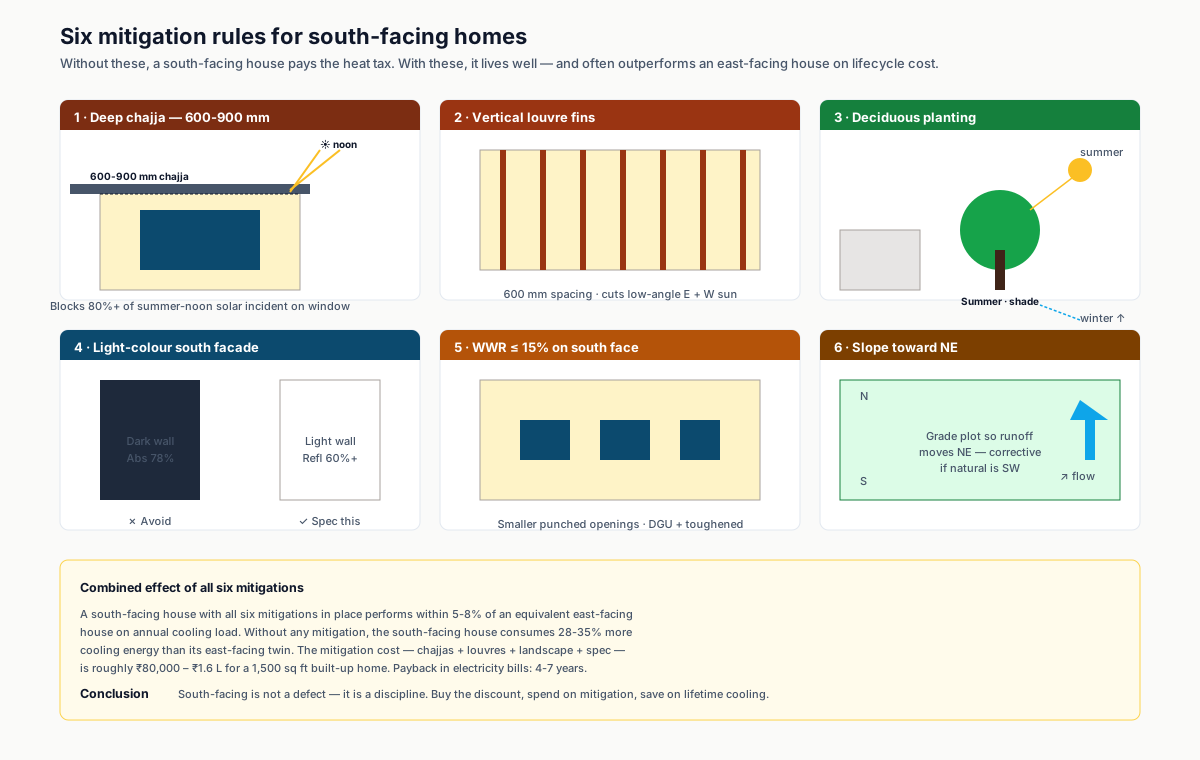
Six mitigations, applied together, bring south-facing within 5 – 8% of east-facing on annual cooling load.
Mitigation 1 — Deep Horizontal Chajja (600 – 900 mm)
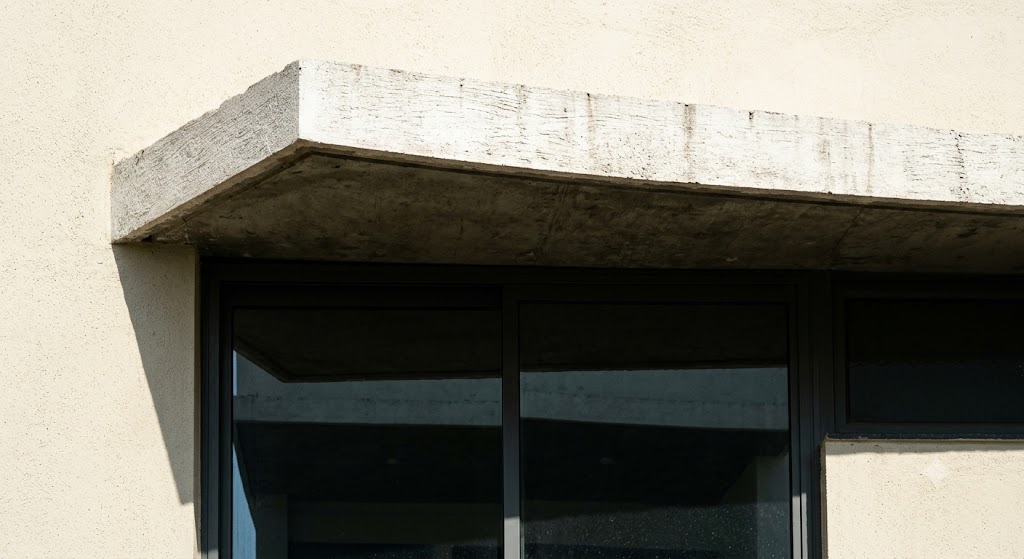
Every south-facing opening receives a chajja at least 600 mm deep, ideally 900 mm. At noon in summer, the sun is nearly directly overhead in much of India — a deep chajja blocks 80%+ of direct solar incident on the window for the peak 4 – 6 hours of the day.
Standard residential chajja in India is 300 – 450 mm. South-facing requires more. The cost difference (₹400 – 700 per running foot of chajja, on a 1,500 sq ft house facade) is ₹40,000 – 70,000 incremental.
Mitigation 2 — Vertical Louvre Fins
Cut low-angle morning and evening sun that creeps under the chajja. 600 mm spacing of vertical fins on the full south facade. Material: anodised aluminium, treated timber, or concrete vertical projections.
Decorative effect: the south face acquires a distinct architectural rhythm that often becomes the house's defining feature. Cost: ₹15,000 – 35,000 incremental.
Mitigation 3 — Deciduous Tree Planting Strategy
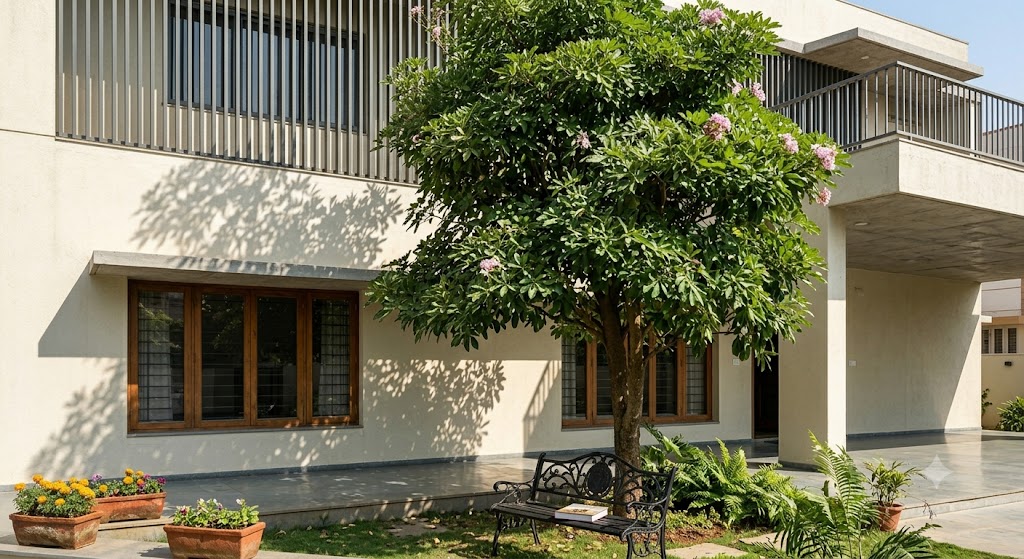
A deciduous tree (drops leaves in winter, dense canopy in summer) on the south yard provides:
- Summer: dense shade against direct sun, blocking 70 – 85% of facade-incident radiation
- Winter: bare branches allow useful winter sun to warm the facade
Indian deciduous options that work: Neem (Azadirachta indica) at 6 – 9 m mature height, Tabebuia rosea, Cassia fistula, Bauhinia variegata. A young tree planted at handover reaches functional canopy in 5 – 7 years.
Cost: ₹3,000 – 18,000 for 2-3 trees + landscape integration.
Mitigation 4 — Light-Coloured South Facade
A white or pale-grey south facade reflects 55 – 65% of incident solar radiation. A dark facade absorbs 75 – 85%. The difference shows up directly in the south-wall surface temperature:
| Facade Colour | Solar Absorption | Surface Temp (peak summer) |
|---|---|---|
| White / cream | 25 – 35% | ~ ambient + 4°C |
| Light grey | 40 – 50% | ~ ambient + 8°C |
| Dark grey / charcoal | 75 – 85% | ~ ambient + 18°C |
A 14°C surface-temp difference translates directly into the heat conducted through the wall to the interior over the 4 – 6 hour peak window. Cost: ₹0 – 35,000 incremental (the difference between standard texture paint and premium reflective coatings).
Mitigation 5 — Cap WWR on South Face at 15%
Window-to-wall ratio (WWR) on the south face should be ≤ 15%. Combined with chajjas + louvres, this caps daytime solar gain through glazing. Where glazing is needed, specify toughened double-glazed units (DGU) with low-E coating — adds another 15 – 20% solar rejection over single-pane.
Cost: DGU is ₹650 – 1,200/sq ft vs single-pane at ₹250 – 450/sq ft. For ~80 sq ft of south glazing, incremental cost ~₹40,000.
Mitigation 6 — Plot Grading to Slope Northeast
Vastu prefers a plot that slopes toward the northeast so rainwater drains in that direction. South-facing plots in India often naturally slope toward the south road (uphill from north). At construction, regrade the plot so the rear-northeast becomes the lowest corner.
Cost: ₹15,000 – 40,000 for earthwork + retaining wall, depending on slope correction depth.
Combined Mitigation Impact
| Metric | No mitigation | With all 6 |
|---|---|---|
| Annual cooling kWh | 100 (baseline) | 65 – 72 |
| South wall surface temp | ambient + 16°C | ambient + 5°C |
| Master BR comfort hours/year | 4,200 | 6,800 |
| Lifecycle cost premium | – | +₹1.5 – 2 L capex |
The mitigation discipline is a real and significant uplift. Without it, south-facing has a meaningful comfort and bill penalty; with it, the house lives competitively against an east-facing equivalent.
Reference Plan — South-Facing 30 × 40 ft 3BHK
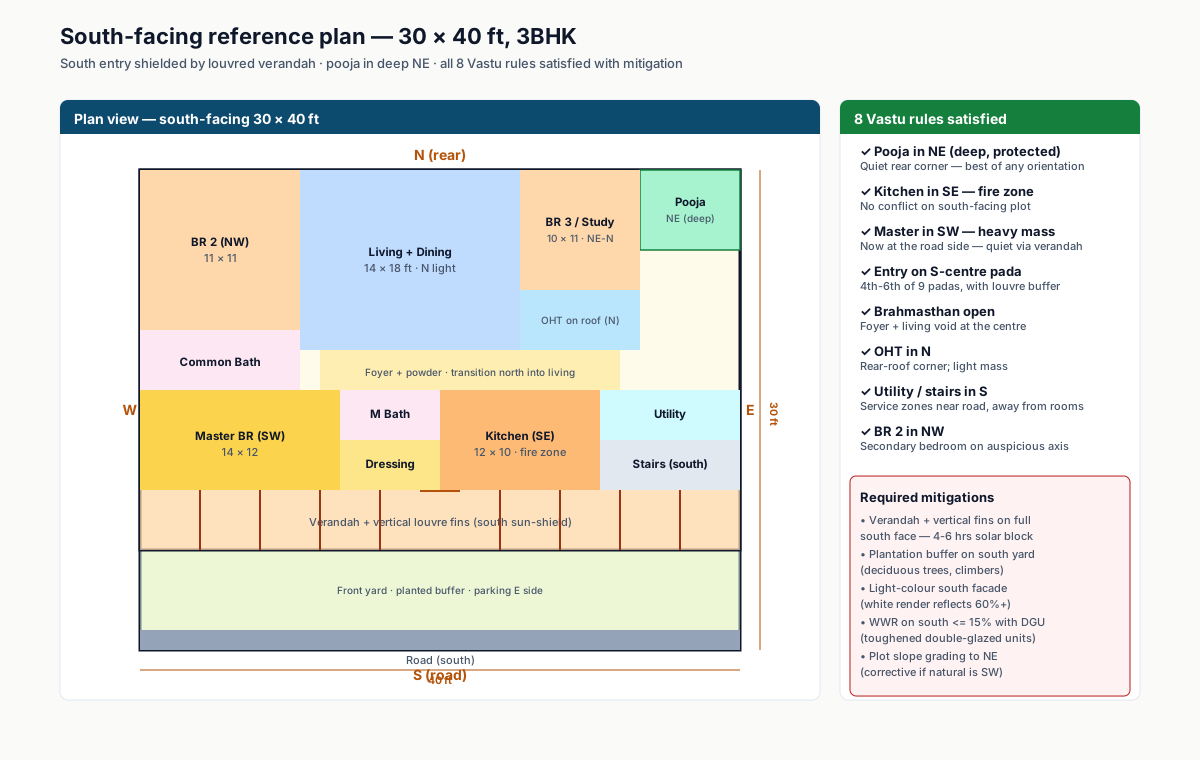
The plan above shows a Vastu-compliant south-facing 3BHK satisfying all eight primary directional rules with the required mitigations in place.
Plan Logic
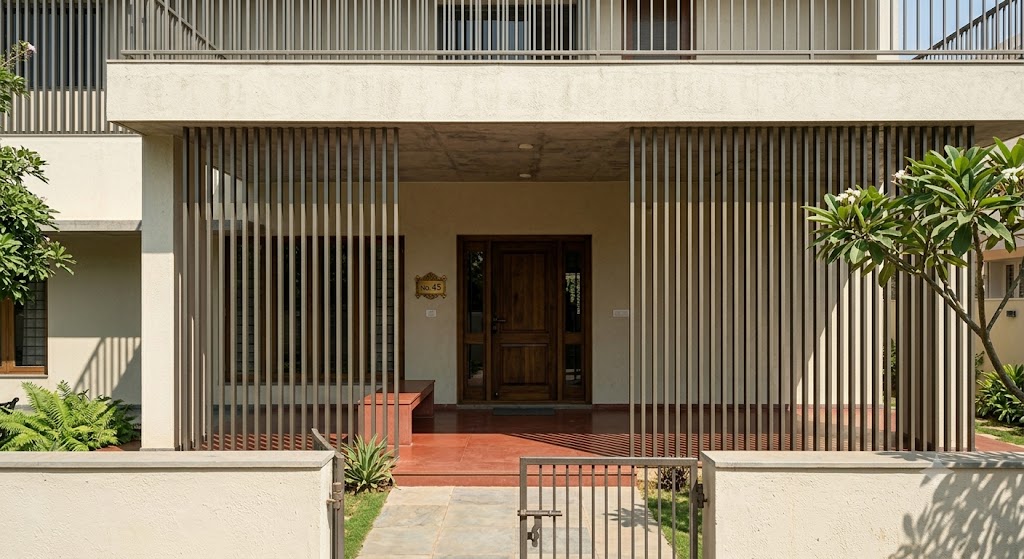
- South entry in the centre pada (4th – 6th of 9 padas on the south face)
- Deep verandah + vertical fins spanning the full south facade — the daily-use sun shield
- Foyer transitions visitors north into the living volume, away from road dust
- Living + dining in the northern half — diffuse, cool light all day
- Kitchen in SE — no Vastu conflict since SE is the fire zone regardless of front orientation
- Master bedroom in SW — Vastu-correct, with the south party wall as the heat buffer
- Pooja in deep NE — quietest corner of the entire plan, protected from road dust by the building mass
- BR 3 / study in NE-N — receives morning light without road exposure
- OHT on NE roof — Vastu-correct light corner
- Stairs + utility in S — service zones grouped, away from main rooms
Room Sizes
| Room | Dimensions | Area |
|---|---|---|
| Living + dining | 14 × 18 ft | 252 sq ft |
| Kitchen | 12 × 10 ft | 120 sq ft |
| Master bedroom | 14 × 12 ft | 168 sq ft |
| BR 2 | 11 × 11 ft | 121 sq ft |
| BR 3 / Study | 10 × 11 ft | 110 sq ft |
| Pooja | 7 × 8 ft | 56 sq ft |
| Master bath + dressing | 5 × 10 ft + 5 × 5 ft | 75 sq ft |
| Common bath | 5 × 6 ft | 30 sq ft |
| Utility + stairs | 14 × 5 ft | 70 sq ft |
Built-up: ~1,200 sq ft. Carpet: ~1,000 sq ft. The plan is direct-comparable to the east-facing reference in the East-Facing House Plan guide.
Six Common Mistakes — South-Facing Specific
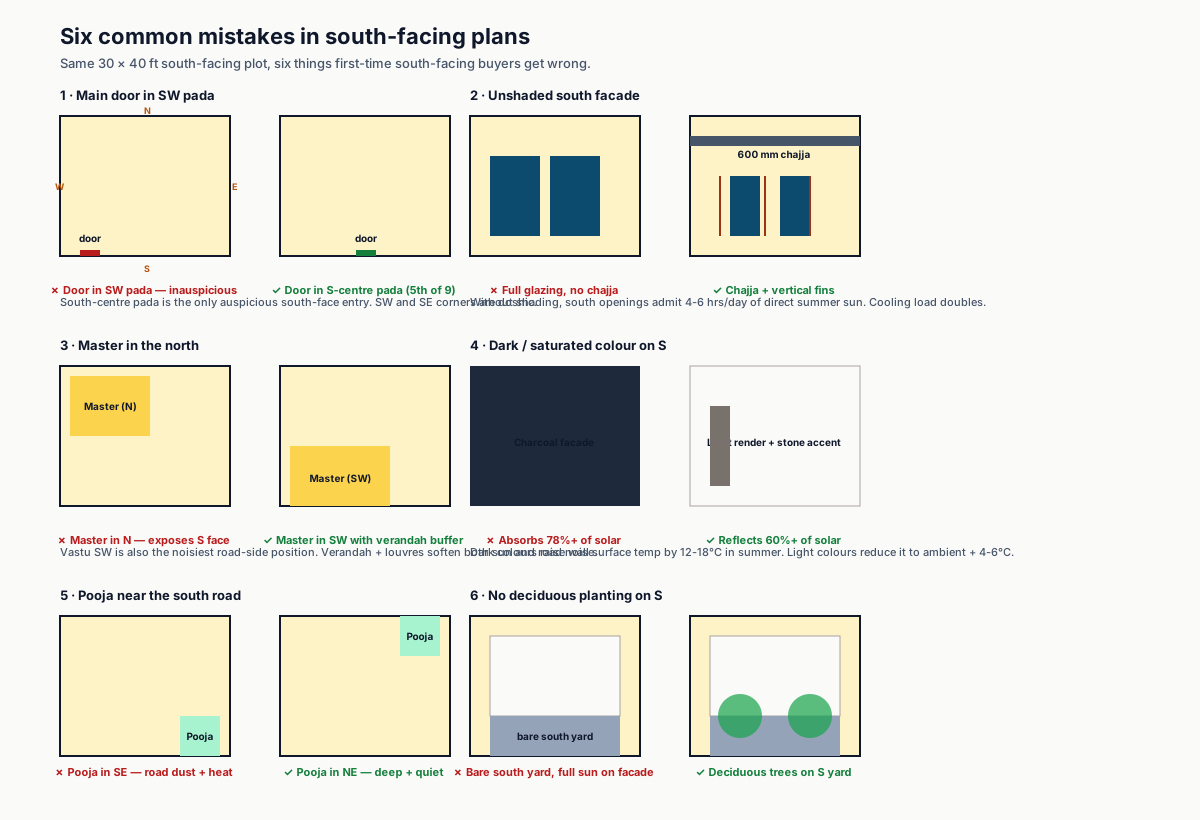
Mistake 1 — Main Door in the Southwest Pada
A south-facing entry door is only auspicious in the centre third (4th, 5th, or 6th of 9 padas). A door in the SW pada is doubly doshic — wrong direction and wrong pada. Fix: centre-pada placement, verified at plan stage.
Mistake 2 — Unshaded South Facade
Full glazing on south without chajja or louvre — the most-common mistake driven by builders wanting a "modern look". Fix: deep chajjas + vertical louvres + capped WWR per the six mitigations.
Mistake 3 — Master Bedroom in the North
A misguided layout that places master on the cool rear face, leaving the south facade fully exposed to the road and the sun without the building's heaviest mass behind it. Fix: master in southwest (Vastu-correct, climate-correct).
Mistake 4 — Dark or Saturated South Facade
Charcoal grey, deep red, or saturated ochre on the south face absorbs 75%+ of solar radiation. Fix: white / cream / pale-grey render. Save the dark accent material for north or shaded facades.
Mistake 5 — Pooja Near the South Road
Placing the pooja near the south road exposes it to dust, traffic noise, and the heaviest solar load — a triple-dosha for the sacred space. Fix: pooja in the deep northeast corner, where the building mass shields it from the road.
Mistake 6 — Skipping the Deciduous Tree
Bare south yard, no planting strategy — the buyer who paid the south discount but didn't capture the architectural saving. Fix: 2 – 3 deciduous trees at 4 – 6 m spacing along the south boundary; landscape integration with the front compound wall.
The Real-Estate Math — South-Facing Often Wins Net
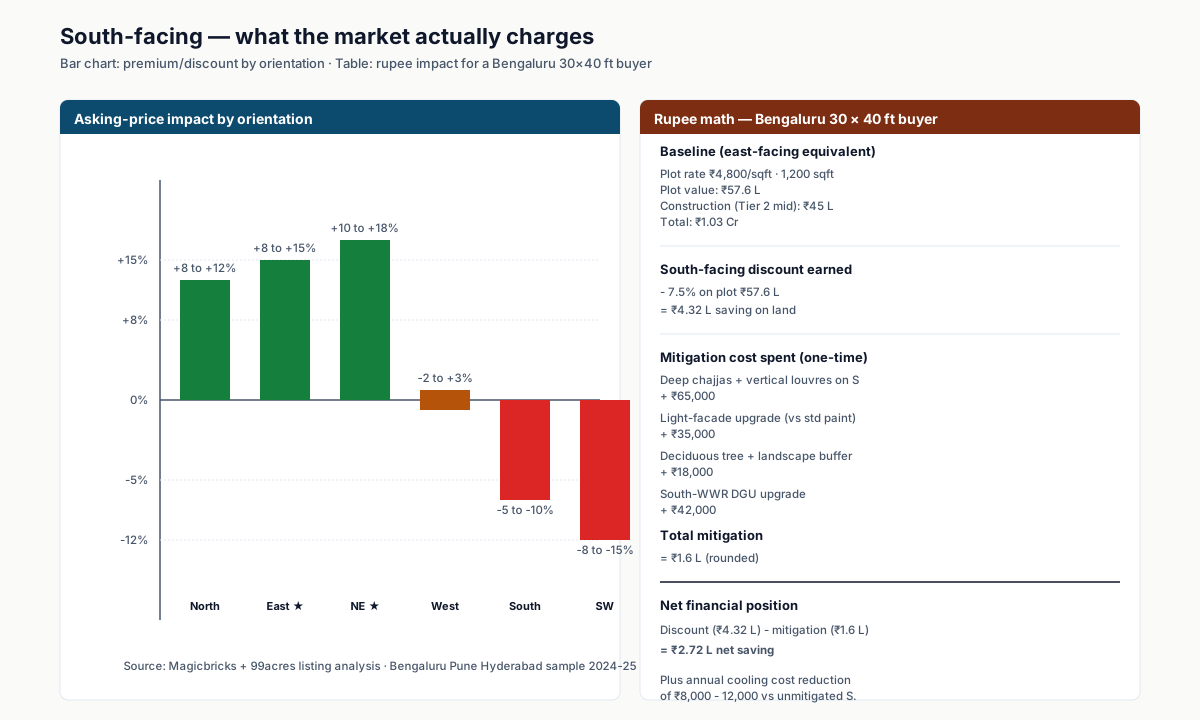
The figure above does the math for a Bengaluru buyer on a typical 30 × 40 ft plot. The conclusion holds broadly: south-facing typically nets the buyer ₹2 – 5 L of savings on equivalent built quality, after paying for all six mitigations.
The bargain is real if (and only if) the buyer:
- Captures the full discount at plot purchase (negotiate hard on south-facing)
- Spends the saved capital on the specific six mitigations above
- Doesn't pay double penalty by under-spec-ing the build to "save more"
The buyer who pays an east-facing premium for a builder-default flat does not, in the end, get more value than the buyer who pays south-facing discount and spends the captured saving on a competent architect.
FAQ — Common Orthodox-Vastu Questions
Q: My family is strict-orthodox Vastu. Can I buy a south-facing plot at all?
The strict reading varies by school. Some traditions (notably South Indian Sthapatya) tolerate south-facing if the entry pada is centre. North Indian schools tend to be stricter. Engage your family's regular Vastu consultant before plot purchase; the discount is meaningless if your family will not feel at peace.
Q: What is the most-defended Vastu fix if I cannot avoid south-facing?
The entry door in the south-centre pada with a deep, well-shaded verandah is the single most-respected remedy across schools. Many orthodox consultants will approve the plot if this is in the design.
Q: Does the front gate's direction also matter?
Yes. The compound wall gate should ideally be in line with — or slightly east of — the main door. A gate at the southwest of the south wall is often flagged as a separate dosha. Fix: gate centred on the south wall, in line with the main door.
Q: Should the master bedroom in a south-facing house be on the ground floor or first floor?
Either works if Vastu-SW is honoured. Ground-floor master is the conventional choice for elderly accessibility. First-floor master with ground-floor guest bedroom is increasingly popular for younger families. See 3BHK House Design Layout D.
Q: My south-facing plot also has a road on the west. Is this a corner plot dosha?
Two-road plots (south + west) introduce additional Vastu considerations but are not automatically doshic. The rules: front gate stays on the south (in line with main door); the west road provides secondary access only; landscape buffer dense on the south-west corner. Many consultants treat west-road exposure as a separate issue from south-facing.
Q: Is south-facing a permanent label or can it be "converted"?
Vastu treats orientation as a property of the building, not the plot. If a south-facing plot's building is designed with the entry on a different face (achievable for plots with width > depth), the building itself can be east-facing or north-facing for Vastu purposes — even on a south road. This is a real design opportunity that many south-facing buyers don't realise.
Q: Does south-facing affect insurance, loan approval, or registration?
No. The municipal sanction, registration, and home loan processes are orientation-blind. Vastu compliance is a buyer/seller preference, not a regulatory requirement.
Pre-Construction Checklist for South-Facing Plans
- [ ] Door pada verified — centre third (4th – 6th of 9 padas) on the south face
- [ ] Deep chajja (600 – 900 mm) specified on every south opening
- [ ] Vertical louvre fins at 600 mm spacing on full south facade
- [ ] Light-colour south facade — white / cream / pale-grey render
- [ ] South WWR capped at 15% with DGU + low-E glazing
- [ ] Deciduous tree planting — 2-3 trees on south yard at 4-6 m spacing
- [ ] Plot graded to slope NE — corrective if natural is SW
- [ ] Pooja in deep NE — protected from road dust
- [ ] Kitchen in SE — fire zone alignment
- [ ] Master in SW — heavy mass quadrant
- [ ] OHT in NE roof — light corner
- [ ] Compound gate centred on south, in line with main door
- [ ] Vastu consultant sign-off — if family follows orthodox practice
- [ ] Discount captured at purchase — south-facing land negotiated below market
- [ ] Mitigation budget allocated and protected (don't sacrifice when budget squeezes)
Cross-Links — Going Deeper
Vastu cluster
- Vastu Shastra for Modern Homes
- East-Facing House Plan — the companion orientation guide
- Vastu House Plan — layout-focused deep dive
- Pooja Room Design
Plans and architecture
- 2BHK House Plan
- 3BHK House Design
- Indian House Front Elevation Design
- Modern House Design in India
- Functional House Layout Planning
Climate and passive design
- Designing for the Indian Climate
- Passive Design across Indian Climate Zones
- Cross Ventilation in Indian Homes
- Natural Light Planning for Indian Homes
- Daylighting Indian Homes and Buildings
- Facade Design for Indian Climates
- Solar Power for Homes
- Sustainable Home Design in India
Process and money
- Complete Guide to Building a House in India
- Building Plan Approval Process in India
- RERA Guide for Homebuyers
- Architect Fee Structures in India
- How to Choose the Right Architect
References
1. Vastu Shastra mainstream consensus — Manasara, Mayamatam, Samarangana Sutradhara; door pada and orientation rules.
2. Bureau of Indian Standards (1987). SP 41 — Handbook on Functional Requirements of Buildings. New Delhi: BIS.
3. Bureau of Energy Efficiency (2018). Eco-Niwas Samhita. New Delhi: Government of India.
4. Indian Meteorological Department (2024). Solar Radiation Atlas of India — Monthly Direct and Diffuse Irradiance. Pune: IMD.
5. Magicbricks Research (2024-25). Vastu Premium and Resale Velocity Study — Tier-1 City Residential.
6. 99acres Market Reports (2024-25). Orientation Premium Analysis — Bengaluru / Pune / Hyderabad.
7. Krishan, A. et al. (2001). Climate Responsive Architecture. New Delhi: Tata McGraw-Hill.
8. Saini, B.S. (1980). Building in Hot Dry Climates. Wiley.
9. National Building Code of India (2016). Part 11 — Approach to Sustainability. New Delhi: BIS.
10. TERI (2014). Sustainable Habitat: Inspirational Building Models for India.
Author's note: South-facing is the most-misunderstood orientation in the Indian residential market. The popular narrative reduces it to "inauspicious — avoid" when the architectural truth is closer to "acceptable with a specific discipline that costs ₹1.5 – 2 L extra at construction but earns ₹4 – 5 L in plot discount at purchase." Net, the south-facing buyer is often the most-rewarded buyer if they understand what they are doing. This guide is for the buyer who would not refuse a south-facing plot if shown the math — and for the architect who needs an authoritative reference to put in front of an orthodox-Vastu client family. Get the six mitigations right, capture the discount, build the better house. South-facing is a market inefficiency hiding in plain sight.
Disclaimer: Solar irradiance figures are 2024 indicative for Indian latitude band (8°N – 36°N); regional variations apply. Real-estate premium / discount figures are 2024-25 indicative for Tier-1 and Tier-2 Indian cities and vary by micro-market, neighbourhood Vastu reputation, and seasonal market conditions. Vastu prescriptions reflect mainstream practitioner consensus; individual family traditions and regional Vastu schools may impose stricter rules. Cost bands for mitigations are 2026 indicative; verify against local quotes. Studio Matrx, its authors, and contributors accept no liability for decisions made on the basis of this guide; engage a licensed architect, a competent Vastu consultant if your family follows orthodox practice, and a qualified contractor for site-specific design and execution.
Export this guide
Related Guides — Deep-dive reading
East-Facing House Plan — Complete Guide for India
Vastu Logic, Sun-Path, Room-Direction Matrix & Reference Plans for the Most-Asked Orientation in Indian Homes
Room PlanningUnderstanding Sun Path Analysis for Your Home
How the sun actually moves over an Indian site through the day and the year — and why that single fact quietly decides where your kitchen, bedroom and living room should sit.
Site PlanningDesigning a Naturally Energy-Efficient Indian Home
Comfort first, gadgets last — passive design, orientation, insulation, ventilation and the climate wisdom that cuts Indian energy bills
SustainabilityRelated Tools — Try Free
Cross-Ventilation Analyzer
Estimate airflow and air changes per hour (ACH) from room size, window areas, layout, and local wind — with NBC 2016 Part 8 compliance check.
Ventilation CalculatorBrise-Soleil Visualizer
Interactive horizontal-louvre cut-off angle calculator — sun altitude, louvre depth, and spacing inputs with a live shadow preview. Computes θ = arctan(spacing/depth) for façade shading, ECBC envelope compliance, hospital daylight design, and tropical sun-control detailing.
Sun Shading ToolVastu Window Planner
Vastu guidance for window placement and size by wall direction and room — rating and remedies.
Vastu