
Daylighting Design Using Windows (India): Getting Light Deep Into a Room
How far daylight travels, why tall windows beat wide ones, and when to reach for light shelves, clerestories and top-light
Most Indian rooms are not dark because they lack windows. They are dark because the light from those windows stops about a third of the way in and never reaches the back wall. Daylighting design is the craft of pushing daylight deeper into a room, and it follows a handful of rules a designer uses on every plan. This guide is the technique: how far light travels, why tall beats wide, when a side window simply will not do, and how to keep the brightness without the heat.
Daylight is free, beautiful and good for your health and electricity bill. Wasting it to a badly proportioned window is one of the most common, and most fixable, mistakes in Indian homes.
This is the design-method guide. For the arithmetic behind the targets (how Daylight Factor is actually computed), see Daylight Factor explained for Indian homes — the maths live there. For the homeowner's light-quality view (bright, even, glare-free rooms by feel and finish), see Window design for natural light. For the overall plan logic of where openings go, start at the Window placement guide.
The one rule that explains everything: the 2 to 2.5x depth
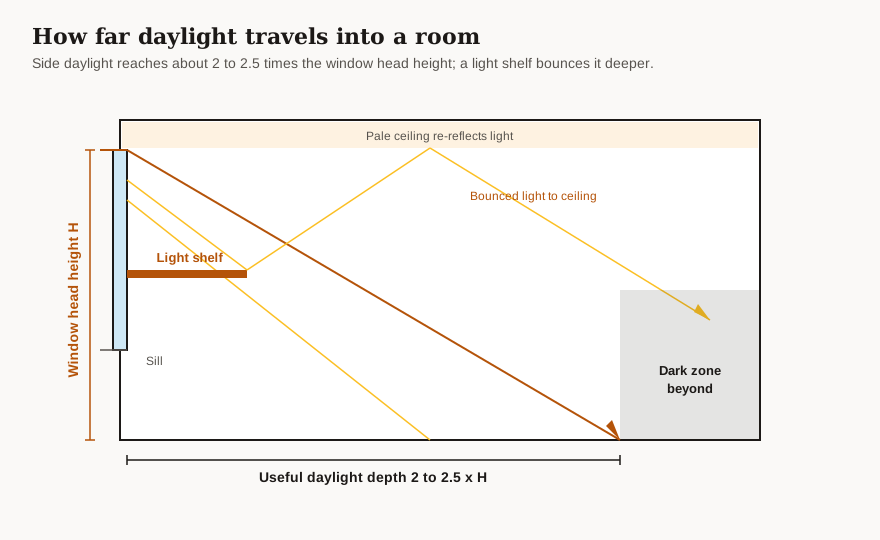
Daylight from a side window penetrates a room to a depth of roughly 2 to 2.5 times the head height of the window — the height of the top of the glass above the floor (indicative; the exact figure depends on glass transmittance, wall colour and external obstructions).
So a window whose head sits at a typical 2.1 m lights a useful depth of about 4.2 to 5.25 m. Beyond that, the back of the room falls into gloom no matter how bright the front is.
This single number drives the most important design moves:
- Raise the head, not just the area. Light enters along a sightline from the top of the glass. The higher the head, the further in the light reaches.
- Match room depth to window head. A 6 m deep room needs a window head near 2.4 to 3 m, or a second light source, or it will be dark at the back.
- A light shelf doubles the reach. A horizontal shelf across the window (a pale, reflective surface at roughly door height) bounces light up onto the ceiling, which then re-reflects it deep into the room — extending the bright zone well past the basic 2.5x line while also shading the lower glass from glare.
Why tall windows beat wide ones
For the same glass area, a tall narrow window lights a room deeper than a wide short one. Width spreads light sideways across the front; height is what carries it inward. A 1.2 m wide x 1.8 m tall window will out-perform a 1.8 m wide x 1.2 m tall window of identical area for depth of penetration.
The practical corollary in Indian planning: where you want a deep room lit from one side, borrow ceiling height for the window before you borrow floor width. Clear ceiling height is at least 2750 mm under NBC 2016, which gives generous room to raise window heads.
| Lever | What it does to depth | When to use it |
|---|---|---|
| Raise window head | Light reaches further in (2 to 2.5x head) | Always the first move |
| Make window taller (not wider) | Deeper penetration per unit area | Deep, single-aspect rooms |
| Add a light shelf | Bounces light onto ceiling, extends bright zone | South/east walls, deep living rooms |
| Pale ceiling and rear wall | Re-reflects light to the back | Every daylit room |
| Lower the sill | Adds floor-level light and view, not depth | Seated views, not penetration |
When a side window is not enough: top-light and dual-aspect
The 2.5x rule sets a hard limit. Once a room is deeper than about 5 to 6 m from its only window wall, no side window will reach the back. Three techniques solve this:
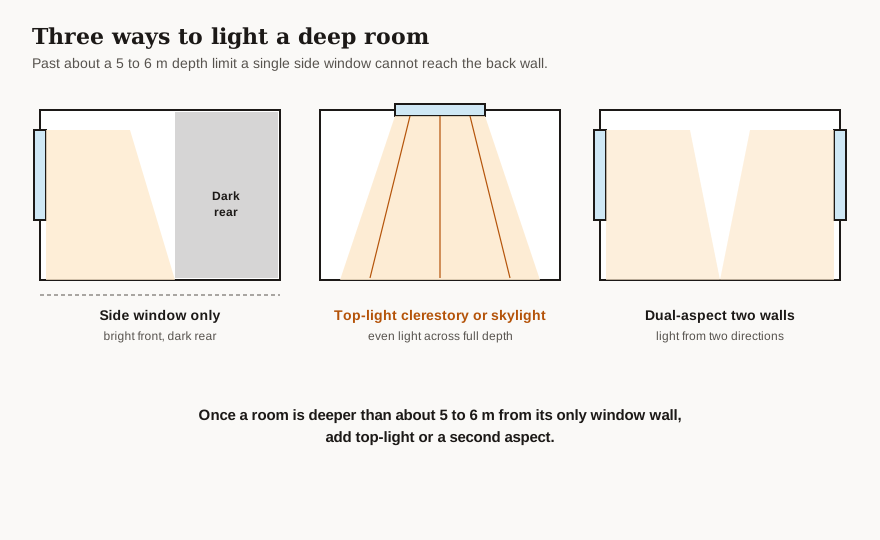
- Top-light (clerestory or skylight). A row of windows high on the wall — a clerestory — washes soft, glare-controlled daylight down across the full depth of a room, and lets hot air escape high (stack ventilation). A skylight or roof window brings overhead daylight to spaces with no exterior wall at all, such as a central stair or a deep middle room. These are the top-light window types — see those guides for the products; here they are simply a daylighting tool. Roofs need Low-E or heat-reflective glass and careful flashing (ENS roof U-value not greater than 1.2 W/m2K).
- Light shelves, as above, to extend a side window's reach.
- Dual-aspect rooms — windows on two different walls (ideally two orientations). Light arrives from two directions, the dark middle zone disappears, and you get cross-ventilation as a bonus. On a narrow urban plot where only the front and rear walls are free, dual-aspect plus a clerestory or light-well over the deep centre is the standard fix — see compact urban home planning.
Set a target, then test: the Daylight Factor
"Bright enough" is not a feeling you should design by. Daylighting uses a metric — the Daylight Factor (DF) — the daylight indoors at a point as a percentage of the daylight available outdoors under an overcast sky (the basis of IS 2440 and the BRE method).
| Space | Indicative target Daylight Factor |
|---|---|
| Bedroom | 1 per cent or more |
| Living room | 1.5 per cent or more |
| Kitchen | 2 per cent or more |
| Study or work area | 2.5 to 5 per cent |
Use DF as the design target, then check whether your window head, area and depth deliver it. The full calculation method — daylight area ratios, the no-sky line, worked examples — lives in Daylight Factor explained for Indian homes. NBC 2016's rule of thumb that openable area should be at least 10 per cent of room area is a ventilation floor, not a daylighting target; a room can meet it and still be gloomy at the back.
Glare control and the heat trade-off
Deeper light is the goal; uncontrolled light is the failure. The same big window that lights a room can also blind anyone facing it and bake the room behind it.
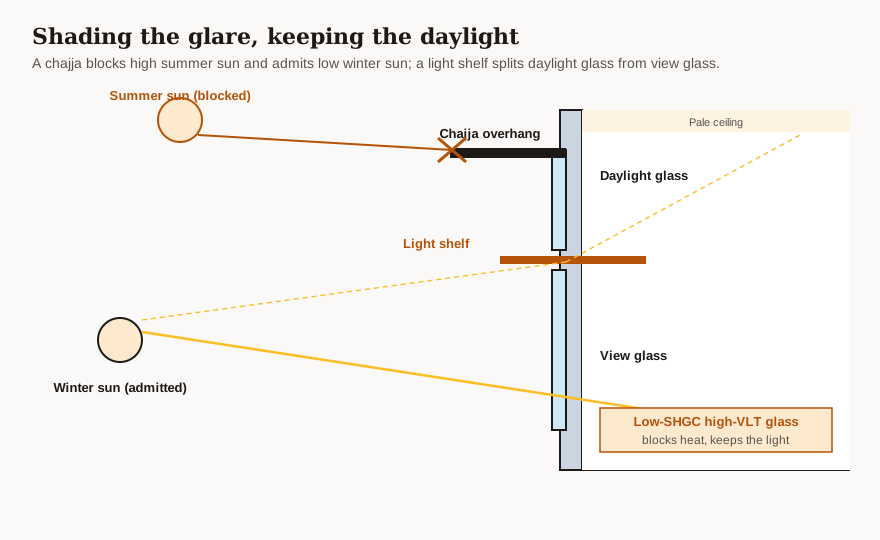
- Glare comes from a bright window seen against a dark wall, or direct sun on a work surface. Fixes: bounce light off pale walls and ceilings so the contrast drops; place desks side-on to the window; use a light shelf to push glare-free light up; add blinds or sheers for fine control.
- Heat rides in with the light. The brighter you make a room, the more solar gain you invite — unless you separate the two. The order of operations: shade the glass externally first (a chajja or overhang sized to the sun angle — easiest on a south wall, hardest on east and west low sun), then choose low-SHGC, high-VLT glass (Low-E lets daylight through while rejecting heat).
- Window-to-wall ratio drives the code. As you add glass, the Eco-Niwas Samhita raises the minimum VLT it demands and caps wall RETV at 15 W/m2 — so more glazing forces better (lower-SHGC) glass. A WWR of about 20 to 40 per cent with good glass and shading suits most Indian rooms.
For the whole heat-versus-light balancing act in living terms, see window design for natural light; for orientation strategy, the window placement guide.
A daylighting checklist by room
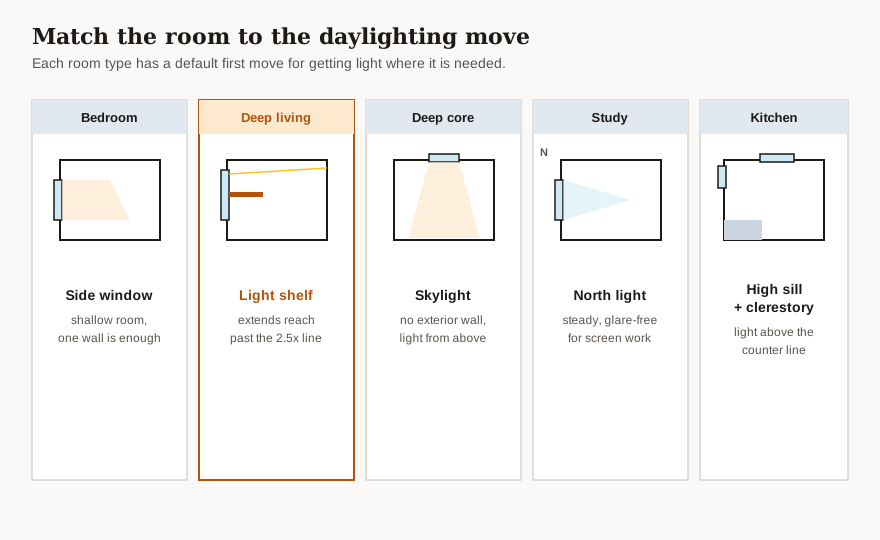
| Room | Daylighting move |
|---|---|
| Bedroom (shallow) | Side window, head 2.1 m or higher; pale rear wall |
| Living room (deep) | Tall window plus light shelf, or dual-aspect; pale ceiling |
| Study, studio, art | North side window — soft, even, glare-free, low heat |
| Kitchen | High sill (1050 to 1200 mm) plus clerestory or awning above |
| Deep core, stair, middle room | Skylight or clerestory top-light — the only options |
| Narrow-plot middle | Dual-aspect plus light-well or skylight over the centre |
Design rule of thumb: light the front of a room with the window's height, the middle with a light shelf and pale ceiling, and the back of a deep room with top-light. If you cannot do all three, make the room shallower.
Daylighting is geometry, not glass area. Get the head height, depth and bounce surfaces right, set a Daylight Factor target, control the glare and the heat, and an ordinary room becomes a bright one — for free, all day.
References
- BIS Guide for Using NBC 2016: https://www.bis.gov.in/wp-content/uploads/2022/08/Booklet-Guide-for-Using-NBC-2016.pdf
- Eco-Niwas Samhita 2018 (BEE/ECBC): https://ecbc.in/econiwas.html
- IS 3362 — Natural ventilation of residential buildings: https://law.resource.org/pub/in/bis/S03/is.3362.1977.pdf
- Standard window size by room (CiviConcepts): https://civiconcepts.com/blog/standard-window-size
Export this guide
Related Guides — Deep-dive reading
Window Design for Natural Light (India): A Brighter, Evenly Lit Home
How to size, place and glaze windows so every room is bright and evenly lit, without glare or gloom
Windows & GlazingNorth-Facing Window Design (India): The Best Light With the Least Heat
Why the north wall gives soft, even, glare-free daylight with almost no heat, and how to design large, high-VLT windows that make the most of it.
Windows & GlazingWindow Design for Villas (India): Using the Freedom of All Four Sides
With walls free on all four sides, you can tune every window to its sun: north light for studies, east for bedrooms, shaded south for living, minimal west, plus feature windows, dual-aspect rooms and stairwell glazing.
Windows & GlazingRelated Tools — Try Free
Cross-Ventilation Analyzer
Estimate airflow and air changes per hour (ACH) from room size, window areas, layout, and local wind — with NBC 2016 Part 8 compliance check.
Ventilation CalculatorBrise-Soleil Visualizer
Interactive horizontal-louvre cut-off angle calculator — sun altitude, louvre depth, and spacing inputs with a live shadow preview. Computes θ = arctan(spacing/depth) for façade shading, ECBC envelope compliance, hospital daylight design, and tropical sun-control detailing.
Sun Shading ToolWindow Orientation Planner
Pick the best window type, glass and shading by wall direction — north, east, south and west.
Window Tool