

Daylighting Indian Homes and Buildings
NBC 2016 Part 8, IS 2440, and the Science of Natural Light — A Comprehensive Guide for Architects
Of all the architectural choices an Indian designer makes — material, colour, plan, facade — daylight is the most under-considered and the most consequential. A room receives light for every waking hour its occupants are in it; poor daylight design produces gloomy, electricity-hungry spaces that fail their inhabitants quietly for decades. Yet daylight remains the one architectural variable that most Indian residential projects optimise last, if at all — a question of window placement rather than lumen output, addressed through rules of thumb rather than measurement.
This guide exists to change that. It is written for architects, interior designers, and informed clients who want to understand how daylight performs in buildings, how it is quantified in the Indian regulatory framework, and how to design for it with intent. It covers the prescriptive requirements of the National Building Code of India 2016 Part 8, the performance methodology of IS 2440:1975, the modern Littlefair/BRE split-flux formula now standard in CIBSE and Indian professional practice, and the specific challenges posed by India's climate and urbanisation.
"A room that lives by daylight lives well. A room that depends on electric light must justify itself." — Louis Kahn, Light is the Theme (Kahn and Harlan, 1975)
1. Why Daylight Matters More in India
The Indian design context intensifies both the benefits and the difficulty of daylighting. India's daylight availability is genuinely exceptional — horizontal illuminance under clear skies routinely exceeds 30,000 lux for 8–10 hours a day across most of the country, and even under overcast monsoon conditions remains above 10,000 lux (Bureau of Indian Standards, 1975). In theory, Indian buildings should be among the best-daylit in the world.
In practice, they are among the worst. Dense urban construction with minimal setbacks, balconies deep enough to cast permanent shadow on the room behind them, heat-reflective glazing that blocks daylight as efficiently as it blocks heat, and interior layouts with 6–8 m room depths accessible to light only through a single window on one wall — these choices have made many Indian homes and offices more reliant on electric lighting during the day than equivalent buildings in London or Berlin.
The consequences are measurable. A 2018 post-occupancy study of residential apartments in Mumbai and Delhi found that artificial lighting accounted for 12–18% of total electricity consumption — a fraction that could have been halved with daylight-aware design (BMTPC, 2018). Beyond energy, inadequate daylight affects circadian rhythm, mood, and cognitive performance. Boyce's extensive review of the occupational lighting literature concluded that natural light exposure during working hours is associated with improved sleep quality, reduced depressive symptoms, and measurable gains in productivity (Boyce, 2014).
For architects, the professional implications are straightforward: a building that fails to exploit its daylight potential has wasted its most abundant and most valuable design resource.
"In India, we have perhaps more natural light than any architect could reasonably want. That we fail so often to use it is not a failure of climate — it is a failure of imagination." — B.V. Doshi, Pritzker laureate, in an address to IIA (Doshi, 2018)
2. The Regulatory Framework — NBC 2016 Part 8
The National Building Code of India 2016, Part 8, Section 1 (Lighting and Ventilation) is the primary regulatory document governing daylight requirements in Indian construction (Bureau of Indian Standards, 2016). Its core prescriptive requirement is the window-to-floor area ratio — the minimum proportion of a room's floor area that must be provided as openable window area, including both glazing and effective ventilation opening.
NBC 2016 Part 8 Window-to-Floor Ratio Minimums
| Room Type | Min Window-to-Floor Ratio | Min Openable Fraction | Typical Application |
|---|---|---|---|
| Habitable room (living, dining, bedroom) | 10% | 50% of window area | Primary living spaces |
| Kitchen | 10% | 50% | Cooking and food preparation |
| Bathroom / WC | 5% | 50% | Where window is provided |
| Staircase / corridor | 7.5% | — | Circulation spaces |
| Classroom | 20% | 50% | Schools (state bye-law addition) |
| Office (general) | 12.5% (recommended) | 50% | ECBC guideline, often in state rules |
| Hospital ward | 15% (recommended) | 50% | IS 5216 guideline |
Source: NBC 2016 Part 8 Section 1 Clause 5.2.1 (Bureau of Indian Standards, 2016); state variations and sectoral codes noted.
NBC compliance is a necessary but not sufficient condition for good daylight design. The WFR requirement is intentionally simple — it can be checked with a measuring tape and a calculator, and it represents the historic minimum below which interior spaces become uncomfortable. It says nothing about the depth of the room, the glass type, external obstructions, or interior reflectance. A classroom with 20% WFR but dark walls and a heavily obstructed sky view will fail to deliver the daylight its window area nominally promises.
The NBC requirement derives from a lineage of municipal bye-laws going back to the colonial period — the 1888 Calcutta Municipal Act specified a 10% window-to-floor minimum, a figure preserved through independence and codified into NBC. Its persistence reflects the fact that, for a typical shallow room of 4 × 4 × 3 m with reasonable interior finishes, 10% WFR produces adequate daylight under average conditions. For deeper rooms, darker interiors, or obstructed sites, the 10% figure can fail dramatically.
3. From WFR to Daylight Factor — The Performance Leap
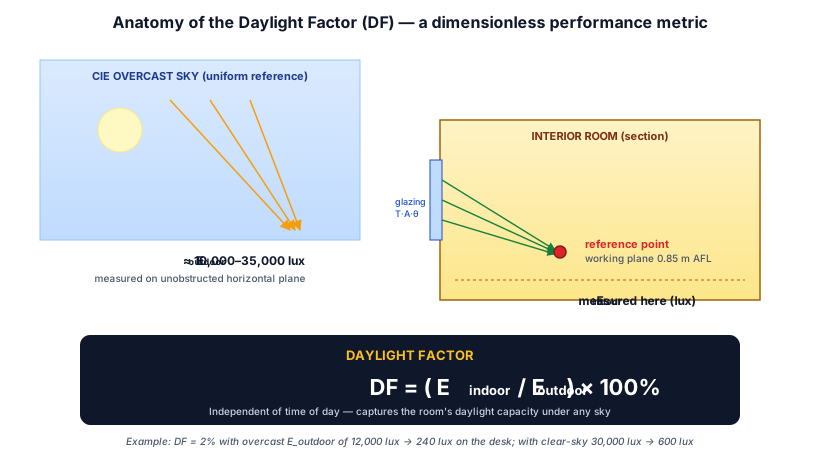
A second approach to daylight quantification emerged from the British Research Station (now the Building Research Establishment, BRE) in the 1930s and reached India through the work of Narasimhan and Hopkinson at the Central Building Research Institute Roorkee (Narasimhan, 1961). The Daylight Factor is a dimensionless metric:
DF = (Eindoor / Eoutdoor) × 100%
where Eindoor is the illuminance at a point inside the room and Eoutdoor is the simultaneous horizontal illuminance in the unobstructed exterior, both measured under a standard CIE overcast sky. The overcast sky reference is chosen because it produces the most uniform distribution of sky brightness — the "worst case" for daylight design that any more favourable sky will exceed.
Unlike WFR, Daylight Factor accounts for everything that actually affects daylight at the work plane: window size and position, glass transmittance, external obstructions, and internal reflectances. It is a true performance metric.
IS 2440 / CIBSE LG1 Recommended Daylight Factors
| Task / Space | Recommended Avg DF | Equivalent Indoor Lux (10 kLux overcast) | Equivalent Indoor Lux (30 kLux clear) |
|---|---|---|---|
| General living (residential) | 1.0% | 100 lux | 300 lux |
| Bedroom | 0.5% | 50 lux | 150 lux |
| Kitchen | 2.0% | 200 lux | 600 lux |
| Bathroom | 0.6% | 60 lux | 180 lux |
| Staircase | 1.0% | 100 lux | 300 lux |
| Study / home office | 2.0% | 200 lux | 600 lux |
| Office (general) | 2.0% | 200 lux | 600 lux |
| Classroom | 2.5% | 250 lux | 750 lux |
| Drawing office / studio | 3.5% | 350 lux | 1050 lux |
| Hospital ward | 1.5% | 150 lux | 450 lux |
| Examination / treatment room | 3.0% | 300 lux | 900 lux |
| Art gallery / museum | 5.0% (max 600 lux for conservation) | 500 lux | 1500 lux |
Source: IS 2440:1975 Tables 1–3 (Bureau of Indian Standards, 1975); CIBSE Lighting Guide LG1 Table 2.1 (CIBSE, 2015); IS 3646 Part 2 recommended illuminance values (Bureau of Indian Standards, 1992).
The relationship between DF and actual indoor illuminance is immediate — if a room has DF = 2% and the exterior sky is producing 25,000 lux of horizontal illuminance, the indoor average is 500 lux. This is the value of DF as a design metric: it disentangles the room's daylight capacity from the daily variation in sky brightness.
"The Daylight Factor is a democratic number. It treats every overcast day the same and makes no special allowance for the architect's climate." — R.G. Hopkinson, Architectural Physics: Lighting (Hopkinson, 1963)
4. The Littlefair/BRE Split-Flux Formula
The modern standard method for computing average Daylight Factor in a room is the split-flux formula developed by Paul Littlefair at the Building Research Establishment and codified in CIBSE Lighting Guide LG1:2015 (CIBSE, 2015). It replaced earlier point-by-point computation methods with a single equation that gives reliable average DF for rectangular rooms with a single window wall:
DFavg = (T × Aw × θ) / (Atotal × (1 − R²))
Each variable has an immediate physical meaning:
- T — diffuse transmittance of the glass (0–1), the fraction of incident diffuse light that passes through the glazing
- Aw — net glazed area (m²), gross window opening minus frame (typically 0.8 × gross per IS 1948)
- θ — visible sky angle in degrees from the reference point, reduced by external obstructions
- Atotal — total internal surface area (m²): floor + ceiling + all walls
- R — area-weighted mean reflectance of internal surfaces (0–1)
The denominator (1 − R²) represents the inter-reflected component: a light ray entering the window bounces around internal surfaces, with each reflection losing a factor R of its intensity. The geometric sum of the series is (1 − R²) in the denominator, which means higher reflectance produces geometrically higher DF — doubling R from 0.3 to 0.6 raises DF by more than 40%.
Worked Example — Mumbai Living Room
Consider a typical living room in a Mumbai apartment: 4.5 × 3.6 × 3.0 m, with a single 1.5 × 1.2 m clear DGU window (T = 0.78), 30° obstruction from the opposite building across the compound, and light beige walls with white ceiling (R = 0.40). No balcony.
Step 1 — Compute areas.
- Floor area = 4.5 × 3.6 = 16.2 m²
- Ceiling area = 16.2 m²
- Wall area = 2 × 3.0 × (4.5 + 3.6) = 48.6 m²
- Total internal surface Atotal = 16.2 + 16.2 + 48.6 = 81.0 m²
Step 2 — Window area and sky angle.
- Gross window = 1.5 × 1.2 = 1.80 m²
- Net glazed Aw = 1.80 × 0.80 (frame) = 1.44 m²
- Base visible sky angle ≈ 70° (vertical window, no balcony)
- Reduced by 30° obstruction: θ ≈ 40°
Step 3 — WFR check.
- WFR = 1.80 / 16.2 = 11.1% — passes NBC 10% minimum.
Step 4 — Apply Littlefair formula.
- DFavg = (0.78 × 1.44 × 40) / (81.0 × (1 − 0.40²))
- DFavg = 44.93 / (81.0 × 0.84) = 44.93 / 68.04
- DFavg = 0.66%
Apply a maintenance factor of 0.9 for typical urban dust accumulation:
- DFavg (practical) = 0.66 × 0.9 = 0.59%
Step 5 — Interpret. IS 2440 recommends DF 1.0% for a general living room. This room satisfies NBC WFR but falls short of IS 2440 performance guidance by roughly 40%. In practice, this means the room will feel dim under overcast skies (100 lux indoor vs 150 lux recommended) and will require electric lighting for reading or detailed tasks even during the day.
Design improvements to consider:
- Lighter walls (R = 0.55). DFavg rises to 0.82% — a 24% gain with zero construction cost.
- Additional window (second 1.5 × 1.2 m unit). DFavg rises to 1.18% — now meeting IS 2440 target.
- Remove the obstruction. Obviously impossible in an existing apartment, but in new design, deeper setbacks or elevated floor levels can dramatically improve θ.
- Clearer glass. Switching from DGU (T = 0.78) to single-pane (T = 0.88) raises DF to 0.67% — a modest gain that doesn't justify losing the thermal benefit of DGU.
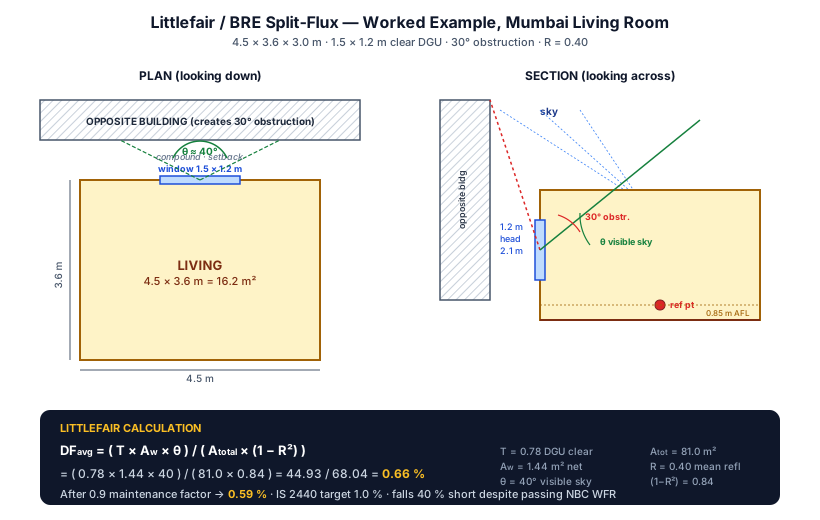
This example illustrates why the WFR check alone is inadequate. The room passes NBC and would be approved by any plan-review authority, yet delivers substandard daylight in the very performance metric that matters to the occupant.
5. Sky Component, External Reflection, and Internal Reflection
The average DF computed by the Littlefair formula can be decomposed into three physical contributions — the split-flux breakdown that gives the method its name:
Sky Component (SC) — direct daylight from the visible sky, arriving at the reference point through the window. This is the dominant contributor in unobstructed rooms and scales linearly with the visible sky angle.
Externally Reflected Component (ERC) — daylight reflected off external surfaces (neighbouring buildings, paving, vegetation) before entering the window. Typical magnitudes are 5–15% of the sky component in dense urban contexts; can be higher if a large bright facade faces the window.
Internally Reflected Component (IRC) — daylight that has entered through the window and bounced off internal surfaces before reaching the reference point. IRC is governed entirely by the R² term in the formula and can contribute 40–60% of total DF in a well-reflective room.
The three components add: DF = SC + ERC + IRC. In Indian urban contexts, ERC is often the most neglected — designers focus on the window as the "source" of daylight and forget that a white building across the compound can effectively double the available light, while a dark glass tower can halve it.
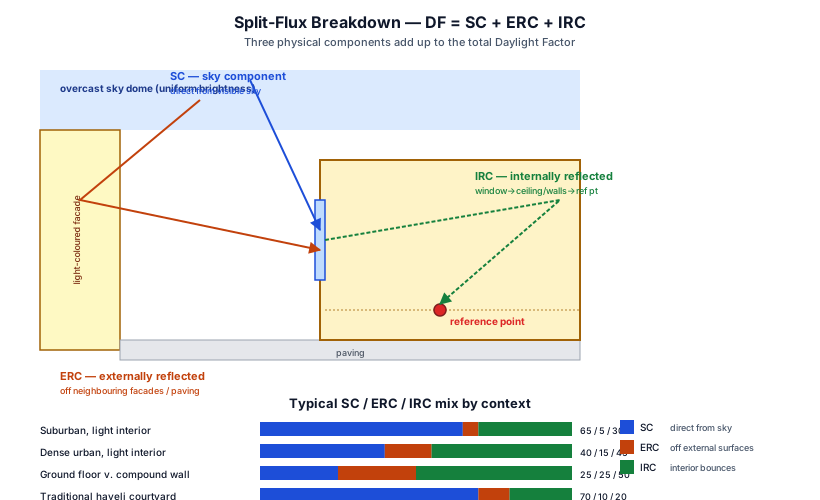
Typical Split-Flux Contributions
| Context | SC | ERC | IRC |
|---|---|---|---|
| Unobstructed suburban, light interior | 65% | 5% | 30% |
| Dense urban, light interior | 40% | 15% | 45% |
| Dense urban, dark interior | 50% | 15% | 35% |
| Ground floor facing compound wall | 25% | 25% | 50% |
| Rural courtyard, traditional haveli | 70% | 10% | 20% |
After Hopkinson, Petherbridge and Longmore (1966); figures calibrated to Indian conditions per Narasimhan (1961).
"The lighting of a room is never complete until one has understood not just the window, but what the light does after it enters." — P.R. Boyce, Human Factors in Lighting (Boyce, 2014)
6. Glass Transmittance — The Tradeoff with Heat
Indian architects routinely face a tension between daylight and thermal performance. Clear glass transmits 88% of incident daylight but also 86% of visible solar energy, leading to uncomfortable heat gain in rooms with significant west or south exposure. Heat-reflective coatings and tinted glass reduce both, but the reduction is rarely symmetric — aggressive solar control typically cuts daylight more than heat.
ECBC 2017 (Bureau of Energy Efficiency, 2017) addresses this by specifying separate metrics: Solar Heat Gain Coefficient (SHGC) should be low (≤ 0.25 in ECBC climate zones 1, 2, 5) while Visible Light Transmittance (VLT) should remain above 0.27 for spaces intended to be daylit. Modern low-E coatings achieve this "spectrally selective" performance — high VLT, low SHGC — at a cost premium over conventional glass.
Indian Glass Performance Data
| Glass Type | Visible Transmittance (VLT) | Solar Heat Gain (SHGC) | U-value (W/m²K) | Indicative Cost Index |
|---|---|---|---|---|
| Clear single-pane float (6mm) | 0.88 | 0.82 | 5.8 | 1.0 × |
| Tinted single-pane (green) | 0.70 | 0.58 | 5.8 | 1.3 × |
| Clear DGU (6-12-6) | 0.78 | 0.70 | 2.7 | 2.5 × |
| Low-E DGU (solar control) | 0.70 | 0.30 | 1.8 | 4.0 × |
| Tinted Low-E DGU | 0.50 | 0.22 | 1.8 | 4.5 × |
| Heat-reflective single | 0.30 | 0.35 | 5.5 | 2.0 × |
| Triple-glazed low-E | 0.65 | 0.28 | 1.1 | 7.0 × |
Sources: Saint-Gobain Glass India product catalogue (2023); Asahi India Glass technical data (2024); IS 2553:2018 (Bureau of Indian Standards, 2018). VLT is the metric most relevant to daylight design; diffuse transmittance (used in DF formula) is typically 0.85–0.95 of VLT.
The design rule of thumb: for daylit spaces, VLT should be at least 2× SHGC for a glazing unit to be considered "daylight-efficient." Low-E coated DGUs typically achieve VLT/SHGC ratios of 2.0–2.5, compared to 1.0–1.2 for conventional tinted glass. ECBC-compliant architects should specify the Light-to-Solar Gain (LSG) ratio — a single number that captures this trade-off.
7. Interior Reflectance — The Free Upgrade
No design intervention improves daylight more cheaply than raising internal reflectance. Paint is measured in hundreds of rupees per square metre; the daylight improvement it produces lasts the life of the finish. Yet Indian interior trends have moved towards darker, more saturated palettes — charcoal accent walls, espresso timber, matt-black fittings — that measurably reduce DF while offering minimal functional benefit.
Typical Surface Reflectance Values
| Surface / Finish | Reflectance (R) |
|---|---|
| White emulsion paint | 0.85 |
| Off-white / ivory | 0.75 |
| Light pastel (cream, light blue, pale green) | 0.55–0.65 |
| Medium tones (beige, light grey, soft taupe) | 0.35–0.50 |
| Natural teak / sheesham timber | 0.25–0.35 |
| Dark wood (walnut, wenge) | 0.10–0.20 |
| Deep-tinted walls (navy, forest, charcoal) | 0.05–0.15 |
| Indian red laterite (polished) | 0.15–0.25 |
| Kota stone (honed, grey) | 0.25–0.35 |
| White marble (polished) | 0.65–0.75 |
| Terracotta tile (natural) | 0.25–0.35 |
| Mirror (specular; use with caution) | 0.90 |
Sources: CIBSE Lighting Guide LG1:2015 Table 2.4; IS 2440:1975 Appendix A; IESNA Lighting Handbook 10th edn (DiLaura et al., 2011); manufacturer finish schedules.
To compute the area-weighted mean reflectance R for a room: multiply each surface's area by its reflectance, sum, and divide by total surface area. For a typical Indian living room with white ceiling (R=0.85, 16 m²), light beige walls (R=0.55, 49 m²), and vitrified floor (R=0.35, 16 m²), the area-weighted mean is:
Rmean = (16 × 0.85 + 49 × 0.55 + 16 × 0.35) / 81 = (13.6 + 26.95 + 5.6) / 81 = 0.57
A modest uplift from 0.40 to 0.57 — achievable by switching beige walls to light cream and replacing dark floor with pale vitrified — raises DF by roughly 30% through the (1 − R²) denominator alone.
"The best window in the world is wasted on a dark room. The worst window can still succeed in a white one." — Peter Tregenza, Daylighting: Architecture and Lighting Design (Tregenza and Wilson, 2011)
8. Room Depth — The 2.5 × Head Height Rule
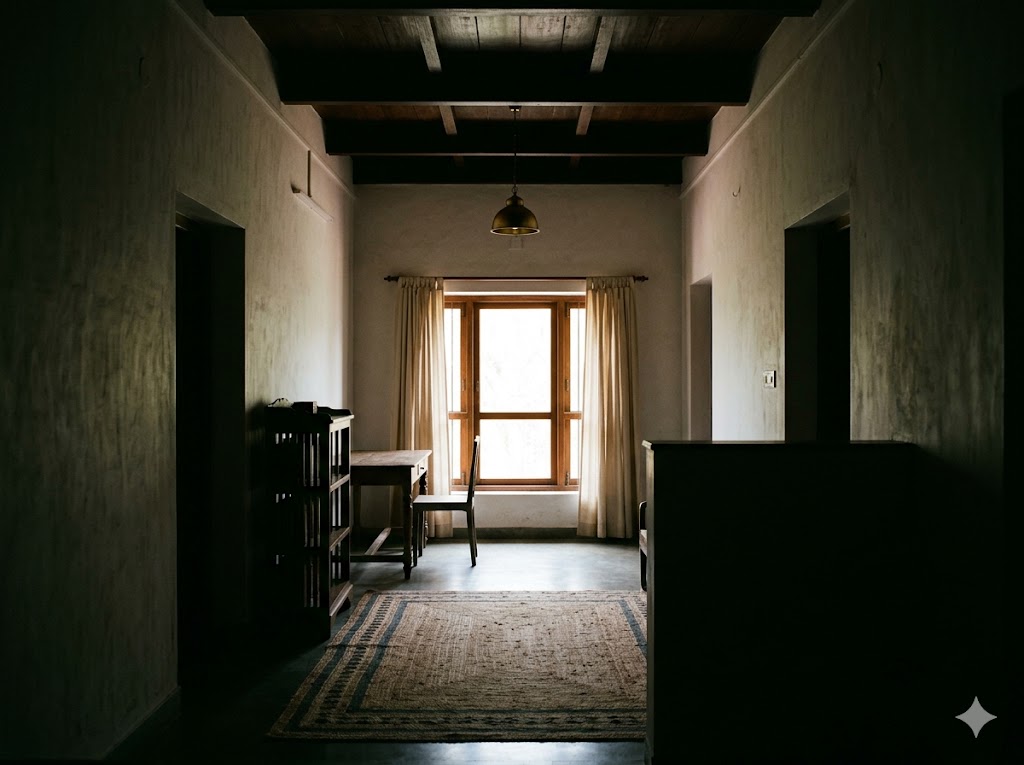
Daylight does not penetrate indefinitely into a room. The traditional CIBSE rule of thumb — which underlies Indian daylight design practice — is that usable daylight extends a horizontal distance of roughly 2.5 times the window head height from the window wall. For a standard 2.1 m window head, this gives a useful daylight depth of 5.25 m. Rooms deeper than this have a permanently dim back half that will require artificial lighting even on bright days.
This is why open-plan apartments in Indian metros often feel gloomy at the far end from the balcony — a 6.5–7.5 m deep living-dining with windows on one short wall is beyond the daylight reach. Traditional Indian architecture addressed this with courtyards, clerestoreys, and light wells — built-in secondary daylight sources that extended useful light into deep rooms. Modern apartment planning has largely abandoned these techniques.
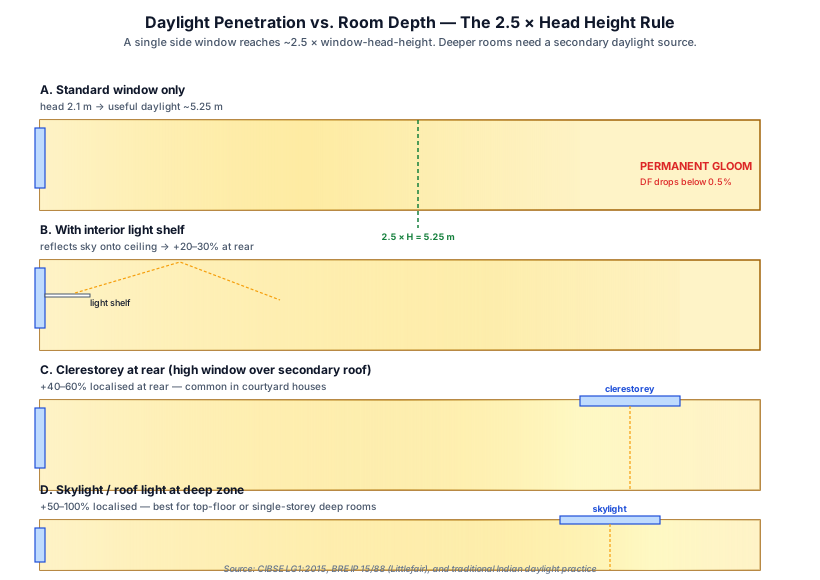
Daylight Penetration Strategies for Deep Rooms
| Strategy | Typical Daylight Gain | Architectural Cost |
|---|---|---|
| Raise window head to ceiling | +15–20% at back | Low; requires lintel detail |
| Light shelf at transom height | +20–30% at back | Medium; interior projection |
| Clerestorey above secondary room | +40–60% (localised) | Medium; requires height differential |
| Skylight / roof light | +50–100% (localised) | High; structural and waterproofing |
| Second window on adjacent wall | +40–60% (average) | Depends on plan constraints |
| Internal glazing to brighter room | +15–25% | Low; privacy trade-off |
| Reflective floor (polished stone) | +10–15% | None; finish choice |
Figures from BRE Information Paper IP 15/88 (Littlefair, 1988) and the author's measurements in Indian residential case studies.
The design principle: where the plan enforces a deep room, the architect must compensate with a secondary daylight source. A single window on one wall cannot do the job of two windows — not because of area, but because daylight's angular geometry forbids it.
9. Orientation, Latitude, and Climate Zone
Daylight Factor as defined is orientation-independent, but the actual illuminance delivered to a daylit room varies substantially by orientation and season. India's latitude range — from 8°N (Kanyakumari) to 37°N (Kashmir) — produces meaningful variation in sun path and sky brightness across the country.
Orientation Guidance for Indian Daylight Design
| Orientation | Daylight Character | Heat Gain | Suitability |
|---|---|---|---|
| North | Cool, consistent, diffuse — ideal for task light | Minimal | Studios, offices, kitchens |
| South | Bright, dynamic, strong mid-day | High in summer | Living rooms with shading |
| East | Morning sun, soft afternoon | Moderate morning | Bedrooms, breakfast rooms |
| West | Harsh afternoon sun, glare risk | Very high, late | Service areas; shade aggressively |
| North-East | Good morning light, cool midday | Low-moderate | Bedrooms, classrooms |
| North-West | Evening daylight without direct sun | Low | Living areas |
Synthesised from ECBC 2017 Appendix B (Bureau of Energy Efficiency, 2017) and traditional Indian orientation principles recorded in Vastu Shastra (Acharya, 1946).
North-facing glazing is the daylight designer's ideal — consistent brightness, no direct sun, minimal glare, minimal heat. Unfortunately, Indian apartment blocks rarely afford this luxury: plots are orientated to the road, not the sun. Where orientation cannot be controlled, shading and glazing selection must compensate. A west-facing window requires either aggressive external shading (horizontal louvres, deep overhang, fabric shade), low-SHGC glazing, or both — but all of these also reduce daylight, producing the exact compromise the Indian designer navigates daily.
ECBC 2017 Appendix B provides climate-zone-specific daylight availability hours for five Indian climate zones (Composite, Hot-Dry, Warm-Humid, Temperate, Cold). For design calculations, the available daylight hours range from 2,700 hours/year (Srinagar, cloudy winters) to 3,400 hours/year (Jodhpur, clear desert skies).
10. India's Traditional Daylight Wisdom
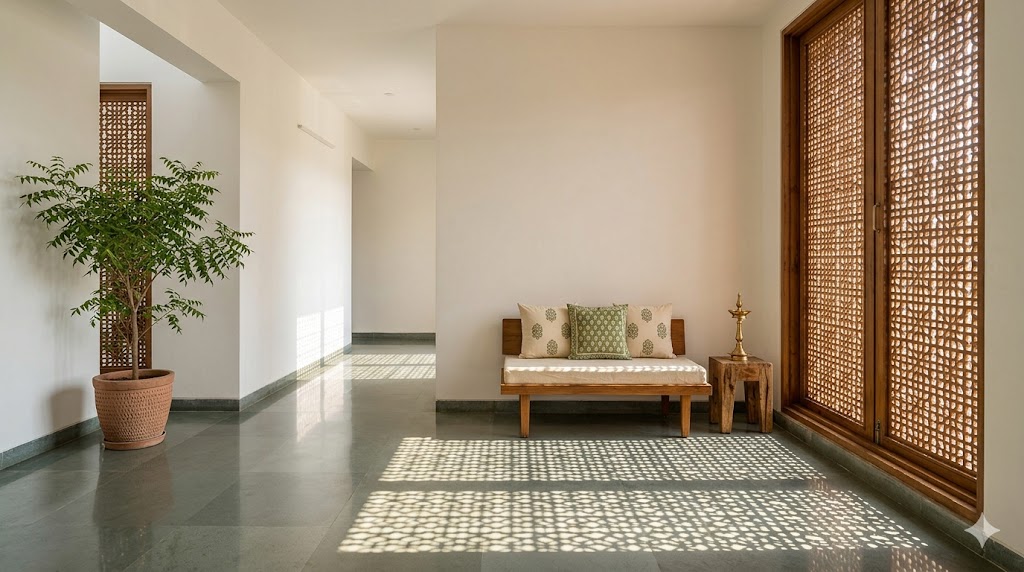
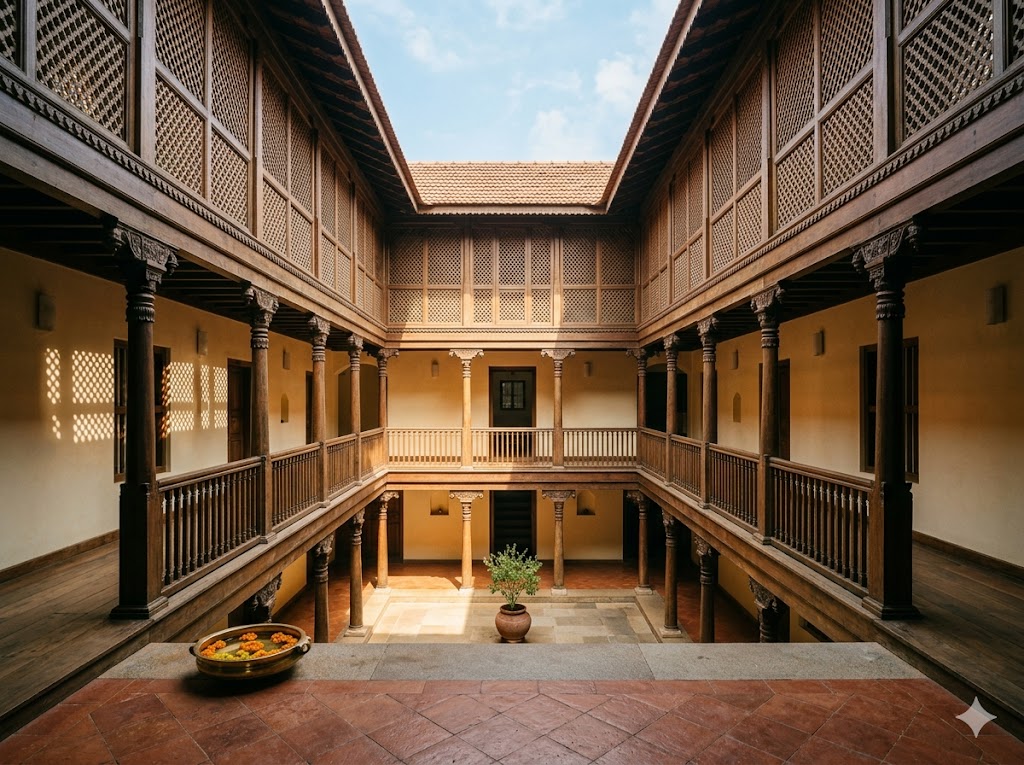
Before industrial glazing and artificial lighting, Indian builders developed a remarkable vocabulary of daylight techniques that remain relevant to modern practice. The courtyard house (haveli, angan, nalukettu) provides a universal second daylight source — every room has at least one window onto an interior courtyard that receives sky light from above. The jaali — perforated stone or wood screen — admits soft, diffused daylight while maintaining privacy and reducing glare. The chhatri and chhajja — projecting stone brackets and deep eaves — provide shade without blocking daylight by intercepting direct sun at steep angles while leaving the horizon visible.
The Mughal jharokha — the projecting oriel window characteristic of Fatehpur Sikri and Hyderabadi architecture — extends the window outward from the wall plane, dramatically increasing the sky angle visible from the room behind. The Kerala nalukettu and Karnataka totti mane use a sunken interior courtyard that admits light to ground-floor rooms that would otherwise face interior walls. The Rajasthani kund stepwell — though primarily a water-collection structure — uses stepped geometry to admit daylight deep below ground level, a principle now applied in subway stations and underground bookstores.
Traditional haveli design in Shekhawati routinely achieves DF values of 3–5% in interior rooms through courtyard amplification — better than most modern apartments manage with direct external windows. The lesson for contemporary practice: daylight can be delivered through a sequence of reflective bounces, not only through a direct window. The design tool is geometry, not glass.
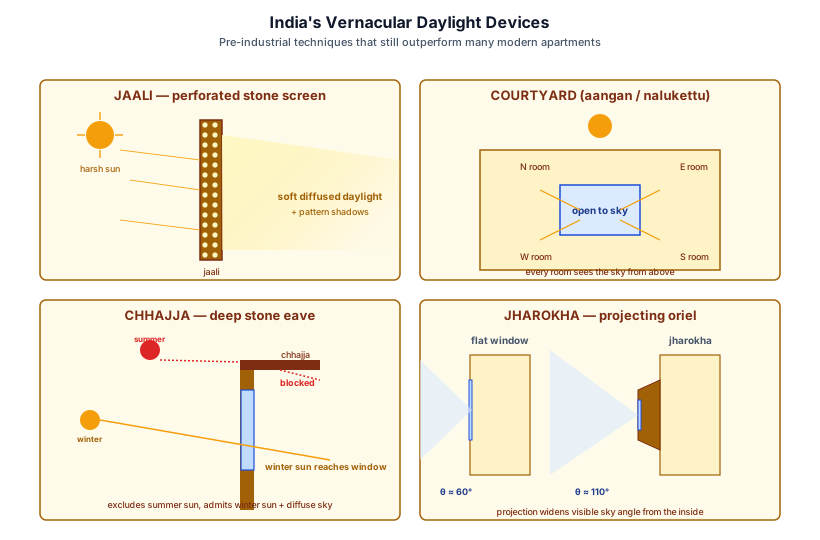
"The jaali is the most intelligent daylight device in architecture. It admits light, excludes heat, preserves privacy, and creates pattern — all with stone." — Ashok B. Lall, architect (Lall, 2005)
11. Measurement and Verification
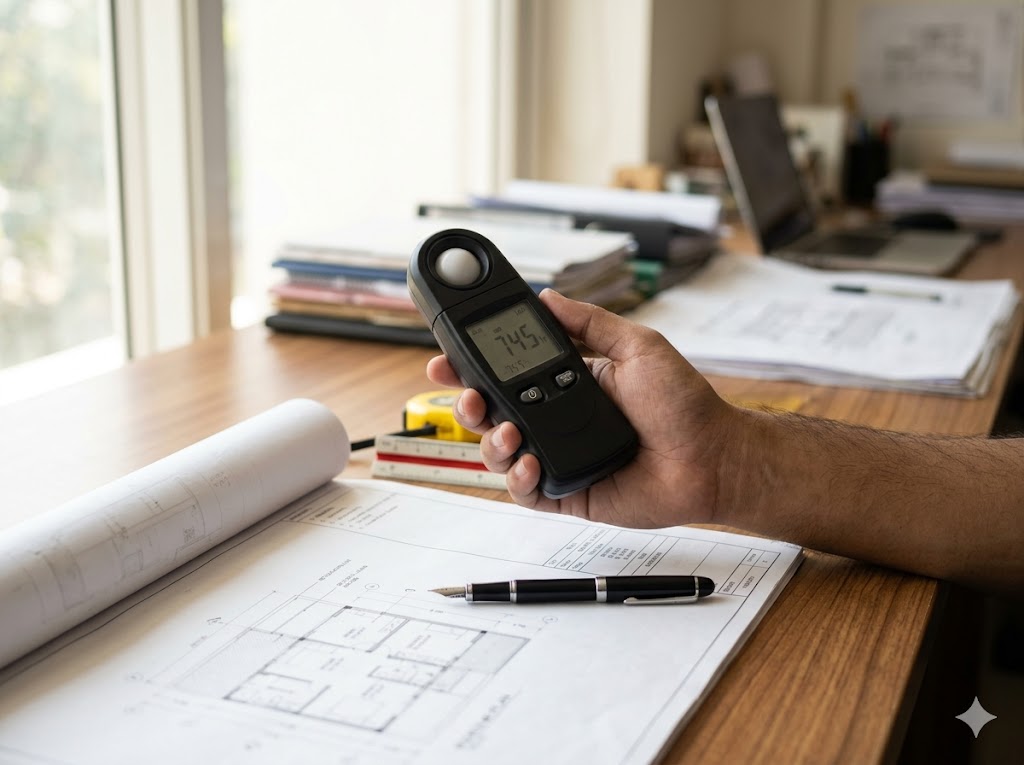
For critical projects — schools, hospitals, museums, LEED/GRIHA-rated buildings — calculated DF should be verified post-construction with on-site illuminance measurement. The protocol is straightforward:
1. Select a representative overcast day (IS 2440 reference sky, uniformly grey dome).
2. Measure outdoor horizontal illuminance Eoutdoor in an unobstructed location using a calibrated lux meter meeting IS 9878:1981 (Bureau of Indian Standards, 1981).
3. At each reference point inside the room (typically on a 1 m grid at working-plane height of 0.85 m), measure Eindoor.
4. Compute DF = (Eindoor / Eoutdoor) × 100% at each point.
5. Average across the grid to obtain average DF; compare to design prediction.
Measurements should be taken between 10 AM and 2 PM local solar time, with electric lighting off and blinds fully open. Modern lux meters such as the TES 1335 (IS 9878 Class B) or the Konica-Minolta T-10A provide accuracy within ±3% — adequate for design verification.
For buildings seeking GRIHA 5-star rating (GRIHA Council, 2019) or LEED Platinum (USGBC, 2014), daylight measurement is part of post-occupancy commissioning; documented DF compliance across 75% of regularly-occupied space is one pathway to the relevant credits.
12. Design Strategies That Work in India
Synthesising the preceding sections, the following strategies most reliably produce adequate daylight in Indian buildings:
1. Plan shallow rooms. A 4-metre room depth can be well-lit by a single window on one short wall; a 6-metre room cannot. Architects should prioritise plan depth before window area.
2. Use tall windows. A 2.4 m tall window at 0.9 m sill lets daylight penetrate 5.25 m into the room; a 1.2 m window lets it reach only 2.6 m. Head height matters more than width.
3. Specify clear or low-E DGU glass. Avoid heat-reflective coated single-pane in any daylit space. The thermal benefit is more than offset by the daylight penalty.
4. Keep interior finishes light. Ceiling R ≥ 0.75, walls R ≥ 0.50, floor R ≥ 0.35. Every dark wall is a daylight tax with no proportional design reward.
5. Respect the 2.5 × head height rule. Beyond this depth, add a second source — courtyard, clerestorey, skylight, or second window.
6. Shade intelligently. External shading devices that exclude summer sun while preserving winter sun and diffuse sky component — horizontal louvres on south, vertical fins on east/west, deep overhangs on north.
7. Assess context. Visit the site in morning and afternoon. Note visible obstructions. Photograph the sky from where the room will be. The calculated DF is only as good as the θ value it assumes.
8. Separate daylight from glare control. Daylight is sky light from above; glare is direct sun at low angles. The two require different design responses — diffusing devices for sky, directional shading for sun.
9. Plan for the overcast day. Monsoon daylighting is what separates adequate Indian buildings from poor ones. Design for 10,000 lux exterior, not 35,000.
10. Verify after construction. A lux meter and an afternoon is enough to confirm whether your design delivered what you intended.
References
- Acharya, P.K. (1946) An Encyclopaedia of Hindu Architecture. London: Oxford University Press.
- BMTPC (2018) Residential Energy Consumption Study — Indian Metropolitan Cities. New Delhi: Building Materials and Technology Promotion Council, Ministry of Housing and Urban Affairs.
- Boyce, P.R. (2014) Human Factors in Lighting. 3rd edn. Boca Raton: CRC Press.
- Bureau of Energy Efficiency (2017) Energy Conservation Building Code 2017. New Delhi: Ministry of Power, Government of India.
- Bureau of Indian Standards (1975) IS 2440:1975 — Guide for Daylighting of Buildings. 2nd rev. New Delhi: BIS.
- Bureau of Indian Standards (1981) IS 9878:1981 — Specification for Photoelectric Type Illuminance Meter. New Delhi: BIS.
- Bureau of Indian Standards (1992) IS 3646 (Part 2):1992 — Code of Practice for Interior Illumination: Schedule for Values of Illuminance and Glare Index. New Delhi: BIS.
- Bureau of Indian Standards (2016) National Building Code of India 2016 — Part 8 Building Services Section 1: Lighting and Ventilation. New Delhi: BIS.
- Bureau of Indian Standards (2018) IS 2553 (Part 1):2018 — Specification for Safety Glass. 3rd rev. New Delhi: BIS.
- CIBSE (2015) Lighting Guide LG1: The Industrial Environment. London: Chartered Institution of Building Services Engineers.
- DiLaura, D.L., Houser, K.W., Mistrick, R.G. and Steffy, G.R. (eds) (2011) The Lighting Handbook. 10th edn. New York: Illuminating Engineering Society of North America.
- Doshi, B.V. (2018) 'Natural light in Indian architecture', Address to the Indian Institute of Architects Annual Convention, Ahmedabad, 18 November.
- GRIHA Council (2019) Green Rating for Integrated Habitat Assessment — Version 2019 Reference Manual. New Delhi: Association for Development and Research of Sustainable Habitats.
- Hopkinson, R.G. (1963) Architectural Physics: Lighting. London: HMSO.
- Hopkinson, R.G., Petherbridge, P. and Longmore, J. (1966) Daylighting. London: Heinemann.
- Kahn, L.I. and Harlan, A. (1975) Light is the Theme: Louis I. Kahn and the Kimbell Art Museum. Fort Worth: Kimbell Art Foundation.
- Lall, A.B. (2005) 'Daylight and shadow in contemporary Indian architecture', Architecture + Design, 22(4), pp. 44–52.
- Littlefair, P.J. (1988) Innovative Daylighting Systems: A Critical Review. BRE Information Paper IP 15/88. Garston: Building Research Establishment.
- Littlefair, P.J. (2011) Site Layout Planning for Daylight and Sunlight: A Guide to Good Practice. 2nd edn. BRE Report BR 209. Garston: Building Research Establishment.
- Narasimhan, V. (1961) Daylighting in Buildings. Roorkee: Central Building Research Institute.
- Reinhart, C.F. (2014) Daylighting Handbook I — Fundamentals, Designing with the Sun. Cambridge, MA: Massachusetts Institute of Technology.
- Tregenza, P. and Wilson, M. (2011) Daylighting: Architecture and Lighting Design. London: Routledge.
- USGBC (2014) LEED v4 Reference Guide for Building Design and Construction. Washington, DC: U.S. Green Building Council.
Author's Note: Daylight design is simultaneously one of the oldest and one of the most under-practised disciplines in Indian architecture. The NBC 2016 Part 8 requirements and IS 2440:1975 methodology have been in place for decades; what has been missing is widespread professional engagement with the quantitative tools they make available. The Studio Matrx Daylight Factor Calculator implements the methods described in this guide and is intended to make daylight design a routine part of concept-stage decision-making. All IS codes cited are subject to periodic revision; readers should verify current editions via the BIS website (bis.gov.in).
Disclaimer: This article is for informational and educational purposes only. It does not constitute professional lighting design advice. Critical daylight design decisions — for schools, hospitals, museums, and code-compliance submissions — should be verified by a qualified building services or lighting consultant using software-based simulation (Radiance, DIAL+, IES-VE) where high accuracy is required.
Interactive · Daylight Factor calculator
12×10 ft room · 5×4 ft window · North-facing → DF 4.02% · Excellent
0 = clear sky · 20-40 = typical urban · 60+ = dense city / opposite building close
Daylight Factor
4.02%
Excellent
Most consistent daylight in Indian latitudes — gentle, glare-free.
How this DF compares per room use
| Bedroom | ≥1% | ✓ Pass |
| Living room | ≥1.5% | ✓ Pass |
| Kitchen | ≥2% | ✓ Pass |
| Study / Workspace | ≥2.5% | ✓ Pass |
| Bathroom | ≥1% | ✓ Pass |
Export this guide
Related Guides — Deep-dive reading
Floor-to-Ceiling Windows (India): Maximum Light, and the Heat Trade-Off
Full-height glazing for Indian homes — how to win the daylight and view without losing the energy code, comfort or safety.
Windows & GlazingNorth-Facing Window Design (India): The Best Light With the Least Heat
Why the north wall gives soft, even, glare-free daylight with almost no heat, and how to design large, high-VLT windows that make the most of it.
Windows & GlazingHospital Façade & Daylight Design in India
An Architect's Working Reference — Climate-Responsive Envelope · India's Five Climate Zones · WWR by Programme · Daylight Strategy & Glare Control · Shading Device Library (Overhang · Fin · Jaali · Brise-Soleil · Verandah · BIPV) · Courtyard Organisation · ECBC 2017 Compliance · BIPV Integration · Cyclone-Zone Specs · Acoustic Envelope
Healthcare ArchitectureRelated Tools — Try Free
Brise-Soleil Visualizer
Interactive horizontal-louvre cut-off angle calculator — sun altitude, louvre depth, and spacing inputs with a live shadow preview. Computes θ = arctan(spacing/depth) for façade shading, ECBC envelope compliance, hospital daylight design, and tropical sun-control detailing.
Sun Shading ToolCross-Ventilation Analyzer
Estimate airflow and air changes per hour (ACH) from room size, window areas, layout, and local wind — with NBC 2016 Part 8 compliance check.
Ventilation CalculatorCircadian Light Meter
Patient-centric circadian lighting visualizer for Indian healthcare design — time-of-day × intensity → CCT, melanopic lux (EML / mEDI), melatonin suppression, and an alertness curve. Calibrated against WELL v2 L03 Circadian Lighting Design, CIE S 026:2018, Brainard 2001, and Lucas et al. 2014.
Circadian Tool