
South-Facing Window Design (India): High Sun You Can Actually Shade
Why the south wall's high midday sun is the easiest to block, how to size a chajja by latitude, and how big south glass works with the right shade and glass
The south wall has a reputation as a hot wall, and in India it can be. But of all four orientations it is the one whose sun you can most easily tame, because at midday the south sun rides high overhead. A simple horizontal overhang, the chajja Indian builders have used for centuries, sized to your latitude, cuts the harsh high summer sun while still letting the lower winter sun slip in underneath. Get that one geometry right and a large south window becomes the best controllable daylight in the house. This guide is the window-design view of the south wall: how to size the overhang, pair it with the right glass, and make big south glass work in the Indian heat.
The south sun is high, so it is shadeable. A fixed overhang that blocks summer and welcomes winter is the south wall's superpower.
South versus the other three walls — why it is the easy one
Each wall gets a different sun, so each needs a different window strategy. This guide is the south-wall member of a set; read it alongside its siblings and do not duplicate.
- North is soft, even and almost sunless — large glass with the least heat. See north-facing window design.
- East gets gentle low morning sun that an overhang cannot block (the sun is below it) — you shade east with verticals and blinds. See east-facing window design.
- West is the problem wall — low, raking, hot afternoon sun that defeats overhangs. See west-facing window design.
- South (this guide) gets high midday sun that a horizontal overhang shades beautifully — the one wall where a fixed shade does the whole job.
| Wall | Sun character | Shade with | Window verdict |
|---|---|---|---|
| North | Soft, even, no direct sun | Little needed | Large glass, easiest of all |
| East | Low morning sun | Verticals, blinds | Overhangs fail (sun is low) |
| South | High midday sun | Horizontal overhang/chajja | Large glass works with proper shade |
| West | Low harsh afternoon sun | Verticals, fins, trees | Minimise glass |
For where, how big and which way every window goes overall, the planning pillar is the window placement guide. For the whole-house version of this orientation, see south-facing house design — that guide plans the entire home by facing; this guide designs the window on the south wall.
The whole trick: high summer sun, low winter sun
Here is the geometry that makes the south wall special. In India (Northern Hemisphere) the sun crosses the southern sky, and its noon height changes with the season. In summer the noon sun is very high; in winter it is much lower. A horizontal overhang of the right depth sits in the path of the high summer beam and casts the window into shade, while the low winter beam passes underneath it and warms the room.
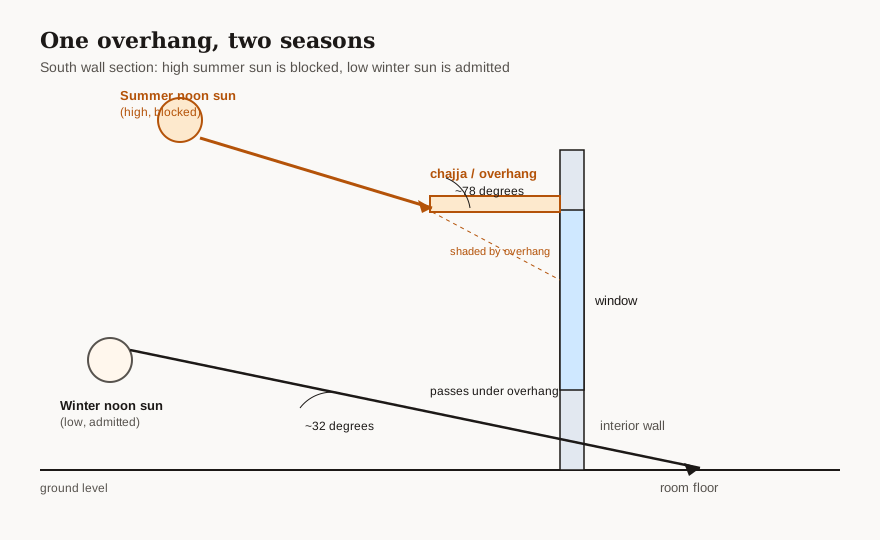
One fixed overhang, two seasons: it shades the hot high summer sun and admits the welcome low winter sun. No moving parts.
That seasonal swing is real and useful even in mostly-hot India: north Indian winters (Delhi, Chandigarh, Jaipur) genuinely benefit from that low winter sun, and even in milder south India it does no harm because the high summer sun is already blocked. This is exactly why building science and Vastu agree on keeping south glass modest-to-medium and well shaded rather than huge and bare — but, crucially, shaded south glass is fine, far better than the same area on the west.
Sizing the overhang by your latitude
The overhang depth that just shades the summer noon sun depends on the sun's noon altitude, which depends on your latitude. The further south you live (lower latitude), the higher the summer sun, so the shallower the overhang you need; the further north, the lower the sun and the deeper the overhang.
A simple working rule: the overhang projection (how far it sticks out) relates to the window head height below it through the sun's noon altitude angle. Greater sun altitude means a shallower projection shades the full glass; lower altitude needs a deeper one. The table gives indicative starting depths for a full-shade-at-summer-noon overhang above a typical window head, to confirm with a proper sun-angle calculation for your exact site.
| City (approx latitude) | Summer noon sun | Indicative overhang depth (per unit of window height) | Winter noon sun |
|---|---|---|---|
| Thiruvananthapuram (~8 degrees N) | Very high (near overhead) | Shallow (~0.2 to 0.3x) | Still fairly high |
| Chennai/Bengaluru (~13 degrees N) | Very high | Shallow (~0.3x) | High |
| Mumbai/Hyderabad (~18 to 19 degrees N) | High | Moderate (~0.35x) | Moderate |
| Delhi/Jaipur (~27 to 28 degrees N) | High | Deeper (~0.4 to 0.5x) | Lower (welcome winter warmth) |
| Srinagar (~34 degrees N) | Moderately high | Deepest (~0.5x or more) | Low (real winter benefit) |
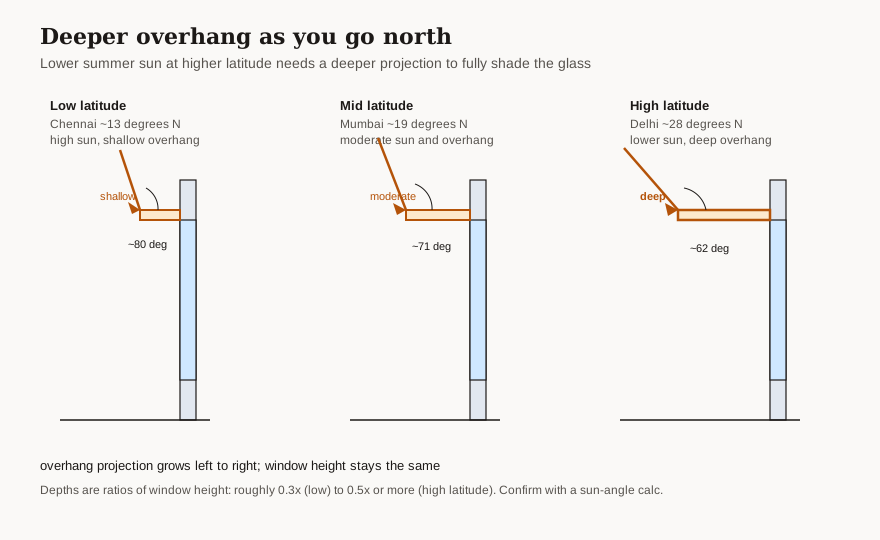
The depths above are ratios to window height, so a taller window needs a proportionally deeper overhang to shade all of it — another reason to fix the overhang to the window head, not an arbitrary slab line. Extend the overhang a little past each side of the window so the early-afternoon sun does not sneak in around the edge.
How big can a south window be?
Bigger than people fear, once it is shaded. Because a horizontal overhang removes most of the direct summer beam, the remaining heat is diffuse sky and ground reflection — far gentler than direct sun. That means south can carry large glass with good controllable daylight, much like north but with the bonus of winter warmth.
Start from the legal floor: the National Building Code (NBC) 2016 rule of thumb is openable window area of at least 10 per cent of the room's carpet area (some bye-laws ask roughly one-seventh to one-eighth of floor area for light and ventilation combined — verify locally). Then size to the room and tune the sill:
| Room on the south wall | Indicative window size | Sill height | Note |
|---|---|---|---|
| Living/family | 5 ft x 4 ft to 6 ft x 4 ft | 600-750 mm | Low sill for seated view; pair with a deep chajja |
| Bedroom | 4 ft x 4 ft | 600-750 mm | Calm shaded daylight, winter warmth |
| Kitchen | 4 ft x 3 ft | 1050-1200 mm | Sill clears the counter |
| Bathroom | 2 ft x 1.5 ft | ~1500 mm | High sill for privacy |
Light from a side window reaches roughly 2 to 2.5 times the window head height into the room, so a tall, well-headed south window lights deep — and the deeper you set the glass behind the overhang, the more even the light. The whole-room daylight method (clerestories, light shelves, daylight factor) lives in daylighting design with windows.
Glass and shading work as a pair
Shading handles the direct beam; the glass handles the rest. The selectors are VLT (visible light transmittance — daylight let through) and SHGC (solar heat gain coefficient — heat let through, lower is cooler). On the south wall you want adequate VLT with low SHGC — spectrally selective Low-E glass that keeps the room bright while cutting heat.
The Eco-Niwas Samhita (ENS) 2018 code ties glass to glass area. As the window-to-wall ratio (WWR) rises, ENS demands a minimum VLT so big windows stay genuinely daylit, while the wall envelope stays within RETV of 15 W/m2 or less — and windows are the biggest lever on that number.
| WWR band | ENS minimum VLT |
|---|---|
| 0 to 0.30 | 0.27 |
| 0.31 to 0.40 | 0.20 |
| 0.41 to 0.50 | 0.16 |
| 0.51 to 0.60 | 0.13 |
| 0.61 to 0.70 | 0.11 |
A sweet spot for most Indian rooms is roughly 20 to 40 per cent WWR. On a well-shaded south wall you can sit at the higher end of that band more comfortably than on west or even east, because the overhang has already done the hard work.
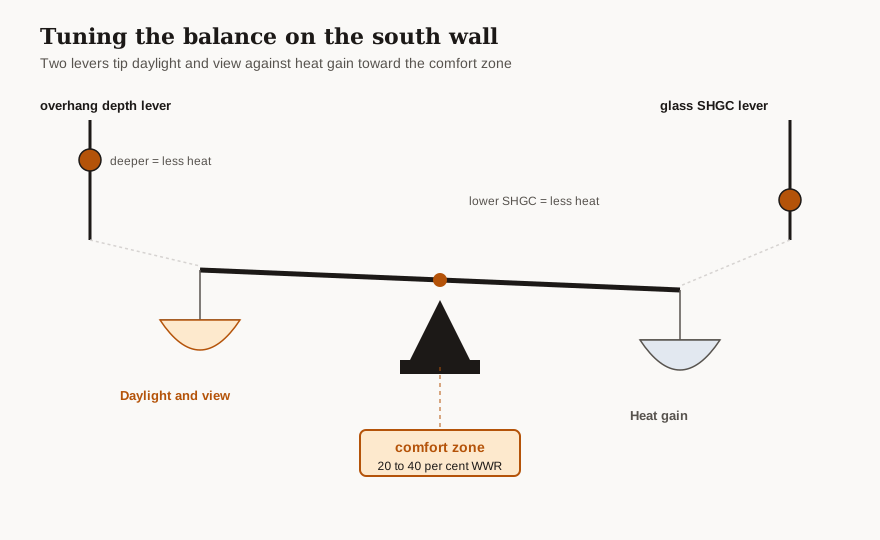
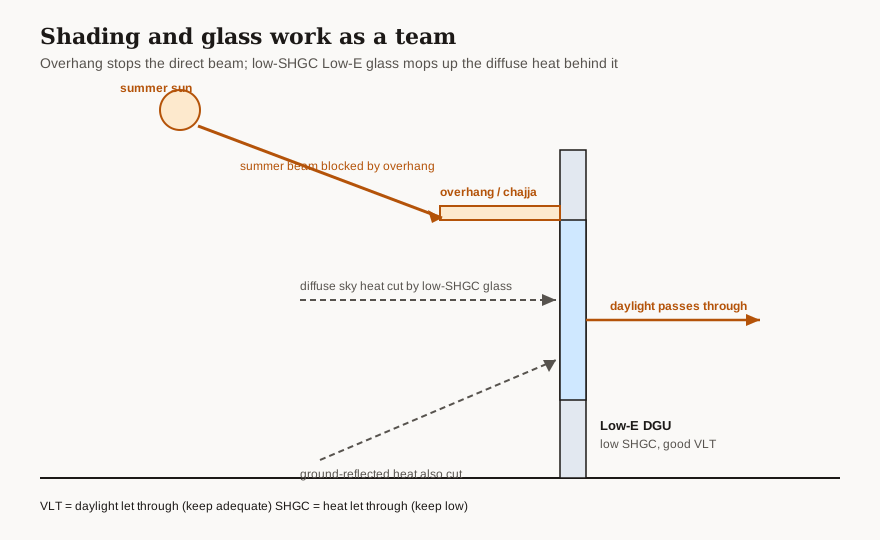
Shading and glazing are a team: the overhang stops the direct summer beam, low-SHGC Low-E glass mops up the diffuse heat behind it. Neither alone is enough on a big south window.
For the full hot-climate glass choice, see the best glass for a hot climate. And remember a chajja is not the only shade: where you want the winter sun fully and the summer sun gone, an overhang wins; for finer control, add an internal light-filtering blind to manage the diffuse brightness.
Do and avoid on the south wall
| Do | Avoid |
|---|---|
| Add a horizontal overhang/chajja sized to your latitude | A bare south window with no shade |
| Fix the overhang to the window head and extend past both sides | A shallow slab that shades only the top of the glass |
| Use Low-E low-SHGC DGU with adequate VLT | High-SHGC clear single glazing on big south glass |
| Welcome the low winter sun underneath the overhang (north India) | Blocking winter sun you would have wanted |
| Sit at the higher end of 20 to 40 per cent WWR if well shaded | Treating south like west and minimising glass |
| Combine the overhang with an internal light-filtering blind | Relying on tint so dark it needs lights on by day |
A note on Vastu: it favours small windows south and west and bigger ones north and east. On the south the climate logic is softer than Vastu suggests — a shaded south window performs well — so treat Vastu as harmonised guidance and let the overhang reconcile the two. The orientation-by-Vastu detail is in Vastu for modern homes; the whole-house south layout is in south-facing house design.
Related reading
- Planning pillar: Window placement guide for India
- The other walls: North-facing, East-facing and West-facing window design
- Whole-house version: South-facing house design
- The daylight technique: Daylighting design with windows
- Hot-climate glass: Best glass for a hot climate
References
- BIS Guide for Using NBC 2016: https://www.bis.gov.in/wp-content/uploads/2022/08/Booklet-Guide-for-Using-NBC-2016.pdf
- Eco-Niwas Samhita 2018 (BEE/ECBC): https://ecbc.in/econiwas.html
- IS 3362 natural ventilation of residential buildings: https://law.resource.org/pub/in/bis/S03/is.3362.1977.pdf
- Standard window size by room (CiviConcepts): https://civiconcepts.com/blog/standard-window-size
- Vastu for doors and windows (Livspace): https://www.livspace.com/in/magazine/vastu-for-house-doors-windows
Export this guide
Related Guides — Deep-dive reading
Understanding Sun Path Analysis for Your Home
How the sun actually moves over an Indian site through the day and the year — and why that single fact quietly decides where your kitchen, bedroom and living room should sit.
Site PlanningNorth-Facing Window Design (India): The Best Light With the Least Heat
Why the north wall gives soft, even, glare-free daylight with almost no heat, and how to design large, high-VLT windows that make the most of it.
Windows & GlazingFloor-to-Ceiling Windows (India): Maximum Light, and the Heat Trade-Off
Full-height glazing for Indian homes — how to win the daylight and view without losing the energy code, comfort or safety.
Windows & GlazingRelated Tools — Try Free
Cross-Ventilation Analyzer
Estimate airflow and air changes per hour (ACH) from room size, window areas, layout, and local wind — with NBC 2016 Part 8 compliance check.
Ventilation CalculatorBrise-Soleil Visualizer
Interactive horizontal-louvre cut-off angle calculator — sun altitude, louvre depth, and spacing inputs with a live shadow preview. Computes θ = arctan(spacing/depth) for façade shading, ECBC envelope compliance, hospital daylight design, and tropical sun-control detailing.
Sun Shading ToolWindow Orientation Planner
Pick the best window type, glass and shading by wall direction — north, east, south and west.
Window Tool