
Window Design for Natural Light (India): A Brighter, Evenly Lit Home
How to size, place and glaze windows so every room is bright and evenly lit, without glare or gloom
A room can have plenty of glass and still feel wrong: a glaring hot-spot by one window, gloom in the far corner, a screen you cannot read at 4 pm. Good natural light is not about more window, it is about the right window, on the right wall, with the right glass, so the whole room sits in a soft, even brightness. This guide is the homeowner's light-quality view: how to choose and place windows so a room is bright and evenly lit, without glare and without gloom.
Bright is easy. Evenly bright, glare-free, all day, is the actual design problem.
Three guides, three jobs — read them together
This batch deliberately splits a big subject so each guide goes deep without repeating the others.
- This guide (#67) is the light-QUALITY and brightness angle for homeowners: where to put windows, what glass to pick, what the light feels like by orientation, how to balance a room.
- Daylighting design with windows is the TECHNIQUE — daylight factor, how deep light travels, top-light, clerestories and light shelves: the architectural method.
- Natural light planning for Indian homes is the broad SCIENCE — the why behind all of it.
For where, how big and which way every window goes, the planning pillar is the window placement guide.
Size and sill: enough light, in the right place
Start with the legal floor. The National Building Code (NBC) 2016 rule of thumb is openable window area of at least 10 per cent of the room's carpet area (some local bye-laws ask for window area of roughly one-seventh to one-eighth of floor area for light and ventilation combined — verify locally). That is a minimum for habitable, not a target for lovely.
Indicative standard sizes give you a sensible starting point, then tune to the room:
| Room | Indicative window size | Sill height | Why |
|---|---|---|---|
| Living | 5 ft x 4 ft to 6 ft x 4 ft | 600-750 mm (2-2.5 ft) | Low sill for a seated view, daylight to the sofa |
| Bedroom | 4 ft x 4 ft | 600-750 mm | View from the bed, calm even light |
| Kitchen | 4 ft x 3 ft | 1050-1200 mm (above counter) | Sill clears the worktop and tiles |
| Bathroom | 2 ft x 1.5 ft | ~1500 mm | High sill for privacy |
Ceiling clear height is at least 2750 mm (NBC). The number that matters most for light reach is the head height — the top of the glass. Light from a side window penetrates roughly 2 to 2.5 times the head height into the room. So a tall window with a high head lights the far wall; a short, wide window of the same area lights a bright strip near the glass and leaves the back gloomy.
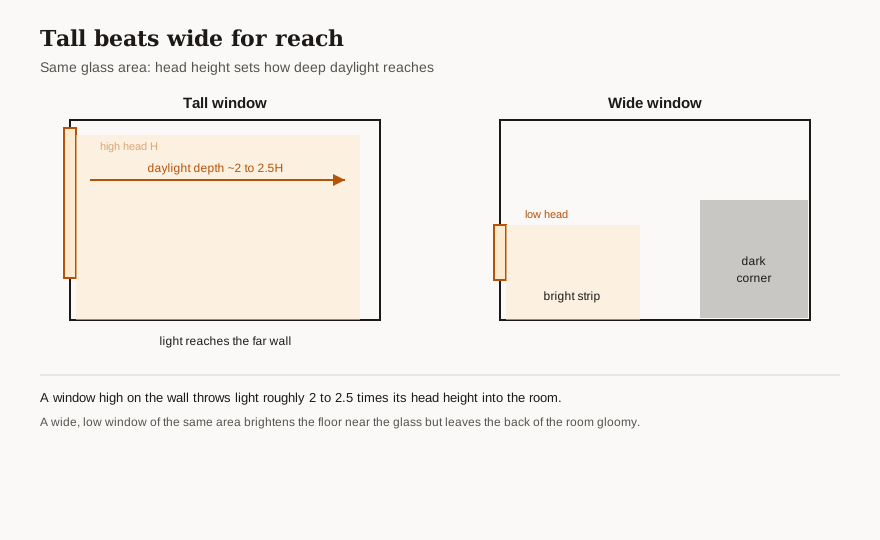
For evenness, lift the glass higher, not just wider. The head height is your reach lever.
The quality of light by orientation
The same window gives completely different light depending on which wall it sits on. In India (Northern Hemisphere) the sun swings from the east, high across the south, and sets in the west, so:
| Wall | Light quality | Heat and glare | Best rooms |
|---|---|---|---|
| North | Soft, even, steady, glare-free; almost no direct sun | Least heat — you can use large glass with the smallest penalty | Study, studio, art, home office, anything needing steady light |
| East | Gentle warm morning sun, low angle | Pleasant at dawn, heat manageable; low sun is hard to shade with an overhang | Bedroom, breakfast nook, pooja |
| South | High midday sun, controllable | Easiest to shade — a horizontal chajja or overhang sized to your latitude cuts summer sun and lets in winter warmth | Living, family rooms (with shading) |
| West | Harsh, low, raking afternoon sun | The problem wall — most heat and worst glare | Minimise glass; service rooms, not living areas |
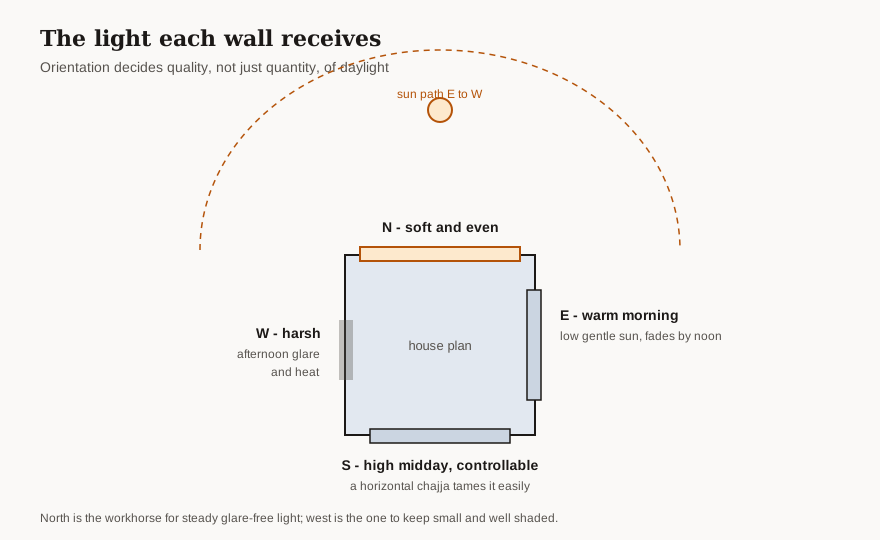
The happy news for India: building science and Vastu largely agree here. Vastu favours bigger windows north, east and northeast and small or no windows west and southwest — which is also exactly what the heat reality wants. Treat that as harmonised guidance, not a clash. The orientation-specific detail lives in the east-facing and south-facing house-plan guides (those are whole-house plans; this is the window on the wall) and in Vastu for modern homes.
Glass: let light in, keep heat out
The glass selector for light quality is VLT — visible light transmittance, the percentage of daylight the glass passes. High VLT means a brighter room; very low VLT (heavily tinted or reflective) makes a room read as gloomy and switches lights on by day, defeating the point.
The trick in hot India is keeping VLT up while keeping heat (SHGC) down — that is what spectrally selective Low-E glass does. The Eco-Niwas Samhita (ENS) 2018 code ties the two together: as your window-to-wall ratio (WWR) rises, it demands a minimum VLT so big windows stay genuinely daylit, while the wall envelope stays within RETV of 15 W/m2 or less.
| WWR band | ENS minimum VLT |
|---|---|
| 0 to 0.30 | 0.27 |
| 0.31 to 0.40 | 0.20 |
| 0.41 to 0.50 | 0.16 |
| 0.51 to 0.60 | 0.13 |
| 0.61 to 0.70 | 0.11 |
A sweet spot for most Indian rooms is roughly 20 to 40 per cent WWR with good Low-E glass and external shading. For the hot-climate glass choice in detail, see the best glass for a hot climate.
Bounce, don't blast: pale surfaces do the heavy lifting
A window is a source; the room is a reflector. Daylight that enters bounces around and reaches the dim corners only if your surfaces are pale. Light walls and especially a light ceiling redistribute daylight far better than a single big window ever can.
- Keep ceilings white or near-white — the ceiling is your biggest daylight bouncer.
- Use pale wall finishes on the wall opposite the window so light reflects back into the room.
- Place a window close to a side wall (rather than dead-centre) so light washes along that wall and feels even, not spotlit.
- Reflective floors and pale curtains extend the effect.
This is also why a single bright window often feels gloomy: one source plus dark surfaces equals a hot patch and a dark surround. Spread and bounce instead.
Dual aspect: the cure for both gloom and glare
The single most effective move for even light is dual aspect — windows on two different walls, ideally at right angles or opposite. One window lights a room from one side only, so brightness falls off sharply across the depth and you get strong contrast (bright near, dark far) that the eye reads as glare-plus-gloom. A second window on another wall fills the shadow side, flattens the contrast, and gives soft, even light all day.
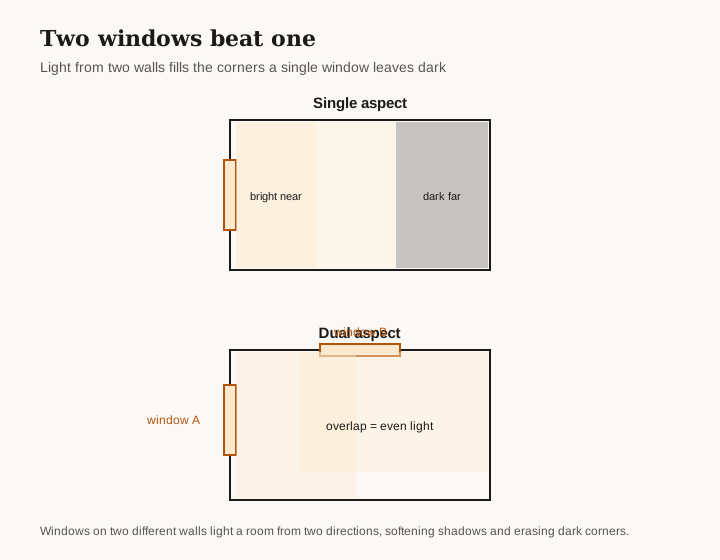
Dual aspect also lets you mix qualities — pair a calm north window for steady light with a small east window for morning warmth, and the room is both pleasant and even. (The same two-wall move powers cross ventilation; for the airflow side, see cross ventilation in Indian homes.) Where a room is too deep to reach with side windows, that is the daylighting technique guide's territory — clerestories, skylights and light shelves.
Avoiding glare without going gloomy
Glare is contrast: a very bright patch next to a darker field. You tame it without killing brightness.
| Do | Avoid |
|---|---|
| Bounce light off pale ceilings and walls | One big window on a dark-walled room |
| Use external shading (chajja, overhang, fins) on south and west | Big unshaded west glass |
| Add a second, opposite window for balance | Relying on a single source |
| Tune with layered treatments (sheer + blind) | Heavy dark tint that needs lights on by day |
| High head height for deep reach | Short wide windows that light only a strip |
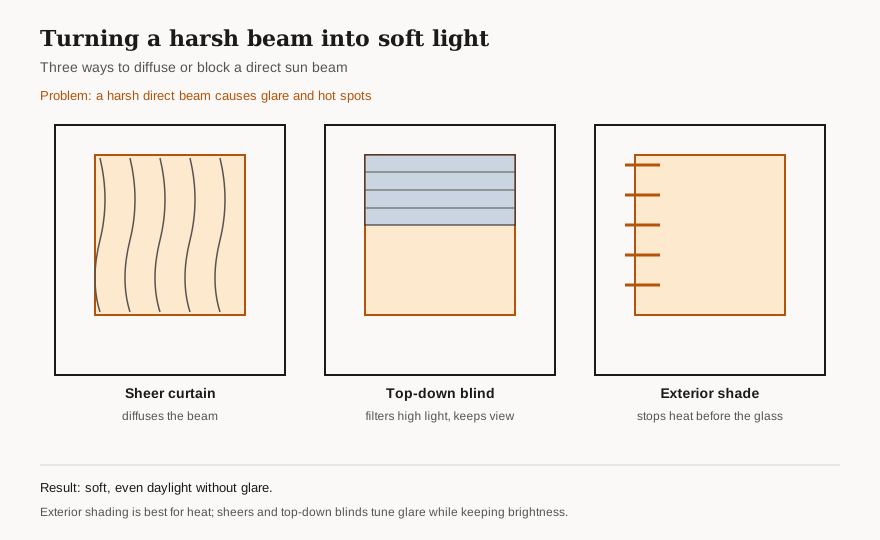
Window treatments are your fine-tuning dial. Sheer curtains diffuse a harsh beam into soft fill light; top-down or light-filtering blinds let you keep the upper glass open for daylight while blocking low glare; on the west, an external louvre or blind stops heat and glare before it hits the glass. Layer a diffusing sheer with a control blind and you can hold a room evenly lit from morning to evening.
Related reading
- Planning pillar: Window placement guide for India
- The technique: Daylighting design with windows
- The science: Natural light planning for Indian homes
- Window types and their light: Types of home windows in India
- Hot-climate glass: Best glass for a hot climate
References
- BIS Guide for Using NBC 2016: https://www.bis.gov.in/wp-content/uploads/2022/08/Booklet-Guide-for-Using-NBC-2016.pdf
- Eco-Niwas Samhita 2018 (BEE/ECBC): https://ecbc.in/econiwas.html
- IS 3362 natural ventilation of residential buildings: https://law.resource.org/pub/in/bis/S03/is.3362.1977.pdf
- Standard window size by room (CiviConcepts): https://civiconcepts.com/blog/standard-window-size
- Vastu for doors and windows (Livspace): https://www.livspace.com/in/magazine/vastu-for-house-doors-windows
Export this guide
Related Guides — Deep-dive reading
North-Facing Window Design (India): The Best Light With the Least Heat
Why the north wall gives soft, even, glare-free daylight with almost no heat, and how to design large, high-VLT windows that make the most of it.
Windows & GlazingWindow Design for Villas (India): Using the Freedom of All Four Sides
With walls free on all four sides, you can tune every window to its sun: north light for studies, east for bedrooms, shaded south for living, minimal west, plus feature windows, dual-aspect rooms and stairwell glazing.
Windows & GlazingWindow Placement Guide for Indian Homes (2026): Where Windows Should Go
The planning pillar for where windows go: orientation, the inlet-outlet pair, daylight reach, sill heights, WWR balance and a room-by-room checklist for Indian homes.
Windows & GlazingRelated Tools — Try Free
Cross-Ventilation Analyzer
Estimate airflow and air changes per hour (ACH) from room size, window areas, layout, and local wind — with NBC 2016 Part 8 compliance check.
Ventilation CalculatorBrise-Soleil Visualizer
Interactive horizontal-louvre cut-off angle calculator — sun altitude, louvre depth, and spacing inputs with a live shadow preview. Computes θ = arctan(spacing/depth) for façade shading, ECBC envelope compliance, hospital daylight design, and tropical sun-control detailing.
Sun Shading ToolWindow Orientation Planner
Pick the best window type, glass and shading by wall direction — north, east, south and west.
Window Tool