
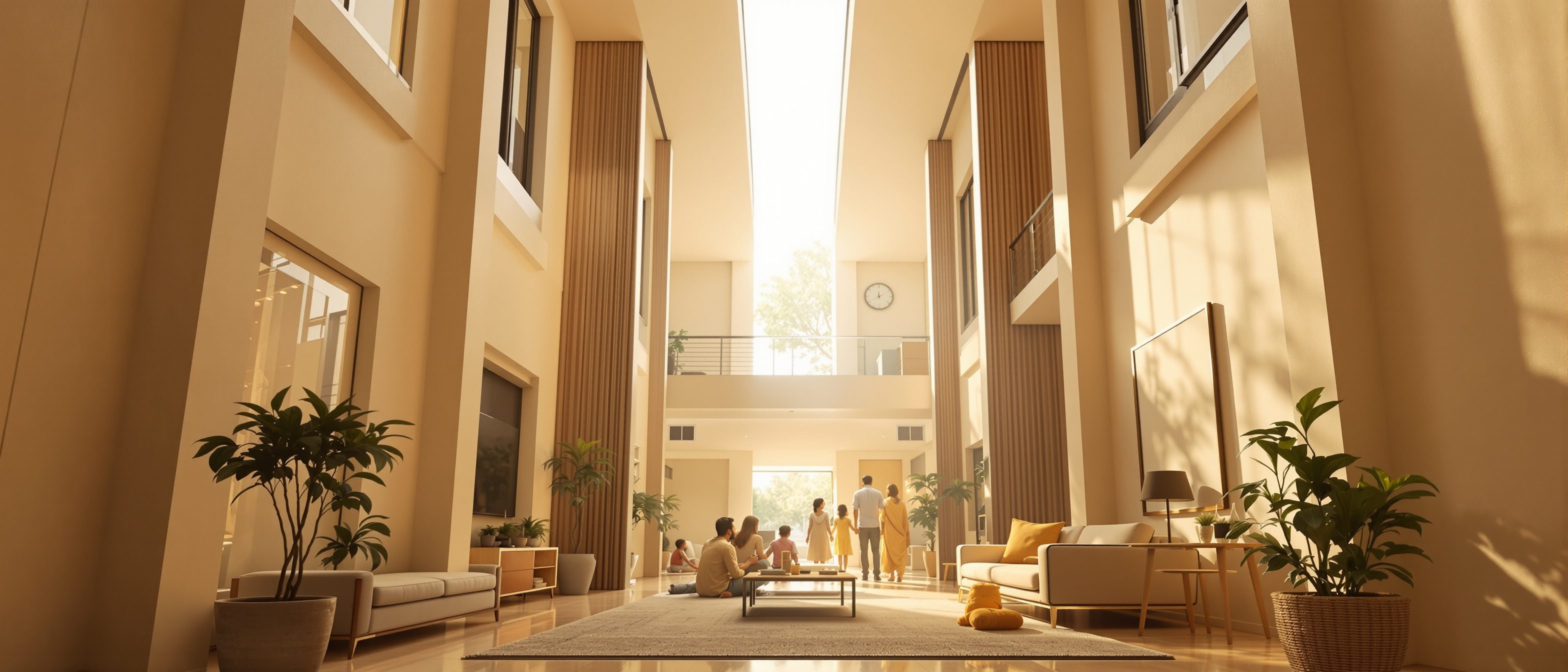
Window Design for Narrow Plots (India): Light and Air When Only Two Walls Are Free
On 20x40 and 25x50 plots with side walls on the boundary, daylight and ventilation must come from the front, the rear and the top. Here is how to plan the windows, shafts and light-wells.
The 20 by 40 and 25 by 50 plot is the workhorse of Indian cities. It is long, it is thin, and it almost always shares its two long side walls with the neighbours, sitting right on the boundary. That single fact rewrites every window decision: light and air cannot come from the sides, so they must arrive from the two free ends, the front and the rear, and from the top. Plan for that from the start and a narrow home is bright and breezy. Ignore it and the middle of the house turns into a dark, stuffy tunnel that no amount of artificial light ever fully rescues.
This guide is the window, light and air angle for narrow plots. For the whole-home compact-plot strategy (room stacking, circulation, where to put the stair), read the planning pillar /guides/compact-urban-home-planning-india and pair it with the placement pillar /guides/window-placement-guide-india. Here we focus only on the openings.
Why the side walls are off the table
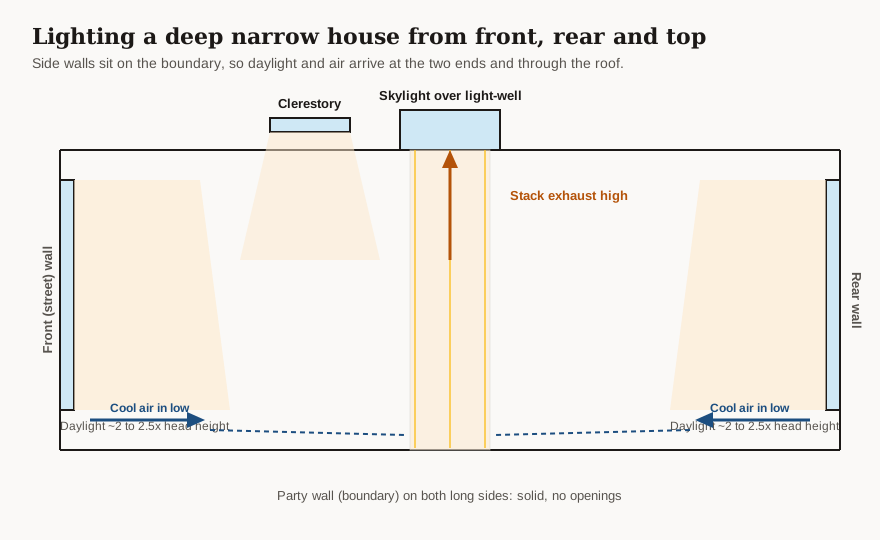
On a typical 20 by 40 (about 6 by 12 metres) plot, the two long sides are party walls on the boundary line. You cannot put a window in a wall that abuts a neighbour, both for privacy and because most municipal bye-laws require a setback (commonly 0.9 to 1.5 metres, often more) before any opening is permitted, and on a 20-foot frontage you rarely have that side space to spare.
That leaves three sources of light and air:
- the front (street) wall
- the rear (backyard or rear-setback) wall
- the roof / top of the deep middle
On a narrow plot, light is a top-and-ends problem. Solve it in section, not just in plan.
Lever 1: tall windows on the two free ends
A side window throws useful daylight only about 2 to 2.5 times its head height into the room. So a window whose top is 2.1 m above the floor lights roughly the first 4.5 to 5 m of depth, then it fades. On a 12 m deep house lit only from the ends, the front room and rear room are fine, but a band in the middle is starved.
The fix on the ends is to go tall, not just wide. A taller window has a higher head, so daylight reaches deeper. Floor-to-near-ceiling glazing on the front and rear, or stacked windows plus a clerestory above, pushes daylight as far inward as a side opening physically can.
Indicative sizes and sills still apply (per NBC 2016 and common practice):
| Room (narrow plot) | Indicative size | Sill height | Why |
|---|---|---|---|
| Front living | 6 ft x 4 ft, or floor-to-ceiling | 600 to 750 mm | Maximum daylight + street view, deep throw |
| Rear bedroom | 4 ft x 4 ft, taller if possible | 600 to 750 mm | Cross-flow outlet, privacy from rear |
| Mid kitchen (on a shaft) | 4 ft x 3 ft | 1050 to 1200 mm | Above the counter, vents to light-well |
| Mid bath (on a shaft) | 2 ft x 1.5 ft | ~1500 mm | Privacy, exhausts to shaft |
Keep the NBC rule of thumb: openable area at least 10 per cent of the room's carpet area (confirm against your local bye-laws, some ask for window area of about one-seventh to one-eighth of floor for light and ventilation combined).
Lever 2: top-light for the deep middle
Wherever the plan is deeper than the ends can reach, bring light from above. Three tools, in rising order of intervention:
- Clerestory windows: a row of glazing high on an internal upper wall or stairwell, above eye level. It drops soft, glare-free daylight onto the floor below and lets hot air escape high. Ideal where the stair or a double-height void sits in the middle of the plan.
- Skylight / roof window: a glazed opening in the roof over the central zone, the strongest overhead daylight for a room with no exterior wall. Use Low-E or heat-reflective glass and detail the flashing carefully (the Eco-Niwas Samhita caps roof U-value at 1.2 W/m2K, and a skylight is roof). Monsoon waterproofing is the real risk, not the daylight.
- Internal light-well / light shaft: a small open shaft punched through the upper floors, open to sky (or skylit at the top), with internal windows of the surrounding rooms facing into it. It is a miniature courtyard turned vertical, and it lights and ventilates the very middle that ends and roof cannot reach.
This is top-light technique, covered in depth in /guides/daylighting-design-windows-india, including light shelves and the daylight-factor maths. This guide differs by applying those tools to the specific geometry of a side-walled narrow plot.
Lever 3: the internal courtyard or light-well, with jali
The traditional answer, and still the best, is to give up a small slice of floor in the middle to an internal courtyard or light-and-air well. Rooms turn inward to face it; it delivers daylight, cross and stack ventilation, and privacy all at once, without a single window facing the neighbour's wall. A jali (perforated stone, terracotta, concrete-block or GFRC screen) over the well or over a mid-level window diffuses harsh top-light, gives privacy and security, and actually cools the incoming air by accelerating it through small openings (the venturi effect). This is the courtyard logic, treated for climate in the sibling guide /guides/windows-for-courtyard-houses-india; here the courtyard is a survival tool for a plot that has no other way in.
Lever 4: make the air move end to end and top to bottom
A narrow plot is actually good for ventilation if you set it up right, because the front and rear openings sit on opposite walls, the ideal inlet-outlet pair.
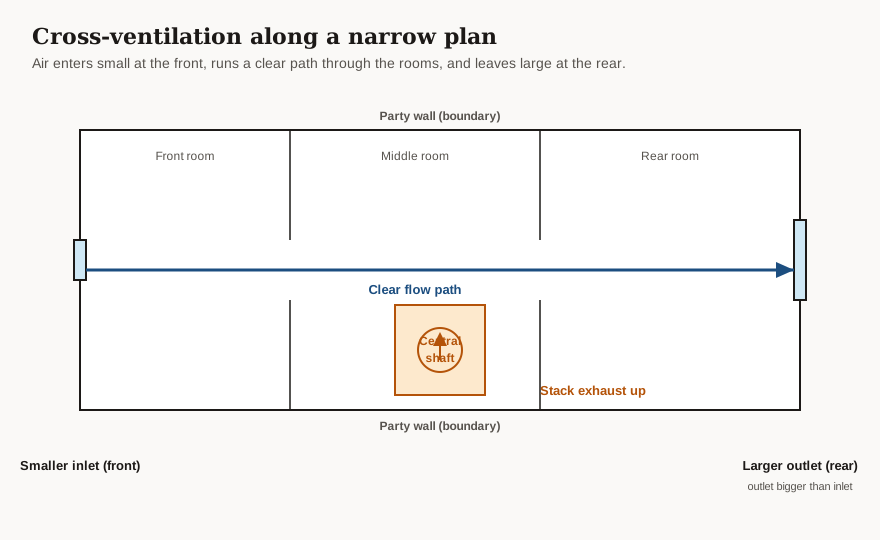
- Cross ventilation: keep the path from front inlet to rear outlet clear of solid partitions. Make the outlet at least as large as the inlet, ideally larger, so the breeze speeds up (a smaller inlet plus a larger outlet is a deliberate venturi). Casement, awning and louvred windows catch and direct air far better than sliding (which opens only about half). The science lives in /guides/cross-ventilation-indian-homes; here it is the front-to-rear geometry.
- Stack (chimney) ventilation: the central shaft, light-well or clerestory is also a thermal chimney. Hot air rises and leaves through a high vent or operable skylight at the top, pulling cooler air in low at the ends. This is what saves the windless middle of the house. Pair with /guides/passive-cooling-strategies-indian-homes for the whole-building picture.
Lever 5: borrow light through internal glazing
When an inner room genuinely cannot reach an outside wall or a shaft, borrow light from a room that can. Internal glazing, a glazed partition, a transom or fanlight over a door, a glass-block panel, or a frosted internal window lets daylight from a bright front room bleed into a darker inner one. It is the difference between a buried pooja room or study being a black box and being usably lit by day.
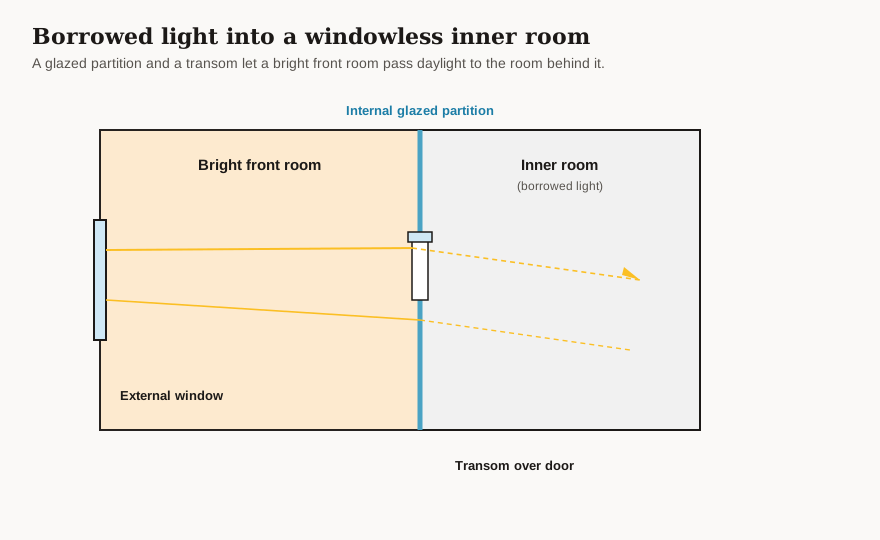
Use frosted or reeded glass where privacy matters, clear where it does not. Borrowed light supplements, it does not replace: every habitable room still needs its own openable area for air under NBC.
Putting the levers in order
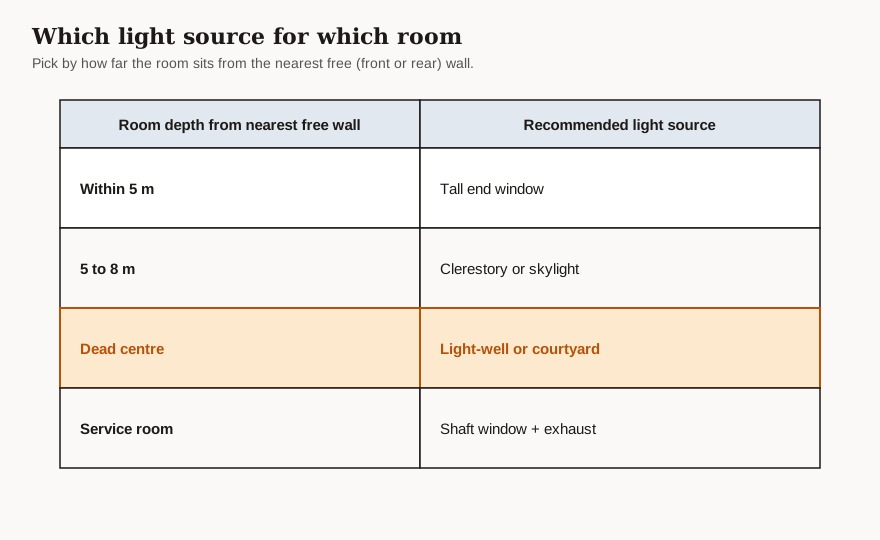
| Where the room sits | First choice | Backup |
|---|---|---|
| Within ~5 m of front or rear wall | Tall end window | Wider opening |
| 5 to 8 m in (mid zone) | Clerestory or skylight | Light-well |
| Dead centre / fully internal | Internal courtyard or light-well | Borrowed internal glazing |
| Service room (bath, store) | Window onto shaft + exhaust | Mechanical extract |
Reconcile this with vastu if it matters to you: vastu favours larger openings to the north and east and smaller ones west and south, which on a narrow plot mostly aligns with putting your generous glazing on whichever free end faces north or east, and being restrained on a west-facing end (which is also the hot, glary wall). See /guides/window-placement-guide-india for orientation tuning.
Do not fight the plot. Light the two ends generously, light the middle from the top, move air end to end, and borrow what is left over.
A few avoidable mistakes: relying on a single mid-house skylight with no waterproofing margin; making the rear outlet smaller than the front inlet (kills the breeze); filling the deep middle with solid partitions that block both light and air; and forgetting that a sliding window on a tight end gives you only half its area of ventilation when a casement would give all of it. Get the section right first, and a narrow plot becomes one of the most comfortable homes in the city.
References
- BIS Guide for Using NBC 2016: https://www.bis.gov.in/wp-content/uploads/2022/08/Booklet-Guide-for-Using-NBC-2016.pdf
- IS 3362 natural ventilation of residential buildings: https://law.resource.org/pub/in/bis/S03/is.3362.1977.pdf
- Eco-Niwas Samhita 2018 (BEE/ECBC): https://ecbc.in/econiwas.html
- Standard window size by room (CiviConcepts): https://civiconcepts.com/blog/standard-window-size
- Standard door and window sizes in India (HouseYog): https://www.houseyog.com/blog/standard-door-window-sizes-india-schedule/
Export this guide
Related Guides — Deep-dive reading
Window Design for Cross Ventilation (India): Inlet, Outlet and the Path of the Breeze
How to size, place and choose windows so a breeze actually crosses the room, windward inlet to leeward outlet, with the right window types and a clear flow path.
Windows & GlazingNorth-Facing Window Design (India): The Best Light With the Least Heat
Why the north wall gives soft, even, glare-free daylight with almost no heat, and how to design large, high-VLT windows that make the most of it.
Windows & GlazingWindow Placement Guide for Indian Homes (2026): Where Windows Should Go
The planning pillar for where windows go: orientation, the inlet-outlet pair, daylight reach, sill heights, WWR balance and a room-by-room checklist for Indian homes.
Windows & GlazingRelated Tools — Try Free
Cross-Ventilation Analyzer
Estimate airflow and air changes per hour (ACH) from room size, window areas, layout, and local wind — with NBC 2016 Part 8 compliance check.
Ventilation CalculatorBrise-Soleil Visualizer
Interactive horizontal-louvre cut-off angle calculator — sun altitude, louvre depth, and spacing inputs with a live shadow preview. Computes θ = arctan(spacing/depth) for façade shading, ECBC envelope compliance, hospital daylight design, and tropical sun-control detailing.
Sun Shading ToolVastu Window Planner
Vastu guidance for window placement and size by wall direction and room — rating and remedies.
Vastu