
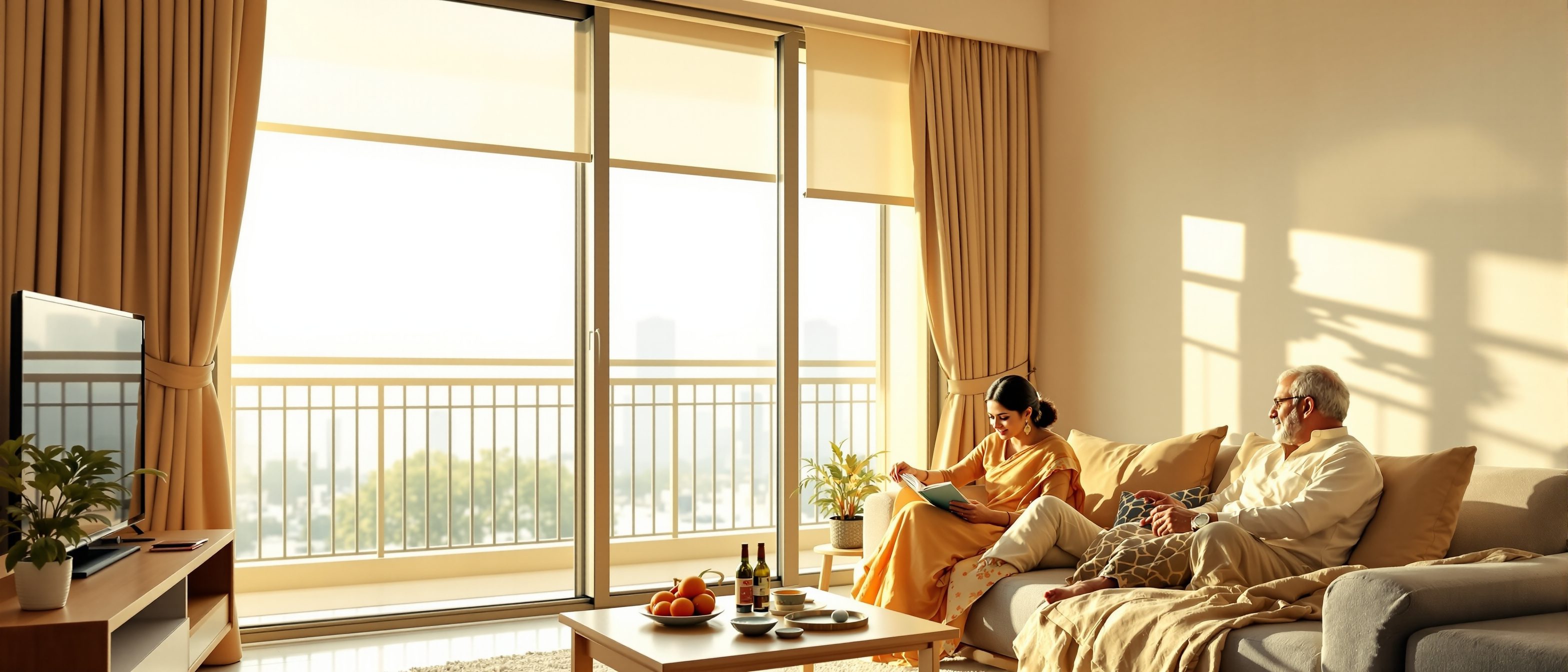
Window Design for Apartments (India): Working With Openings You Cannot Move
You rarely get to move an apartment window, so the design happens at the glass, the balcony and the bye-laws. Films, blinds, secondary glazing, safe grilles, single-aspect cross ventilation and what the society actually lets you change.
In an apartment, the most important window fact is one you discover on day one: you usually cannot move the openings. The builder fixed them, the structure carries them, and the society's facade rules freeze them. What you actually design is everything that happens at and behind the glass you were given, plus the balcony, the one variable you often control.
This guide is the apartment-specific companion to the planning pillar Window placement guide (India) and the types reference Types of home windows (India). Its mirror image is Window design for villas (India), where you have freedom on all four walls. Here you have constraints on every wall, so this is a guide about working within them well.
What you can and cannot change
Three forces lock apartment openings. Structure: the window is sized to the beam, lintel and shear wall around it. The society: most resident welfare associations and apartment owners' associations enforce facade uniformity, so the building reads as one design from outside. The bye-laws: the National Building Code 2016 already set the openable area when the tower was sanctioned, an indicative openable window area of at least 10 per cent of the room carpet area for habitable rooms. You inherit that compliance; you do not get to renegotiate it.
Rule of thumb: if a change shows from the street, expect the society to say no. If it is invisible from outside, it is usually yours to make.
| Lever | Who controls it | Your realistic freedom |
|---|---|---|
| Window opening size and position | Structure plus sanctioned plan | None, fixed |
| External frame colour and profile | Society facade rules | None to little |
| Window glass and film (inside) | You | High |
| Internal blinds, curtains, secondary glazing | You | High |
| Mesh and child-safety grille | You, within society pattern | Moderate, often a set design |
| Balcony enclosure | Society plus municipal bye-laws | Conditional, check first |
Retrofits: allowed versus not allowed
Because you cannot touch the opening, retrofits are the whole game. The split below is the single most useful thing to internalise before you spend money.
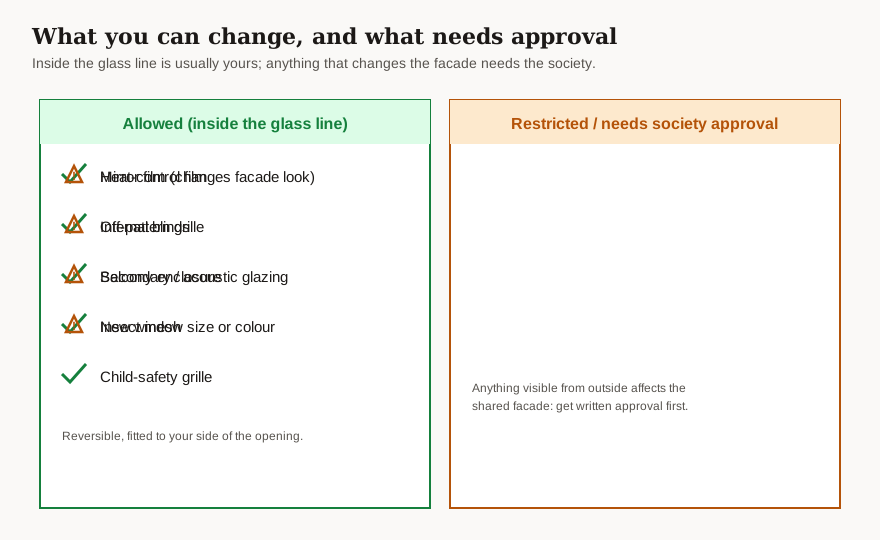
| Retrofit | Typically allowed | Usually restricted or needs approval |
|---|---|---|
| Solar or heat-control film (inside face of glass) | Yes, invisible outside | Mirror-finish film that changes facade look |
| Internal blinds, roller, roman, honeycomb | Yes | None |
| Secondary or acoustic glazing (inner pane behind existing) | Yes, sits inside | None |
| Insect mesh on existing frame | Yes | A colour or pattern off the society norm |
| Child-safety grille | Yes, safety first | A bespoke design unlike the building pattern |
| Balcony glazing or openable enclosure | Conditional | Almost always needs society plus bye-law clearance |
| Replacing the window with a new size or colour | No | Changes the facade, refused |
The reliable winners are the ones that live inside the glass line: films, blinds, secondary glazing. Heat-control film cuts solar heat gain on a hot exposed face without a single external change, and an internal secondary pane (a slim inner sash 50 to 100 mm behind the builder's window) turns a single-glazed apartment into something near a Double Glazed Unit for acoustics and heat, again with nothing showing outside. This is the apartment route to the comfort that a villa would get from a factory DGU; for the glass science behind both, see Types of glass for windows (India).
Safety: mesh and child grilles are non-negotiable
High-rise living makes two fittings essential rather than optional. Insect mesh keeps mosquitoes out while you ventilate, which matters because in a tower you ventilate through the same opening you light through. Child-safety grilles or window restrictors prevent falls, the single gravest apartment window risk. Choose grilles that match the society's approved pattern so approval is automatic, and specify a grille with a small openable or removable section so it does not become a fire trap. Pair any large or low pane with toughened or laminated glass.
| Fitting | Why it matters in a tower | Specify |
|---|---|---|
| Insect mesh | Ventilate without mosquitoes | Removable powder-coated mesh on existing frame |
| Child-safety grille | Fall prevention, top priority | Society-pattern grille, gaps under 100 mm, an openable panel |
| Window restrictor | Limits opening to a safe gap | On bedrooms and any low sill |
| Safety glass | Low or large panes near floor | Toughened or laminated |
Cross ventilation when windows are on one wall
A villa gets windows on opposite walls; a typical flat does not. Many apartments are single-aspect, with all their windows on one external face and the only other opening being the main door and the balcony. The science here is the same as in Cross ventilation in Indian homes, but the moves are apartment-specific, so treat that guide as the theory and this section as the flat-dweller's playbook.
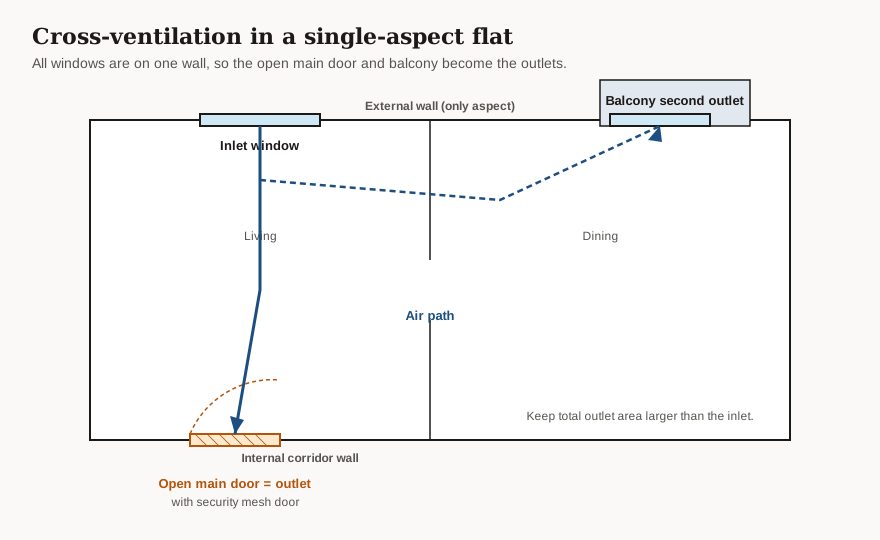
Air needs an inlet and an outlet on different walls. When all your windows share one wall, manufacture the second opening:
- Use the front door as the outlet. Open the window on the external face and the main door together; a security mesh door lets you keep it open safely. Air crosses the whole flat instead of stalling.
- Use the balcony as a partner opening. A door and window on the balcony face, paired with a window on the opposite room, restores a real cross-breeze path.
- Keep the internal doors open along the flow path so the air is not bottled in one room.
- Make the outlet larger than the inlet. A bigger exit speeds the breeze, a venturi effect; even a slightly open door downwind pulls air through.
- Prefer casement or louvre over sliding where you can choose, because a slider opens only about half its area while a casement opens the whole.
For a heat-led approach to the same flat, Passive cooling strategies for Indian homes adds night-purge and stack ideas; the difference is that this guide solves the geometry of one-sided openings, while that one solves the thermal mass.
Privacy and glare in close-packed towers
Two flats can face each other across a narrow gap, so the window that lights your room also reveals it, and an exposed west or single face can overheat one wall of the home.
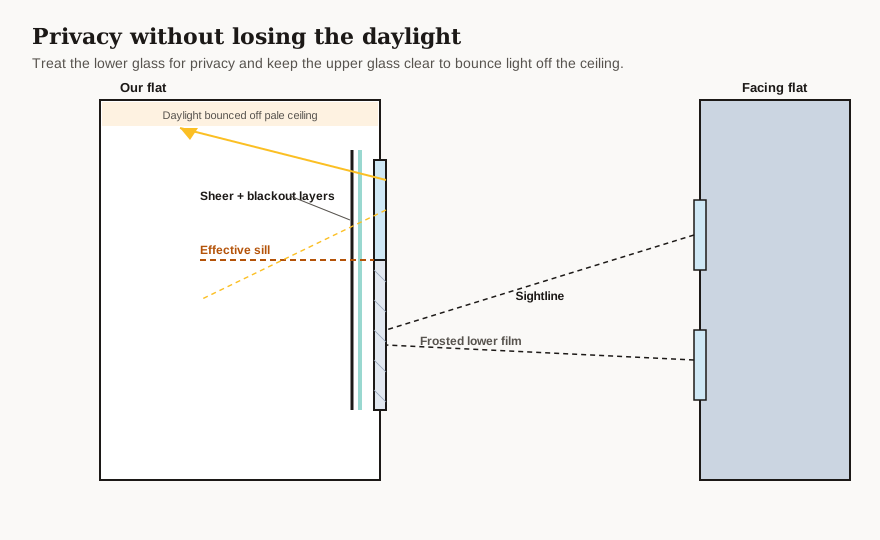
- Privacy without losing light: frosted or gradient film on the lower glass, sheer-plus-blackout double curtains, or honeycomb blinds that open top-down. A higher effective sill (achieved with a fixed lower blind) gives a furniture wall and screens the facing flat while the upper glass still lights the room.
- Glare and heat on one exposed face: you cannot add a chajja, so work inside the glass. Heat-control or low-emissivity film, light-filtering blinds, and pale walls and ceilings that bounce daylight deeper all cut glare without darkening the room. West-facing apartments suffer most from low afternoon sun; treat that face hardest. The orientation logic is the same one set out in the placement pillar.
Renting versus owning
Your tenure decides how permanent your fixes should be.
| Constraint | Renting | Owning |
|---|---|---|
| Films and adhesives | Use removable static-cling film | Permanent adhesive film fine |
| Secondary glazing | Magnetic or tension-fit, reversible | Fixed inner sash |
| Blinds and grilles | Tension or clamp fittings, no drilling | Drill and fix freely |
| Balcony enclosure | Landlord plus society approval | Your application, still society plus bye-law |
| Spend logic | Cheap, portable, reversible | Invest in lasting comfort |
Renters should favour reversible, no-drill, take-it-with-you solutions; owners can commit to secondary glazing and grilles that pay back over years.
The balcony is your real design freedom
The one opening you may genuinely reshape is the balcony, and an openable or sliding balcony enclosure can convert a hot, dusty, unusable ledge into a light-filled, ventilated room extension, or restore cross ventilation to a single-aspect flat. But it is also the most regulated change: it alters the facade and, if you enclose it solidly, can affect sanctioned carpet area and fire access. Check the society bye-laws and municipal rules before you commit, and prefer a fully openable, demountable glazed enclosure over a sealed masonry one so you keep ventilation and stay reversible. The contrast with Window design for villas (India) is sharpest here: a villa adds bay and corner windows at will, while your single big move is to glaze a balcony you are allowed to glaze.
Before any external-looking change, get it in writing from the society. An approved retrofit is permanent peace; an unapproved one is a removal notice.
References
- BIS Guide for Using NBC 2016: https://www.bis.gov.in/wp-content/uploads/2022/08/Booklet-Guide-for-Using-NBC-2016.pdf
- IS 3362 natural ventilation of residential buildings: https://law.resource.org/pub/in/bis/S03/is.3362.1977.pdf
- Eco-Niwas Samhita 2018 (BEE/ECBC): https://ecbc.in/econiwas.html
- Standard door and window sizes in India (HouseYog): https://www.houseyog.com/blog/standard-door-window-sizes-india-schedule/
Export this guide
Related Guides — Deep-dive reading
Window Design for Cross Ventilation (India): Inlet, Outlet and the Path of the Breeze
How to size, place and choose windows so a breeze actually crosses the room, windward inlet to leeward outlet, with the right window types and a clear flow path.
Windows & GlazingWindow Placement Guide for Indian Homes (2026): Where Windows Should Go
The planning pillar for where windows go: orientation, the inlet-outlet pair, daylight reach, sill heights, WWR balance and a room-by-room checklist for Indian homes.
Windows & GlazingFloor-to-Ceiling Windows (India): Maximum Light, and the Heat Trade-Off
Full-height glazing for Indian homes — how to win the daylight and view without losing the energy code, comfort or safety.
Windows & GlazingRelated Tools — Try Free
Cross-Ventilation Analyzer
Estimate airflow and air changes per hour (ACH) from room size, window areas, layout, and local wind — with NBC 2016 Part 8 compliance check.
Ventilation CalculatorBrise-Soleil Visualizer
Interactive horizontal-louvre cut-off angle calculator — sun altitude, louvre depth, and spacing inputs with a live shadow preview. Computes θ = arctan(spacing/depth) for façade shading, ECBC envelope compliance, hospital daylight design, and tropical sun-control detailing.
Sun Shading ToolFuture Home Comfort Score
Score your home 0 to 100 on daylight, ventilation, thermal and acoustic comfort and find the weak link.
Window Tool