
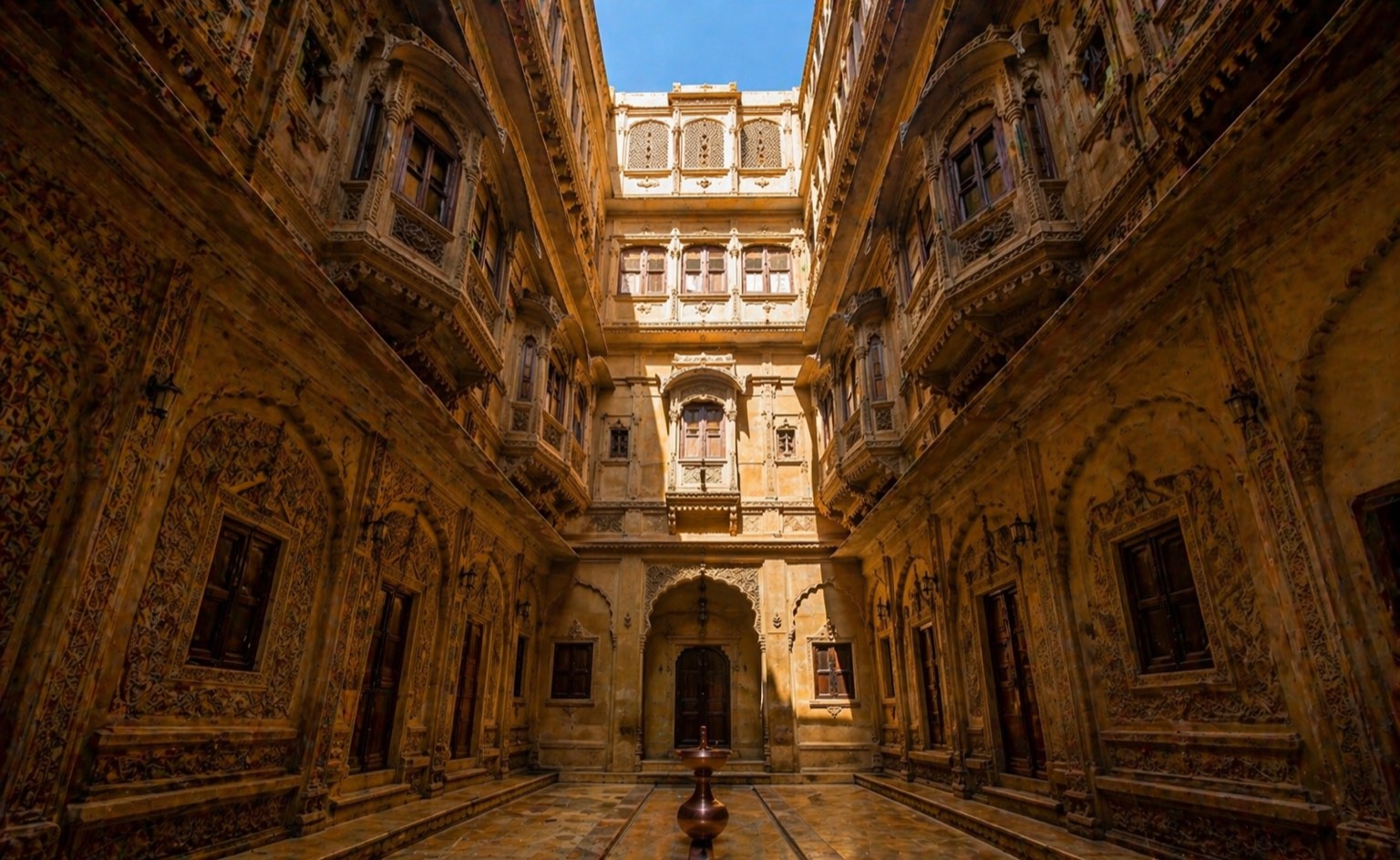
Courtyard Homes in India — Climate-Responsive Design
The Physics, Geometry, and Performance of the Open-to-Sky Court — A Reference for Contemporary Architects
The courtyard is the oldest and most thoroughly studied climate-responsive device in residential architecture. It predates the wall. The earliest excavated houses at Mehrgarh (7000 BCE) and the planned neighbourhoods of Mohenjo-daro (2500 BCE) are organised around open-to-sky spaces. For four millennia the Indian house was built around a court; for the last four decades it has been built without one. The question this guide addresses is not whether the courtyard is a good idea — the archaeological, anthropological, and engineering record settles that — but how a courtyard must be dimensioned, oriented, and detailed to actually perform in contemporary Indian construction.
The courtyard is not a decorative feature. It is a simultaneously operating five-function device: it admits daylight into deep plans, drives stack ventilation, modifies microclimate through evapotranspiration, provides a secure outdoor room, and orients the dwelling inward in high-density contexts. Get the geometry wrong — the wrong aspect ratio, the wrong orientation, the wrong floor finish, the wrong opening configuration — and none of these functions work. Get the geometry right and the courtyard becomes the single most productive 25 m2 of floor plate in the house.
This guide examines the courtyard as a design problem with measurable performance criteria: buoyancy-driven air exchange, daylight factor at court floor, solar access by latitude, microclimate cooling by evapotranspiration, and the thermal-comfort-hour studies published from India's five climate zones. It draws on peer-reviewed engineering research (Muhaisen, 2006; Safarzadeh and Bahadori, 2005; Rajapaksha et al., 2003; Dili et al., 2010), established architectural references (Edwards et al., 2006; Reynolds, 2002), and the built work of Correa, Doshi, Anagram, Studio Mumbai, Sameep Padora, and Morphogenesis.
"The open-to-sky space is the most precious room in the Indian house. The whole organisation of the dwelling can be founded upon it." — Charles Correa (1930–2015), architect, from A Place in the Shade (Correa, 2010)
1. The Courtyard as a Climate-Responsive Device
A courtyard is an open-to-sky space enclosed on three or four sides by built form. In architectural classification, it differs from an atrium (glass-roofed, not open), a light-well (too narrow to be inhabited), and a yard (not internal to the building). The courtyard must satisfy three conditions to function climatically:
1. Proportion. Depth of enclosure must permit direct solar access (for winter warmth) and self-shading (for summer cooling). Out-of-range aspect ratios fail.
2. Porosity. Rooms around the court must open into it — not merely look onto it. Enclosed rooms with only sealed windows cannot exchange air with the court.
3. Orientation. Long axis and opening configuration must respond to prevailing wind and seasonal sun.
The courtyard performs five simultaneous functions:
| Function | Mechanism | Dominant Climate Zone |
|---|---|---|
| Daylighting | Reflects sky light into deep plan without east/west apertures | All |
| Stack ventilation | Warm air rises from shaded rooms, exits through court opening; cool air drawn in | Hot-dry, composite, warm-humid |
| Evaporative cooling | Water, plants, moist floor reduce court air temperature by 3–7 deg C | Hot-dry, composite |
| Microclimate buffer | Court air mediates between interior and street/atmosphere | All |
| Spatial-social | Internal outdoor room; private open air for joint-family interaction | Universal |
No single modern design device achieves any three of these simultaneously. The courtyard achieves all five — and does so with zero energy input, zero moving parts, and a maintenance requirement limited to sweeping the floor.
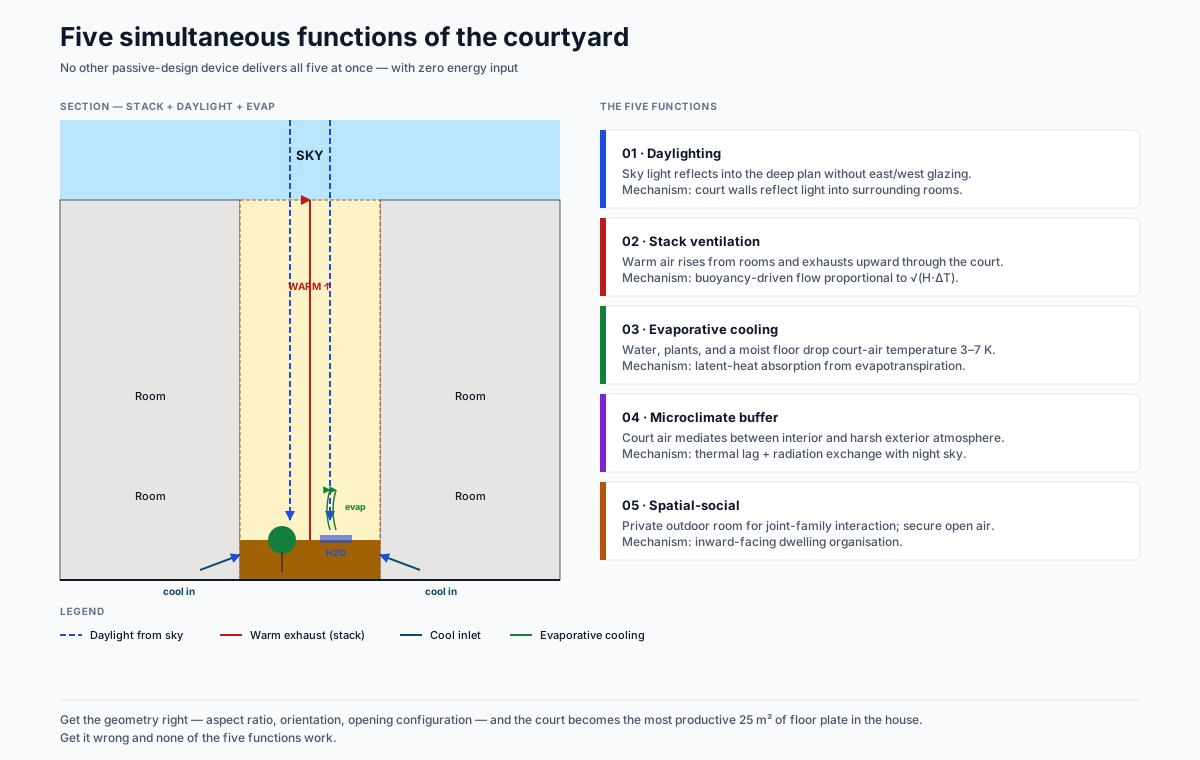
2. The Physics — Stack Ventilation and Buoyancy-Driven Flow
The courtyard's cooling performance rests primarily on stack effect — the buoyancy-driven vertical movement of air caused by temperature difference. The governing equation (Lechner, 2015; ASHRAE Fundamentals) is:
Q = Cd × A × sqrt(2 × g × H × ΔT / T)
Where:
- Q = volumetric airflow rate (m3/s)
- Cd = discharge coefficient of the opening (≈ 0.65 for sharp-edged openings)
- A = effective opening area (m2)
- g = 9.81 m/s2
- H = vertical distance between inlet and outlet (m)
- ΔT = temperature difference between interior/court and exterior (K)
- T = reference temperature (K, absolute)
Worked example — two-storey Kerala nalukettu:
- H = 6 m (ground inlet to roof outlet)
- ΔT = 5 K (interior 28 deg C, court 33 deg C during peak)
- A = 2 m2 (combined opening area, inlet and outlet balanced)
- T = 301 K (28 deg C)
Q = 0.65 × 2.0 × sqrt(2 × 9.81 × 6 × 5 / 301) = 0.65 × 2.0 × 1.4 = 1.82 m3/s
For a 100 m3 interior volume, this gives an air change rate of approximately 65 ACH — well above the 6–10 ACH required for thermal comfort in warm-humid conditions (Manu et al., 2016).
| Courtyard Configuration | Approximate H (m) | ΔT Assumption (K) | ACH (100 m3 space, 2 m2 openings) |
|---|---|---|---|
| Single-storey court | 3.0 | 3 | 20–25 |
| Two-storey court | 6.0 | 5 | 50–70 |
| Three-storey haveli | 9.0 | 6 | 85–105 |
| Four-storey taq (Kashmir) | 12.0 | 7 | 130–160 |
The three conditions stack effect requires:
1. A temperature differential (≥ 3 K for meaningful flow).
2. Vertical separation between inlet and outlet (higher H, higher flow, non-linearly).
3. Unobstructed vertical path — one room must exhaust through another, typically via a court or stair well.
The courtyard is the optimum stack-effect device because it is both the exhaust path and the heat rejector to the open sky.
"The chowk is the lung of the haveli. In the morning it inhales cool night air; through the day it exhales the heat the building has absorbed. A house without a chowk is a house that cannot breathe." — V.S. Pramar, from Haveli: Wooden Houses and Mansions of Gujarat (Pramar, 1989)
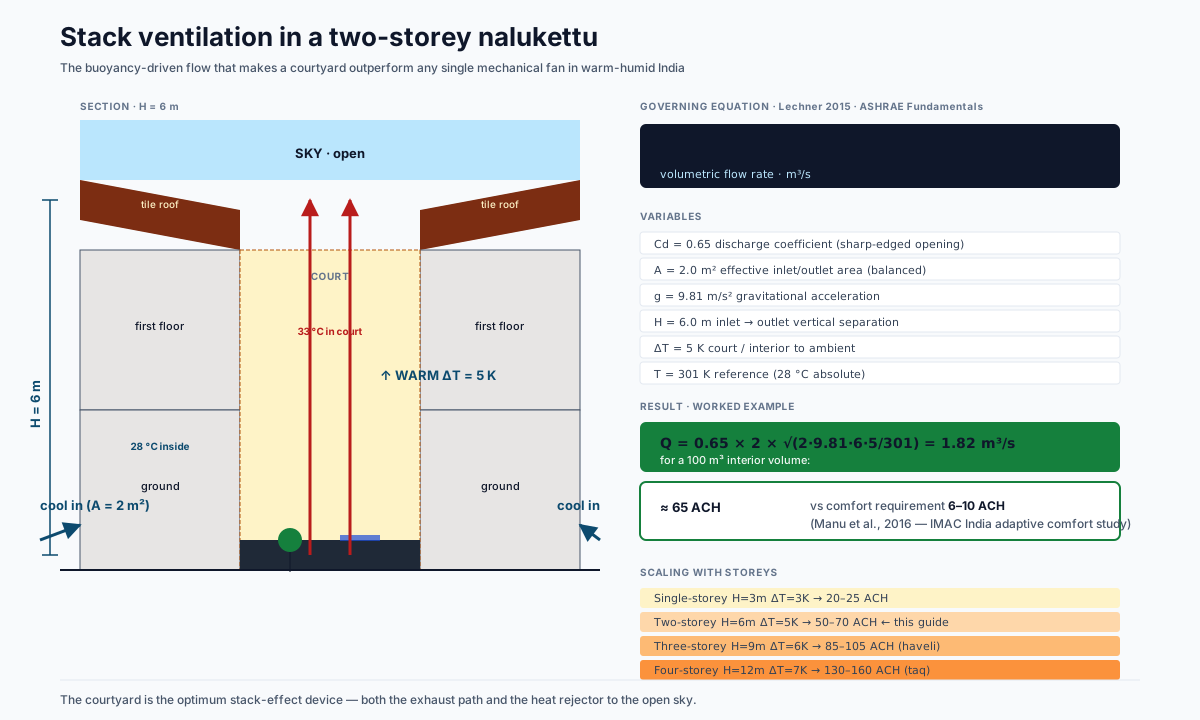
3. Daylight in the Courtyard — Well Index and Floor Illumination
The courtyard delivers daylight to rooms facing it without requiring east/west glazing (which brings heat). The effectiveness depends on the well index — a geometric ratio that predicts how much sky light reaches the court floor and the surrounding rooms.
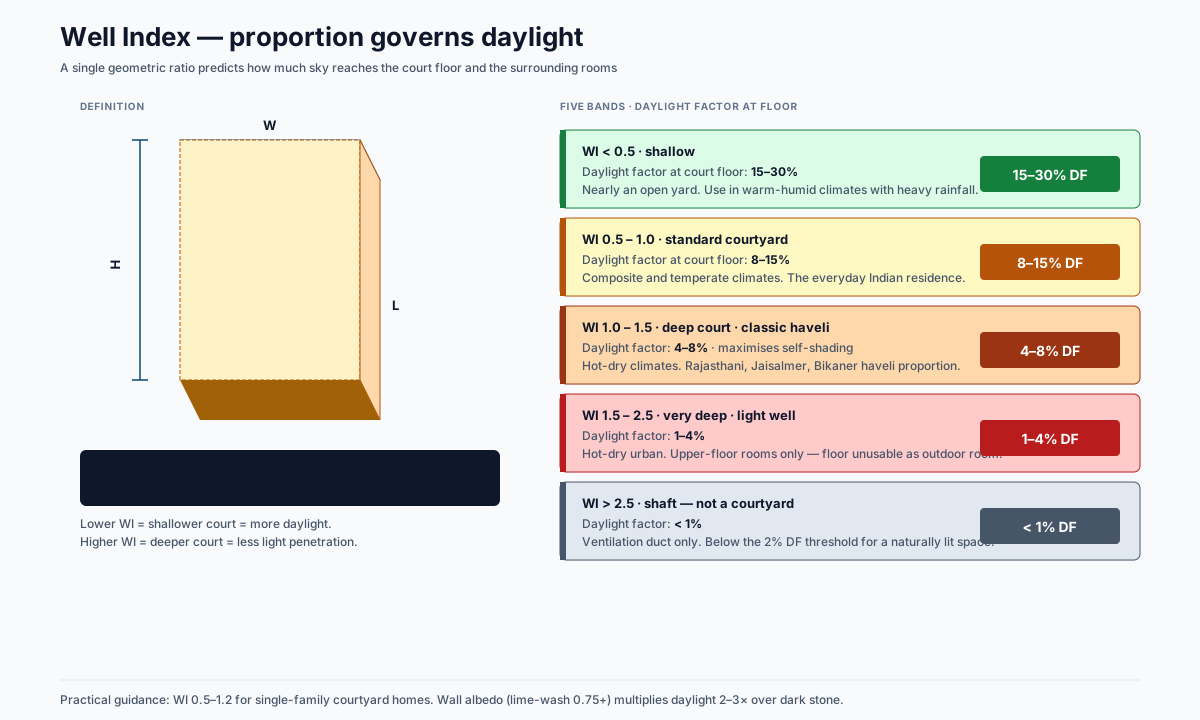
Well Index (WI) = H × (W + L) / (2 × W × L)
Where H = court height, W = width, L = length. Lower WI = shallower court = more daylight at floor and lower-floor windows. Higher WI = deeper court = less light penetration.
| Well Index | Interpretation | Daylight Factor at Court Floor | Useful For |
|---|---|---|---|
| < 0.5 | Shallow — nearly open yard | 15–30% | Warm-humid with heavy rainfall |
| 0.5–1.0 | Standard courtyard | 8–15% | Composite, temperate climates |
| 1.0–1.5 | Deep court (classic haveli) | 4–8% | Hot-dry — maximises self-shading |
| 1.5–2.5 | Very deep (light well) | 1–4% | Hot-dry urban; upper-floor rooms only |
| > 2.5 | Shaft — not a courtyard | < 1% | Ventilation only; not inhabitable |
Practical guidance: For a single-family courtyard home, WI should sit between 0.5 and 1.2. Below 0.5 the court ceases to self-shade and becomes a solar aperture in hot climates. Above 1.5 the court becomes unusable as an outdoor room — daylight at floor level falls below the 2% DF threshold that defines a naturally lit space (BS 8206-2; ECBC 2017).
Wall reflectance matters. Court walls that are lime-washed (albedo 0.75–0.85) deliver 2–3 times more daylight to surrounding rooms than dark stone walls (albedo 0.25–0.35). The traditional Rajasthani white lime finish is not decorative — it is a daylight amplifier.
| Court Wall Finish | Typical Albedo | Daylight Factor Multiplier | Notes |
|---|---|---|---|
| Lime wash, white | 0.75–0.85 | 1.0 (baseline) | Traditional Rajasthani, Greek-island approach |
| White distemper / acrylic | 0.70–0.80 | 0.95 | Modern equivalent |
| Exposed brick, natural | 0.30–0.40 | 0.45 | Low daylight; high character |
| Sandstone, buff | 0.40–0.55 | 0.55 | Jaisalmer haveli default |
| Grey granite, polished | 0.20–0.30 | 0.35 | Minimal daylight bounce |
| Corten / dark weathered steel | 0.15–0.25 | 0.30 | Contemporary, but cuts daylight |
4. Geometry — Aspect Ratios by Climate Zone
The single most important design decision for a courtyard is its aspect ratio H/W (ratio of enclosing wall height to court width). This single parameter determines whether the court becomes a cooling well (self-shading, stack-venting) or a solar trap (direct exposure, heat accumulation).
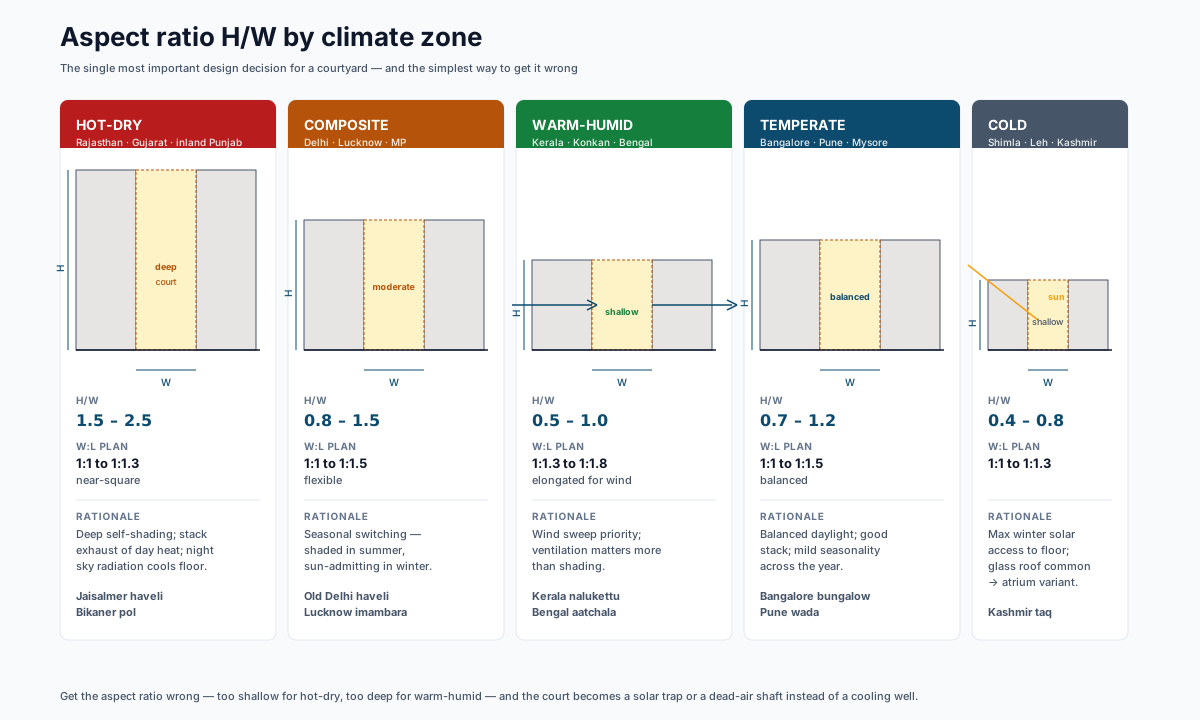
| Climate Zone | Recommended H/W | Court Plan Proportion (W:L) | Rationale |
|---|---|---|---|
| Hot-Dry (Rajasthan, Gujarat, inland Punjab) | 1.5–2.5 | 1:1 to 1:1.3 (near-square) | Deep self-shading; stack exhaust of day heat; night sky radiation cools court floor |
| Composite (Delhi, Lucknow, MP) | 0.8–1.5 | 1:1 to 1:1.5 | Seasonal switching — shaded in summer, sun-admitting in winter |
| Warm-Humid (Kerala, Konkan, Bengal, Chennai) | 0.5–1.0 | 1:1.3 to 1:1.8 (elongated) | Wind sweep priority; ventilation greater than shading |
| Temperate (Bangalore, Pune, Mysore) | 0.7–1.2 | 1:1 to 1:1.5 | Balanced; good daylight; moderate stack |
| Cold (Shimla, Leh, Kashmir) | 0.4–0.8 | 1:1 to 1:1.3 | Maximise winter solar access to court floor; glass-roof option (atrium) |
Orientation rules that accompany the proportion:
1. Long axis east–west — minimises east and west solar exposure of enclosing walls, maximises south-facing wall (useful in winter, manageable with chajja in summer).
2. Primary opening toward prevailing wind in warm-humid zones — usually south-west during monsoon, captured through a large doorway or verandah opening into the court.
3. Court floor elevation — at or 150 mm below ground floor — slightly sunken courts retain cool air at night (pooling effect).
4. Roof drainage directed out of court in warm-humid climates (courtyard collects and evaporates some water but cannot handle 2500+ mm/year alone).
"Form follows climate. The plan, the section, the orientation, the size of the openings — all are dictated by the sun and the wind, before they are dictated by anything else." — Charles Correa (Correa, 2010)
5. Indian Courtyard Typologies — Formal Comparison
India has evolved at least seven distinct courtyard typologies, each a formal response to a regional climatic and social context. The table summarises geometric and programmatic differences an architect would use when selecting a precedent.
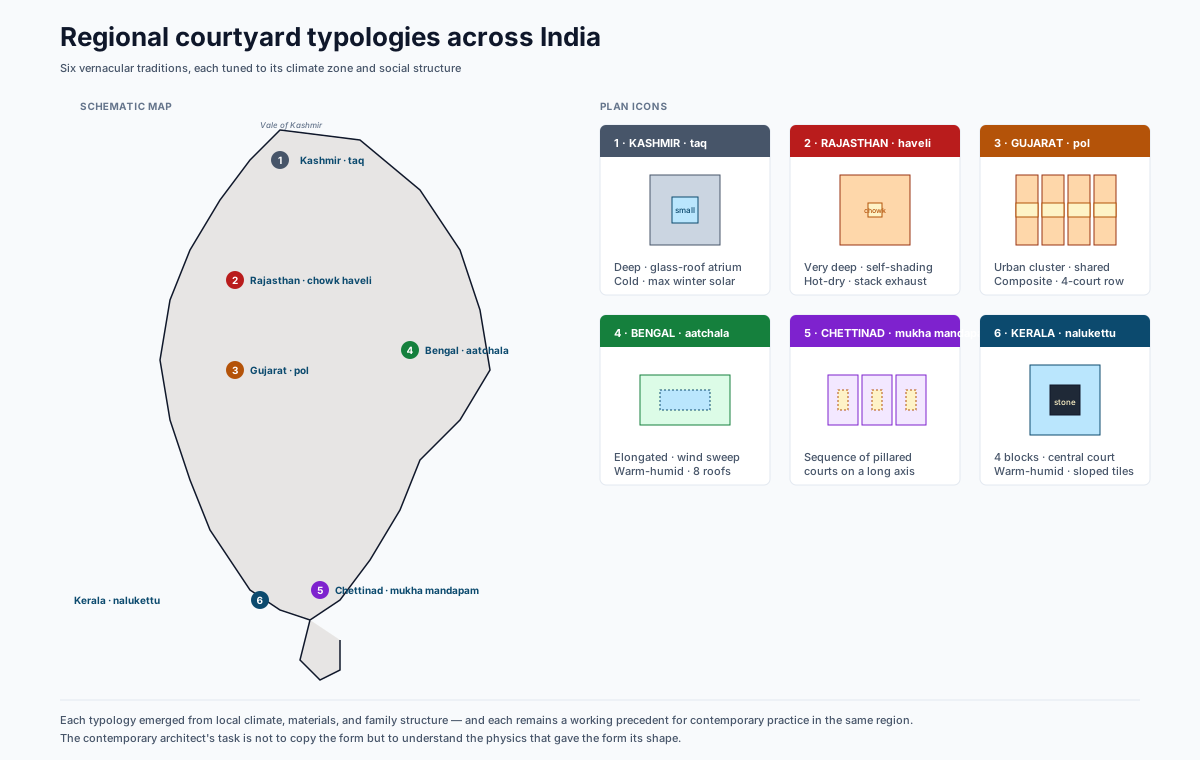
| Typology | Region | Typical W × L × H | H/W | Number of Courts | Key Architectural Features |
|---|---|---|---|---|---|
| Nalukettu nadumuttam | Kerala | 4 × 6 × 4 m | 0.7 | 1 (ettukettu has 2, pathinarukettu has 4) | Four hipped timber-rafter roof falls into court; open on all four sides |
| Jaisalmer chowk | Rajasthan | 4 × 4 × 8 m | 2.0 | 1 main + ancillary | Three-storey sandstone enclosure; jharokhas project into court; jali screens at upper level |
| Gujarati pol chowk | Ahmedabad | 3 × 4 × 6 m | 1.7 | 1 per house | Narrow, tall; timber columns at ground; otla at street |
| Chettinad mukha-mandapam | Tamil Nadu | 6 × 8 × 5 m | 0.7 | 2–5 courts in axial series | First court male-public, deeper courts increasingly private; thinnai at entry |
| Bengali thakur dalan | Bengal | 5 × 7 × 5 m | 0.7 | 1 central + narrow service courts | Deity-worship pavilion on court axis; curved atchala roof on surrounding blocks |
| Goan Indo-Portuguese angan | Goa | 4 × 5 × 5 m | 1.0 | 1 internal (small) | Balcao at entry preserves street-facing Mediterranean tradition; internal court handles ventilation |
| Lucknow haveli sahn | UP | 6 × 8 × 6 m | 0.85 | 1 main + zenana | Arcaded verandahs on 2–3 sides; Mughal-derived proportions; scalloped arches |
| Himachal obra | Himachal Pradesh | 3 × 4 × 4 m | 1.1 | 1 (modest) | Small winter-sheltering court, south-facing timber balconies (jaula), kath-kuni walls |
The formal insight: courtyard typology tracks climate more tightly than region. The Bengali thakur dalan and the Chettinad mukha-mandapam — separated by 2,000 km culturally — converge on a low H/W (~0.7) because both sit in warm-humid conditions. The Jaisalmer and Gujarati pol courts — culturally adjacent — diverge in proportion because one sits in the open desert and the other in dense urban fabric.
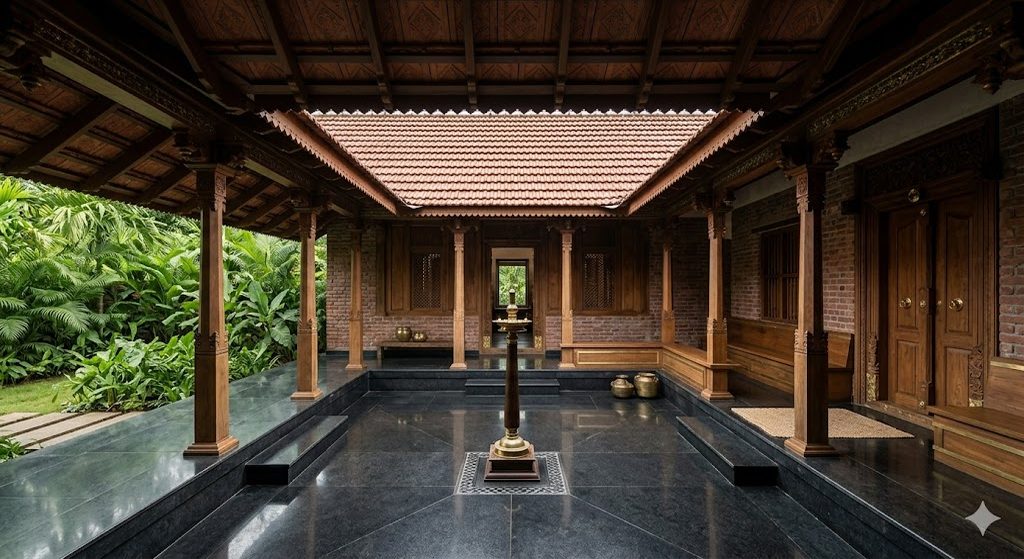
6. Microclimate Modification — Water, Vegetation, and Evaporation
A bare courtyard floor is a radiant heater. A courtyard with water, plants, and a porous floor surface becomes an evaporative cooler. The difference in court air temperature between a bare concrete court and a planted, water-bearing court is measured (Meir et al., 1995; Al-Hemiddi and Al-Saud, 2001) at 3–7 deg C in peak summer conditions.
The three microclimatic instruments:
1. Shade plants (large-leaf, evapotranspiring). A single mature neem or ficus in a 25 m2 court can reduce court air temperature by 2–3 deg C through evapotranspiration alone (~200–400 W of latent cooling).
2. Open water surface. A 2 × 3 m shallow pool in a Rajasthani chowk provides 5–10 litres/day evaporation — approximately 150–300 W of continuous latent cooling through the summer.
3. Porous court floor. Washed stone, morum gravel, or unsealed terracotta tile holds moisture after monsoon or cleaning, releasing it gradually — an effect exploited in the Jaipur haveli floor specification.
| Microclimate Device | Cooling Effect (Peak Summer) | Latent Power Delivered | Water Requirement |
|---|---|---|---|
| Bare concrete floor | None (adds heat) | 0 W | 0 |
| Sealed stone floor, sprinkled | Negligible | < 50 W | Daily |
| Morum / washed stone floor | Modest | 100–200 W | Weekly replenishment after rain |
| Single mature tree (neem, ficus) | 2–3 deg C air temp reduction | 200–400 W | Established root — self-sustaining |
| Open shallow water pool (6 m2) | 1–2 deg C court air reduction | 150–300 W | 5–10 L/day evaporative makeup |
| Planted climber wall (bougainvillea, jasmine) | 1–2 deg C surface temp reduction | 100–200 W | Drip irrigation |
| Combined — tree + water + porous floor | 5–7 deg C cumulative reduction | 500–900 W | Moderate, mostly rain-captured |
The vegetation selection question is architectural, not horticultural. The right court plants are:
- Evapotranspiring but not cluttering — one large-canopy tree beats ten shrubs
- Deep-rooted and drought-tolerant (neem, peepal, ficus, gulmohar)
- Deciduous in composite climate — provides summer shade but admits winter sun
- Non-fragile in foot traffic zones — the court is a working outdoor room
Plants to avoid in the court: species with aggressive roots near the building (banyan, pipal close to foundation walls); shallow-rooted ornamentals that require weekly irrigation; toxic or allergenic species in a household context; anything that drops heavy fruit or litter into an inhabited space.
7. Instrumented Field Studies — What the Data Shows
The empirical case for the courtyard is not anecdotal. The last twenty years have produced a substantial peer-reviewed body of work on measured performance. The headline findings:
| Study | Location / Climate | Courtyard Type | Headline Finding |
|---|---|---|---|
| Dili, Naseer and Varghese (2010) | Kerala / warm-humid | Traditional nalukettu | Interior 2.5–4.5 deg C cooler than exterior in peak summer; 78% thermal-comfort hours without AC |
| Singh, Mahapatra and Atreya (2009) | NE India / warm-humid subtropical | Assam tribal longhouse with shaded courts | 80–85% thermal comfort hours achieved passively |
| Al-Hemiddi and Al-Saud (2001) | Riyadh / hot-dry | Ventilated courtyard (sprinkler-augmented) | 4.4 deg C interior reduction vs unventilated baseline |
| Meir, Pearlmutter and Etzion (1995) | Negev / hot-dry | Semi-enclosed attached courtyard | 2–6 deg C microclimate reduction; night-time inversion retains cool air |
| Manioğlu and Yilmaz (2006) | Mardin (Turkey) / hot-dry | Traditional stone courtyard house | 40% reduction in cooling energy demand vs modern detached house of equal area |
| Rajapaksha, Nagai and Okumiya (2003) | Colombo / warm-humid | CFD + field: ventilated courtyard | Courtyard with adequate cross-openings maintains comfort; sealed court becomes heat trap |
| Muhaisen (2006) | Multi-climate simulation | Geometric optimisation | Optimum H/W of 1.0–1.5 for hot-dry; 0.5–1.0 for warm-humid |
| Safarzadeh and Bahadori (2005) | Tehran / hot-dry | Passive cooling elements in court | Shrub + pool combination reduces court air by 4.5 deg C |
The collective conclusion: a well-dimensioned courtyard delivers measurable cooling in every climate where it has been instrumented, with peak reductions of 4–7 deg C in hot-dry conditions and 2–4 deg C in warm-humid conditions — achieved without mechanical systems.
The critical caveat (Rajapaksha et al., 2003): a sealed courtyard — one where the surrounding rooms do not open into it — reverses the effect and becomes a heat trap. The architectural moral: the court must be porous, not merely present.
8. Urban Light-Well vs True Courtyard — A Distinction That Matters
Contemporary Indian urban housing — especially 3–5 storey row-house and apartment typologies — frequently shrinks the courtyard into a light-well: a shaft too narrow to be inhabited, functioning only for minimal ventilation and token daylight. This is not a courtyard in the climatic sense. It is a compromise that should be recognised as such.
| Parameter | Light-Well | True Courtyard | Atrium (for comparison) |
|---|---|---|---|
| Minimum width | 1.2–2.0 m (NBC 2016 minimum) | 3.0 m (functional minimum) | 4.0+ m |
| Aspect ratio H/W | Often > 3 | 0.5–2.0 | 0.5–1.5 |
| Inhabitable floor | No | Yes | Yes (conditioned) |
| Daylight at base | < 2% | 4–30% | 5–20% |
| Stack ventilation | Weak | Effective | Mechanical-assisted |
| Roof | Open | Open | Glazed |
| Typical use | Bathroom / kitchen window ventilation | Living court, outdoor room | Circulation, public space |
NBC 2016 minimum open space (from Clause 8 of Part 3): inner courts must have minimum width equal to one-third of the adjacent wall height, subject to absolute minima. For a 9 m three-storey enclosure, minimum court width is 3 m — which yields H/W = 3.0 and disqualifies it as an inhabitable court. NBC minima ensure legal daylight; they do not ensure climatic performance.
The practical architectural response: if the plot/program can accommodate only a light-well, treat it as such — detail it for ventilation and minimal daylight only, locate service spaces around it, and consider whether a private terrace or roof garden can substitute for the climate-responsive function that the court would have played. Do not call a 1.5 m shaft a "courtyard" on the drawings; the client and the site will both know the difference in the first summer.
9. Courtyard Floor and Wall Finishes — Performance
The finishes of the court floor and enclosing walls are not cosmetic decisions — they are thermal and photometric decisions.
| Surface | Finish Options | Albedo | Thermal Role | Daylight Role | Rainfall Handling |
|---|---|---|---|---|---|
| Court floor | Kota stone, polished | 0.25–0.35 | Absorbs day heat; radiates into court at night | Low bounce | Fast runoff with slope |
| Court floor | IPS (red oxide) | 0.30–0.40 | Moderate mass, moderate heat absorption | Low bounce | Slope + grating |
| Court floor | Terracotta tile (unglazed) | 0.40–0.55 | Porous — holds moisture, evaporative cooling | Moderate bounce | Permeable; slow drainage |
| Court floor | Morum / kankar gravel | 0.40–0.55 | Porous; evaporative after rain | Moderate bounce | Infiltrates; rainwater harvesting compatible |
| Court floor | Lime-surfaced stone (Jaisalmer) | 0.55–0.70 | Evaporative + reflective | High bounce | Traditional; moderate drainage |
| Court floor | White marble (polished) | 0.60–0.75 | Heat mirror — reflects heat upward, cool to touch | High bounce | Fast runoff |
| Court floor | Planted / grass / ground cover | 0.15–0.25 | Evapotranspiration — maximum latent cooling | Low direct bounce | Infiltration |
| Court walls | Lime wash white | 0.75–0.85 | Cool surface all day | Maximum daylight to surrounding rooms | Breathable |
| Court walls | White acrylic paint | 0.70–0.80 | Cool, but less breathable | High daylight | Moisture-trapping concern |
| Court walls | Exposed brick | 0.30–0.40 | High thermal mass; warmer surface | Moderate daylight | Breathable |
| Court walls | Jaisalmer sandstone | 0.45–0.55 | Thermal mass; moderate heat storage | Moderate daylight | Durable |
| Court walls | Dark stone / corten | 0.15–0.30 | Absorbs heat — raises court air temp | Low daylight | Variable |
The performance-driven specification for a hot-dry court floor and walls is: porous or lime-surfaced floor (albedo ≥ 0.55 or evapotranspiring), lime-wash white walls (albedo ≥ 0.75), at least one living tree, and a small water feature. This specification is not historical pastiche — it is measured cooling.
10. Contemporary Courtyard Design in India
The courtyard did not die with the haveli and the nalukettu. It was reinterpreted — sometimes faithfully, sometimes radically — by post-Independence Indian architects and remains a defining device in contemporary Indian residential architecture.
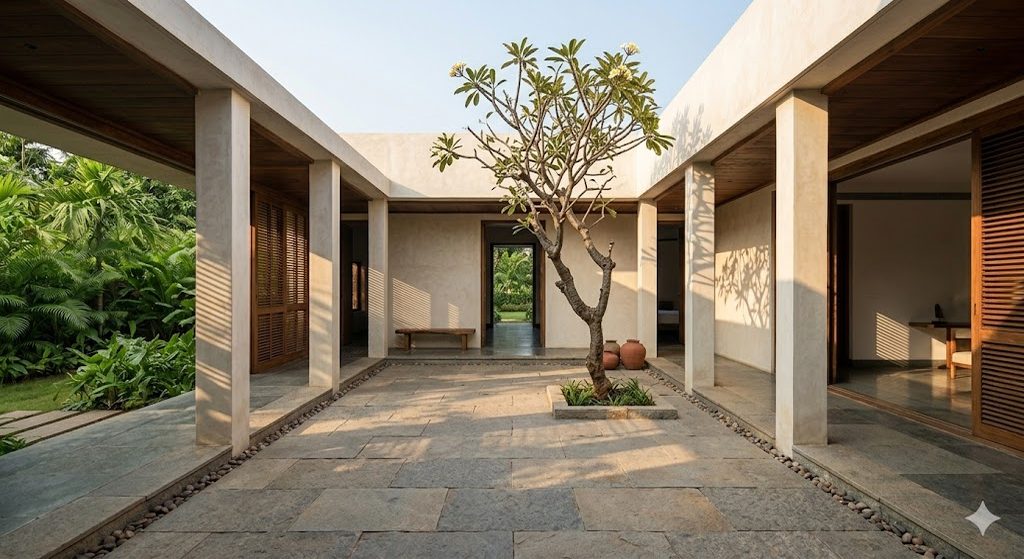
| Project | Architect | Year | Courtyard Strategy |
|---|---|---|---|
| Tube House, Ahmedabad | Charles Correa | 1962 | Linear house with section-driven stack ventilation; open-to-sky pocket at the hot end |
| Gandhi Smarak Sangrahalaya | Charles Correa | 1963 | Grid of courts — each 6 × 6 m — with tile roofs between; museum but rehearses residential strategy |
| Sangath | B.V. Doshi | 1980 | Series of sunken vaulted spaces with courts in between; terraced into ground for thermal mass |
| Aranya Low-Cost Housing, Indore | B.V. Doshi | 1989 | Cluster-scale courtyards — one court per 6–8 families, not one per house |
| Belapur Housing, Navi Mumbai | Charles Correa | 1986 | Incremental housing around shared courts at neighbourhood scale |
| Mehrauli Farm House | Revathi Kamath | 1990s | Stabilised earth walls; courtyard as central social space; traditional materials, modern plan |
| Palmyra House, Alibaug | Studio Mumbai | 2007 | Two pavilions around a palm-filled forecourt; thin timber louvres; monsoon-climate version |
| Copper House II, Chondi | Studio Mumbai | 2011 | Dark patinated copper enclosure around a green court; refined sectional study |
| Street House, Ahmedabad | Matharoo Associates | 2008 | Courtyard cut through a compact urban plot; kitchen and dining open to it |
| SRC House, Bangalore | Khosla Associates | 2009 | Enclosed courtyard with water; temperate Bangalore version |
| House on a Stream, Alibaug | SPASM Design | 2011 | Courts and terraces interleaved with natural stream through site |
| Tara Housing, Delhi | Charles Correa | 1978 | Stacked single-family units, each with a terrace-courtyard |
| Anagram Architects | Various | 2005–present | Recurring use of courts as social, climatic, and structural hinge in Delhi houses |
| Morphogenesis — Pearl Academy, Jaipur | Morphogenesis | 2008 | Institutional courtyard with step-well cooling — residential principles at campus scale |
| Sameep Padora — Maya Somaiya Library | sP+a | 2019 | Vaulted court roofscape — residential instinct applied to public program |
The pattern across the body of work — from Correa's 1962 Tube House to Sameep Padora's 2019 library — is that the Indian architect who engages seriously with climate returns to the courtyard. The specific form varies — sunken, raised, vaulted, open, planted, paved — but the sectional move is consistent: create an open-to-sky space that stack-ventilates the surrounding program and admits controlled daylight.
"The courtyard is not a room — it is an outdoor room. And like any room, it has proportions, a floor, walls, a ceiling (of sky), and openings. The difference is that one of its walls is the sun, and the architect must know when that wall is present and when it is not." — B.V. Doshi, from Paths Uncharted (Doshi, 2012)
11. Common Design Mistakes — and How to Avoid Them
A survey of built courtyard homes in India since 2000 reveals a consistent set of failure modes. All are preventable with attention at design stage.
| Mistake | Consequence | Fix at Design Stage |
|---|---|---|
| Court too narrow (H/W > 2.5) in warm-humid zone | No wind sweep; becomes humid trap | Widen to H/W 0.7–1.0; open one short side to prevailing wind |
| Court too wide (H/W < 0.5) in hot-dry zone | No self-shading; solar trap at noon | Narrow to H/W 1.2–2.0; add louvred canopy for deepest summer weeks |
| Hard impermeable court floor (polished stone) | Radiant heat, no evaporation | Permeable/porous finish; at least one planted zone |
| No rooms opening into court (glazed-only frontage) | No stack ventilation; no porosity | Operable doors/louvres from at least two rooms into court |
| Sealed glass roof over "courtyard" | Becomes atrium (conditioned) — defeats open-to-sky purpose | Either commit to open court or design as proper atrium with mechanical ventilation; do not confuse the two |
| Deep eaves rob courtyard sun in winter | Court becomes dark and cold in cold season | Retractable pergola or removable summer louvre system; seasonal adjustability |
| Dark wall finishes (cement grey, corten, dark brick) | Low daylight to surrounding rooms | Lime wash or white acrylic on court-facing walls; minimum albedo 0.7 |
| Court floor lower than surrounding rooms without drainage | Monsoon flooding | Floor at ground-level minus 100–150 mm; slope to grating; subsoil drain |
| No east–west axis | West afternoon sun heats full height of court wall | Rotate long axis to E–W; minimise west-facing exposed wall |
| Court used as light-well for bathrooms | Odour and humidity concentrate in court | Dedicate bathroom ventilation to separate shaft; keep court for living-space function |
| No water feature in hot-dry court | Misses 1–2 deg C of evaporative cooling | Shallow pool or trickle water element; even 2 m2 helps |
| Overplanting — dense shrubs clutter court | Reduces evaporation efficiency; obstructs daylight | One large tree + minimal understory; let the sky do the work |
12. Fifteen-Point Courtyard Specification Checklist
A working specification checklist — adapted to a specific project's climate zone and program, but covering the decisions that must be made at design stage.
| # | Parameter | Specification Decision |
|---|---|---|
| 1 | Climate zone | Composite / Hot-Dry / Warm-Humid / Temperate / Cold — all subsequent decisions cascade from this |
| 2 | Minimum court dimension | ≥ 3.0 m × 3.0 m at base (below this it becomes a light-well) |
| 3 | Aspect ratio H/W | Per climate-zone table (Section 4) — typically 0.5–2.0 |
| 4 | Plan proportion W:L | 1:1 to 1:1.8 — avoid ratios > 1:2.5 which behave as streets, not courts |
| 5 | Long-axis orientation | East–west preferred (minimises east/west walls) |
| 6 | Rooms opening onto court | Minimum 2 rooms with operable doors/windows directly to court — porosity requirement |
| 7 | Court floor level | Ground level to -150 mm; with grating-slope drainage |
| 8 | Court floor finish | Permeable / porous / lime-surfaced / planted (per Section 9) — avoid dark impermeable finishes |
| 9 | Court wall finish | Lime wash or white acrylic — minimum albedo 0.70 on court-facing surfaces |
| 10 | Solar access in winter | Verify noon sun reaches court floor on winter solstice (shadow study required) |
| 11 | Shading in peak summer | Court geometry self-shades (H/W ≥ 1.0) or retractable pergola / louvre system |
| 12 | Water feature | Shallow pool or trickle element (hot-dry / composite); optional (warm-humid) |
| 13 | Vegetation | One mature deciduous tree + minimal understory; no roots within 1.5 m of foundation |
| 14 | Rainwater management | Court slope ≥ 1:100 to grated drain; connected to recharge pit or collection tank |
| 15 | Monsoon cover option | Removable/retractable light canopy for 40–60 days/year where monsoon intensity exceeds 150 mm/24h events |
This checklist is not exhaustive — it is a minimum. A courtyard that satisfies all fifteen criteria will perform climatically; one that fails on even three may not deliver measurable benefit over a sealed RCC plan.
"An architect must always be sensitive to the spirit of place. A courtyard is where the building stops pretending to be a box and becomes a conversation with the sky." — Geoffrey Bawa (1919–2003), architect, attributed in Robson (2002)
References
- Al-Hemiddi, N.A. and Al-Saud, K.A.M. (2001) 'The effect of a ventilated interior courtyard on the thermal performance of a house in a hot-arid region', Renewable Energy, 24(3–4), pp. 581–595.
- ASHRAE (2021) ASHRAE Handbook — Fundamentals. Atlanta: American Society of Heating, Refrigerating and Air-Conditioning Engineers.
- Bureau of Energy Efficiency (2017) Energy Conservation Building Code 2017. New Delhi: Ministry of Power, Government of India.
- Bureau of Energy Efficiency (2018) Eco-Niwas Samhita 2018: Energy Conservation Building Code for Residential Buildings. New Delhi: Ministry of Power.
- Bureau of Indian Standards (2016) National Building Code of India 2016 (SP 7:2016), Part 3 — Development Control Rules and General Building Requirements. New Delhi: BIS.
- Correa, C. (2010) A Place in the Shade: The New Landscape and Other Essays. New Delhi: Penguin India.
- Dili, A.S., Naseer, M.A. and Varghese, T.Z. (2010) 'Passive environment control system of Kerala vernacular residential architecture for a comfortable indoor environment: A qualitative and quantitative analysis', Energy and Buildings, 42(6), pp. 917–927.
- Dili, A.S., Naseer, M.A. and Varghese, T.Z. (2010) 'Thermal comfort study of Kerala traditional residential buildings based on questionnaire survey among occupants of traditional and modern buildings', Energy and Buildings, 42(11), pp. 2139–2150.
- Doshi, B.V. (2012) Paths Uncharted. Ahmedabad: Vastu Shilpa Foundation.
- Edwards, B., Sibley, M., Hakmi, M. and Land, P. (Eds.) (2006) Courtyard Housing: Past, Present and Future. London: Taylor & Francis.
- Fathy, H. (1986) Natural Energy and Vernacular Architecture. Chicago: University of Chicago Press.
- Givoni, B. (1998) Climate Considerations in Building and Urban Design. New York: Van Nostrand Reinhold.
- Khan, H.U. (1987) Charles Correa: Architect in India. London: Concept Media / Mimar.
- Koenigsberger, O.H., Ingersoll, T.G., Mayhew, A. and Szokolay, S.V. (1974) Manual of Tropical Housing and Building: Part 1 — Climatic Design. London: Longman.
- Krishan, A., Baker, N., Yannas, S. and Szokolay, S. (2001) Climate Responsive Architecture: A Design Handbook for Energy Efficient Buildings. New Delhi: Tata McGraw-Hill.
- Lechner, N. (2015) Heating, Cooling, Lighting: Sustainable Design Methods for Architects. 4th edn. Hoboken: Wiley.
- Manioğlu, G. and Yilmaz, Z. (2006) 'Energy efficient design strategies in the hot dry area of Turkey', Building and Environment, 41(11), pp. 1669–1679.
- Manu, S., Shukla, Y., Rawal, R., Thomas, L.E. and de Dear, R. (2016) 'Field studies of thermal comfort across multiple climate zones for the subcontinent: India Model for Adaptive Comfort (IMAC)', Building and Environment, 98, pp. 55–70.
- Meir, I.A., Pearlmutter, D. and Etzion, Y. (1995) 'On the microclimatic behavior of two semi-enclosed attached courtyards in a hot dry region', Building and Environment, 30(4), pp. 563–572.
- Muhaisen, A.S. (2006) 'Shading simulation of the courtyard form in different climatic regions', Building and Environment, 41(12), pp. 1731–1741.
- Nayak, J.K. and Prajapati, J.A. (2006) Handbook on Energy Conscious Buildings. Mumbai: IIT Bombay / MNRE.
- Pramar, V.S. (1989) Haveli: Wooden Houses and Mansions of Gujarat. Ahmedabad: Mapin Publishing.
- Rajapaksha, I., Nagai, H. and Okumiya, M. (2003) 'A ventilated courtyard as a passive cooling strategy in the warm humid tropics', Renewable Energy, 28(11), pp. 1755–1778.
- Reynolds, J. (2002) Courtyards: Aesthetic, Social, and Thermal Delight. New York: Wiley.
- Robson, D. (2002) Geoffrey Bawa: The Complete Works. London: Thames & Hudson.
- Safarzadeh, H. and Bahadori, M.N. (2005) 'Passive cooling effects of courtyards', Building and Environment, 40(1), pp. 89–104.
- Singh, M.K., Mahapatra, S. and Atreya, S.K. (2009) 'Bioclimatism and vernacular architecture of north-east India', Building and Environment, 44(5), pp. 878–888.
- Sthapak, S. and Bandyopadhyay, A. (2014) 'Courtyard houses: An overview', Recent Research in Science and Technology, 6(1), pp. 70–73.
Author's Note: The courtyard is one of the few design devices in architecture that admits of near-quantitative prescription — the physics is tractable, the geometry is bounded, and the empirical validation is abundant. This is not true of most architectural decisions, and it is a gift that should not be wasted. An architect who designs a courtyard without computing well index, checking H/W against climate zone, verifying winter solar access, and specifying wall albedo is making it up — and the first monsoon or the first May will tell the client which version they got. The fifteen-point checklist in Section 12 exists because every item on it is a decision that gets botched if not made deliberately. The courtyard repays design discipline tenfold; it punishes design inattention proportionately.
Disclaimer: This article is for informational and educational purposes only. It does not constitute professional architectural or engineering advice. Courtyard design, thermal modelling, and daylight analysis must be undertaken by qualified architects and consultants with site-specific climatic and solar data and reference to applicable IS codes (NBC 2016 Part 3, ECBC 2017, ENS 2018) and local building bye-laws. Stack-effect and daylight calculations provided in this guide are illustrative and do not substitute for project-specific simulation. Studio Matrx, its authors, and its contributors accept no liability for decisions made on the basis of the information contained in this guide.
Export this guide
Related Guides — Deep-dive reading
Cross Ventilation in Indian Homes
Science, Physics, and Planning — A Professional Guide for Architects
Room PlanningDesigning a Naturally Energy-Efficient Indian Home
Comfort first, gadgets last — passive design, orientation, insulation, ventilation and the climate wisdom that cuts Indian energy bills
SustainabilityVernacular Architecture — Lessons for Modern Homes
Regional Building Traditions of India and Their Architectural Logic — A Reference for Contemporary Practice
Design StylesRelated Tools — Try Free
Cross-Ventilation Analyzer
Estimate airflow and air changes per hour (ACH) from room size, window areas, layout, and local wind — with NBC 2016 Part 8 compliance check.
Ventilation CalculatorBrise-Soleil Visualizer
Interactive horizontal-louvre cut-off angle calculator — sun altitude, louvre depth, and spacing inputs with a live shadow preview. Computes θ = arctan(spacing/depth) for façade shading, ECBC envelope compliance, hospital daylight design, and tropical sun-control detailing.
Sun Shading ToolRainwater Tank Sizer
How big should your rainwater tank be? Computes annual harvest, recommended tank capacity in litres, water-bill savings, and payback — for 10 Indian cities.
RWH Calculator