
Window Size Standards for Indian Homes (2026): Dimensions, Sills and the 10 Percent Rule
Standard window dimensions by room, sill and head heights, the NBC 10 per cent rule, and how to build a window schedule on your drawings.
A window that is too small leaves a room gloomy and stuffy; one that is too large bakes it. The size and height of every opening is a design decision with a code floor under it. This guide is the reference for how big windows should be, where the sill should sit, and how to write a window schedule for an Indian home. Numbers here are indicative; always confirm against your municipal bye-laws and a fabricator's measured quote.
This is the sizing companion to the planning pillar, Window Placement Guide for Indian Homes. For the energy and glass-fraction lens see Window-to-Wall Ratio for Indian Homes, and for choosing the operation type see Types of Home Windows in India.
The 10 per cent rule: the floor under every window
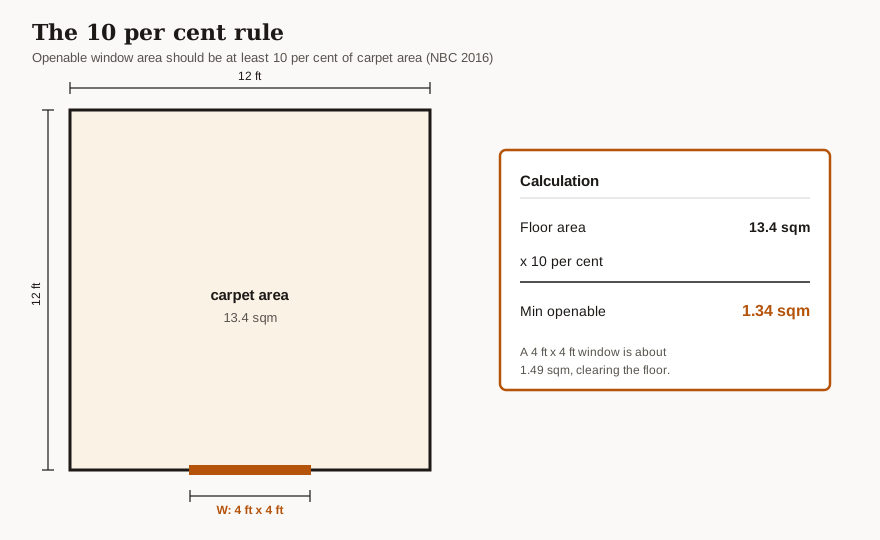
The single most useful number in Indian fenestration comes from the National Building Code (NBC 2016) rule of thumb: for a habitable room the openable window area should be at least 10 per cent of the room's carpet area for light and ventilation. Some local bye-laws phrase it differently and ask for a window area of roughly one-seventh to one-eighth of the floor area for light plus ventilation combined.
Treat 10 per cent of carpet area as a minimum, not a target. A bright, well-aired room usually wants 12 to 20 per cent.
A worked example: a 12 ft x 12 ft (about 13.4 sqm) bedroom needs an openable area of at least 1.34 sqm, roughly 14.4 sqft. A single 4 ft x 4 ft window is 16 sqft of opening, comfortably clearing the floor for a casement (whole sash opens) but tight for a sliding window, where only about half the area actually ventilates. That distinction between glazed area and openable area is exactly why operation type matters as much as size.
Standard window sizes by room
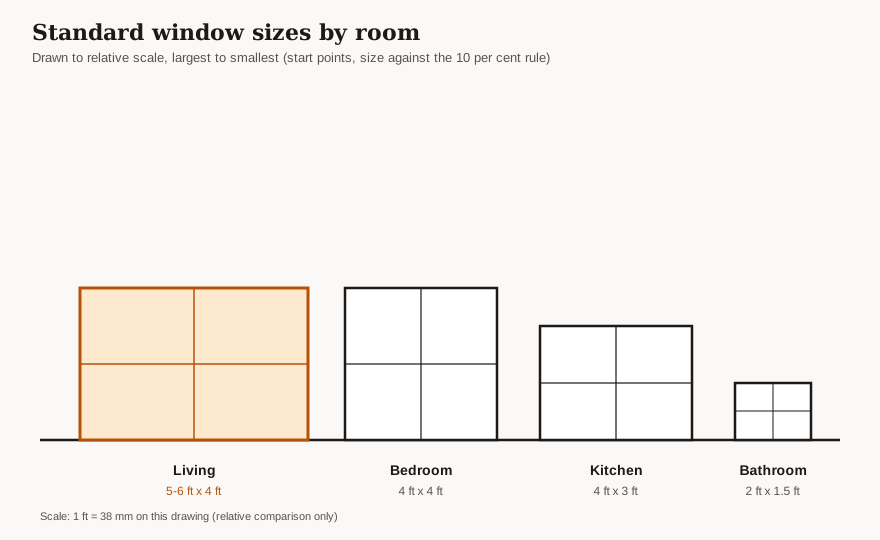
These are the sizes Indian fabricators stock and quote against. They are starting points; scale up for larger rooms, brighter light or a better view, and always size against the 10 per cent rule first.
| Room | Standard size (W x H) | Notes |
|---|---|---|
| Bedroom | 4 ft x 4 ft | Balances light, privacy and wall space for furniture |
| Living room | 5 ft x 4 ft to 6 ft x 4 ft | Larger for view and daylight; pair with shading on west and south |
| Kitchen | 4 ft x 3 ft | Sits above the counter and backsplash; pair with an exhaust |
| Bathroom | 2 ft x 1.5 ft | Small for privacy; an awning or louvre sheds monsoon rain |
Living rooms can go wider still (floor-to-ceiling or a bay), but past a certain glass fraction the Eco-Niwas Samhita (ENS 2018) energy code starts demanding lower-SHGC, higher-spec glazing. That trade-off is the subject of the Window-to-Wall Ratio guide and is summarised below.
Sill heights: where the bottom of the window sits
The sill is the height of the window's bottom edge above the finished floor. It is the quietest decision in a window schedule and the one residents feel every day, because it sets what you see, what furniture fits below and how private the room is.
| Room | Sill height | Why |
|---|---|---|
| Living / bedroom | 600 to 750 mm (2 to 2.5 ft) | Low enough for a seated view, high enough to place a bed or sofa below |
| Kitchen | 1050 to 1200 mm (above counter) | Clears the worktop and backsplash; window starts where the counter ends |
| Bathroom | about 1500 mm (5 ft) | High for privacy while still admitting light and air |
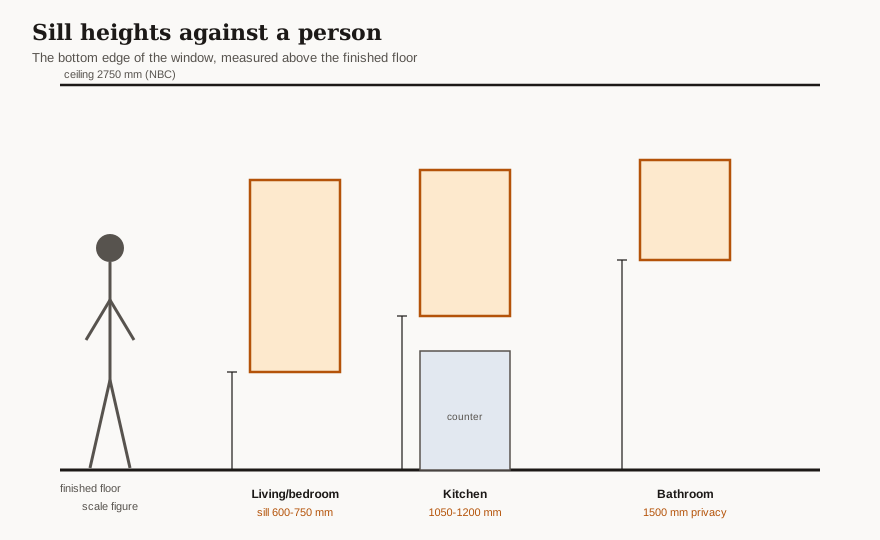
Two design moves follow directly from sill height. Lower sills (around 600 mm) give a seated person, including a wheelchair user or an older resident, a view out and let in more low daylight; higher sills free up the wall below for furniture, storage or a counter, and add privacy. A senior-friendly bedroom favours the lower figure with a safe, easy-to-reach handle, a point developed in the accessibility guides below.
Head height, ceiling and how size shapes light
The top of the window, the head height, is what governs how deep daylight reaches. NBC sets a minimum clear ceiling height of 2750 mm for habitable rooms, and the higher you carry the window head within that, the deeper the light penetrates.
A side window lights a room to roughly 2 to 2.5 times the window head height. Beyond that, the back of the room goes dim.
So a window with its head at 2.1 m lights usefully to about 4.5 to 5 m into the room. A deeper room needs help: a clerestory high on the wall, a skylight, a light shelf to bounce light onto the ceiling, or windows on a second wall (dual-aspect). Crucially, tall windows light deeper than wide ones of the same area, because the daylight depth follows head height, not width. The daylight-factor mathematics behind this live in the science guides, which this guide deliberately does not repeat:
- For the technique and the Daylight Factor metric, see Daylight Factor in India.
- For light quality, gloom and glare by orientation, see Natural Light Planning for Indian Homes. This guide gives you the dimensions; those give you the physics.
Size meets WWR and the energy code
Window area is one input to the window-to-wall ratio (WWR), the glazed area divided by the external wall area of a room. As WWR rises the room gets more light and view but more heat, and the ENS code responds by demanding a higher minimum visible-light transmittance (VLT) and tighter heat control, with the wall envelope's RETV held at or below 15 W per sqm.
| WWR band | Minimum VLT (ENS) |
|---|---|
| 0 to 0.30 | 0.27 |
| 0.31 to 0.40 | 0.20 |
| 0.41 to 0.50 | 0.16 |
| 0.51 to 0.60 | 0.13 |
| 0.61 to 0.70 | 0.11 |
For most Indian rooms a WWR of about 20 to 40 per cent, with good low-SHGC glass and external shading, is the sweet spot. The full ratio logic is the job of the Window-to-Wall Ratio guide; here, just remember that picking a window size also picks a glazing spec.
How to build a window schedule (W1, W2...)
Architects do not scatter sizes across a drawing; they tag every window type with a code and list it in a schedule. This keeps the drawing readable, lets the fabricator quote in bulk and guarantees the 10 per cent rule is met room by room.
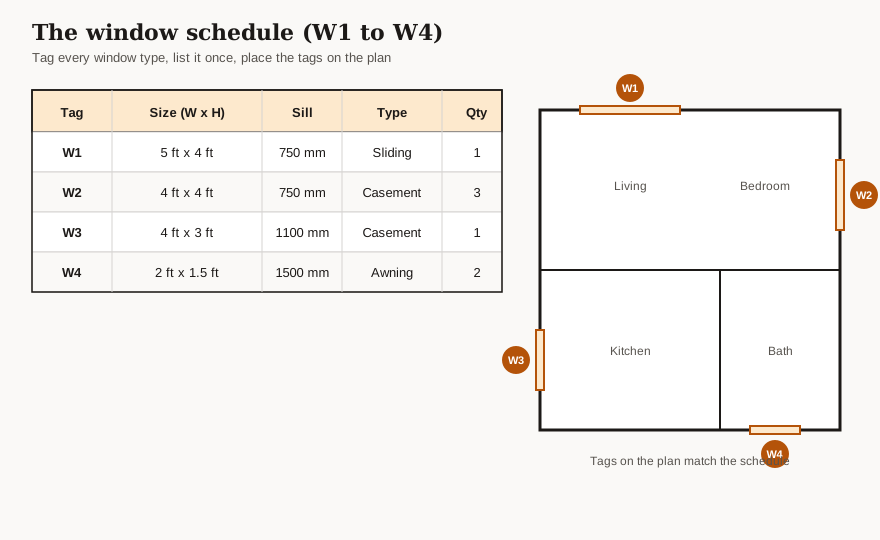
| Tag | Size (W x H) | Sill | Type | Where | Qty |
|---|---|---|---|---|---|
| W1 | 5 ft x 4 ft | 750 mm | Sliding | Living room | 1 |
| W2 | 4 ft x 4 ft | 750 mm | Casement | Bedrooms | 3 |
| W3 | 4 ft x 3 ft | 1100 mm | Casement | Kitchen | 1 |
| W4 | 2 ft x 1.5 ft | 1500 mm | Awning | Bathrooms | 2 |
How to do it:
- Group identical windows under one tag. Three identical bedroom windows are all W2, not W2, W3, W4.
- List width x height, sill, operation type, glazing and quantity for each tag, with a small elevation if the design is unusual.
- Check each room against the 10 per cent openable-area rule as you assign tags, remembering sliding windows open only about half their area.
- Cross-reference the tags on the floor plan and elevations so site staff and the fabricator read the same thing.
- Add a remarks column for safety glass (toughened or laminated for low or large panes), mesh, grilles and restrictors.
Orientation, vastu and people: a quick reconcile
Size and sill interact with which wall the window is on. North and east windows can be generous because they bring cool, even, low-heat light; west and south openings should be more restrained or well shaded. This happens to agree with vastu, which favours larger windows to the north, east and northeast and smaller ones to the west and south, avoiding the southwest. Treat that as guidance harmonised with the sun, and see Vastu for Modern Homes for the framework, which this guide does not duplicate.
For older residents and wheelchair users, drop the sill to around 450 to 600 mm with safe glazing, keep handles within 800 to 1000 mm and choose lever or motorised operation, in line with the RPwD Act 2016 and CPWD Harmonised Guidelines. The whole-home view is in Accessible Home Design in India.
References
- BIS Guide for Using NBC 2016: https://www.bis.gov.in/wp-content/uploads/2022/08/Booklet-Guide-for-Using-NBC-2016.pdf
- Eco-Niwas Samhita 2018 (BEE/ECBC): https://ecbc.in/econiwas.html
- IS 3362, natural ventilation of residential buildings: https://law.resource.org/pub/in/bis/S03/is.3362.1977.pdf
- Standard door and window sizes in India (HouseYog): https://www.houseyog.com/blog/standard-door-window-sizes-india-schedule/
- Standard window size by room (CiviConcepts): https://civiconcepts.com/blog/standard-window-size
- CPWD Harmonised Guidelines (barrier-free): https://www.cpwd.gov.in/Publication/Harmonisedguidelinesdreleasedon23rdMarch2016.pdf
Export this guide
Related Guides — Deep-dive reading
Window Planning for Senior-Friendly Homes (India): Easy, Safe, Bright
Lower sills for a seated view, low-effort lever and motorised hardware, brighter glare-controlled daylight, and safe glass with fall restrictors for ageing residents.
Windows & GlazingWindow Design for Natural Light (India): A Brighter, Evenly Lit Home
How to size, place and glaze windows so every room is bright and evenly lit, without glare or gloom
Windows & GlazingWindow Placement Guide for Indian Homes (2026): Where Windows Should Go
The planning pillar for where windows go: orientation, the inlet-outlet pair, daylight reach, sill heights, WWR balance and a room-by-room checklist for Indian homes.
Windows & GlazingRelated Tools — Try Free
Cross-Ventilation Analyzer
Estimate airflow and air changes per hour (ACH) from room size, window areas, layout, and local wind — with NBC 2016 Part 8 compliance check.
Ventilation CalculatorBrise-Soleil Visualizer
Interactive horizontal-louvre cut-off angle calculator — sun altitude, louvre depth, and spacing inputs with a live shadow preview. Computes θ = arctan(spacing/depth) for façade shading, ECBC envelope compliance, hospital daylight design, and tropical sun-control detailing.
Sun Shading ToolWindow Orientation Planner
Pick the best window type, glass and shading by wall direction — north, east, south and west.
Window Tool