

Window Design for Cross Ventilation (India): Inlet, Outlet and the Path of the Breeze
How to size, place and choose windows so a breeze actually crosses the room, windward inlet to leeward outlet, with the right window types and a clear flow path.
A ceiling fan moves the air you already have. A pair of well-placed windows brings in air you do not have yet, and that is the whole game in an Indian summer. Cross ventilation costs nothing to run, drops the felt temperature by a few degrees, and flushes cooking smells, humidity and stale air out of the house. But it only works if the windows are designed for it, not just punched into whatever wall was convenient.
This guide is about how to design the windows themselves for cross ventilation: where the inlet and outlet go, how big each should be, which window types actually catch and push air, and how to keep the path between them clear. It is the design companion to two existing resources. The physics, air-changes-per-hour and the NBC numbers live in our science guide, Cross Ventilation in Indian Homes; to test your own room layout, use the Cross Ventilation Analyzer. Here, we stay on the windows.
The one rule: inlet on one wall, outlet on another
Air does not flow in and out of a single window. It needs somewhere to enter under pressure and somewhere to leave under suction. A breeze hitting the windward face of your house creates positive pressure there; the opposite leeward face sits in negative pressure (suction). Put an opening on each and air is pushed in the windward side and pulled out the leeward side. That pressure difference, not the fan, is what drives the breeze across the room.
One window ventilates a room the way one nostril breathes a body. You need an inlet and an outlet, ideally on opposite walls.
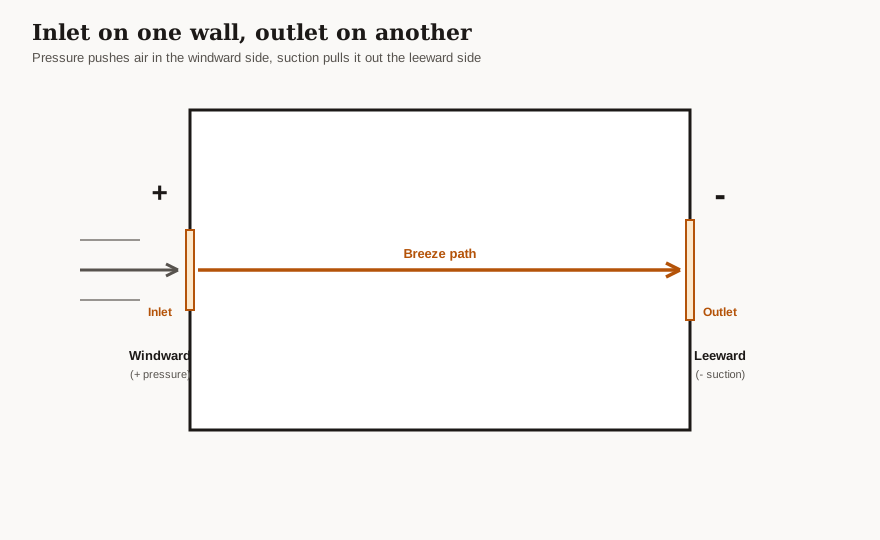
The strongest flow comes from inlet and outlet on opposite walls, directly across from each other. Walls at right angles (adjacent) still work but the path curves and weakens. Two windows on the same wall barely ventilate at all, because both sit in the same pressure zone, there is no difference to drive flow. If your only option is one external wall, you are no longer doing cross ventilation; you need stack ventilation or a fan (covered below).
| Inlet and outlet placement | Cross-flow result |
|---|---|
| Opposite walls, aligned | Strongest, straight path |
| Opposite walls, offset | Strong, the breeze sweeps the room |
| Adjacent (perpendicular) walls | Moderate, curved path |
| Same wall, two windows | Weak, almost no cross-flow |
| One wall only | None, pair with stack or fan |
Make the outlet bigger than the inlet
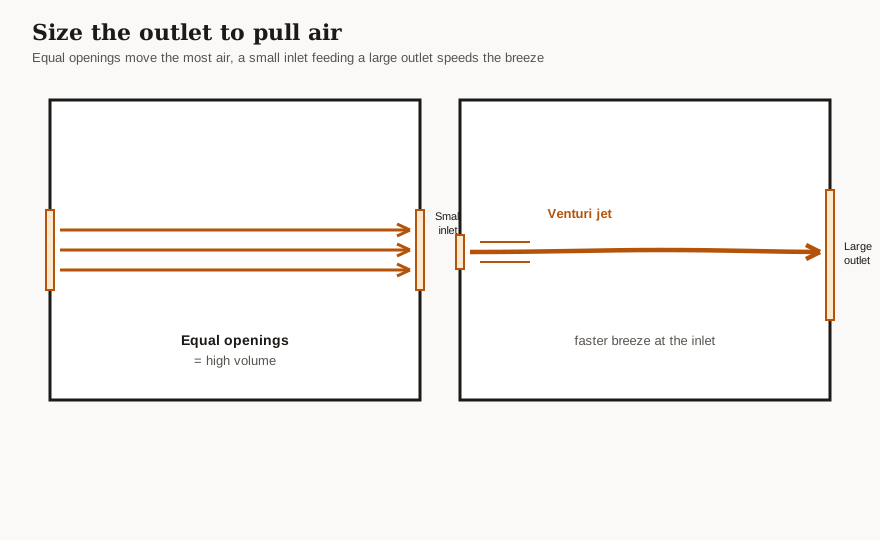
Most people instinctively make the inlet large to "let air in". The opposite is more effective. Sizing the outlet at least as large as the inlet, and ideally larger, increases the volume of air pulled through. The outlet sets the ceiling on how much air can leave, and air cannot enter faster than it can exit.
There is a second, useful trick. A small inlet feeding a large outlet speeds up the incoming breeze at the point of entry, the same venturi effect that makes a partly-covered hose nozzle spray faster. That fast jet of air at the inlet is exactly where you want to sit on a hot afternoon. India's traditional jali screens exploit this: they squeeze air through small perforations, accelerate and cool it slightly on the way in. So:
- For maximum air change (flushing the room): generous openings, outlet at least as big as inlet.
- For maximum felt breeze at a seat (cooling people): smaller inlet, larger outlet, sit in the inlet jet.
As a starting point, the NBC 2016 rule of thumb asks for openable window area of at least 10 per cent of the room's carpet area (some local bye-laws ask for window area around one-seventh to one-eighth of floor area for light and ventilation combined, always verify locally). Treat that as the minimum inlet; the outlet should match or exceed it. Numbers here are indicative, confirm against your municipal bye-laws.
Choose window types that actually move air
Two windows of the same size do not ventilate equally. What matters is how much of the opening clears, and whether the sash can catch and steer the breeze. A sliding window is the worst offender: one sash slides behind the other, so only about 50 per cent of the opening is ever open. A casement, by contrast, opens its whole clear area and the swung-out sash acts like a scoop, deflecting passing wind into the room.
| Window type | Effective open area | Catches and directs air? | Notes for ventilation |
|---|---|---|---|
| Casement (side-hinged, cranks out) | ~100 per cent | Yes, sash scoops the breeze | Best all-round ventilator; airtight when shut |
| Awning (top-hinged, opens out at bottom) | High | Yes, deflects air up | Stays open in light rain; good high or over fixed glass |
| Louvre / jalousie | High, adjustable | Yes, slats tilt to aim air | Rain-proof airflow; ideal humid/coastal homes |
| Sliding | ~50 per cent | No | Common in flats; size up to compensate |
| Hopper (bottom-hinged, opens in) | Moderate | Some | Good for baths/utility; debris falls inside |
| Fixed / picture | 0 per cent | No | Pairs only; needs an operable window beside it |
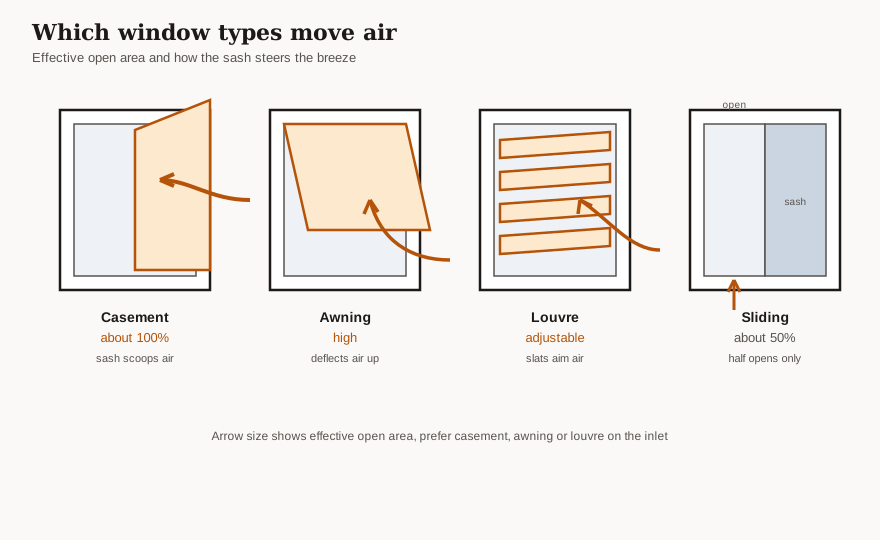
The practical move for cross ventilation: use casement, awning or louvre windows on at least the inlet, even if the rest of the house is sliding for space reasons. A casement inlet angled toward the prevailing wind direction can pull in noticeably more air than a sliding one. For window-type fundamentals beyond airflow, see Types of Home Windows in India.
Keep the path clear, and put the air at body level
A perfect inlet-outlet pair is wasted if a tall wardrobe, a partition or a closed door sits in the breeze's path. Air travels in a fairly straight line from inlet to outlet; furniture in that corridor blocks it, and the room beyond the obstruction stays still. When you plan the room, draw the airflow line first and keep it open, or leave a transom or a louvre over an internal door so air can carry into the next space.
Window height decides where the breeze lands. For ventilation you want air moving across the occupied zone, roughly the level of seated and standing people, not up at the ceiling where only the fan reaches. That argues for living-room and bedroom windows with low sills of around 600 to 750 mm, which let the incoming air sweep across the body. Kitchen sills sit higher (around 1050 to 1200 mm, above the counter) and bathroom sills higher still (around 1500 mm for privacy), so in those rooms expect a higher, less body-level breeze and lean on awning or louvre vents instead.
| Room | Indicative sill height | Effect on the breeze |
|---|---|---|
| Living / bedroom | 600 to 750 mm | Air sweeps across the occupied zone |
| Kitchen | 1050 to 1200 mm (above counter) | Higher flow; pair with exhaust |
| Bathroom | ~1500 mm (privacy) | High vent; use awning or louvre |
When you only have one wall: pair with stack ventilation
Cross ventilation needs two pressure zones, which means two different walls. In a flat where every habitable room faces one side, or a narrow plot where only the front and rear are free, you may not get that. The answer is stack (chimney) ventilation: hot air rises and escapes through a high opening, a clerestory window, a high vent or a ventilator, while cooler air is drawn in through a low window. The taller the gap between the low inlet and the high outlet, the stronger the draw, and it works even on a still, windless day.
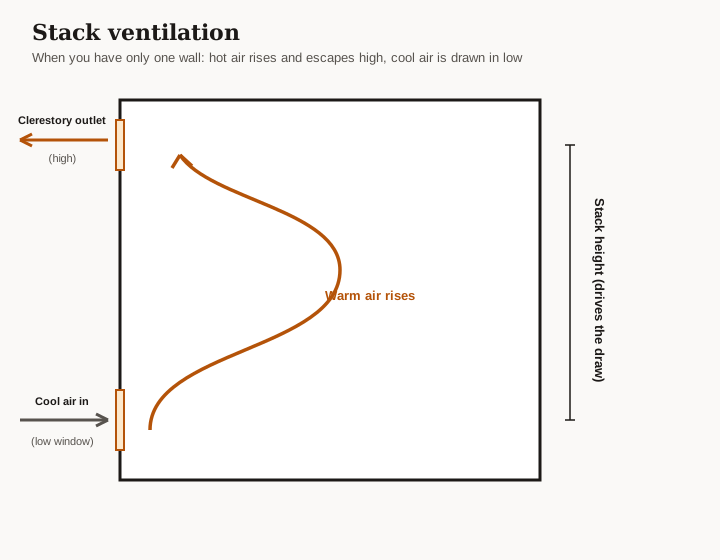
The two strategies combine beautifully. A low inlet on the windward wall plus a high clerestory outlet gives you cross ventilation on breezy days and stack ventilation when the air is still. This is the broader passive-cooling toolkit, the sibling guide Passive Cooling Through Windows in India covers night purge, shading and low-SHGC glass alongside this.
Do and avoid
- Do put inlet and outlet on opposite walls, aligned where possible.
- Do make the outlet at least as large as the inlet; shrink the inlet to speed the breeze where people sit.
- Do prefer casement, awning or louvre over sliding for the inlet.
- Do keep the inlet-to-outlet path clear of furniture and closed doors.
- Avoid two windows on the same wall as your only ventilation.
- Avoid relying on a sliding window's full width, it gives you only half.
- Avoid fixed glass without an operable partner, you cannot ventilate through it.
Where this fits in your window plan
Cross-ventilation window design is one decision among many, orientation, size, glazing and placement all interact. Start from the planning pillar, Window Placement Guide for Indian Homes, which sets the room-by-room logic this guide plugs into. Then run your layout through the Cross Ventilation Analyzer and read the Cross Ventilation in Indian Homes science guide for the air-change and NBC detail behind these rules. Get the openings right and the house breathes on its own, long before you reach for the air conditioner.
References
- BIS Guide for Using NBC 2016: https://www.bis.gov.in/wp-content/uploads/2022/08/Booklet-Guide-for-Using-NBC-2016.pdf
- IS 3362 Code of practice for natural ventilation of residential buildings: https://law.resource.org/pub/in/bis/S03/is.3362.1977.pdf
- Eco-Niwas Samhita 2018 (BEE/ECBC): https://ecbc.in/econiwas.html
- Standard window size by room (CiviConcepts): https://civiconcepts.com/blog/standard-window-size
Export this guide
Related Guides — Deep-dive reading
Cross Ventilation in Indian Homes
Science, Physics, and Planning — A Professional Guide for Architects
Room PlanningNatural Bathroom Ventilation India: Windows, Ventilators, Jaali, Cross-Ventilation & the Stack Effect
How to ventilate an Indian bathroom with air and daylight instead of only a fan — sizing the openable window to NBC, using top-hung ventilators, louvres and jaali, driving airflow with the stack effect and cross-ventilation, keeping privacy, and knowing exactly where the monsoon forces you to add a fan.
BathroomsAwning Windows Guide (India): Rain-Proof Ventilation for Kitchens and Baths
Top-hinged, outward-opening windows that shed rain and breathe high on the wall — the monsoon-smart choice for baths, kitchens and over picture windows.
Windows & GlazingRelated Tools — Try Free
Cross-Ventilation Analyzer
Estimate airflow and air changes per hour (ACH) from room size, window areas, layout, and local wind — with NBC 2016 Part 8 compliance check.
Ventilation CalculatorBrise-Soleil Visualizer
Interactive horizontal-louvre cut-off angle calculator — sun altitude, louvre depth, and spacing inputs with a live shadow preview. Computes θ = arctan(spacing/depth) for façade shading, ECBC envelope compliance, hospital daylight design, and tropical sun-control detailing.
Sun Shading ToolFull-Room BOQ — Living, Bedroom, Kitchen, Bath
Room-wise BOQ across living, bedrooms, kitchen, utility, and bathrooms with line-item pricing.
Full-Room BOQ