
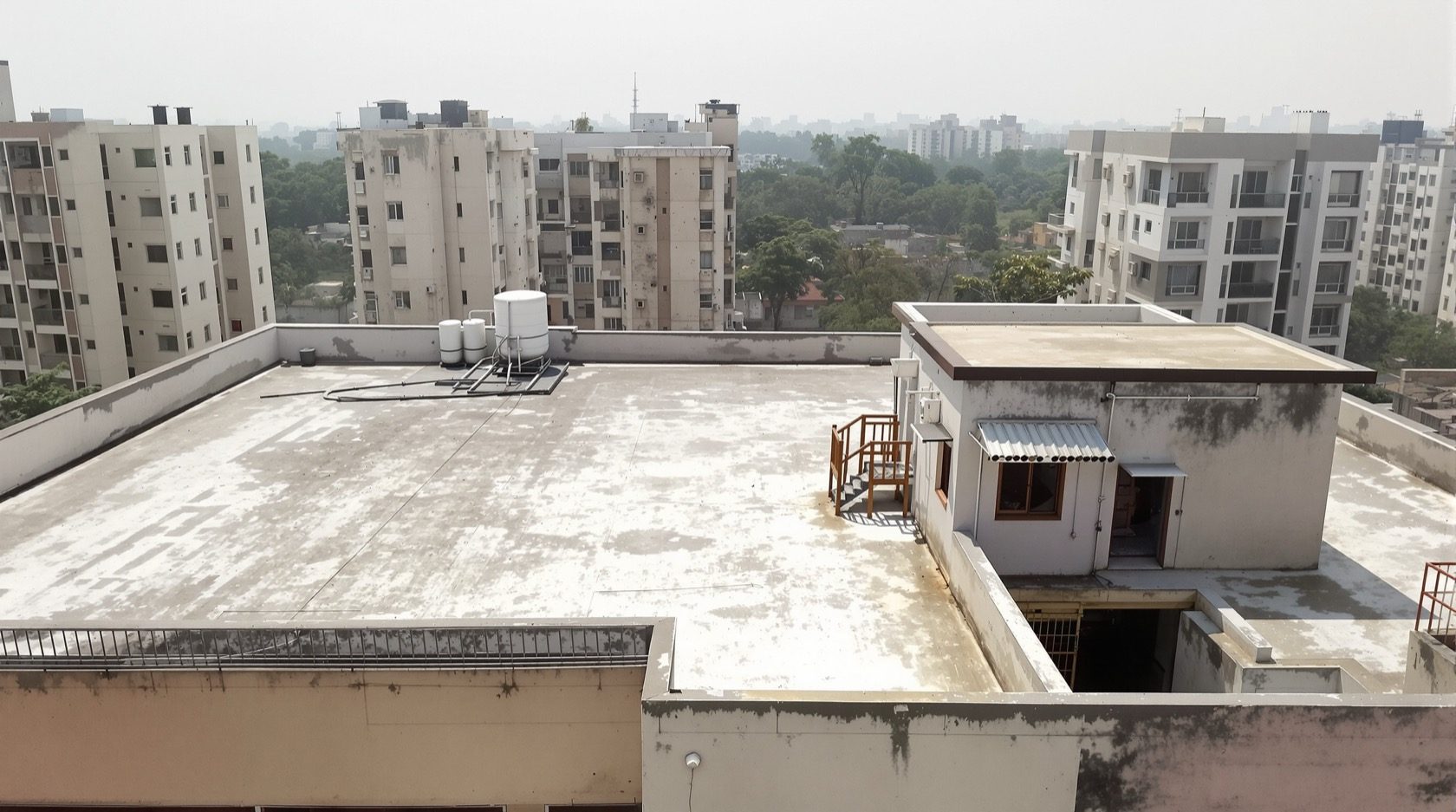
The Apartment Terrace Roof: Shared Ownership, Leaks & Who's Responsible (India)
In a flat, the terrace roof is usually common property owned and maintained by the whole society, not by the top-floor owner who sits under it. This guide explains who owns it, who fixes a leak, who pays, and how access, waterproofing and services on a shared roof actually work in India.
Ask who owns the terrace of a bungalow and the answer is simple: the person who owns the house. Ask the same question about a flat and the answer is where most apartment roof disputes begin. In an apartment building the terrace roof is, in almost every case, common property — owned and maintained not by the top-floor family sitting directly beneath it, but by all the owners together, through their housing society or apartment owners’ association. That single fact reshapes every roofing question a flat-owner might have. It is why the person who suffers a roof leak is often not the person responsible for fixing it, why re-waterproofing happens building-wide rather than flat-by-flat, and why the tank, the lift room, the solar panels and the mobile tower up there are collective decisions, not private ones.
This guide is part of the Roofing Knowledge Hub and a companion to The Ultimate Guide to Roofing Systems. It is not about how to build a roof — for that, read the flat roof design guide and the terrace roof design guide. It is about the thing that makes an apartment terrace roof genuinely different from every other roof in India: the terrace over your flat is almost never yours. It is shared. And so the real subject here is ownership, responsibility, cost-sharing and access — the questions a flat-owner actually loses sleep over.
Scope & safety. This guide helps you understand who owns and maintains an apartment terrace roof, how leak responsibility and cost-sharing typically work, and how to plan and budget for shared roof works. Society, ownership and legal points are typical — confirm them against your own registered society bye-laws, sale deed and the apartment or cooperative-society law that applies in your state. Diagnosing a leak, specifying and applying waterproofing, and any work at height belong to a licensed roofing contractor, and structural questions to a structural engineer. Never climb onto a shared terrace to inspect or patch a leak yourself — report it to the society and let professionals work at height.
Why the apartment roof is a different problem
A single-family roof is a private engineering object: one owner decides, one owner pays, one owner benefits. An apartment terrace roof is a shared asset with a governance problem attached. The concrete slab is the same RCC you would find on any flat roof; what changes is that dozens of families have a stake in it, one family lives immediately under it, and a committee — not an individual — controls its money, its access and its upkeep.
That produces a set of tensions unique to flats:
- The top-floor owner experiences every roof leak first and worst, yet usually cannot repair the roof unilaterally, because it is not theirs to open up.
- The ground and middle-floor owners rarely see the roof, may resent paying for its upkeep, yet are legally co-owners of it and share the bill.
- The society/association holds the roof in trust for everyone, must maintain it, but has to fund large periodic works from a common purse.
- The builder/promoter may still be responsible during the defect-liability window on a new building — or may have illegally “sold” the terrace to one buyer, seeding a dispute for years.
Get the ownership map right and everything else — leaks, waterproofing, cost, access — follows from it. Get it wrong and you get the classic Indian apartment stand-off: a top-floor family with a stained ceiling, a committee that says “it is your flat, you fix it,” and nobody opening the roof while the damp spreads.
Who owns it, who maintains it, who pays
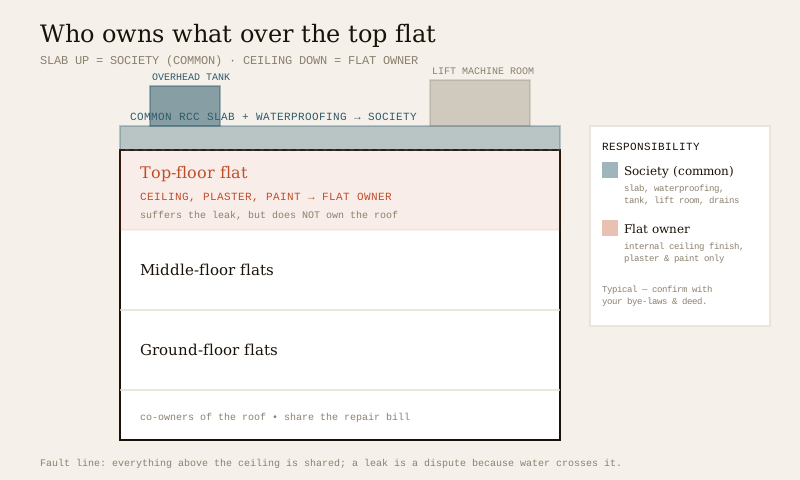
Start from the default position under most Indian apartment ownership frameworks — whether your building is a cooperative housing society, an apartment owners’ association under a state Apartment Ownership Act, or a company — and it is remarkably consistent: the terrace, roof slab and its waterproofing are common areas, held and maintained by the collective body, and their upkeep is a common expense shared by all members. A flat-owner owns the inside of their flat up to the ceiling surface; they do not own the structural roof above it.
There are two important exceptions to keep in mind, both of which you must verify from your own documents:
1. Exclusive-use / restricted-common terrace. Some deeds or society resolutions grant the top-floor flat (or a penthouse) the exclusive right to use a portion of the terrace — a private sit-out, say. This is a use right, not usually full ownership; the slab and its waterproofing normally remain common structure even when one family has exclusive use of the surface. Who then maintains the waterproofing under an exclusive-use terrace is exactly the kind of thing your bye-laws must spell out.
2. Terrace “sold” by the builder. Builders have historically sold terrace rights to a single buyer. Courts and consumer forums have repeatedly frowned on a promoter appropriating common terrace area, and many state laws now treat the terrace as a common area that cannot be sold away. If your building has such a claim, treat it as contested and get legal advice.
The table below is the mental model most societies work from. Treat it as typical, and confirm each row against your registered bye-laws and sale deed.
| Element | Typically owned by | Typically maintained by | Who pays |
|---|---|---|---|
| RCC roof slab (structure) | All owners in common (society) | Society | All members (common fund) |
| Roof waterproofing / brickbat coba | Common | Society | All members (common fund) |
| Terrace floor / surface | Common (or exclusive-use if granted) | Society (structure); user (surface cleanliness) | Common fund; disputes case-by-case |
| Parapet walls & railings | Common | Society | All members |
| Rainwater outlets, drains, downpipes on/from roof | Common | Society | All members |
| Overhead water tank & its platform | Common | Society | All members |
| Lift machine room / stair headroom on roof | Common | Society | All members |
| Top-floor flat internal ceiling, plaster, paint | The flat owner | The flat owner | The flat owner |
| Common solar plant on terrace | Society (if society-owned) | Society / O&M contractor | All members / benefiting members |
| Mobile / telecom tower on terrace | Structure common; equipment = operator | Operator (equipment); society (structure) | Operator pays society rent |
Notice the fault line running through the middle: everything from the slab up is generally the society’s; everything from the ceiling down into your flat is generally yours. A leak is a dispute precisely because it crosses that line — water enters through the common roof and damages the private ceiling.
The top-floor leak problem — the heart of it
This is the single most common apartment-roof conflict in India, and it deserves its own treatment. Picture it: the monsoon arrives, and the top-floor flat develops damp patches, efflorescence and mould on the ceiling, or active dripping. The owner is furious — it is their ceiling, their ruined paint, their child’s bedroom. But the water is almost certainly entering through the common roof waterproofing, which they do not own and cannot lawfully open up on their own.
So who is responsible? It depends chiefly on the age of the building and the terms of your documents. Work through the logic below rather than assuming.
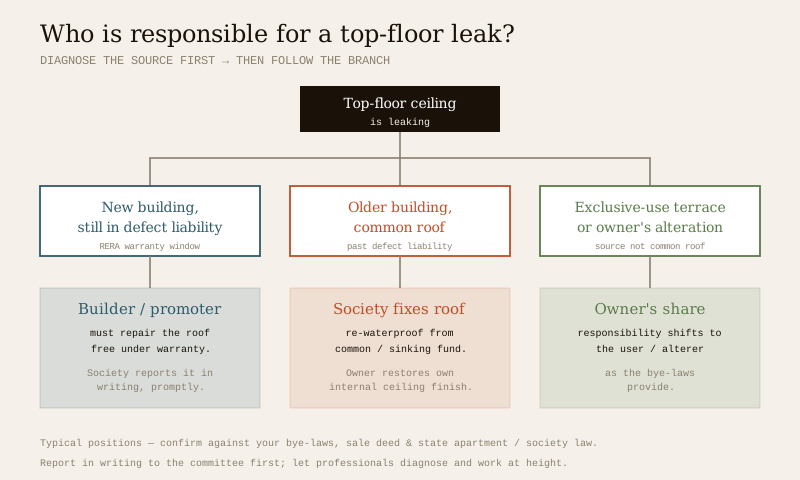
Case 1 — a new building, still within the defect-liability period. Under the Real Estate (Regulation and Development) Act (RERA), a promoter is liable to rectify structural and workmanship defects — including roof leakage and failed waterproofing — reported within a statutory defect-liability window that runs for a period of years from handover (the exact number is set by the Act and applicable rules; verify the current period). During this window, a top-floor leak is generally the builder’s problem to fix free of charge, and the society should raise it formally in writing with the promoter. Do not let a builder quietly run out the clock; report defects promptly and on record.
Case 2 — an older building, past defect liability, common roof. Here the settled position in most societies is: because the roof and its waterproofing are common property, the society repairs the roof — re-waterproofing, treating cracks, clearing drains — from the common fund or sinking fund. The top-floor owner repairs their own internal finish (re-plastering and repainting the ceiling) once the roof above is made watertight. In practice a fair sequence is: society fixes the source, then the owner restores the cosmetic damage inside. Some societies, by resolution, also assist with internal damage caused by a proven roof-side failure — this varies and should be governed by bye-laws, not by whoever shouts loudest.
Case 3 — the leak is not really the common roof. If the water is traced to the owner’s own alteration (an unauthorised terrace extension, a private planter box, a bathroom above), or to a portion under the owner’s exclusive use, responsibility shifts toward that owner as the bye-laws provide. This is why diagnosis by a competent contractor — establishing where the water actually enters — matters before anyone argues about the bill. See the roof defects guide.
The healthy way to handle a top-floor leak is procedural, not adversarial: report in writing to the managing committee, ask for a professional inspection, fix the common source from the common fund (or push the builder if in warranty), and restore the private finish afterwards. A society that maintains its roof proactively rarely reaches the shouting stage at all.
Waterproofing a large shared slab — why it is done together
On a bungalow you waterproof one small roof. On an apartment building you are waterproofing a single large continuous RCC slab — often the whole building footprint — that sits over many flats at once. That scale changes the strategy in a way every committee should understand.
A shared roof membrane is only as good as its weakest patch. Water finding one failed joint can travel under the screed and emerge in a flat several bays away, which is why spot repairs on a large aged roof so often disappoint — you seal one damp patch and the water simply re-routes to the next weak point. This is the core reason societies eventually stop patching and commission a building-wide re-waterproofing: strip or overlay the whole terrace, treat every junction, parapet upstand, drain mouth and construction joint in one coordinated campaign, so the roof behaves as a single continuous barrier again.
- Do it as one job, not ten. A comprehensive re-do — often a fresh brickbat-coba or a modern membrane / liquid-applied system over the entire terrace — is more economical per square metre and far more reliable than years of piecemeal patches. See the roof waterproofing guide and the flat-roof waterproofing guide for systems.
- Time it to the monsoon. Terrace re-waterproofing is planned for the dry pre-monsoon months so it cures before the rains test it. A yearly pre-monsoon inspection, part of routine roof maintenance, tells the committee when a full re-do is due rather than another patch.
- Get it specified and warrantied. Because it is a big collective spend, the society should get a proper specification, competitive quotes, and a written workmanship warranty from the contractor. Read the roofing contractor guide before appointing anyone.
- Protect it afterwards. Once redone, the terrace surface should be kept clear — no heavy planters dumped on the membrane, no random drilling for a new dish antenna — or the collective investment is undone by individual acts.
Because everyone pays for it and everyone benefits from it, re-waterproofing is decided in a general body / committee meeting, funded from the common or sinking fund, and executed for the whole roof at once. It is the clearest example of why the apartment roof is a shared problem with a shared solution.
Drainage of a big roof with many outlets
A large terrace catches a large volume of rain, and getting rid of it is a scale problem. Where a house roof might have two outlets, an apartment terrace has many rainwater outlets feeding several downpipes routed through shafts down the building. Every one of those is common property, and a single blocked grating — leaves, a plastic bag, birds’ nests, planter debris — can pond water over a whole bay and force it through the waterproofing.
For the committee this means drainage is a maintenance routine, not a one-time design: clear every outlet before and during the monsoon, check that downpipes are not choked or broken inside shafts, and make sure water is not discharging against a wall or into a neighbour’s flat. The roof drainage guide and the gutters and downpipes guide cover the how; on a shared roof, the who is the society. Many societies also feed roof runoff into rooftop rainwater harvesting, which on a big terrace can recharge a serious volume — and is a local mandate in several cities, so confirm with your local authority.
The crowded terrace — tanks, lifts, solar and towers
An apartment terrace is rarely an empty slab. It is the building’s services floor, carrying the equipment the whole block depends on. Each item is a shared asset with its own maintenance owner, and each one interacts with the roof waterproofing it sits on.
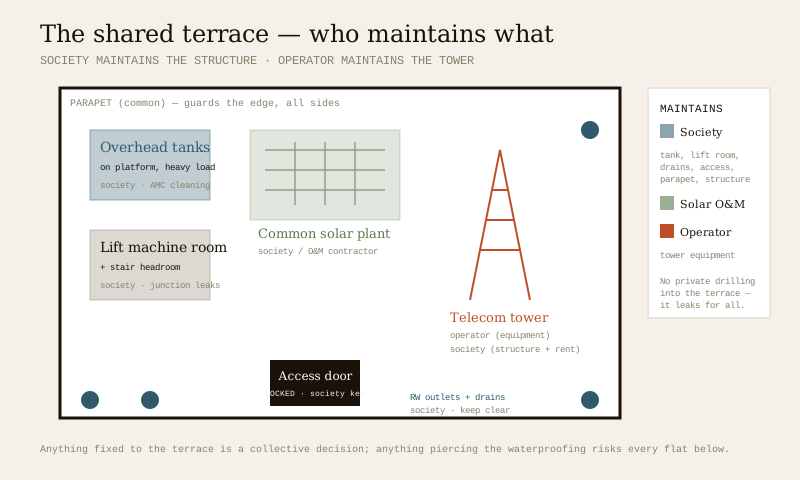
- Overhead water tanks. The building’s tanks sit on the terrace on raised platforms — a heavy, permanent load the structural engineer placed over strong points. They are common property, cleaned and maintained by the society (periodic tank cleaning is a standard AMC item). A leaking or overflowing tank is a frequent hidden source of “roof” damp, so it belongs on the inspection list.
- Lift machine room & stair headroom. The lift’s machine room (or the overrun for machine-room-less lifts) and the staircase headroom project above the terrace. Their small roofs and the junctions where they meet the main terrace are classic leak points, and they are society-maintained.
- Common solar. Many societies now install a rooftop solar plant to cut common-area electricity bills. Mounting frames must not puncture the waterproofing carelessly — ballasted or properly flashed fixings are the norm — and the plant is owned/maintained by the society or an O&M contractor. Approvals, net-metering and DISCOM rules are local; see the solar roof guide and confirm with your local authority and utility.
- Mobile / telecom towers. A society may lease terrace space to a telecom operator for a tower, earning rent for the common fund. The equipment is the operator’s to maintain; the structure and waterproofing it stands on remain the society’s. Any such installation should have proper structural clearance and a written agreement, and residents often have views on it — it is a general-body decision.
The common thread: anything fixed to the terrace is a collective decision, and anything that penetrates the waterproofing is a risk to everyone below. No individual owner should be drilling the terrace for a private antenna or dish; that is exactly how a shared roof springs a shared leak.
Access and safety — who is allowed up, and how it is kept safe
Because the terrace is common and carries critical services and real fall risks, most societies lock roof access and control who goes up. This is normal and sensible, not an infringement — an open terrace is a safety and liability hazard (children, falls, misuse) and a security one. Typical arrangements a bye-law will define:
- Locked access with a key held by the society (secretary/watchman), opened for maintenance, tank cleaning, and controlled resident use.
- Common recreational use by all members at defined times (evenings, festivals, drying), versus exclusive-use grants to a particular flat where the deed allows — the two must not be confused.
- Safety infrastructure — a code-height parapet, a safe access stair and door, lighting, and guarding around tanks, shafts and skylights. On a shared roof used by many, guard-rail and parapet adequacy is a genuine liability matter for the committee. See the roof safety guide.
Whatever the rule, it should be written into the bye-laws and applied evenly — ad-hoc access decisions are themselves a source of dispute. If your terrace is used recreationally, its parapets, edges and services must be made safe for that use, and that is the society’s duty of care.
Common disputes — and how they are typically resolved
Most apartment-roof fights are variations on a handful of themes. Knowing the usual resolution path defuses them faster than argument.
| Dispute | Typical position | Usual resolution |
|---|---|---|
| Top-floor leak — who fixes the roof? | Roof is common; society fixes the source | Society re-waterproofs from common/sinking fund; owner restores internal finish; builder if in warranty |
| Should ground-floor owners pay for roof work? | Roof is common property of all | Yes — shared as a common expense per bye-laws, regardless of floor |
| Owner wants exclusive terrace / penthouse | Terrace is common; use may be granted | Only a formal exclusive-use grant in deed/resolution; slab stays common |
| Builder “sold” the terrace | Often contested; many laws bar it | Legal advice; consumer forum / RERA; treat terrace as common |
| Private installation drilled into roof | Penetrating common waterproofing | Not permitted without society sanction; offender restores/waterproofs |
| Damage inside flat from roof leak | Structure common; finish private | Society fixes structure; internal damage per bye-law (some societies assist) |
The meta-lesson: decisions run through the managing committee and general body, funded from common money, governed by the registered bye-laws and the state apartment/cooperative-society law. When a dispute genuinely cannot be settled internally, the escalation is the Registrar of Cooperative Societies, the state RERA (for new buildings), or a consumer forum — not a private contractor hired by one aggrieved owner to open a common roof.
Cost and how a society budgets roof works
Roof works on an apartment are a large, lumpy, shared expense, and a well-run society plans for them rather than being ambushed. The two big-ticket items are periodic re-waterproofing of the whole terrace and, less often, structural repair of an aged slab. These are indicative 2026 ranges only — get local quotes, because rates vary by city, system, roof area and access.
| Work | What it involves | Indicative 2026 basis | How the society funds it |
|---|---|---|---|
| Routine drain clearing & minor patch | Pre-monsoon clean, seal small cracks | A modest annual line item | Regular maintenance charges |
| Full terrace re-waterproofing | Strip/overlay whole roof, treat all junctions, new membrane/coba | Priced per square metre of terrace — a substantial collective sum for a whole roof | Sinking fund + special contribution |
| Tank cleaning & service | Periodic AMC | Recurring service cost | Maintenance charges |
| Structural roof repair | Crack injection, member strengthening (engineer-led) | Case-specific, can be large | Sinking fund + special levy |
| Common solar plant | Panels, frames, inverter, net-metering | Capital cost, offset by bill savings | Reserve fund / financed / vendor model |
The mechanism most societies use to avoid a sudden painful levy is the sinking fund — a reserve built up through a small regular contribution from every member, precisely so that big periodic works like re-waterproofing and structural repair can be paid for when they fall due without a shock special-assessment. Cost is shared among all owners as a common expense, usually in proportion to flat area or as the bye-laws prescribe — not loaded onto the top-floor owner alone just because they sit under the roof. For general roofing economics and what drives the price of a full re-do, see the roof construction cost guide.
Who decides & who maintains — the short version
- The managing committee runs day-to-day upkeep: drain clearing, tank cleaning, minor repairs, arranging inspections.
- The general body approves big spends: full re-waterproofing, structural repair, a solar plant, a tower lease.
- The sinking/reserve fund pays for major periodic works; maintenance charges cover routine upkeep.
- The top-floor owner maintains only their internal ceiling finish — and is entitled to have the common roof kept watertight by the society.
- The builder/promoter carries defect-liability responsibility during the RERA warranty window on a new building.
All of this is typical. Your building’s registered bye-laws, the sale deed, and the apartment-ownership or cooperative-society law of your state are the real authority — confirm the specifics there.
An owner-safe checklist (ground and flat level only)
You can do all of this without going near the roof edge or working at height. Leave the terrace itself to the society’s contractor.
- Read your sale deed and society bye-laws to see how the terrace, its use, and roof-repair responsibility are defined.
- Ask the committee whether the building is still within its defect-liability period and whether roof defects have been logged with the builder in writing.
- Ask whether a sinking fund exists and roughly when the terrace was last fully re-waterproofed.
- Watch your own ceiling (if top floor) for early damp, staining, efflorescence or mould — common signs of a roof-side leak, covered in the roof defects guide — and report it to the society in writing at first sign — do not wait or patch it privately.
- After heavy rain, note (from your own balcony/window, safely) whether water is discharging cleanly from downpipes rather than overflowing — and flag choked drains to the committee.
- Push for an annual pre-monsoon roof inspection by a professional as a standing society practice.
- Never accept a private installation drilled into the common terrace — yours or a neighbour’s — without society sanction and proper waterproofing.
Where to go next
- The whole subject in one map: The Ultimate Guide to Roofing Systems · the Roofing Knowledge Hub.
- The roof itself: Terrace Roof Design Guide · Flat Roof Design Guide · RCC Roof Guide.
- Keep it dry: Roof Waterproofing Guide · Flat-Roof Waterproofing Guide · Roof Defects Guide.
- Drain and service it: Roof Drainage Guide · Roof Gutters & Downpipes · Roof Maintenance Guide.
- On top of it: Solar Roof Guide · Rooftop Rainwater Harvesting.
- Access & safety: Roof Access Guide · Terrace Safety & Parapets · Roof Safety Guide.
- Rules & defects: Roof Building Bye-laws · Roof Defects Guide · Roof Construction Cost.
- Plan & check: the Roof System Selector · the Roofing Compliance Checklist · the AI Roofing Assistant.
- Sibling building types: Row-House Roof · Farmhouse Roof · Commercial Building Roof · Institutional Building Roof.
References
- Your building’s registered society bye-laws, the sale deed / conveyance, and the apartment ownership or cooperative-society law of your state — the actual authority on ownership, common areas, maintenance and cost-sharing; these vary by state and by building, so confirm the specifics for yours.
- Real Estate (Regulation and Development) Act, 2016 (RERA) and the applicable state RERA rules — for a promoter’s structural-defect and waterproofing liability during the defect-liability period on new buildings; verify the current period and procedure with your state RERA authority.
- National Building Code of India (SP 7), Bureau of Indian Standards — for parapet and protective-barrier heights, roof access and life-safety on accessible terraces; refer by topic and verify the current edition via the BIS catalogue (the 2016 NBC has been superseded — check for SP 7:2026). https://www.services.bis.gov.in/
- IS 456 (RCC), IS 875 (Part 2, imposed loads) and IS 15797 (rooftop rainwater harvesting), Bureau of Indian Standards — cited plainly; verify current editions via the BIS catalogue.
This is an educational overview, not legal or engineering advice. Ownership, maintenance and cost-sharing rules differ by state and by society — confirm them against your registered bye-laws, sale deed and applicable law. Leak diagnosis, waterproofing application, structural repair and any work at height are qualified professional work — engage a licensed roofing contractor and, where structure is involved, a structural engineer, and verify any standard’s current status via the BIS catalogue before relying on it.
Export this guide
Related Guides — Deep-dive reading
Roof Leak Diagnosis & Repair
The homeowner's most common roofing crisis, calmly explained — how to read the signs (stains, damp, efflorescence, peeling paint, drips, a musty smell), why the leak is almost never right above the stain, where roofs actually leak, how leaks are traced, and the honest line between what you can safely check yourself and what needs a professional. India-grounded, monsoon-tested.
RoofingBathroom Waterproofing Failure in India: Causes, Diagnosis & Fixes (2026)
Why bathroom waterproofing fails in Indian homes — poor surface prep, thin coats, missed junctions, no membrane turn-up, damage during tiling — how to read the symptoms, and whether a surface fix or a full redo is the right remedy.
BathroomsWaterproofing Failures Explained: Why Systems Fail and How to Spot It
Why waterproofing so often leaks again within a year or two — the weak links in the system, the junctions that really fail, the flood test everyone skips, and how to tell a real repair from a cosmetic patch.
Structural SafetyRelated Tools — Try Free
Rainwater Tank Sizer
How big should your rainwater tank be? Computes annual harvest, recommended tank capacity in litres, water-bill savings, and payback — for 10 Indian cities.
RWH CalculatorMonsoon-Readiness Checklist
Pre-rain home audit across 9 categories — terrace, drains, waterproofing, electrical, HVAC, pest, vehicles, documents.
Seasonal AuditSociety Handover & NOC Checklist
Builder-to-RWA handover audit — 9 categories, 65+ checkpoints across legal docs, drawings, utilities, STP/WTP, fire safety, finances, warranties.
RWA Handover