
Hiring a Roofing Contractor
Where most roof problems actually start is the hire — a good roof is only as good as the hands that lay it. How to find, vet, quote, contract, manage and sign off a roofing or waterproofing contractor in India, so you buy a lasting roof and not a warranty you can never claim. Plain language, India-grounded.
Almost every roof problem you will ever meet traces back, one step further than people think, to a hire. The material was fine; the design was fine; the roof leaks because the wrong hands laid it, or the right hands were rushed, underpaid or unsupervised. Waterproofing especially is a craft where the very same drum of membrane can last fifteen years or fail in one monsoon depending entirely on who applied it and how carefully. So the most important roofing decision most homeowners make is not the brand or the system — it is the contractor.
This is the hiring guide of the Roofing Knowledge Hub, and the human companion to the Ultimate Guide to Roofing Systems, which explains the assemblies a contractor is quoting on. This guide will not make you a project manager or a waterproofing applicator — but it will let you find, vet, quote, contract, manage and sign off a roofing contractor with your eyes open, and know exactly which decisions are yours and which to hand to a specialist.
Scope & safety. This guide helps you understand, plan, judge and manage the hiring of a roofing contractor. Structural design, load calculation, waterproofing application and any working-at-height are qualified professional work for a structural engineer and a licensed roofing contractor — never do them yourself and never let an unqualified crew do them. Vetting, comparing quotes and reading a contract are homeowner work; the work on the roof is not. Nothing here is legal advice or a substitute for a signed, site-specific contract.
The hire, start to finish
Hiring a roofing contractor is not one decision but a short journey, and homeowners get burned when they skip straight from "find someone" to "pay the advance." Walk it in order and each step protects the next.
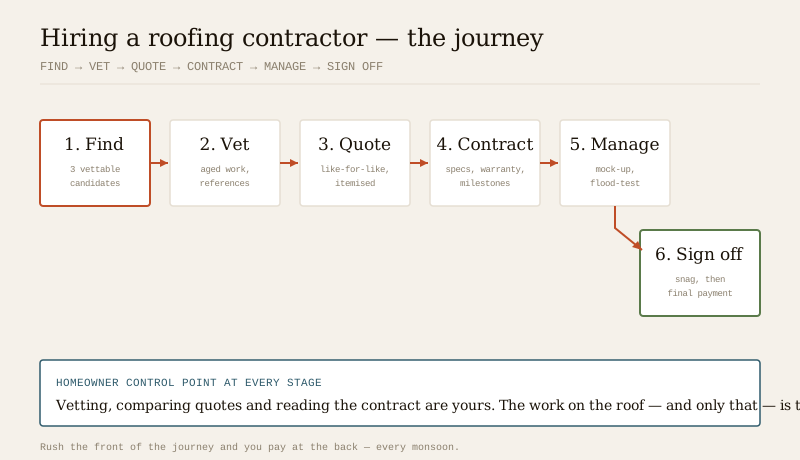
1. Find — build a shortlist of three or so candidates from sources you can actually check.
2. Vet — verify past work, references, specialisation and cover before anyone quotes.
3. Quote — get comparable, itemised written quotations on an identical scope.
4. Contract — put scope, specs, warranty, milestones and retention in a signed document.
5. Manage — supervise the stages, insist on the mock-up and the water test.
6. Sign off — snag, correct, then release the final payment and collect the paperwork.
Rush the front of this journey and you pay at the back — every monsoon.
Where to find a good contractor — and what one looks like
The best roofing contractors are rarely the ones who cold-call you after a rain or paste stickers on your gate. Good sources are ones you can verify:
- Personal referrals — a neighbour, relative or colleague whose terrace has stayed dry through three or more monsoons. Ask to see the actual roof, not a photo.
- Waterproofing brand applicator networks — major waterproofing manufacturers (the ones whose membranes and coatings you would specify) list or certify approved applicators. A brand-certified applicator has been trained on that system and often unlocks a longer, brand-backed warranty.
- Your architect, structural engineer or a trusted builder — professionals who have watched contractors perform over years and stake their own name on the referral.
- Established local firms with a real address — a workshop, a registered business, GST registration, a landline, a history you can trace — not just a phone number.
What a good one actually looks like, across all these sources:
- Diagnoses before quoting. They inspect, find why the roof is failing, and explain what they will do about it — rather than reciting a rate before they understand the problem.
- Specialises. Roofing and waterproofing are their trade, not a sideline to general "civil work." For a waterproofing job you want a waterproofing specialist, ideally a certified applicator of the system you choose.
- Talks in systems and layers, not slogans. They name the membrane, the number of coats, the primer, the fall correction and the flood-test — the language of the waterproofing guide — not just "leak-proof, guaranteed."
- Puts things in writing without being chased. Scope, specs, warranty and payments on paper are their normal, not a favour.
- Carries the paperwork. Registration, GST, and — for at-height work — insurance and a clear line on labour safety.
Vetting — verify before you trust
A quote is a promise; vetting is checking whether the promiser can keep it. Do this before you compare prices, because the cheapest quote from an unvettable contractor is not cheap.
| What to check | How to check it | Why it matters |
|---|---|---|
| Past work that has aged | Visit terraces they did 3+ monsoons ago, not fresh jobs | Waterproofing only proves itself after rain, not on handover day |
| References you actually call | Speak to 2–3 past clients; ask about leaks, delays, claims | A confident contractor gives references freely; a reluctant one is a signal |
| Specialisation | Ask what share of their work is roofing/waterproofing | You want a specialist, not a generalist who dabbles |
| Applicator certification | Ask for the manufacturer’s approved-applicator proof for the system | Unlocks brand-backed warranty and trained application |
| Business legitimacy | GST registration, a real address, years in business | A firm that will still exist to honour a warranty |
| Insurance & labour cover | Ask about workmen’s cover for at-height work | Protects you from liability if a worker is hurt on your roof |
| A written, itemised quote | See the section below | The single best predictor of a professional job |
A practical rule: never let a contractor onto the roof whose past work you have not seen and whose references you have not called. Vetting costs you an afternoon; skipping it can cost you a re-do.
Getting comparable quotations — like-for-like or not at all
The commonest, most expensive mistake in hiring is comparing quotes that are not comparable. Contractor A quotes ₹X and B quotes 30% more — but A has quietly dropped the surface preparation, halved the coats and skipped the flood-test, so you are comparing a real roof against a coat of paint. The fix is to make everyone quote the same scope.
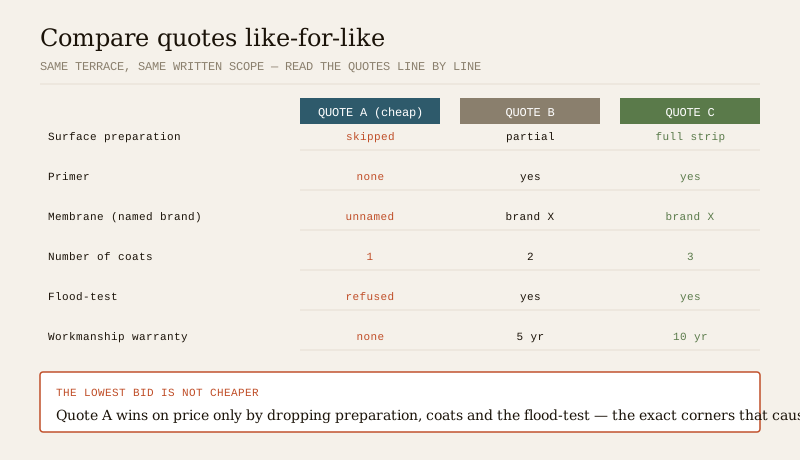
- Write the scope yourself, first. Before you invite quotes, write a one-page brief: the area (in m²), the system or class of system, surface preparation expected, fall correction, detailing at drains and parapets, the flood-test, the finish, and the warranty you want. Give the same brief to every contractor.
- Insist on line items, not a lump sum. A quote should break out surface preparation, primer, membrane (named brand and grade), number of coats or layers, detailing, flood-test, protective finish, and the warranty — each with a rate and a quantity. One big number hides everything.
- Check what is included and excluded. Scaffolding and access, debris removal, drain and parapet treatment, GST, and making good — are they in or extra? Exclusions are where a cheap quote makes its money back.
- Compare unit rates on the same unit. Per m² (or per sq ft) for the same specification, on the same measured area. If the areas differ, someone measured wrong.
- Beware the lowest-bid trap. A quote far below the pack is not a bargain; it almost always means dropped preparation, fewer coats, an unnamed or inferior membrane, or no flood-test — the exact corners that cause failure. Discard the outlier low as readily as the outlier high.
Because prices for the same job swing enormously by city, brand, terrace condition, access and scale, treat any single per-m² figure with suspicion. Get 2–3 local quotes on your written scope, and use the Roof Cost Calculator to sanity-check the range for your area rather than to fix a number.
What roofing and waterproofing work costs — indicatively
The figures below are indicative 2026 ranges only. They vary widely by city, brand and grade of system, the condition and access of the roof, the scale of the job and the state of the market — and they change over time. They are here to help you smell an outlier, not to price your roof. Always get 2–3 local quotes on a written scope, and lean on the Roof Cost Calculator.
| Job (indicative, varies by city/brand/scale) | Indicative 2026 range |
|---|---|
| Basic acrylic/cementitious waterproofing coating, terrace | ₹60–120 per sq ft |
| Torch-applied APP/SBS bitumen membrane, terrace | ₹110–220 per sq ft |
| Premium polyurethane (PU) / high-performance system | ₹150–300+ per sq ft |
| Brick-bat coba re-do (strip, fall, waterproof, finish) | ₹120–250 per sq ft |
| Spot leak repair at a joint / drain / crack | Lump sum — get itemised quotes |
| Sloping-roof re-cover (labour, excl. tiles/sheets) | Varies widely — quote per job |
Ranges are indicative and change; they vary by location, brand, grade, terrace condition, access and scale. Never treat a single figure as fixed — get 2–3 local quotes and confirm inclusions.
The most useful cost habit is to buy lifespan, not headline price: a system that lasts fifteen years at a higher upfront rate almost always beats a cheap coating redone every three. Cheapness that drops the preparation, the coats or the test is the most expensive roof of all.
Reading the quote and the contract
Once you have chosen, the quote must become a contract — a signed document, not a WhatsApp promise. What it must spell out:
- Scope of work. Exactly what is being done, on what area, in what sequence — surface preparation, fall correction, priming, membrane in N coats, detailing, flood-test, finish. Vague scope is the root of most disputes.
- Materials, brands and specifications. The named brand, product and grade of every material, with quantities. "Waterproofing membrane" is not a spec; "brand X polyurethane, two coats at Y microns dry film" is.
- Two warranties, kept separate. The material warranty comes from the manufacturer and covers the product; the workmanship warranty comes from the contractor and covers the application. The workmanship warranty is the one that matters most for leaks, because most failures are application failures. Get it in writing, dated, naming what it covers, for a meaningful period (commonly 5–10 years on a good system) from a contractor who will still exist to honour it.
- Payment milestones tied to stages. Payment should follow completed, verified stages — not the calendar and not a big advance. A sane structure ties money to work done and a chunk to the water test passing.
- Retention. Hold back a retention (commonly around 5–10%) until the first monsoon, or an agreed defect-liability period, proves the job. It is the cheapest quality control there is.
- Timeline, making good, and dispute terms. Start and finish dates, who clears debris and repairs collateral damage, and what happens if it leaks in the warranty period.
A fair payment schedule looks roughly like this — adjust to the job, but resist any front-loading:
| Milestone | Indicative share |
|---|---|
| On signing / mobilisation (materials to site) | 10–20% |
| After surface preparation & fall correction (verified) | ~20% |
| After membrane application & detailing (verified) | ~30% |
| After a passed flood-test | ~20% |
| After finish, snagging & handover | ~10% |
| Retention, released after first monsoon / defect period | 5–10% |
If a contractor demands most of the money up front, that alone is reason to walk.
Questions to ask, and the red flags to walk away from
Before you sign, ask — and listen as much to how they answer as to what they say:
- "Why is my roof failing, and what will you do about the cause, not just the symptom?"
- "What exact system and brand will you use, and how many coats at what thickness?"
- "Will you do a flood-test before the finish, and can it be a condition of payment?"
- "Are you a certified applicator of this system? Can I see the proof?"
- "Can I visit two terraces you did three or more monsoons ago, and call those owners?"
- "What warranty do you give on workmanship, separately from the material warranty, and in writing?"
- "Will you build a small sample or mock-up for me to approve before doing the whole roof?"
The red flags — any one of these should make you pause; two should make you walk:
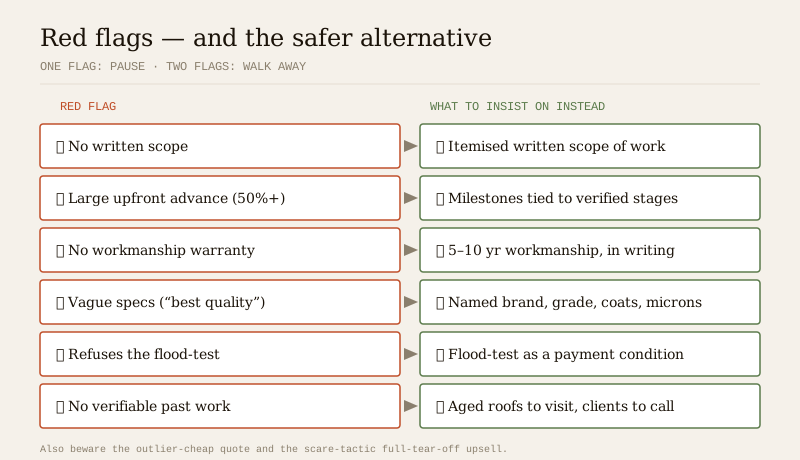
- No written scope. Everything by word of mouth. Disputes are guaranteed.
- A large upfront advance. Demanding 50% or more before work starts, or before materials arrive.
- No workmanship warranty. Only a manufacturer’s material warranty, or none — the application, where leaks come from, is uncovered.
- Vague specifications. "Best quality waterproofing," no named brand, grade or number of coats.
- Refuses the flood-test. Resisting a water test before finishing is telling you the job will not pass one.
- No verifiable past work or references. No aged roofs to visit, no clients to call, no traceable business.
- The outlier-cheap quote. Far below the others — the corners are already cut, you just cannot see them yet.
- The scare-tactic upsell. Pushing a full tear-off when a targeted re-waterproofing would do — the opposite trap, and just as costly.
The mock-up — the cheapest insurance there is
One quietly powerful protection almost no homeowner asks for: a mock-up, or sample approval. Before the contractor waterproofs the whole terrace, have them do a small representative patch — a few square metres including a drain and a parapet turn-up — exactly as they will do the whole roof, with the same system and coats.
You get to see the workmanship, the finish and the detailing on a small scale, agree what "good" looks like in writing, and make it the reference standard for the rest of the job. On finishes — tiles, china-mosaic, a cool-roof coating — a sample approval also settles colour and texture before there is no going back. It costs a little time and a little material, and it turns "I thought it would look/perform like…" from an argument into a signed benchmark. Insist on it.
Managing the job and signing off
A roofing job needs the homeowner present at the hinge points, not hovering every hour. The moments that matter:
- Materials in. Check the delivered brands and grades against the contract before they are opened — substitution of a cheaper product for the specified one is a classic quiet swap.
- After surface preparation. Before anything is covered, confirm the failed layers are stripped to sound concrete, cracks repaired, and — critically — the fall corrected so water runs to the drains and never ponds. The rule from the renovation guide holds: never cover a layer until the one beneath it is proven.
- The mock-up approval. Sign off the sample before the full application.
- The flood-test. Watch the terrace ponded for 24–72 hours and the ceilings below checked for ingress before the protective finish goes on. Tie a payment milestone to it passing.
- Snagging and handover. Walk the finished roof, list every defect — missed detail, poor turn-up at a parapet, a blocked drain, a rough finish — and get them corrected before releasing the final payment.
- Collect the paperwork. The written workmanship warranty, the material warranty and product details, and a short maintenance note. Then hold the retention until the first monsoon proves the job.
Sign-off is not a handshake; it is a snagged, tested, documented close-out. The pre-monsoon inspection guide then tells you how to keep the roof you have paid for in good order.
The one-line answer
A roof is only as good as the hands that lay it, so the most important roofing decision is the contractor — and hiring one is a short journey, not a snap call: find three vettable candidates (referrals, brand-certified applicators, professional recommendations), vet them on aged past work, called references, specialisation and cover before you talk price, get comparable line-item quotations on one written scope so the lowest bid cannot hide its dropped preparation and skipped flood-test, turn the winning quote into a contract that names the system, keeps the workmanship warranty separate from the material warranty, ties payment milestones to verified stages (never a big advance), and holds a retention until the first monsoon. Insist on a mock-up before the full job, manage the hinge points — materials, preparation, the sample, the flood-test — and sign off only after snagging, with the warranties in hand. Walk away from any contractor with no written scope, a huge advance, no workmanship warranty, vague specs or a refusal to water-test. Do that, and you buy a roof you can forget about, in the best way.
Where to go next
- Start with the whole subject: Ultimate Guide to Roofing Systems.
- The hub map: Roofing Knowledge Hub.
- Fix or replace an old roof: Roof Renovation & Replacement Guide.
- Understand what you are buying: Roof Waterproofing Guide.
- Keep it in good order: Pre-Monsoon Roof Inspection · Roof Maintenance Guide.
- Sanity-check the numbers: Roof Cost Calculator.
References
- National Building Code of India (SP 7), Bureau of Indian Standards — Part 6 (Structural Design) & Part 3 (Development Control, Building Services), for the standards a contractor’s work should meet; verify the current edition via the BIS catalogue.
- IS 456: Plain and Reinforced Concrete — Code of Practice (RCC slabs, crack and spalling repair) — Bureau of Indian Standards.
- IS 2645: Integral Cement Water-proofing Compounds — Specification; and related waterproofing standards a contractor should name in a quote — verify current status via the BIS catalogue.
- IS 875 (Part 2): Design Loads (imposed loads) for Buildings and Structures — relevant when a contractor’s work involves added load — Bureau of Indian Standards.
- Roofing and waterproofing prices vary widely by market and change over time — there is no single price authority; get 2–3 local quotes on a written scope and verify any standard’s current status via the BIS catalogue: https://www.services.bis.gov.in/
This is an educational overview, not legal or contractual advice. Structural design, load calculation, waterproofing application and any work at height are qualified professional work — engage a structural engineer and a licensed roofing contractor for your project, sign a site-specific written contract, and verify any standard’s current status via the BIS catalogue before relying on it. All prices are indicative and vary by location, brand and scale — always get local quotes.
Export this guide
Related Guides — Deep-dive reading
How to Read a Construction Quotation in India: Compare Contractor Quotes Without Getting Trapped (2026)
A homeowner's guide to reading and comparing contractor quotations - the parts of a quote, why the cheapest one is often a trap, how to make three quotes truly comparable, and the exclusions and extras that quietly inflate the final bill.
Hiring ProfessionalsUnderstanding Construction Contracts & Retainage in India
A homeowner-protective guide to the contract and payment structure behind every interiors or build project — the contract types and when each fits, how to stage payments so your money trails the work, and the retention clause that quietly protects you more than any other.
Cost & MoneyContractor Red Flags: Warning Signs When Hiring in India (2026)
A homeowner's plain-language guide to the warning signs before you sign and while work is on site - and the practical safeguard for each. Even-handed: most contractors are honest, and these habits protect you against the minority who are not.
Hiring ProfessionalsRelated Tools — Try Free
Monsoon-Readiness Checklist
Pre-rain home audit across 9 categories — terrace, drains, waterproofing, electrical, HVAC, pest, vehicles, documents.
Seasonal AuditInterior Contract Clause Checklist
16 sections and 98 checkboxes covering scope, BOQ, milestones, penalties, warranty, and disputes.
Contract ChecklistContract Studio
AI generates professional architecture service agreements with milestones and scope.
ArchitectAI