
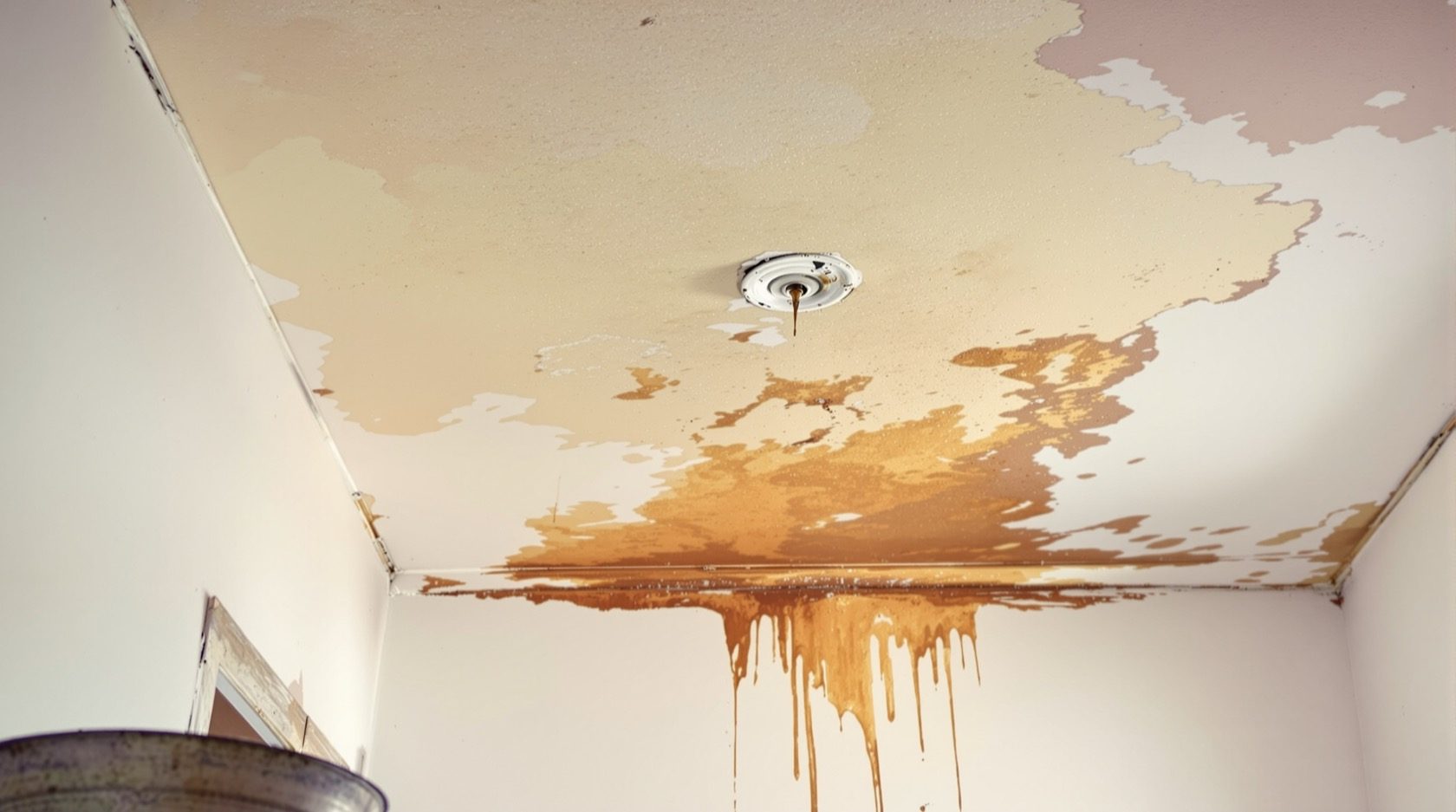
Roof Leak Diagnosis & Repair
The homeowner's most common roofing crisis, calmly explained — how to read the signs (stains, damp, efflorescence, peeling paint, drips, a musty smell), why the leak is almost never right above the stain, where roofs actually leak, how leaks are traced, and the honest line between what you can safely check yourself and what needs a professional. India-grounded, monsoon-tested.
Almost every homeowner meets it eventually: the brown ring on the ceiling, the damp patch that darkens after rain, the first slow drip into a bucket during the monsoon. A leaking roof is the single most common — and most stressful — roofing crisis, and in India it usually arrives with the first heavy downpour of the season. The good news is that a leak is almost never as mysterious as it feels. It follows rules, it leaves clues, and most leaks trace back to a short list of usual suspects.
This is the troubleshooting guide of the Roofing Knowledge Hub, and a companion to The Ultimate Guide to Roofing Systems, where the layer that actually keeps water out — the waterproofing — sits at the heart of the story. Here we stay with the homeowner's real question: my roof is leaking, now what? We will read the signs, explain the one fact that trips everyone up (the leak is rarely above the stain), map where roofs actually leak, walk through how leaks are traced, separate a monsoon emergency patch from a permanent fix, and mark clearly where safe self-inspection ends and a qualified professional begins.
Scope & safety. This guide helps you understand, diagnose and judge a roof leak so you can brief the right person and make good decisions. Tracing a leak from the ground and inside the house is safe. Working at height on a wet or fragile roof, cutting into a slab, and any waterproofing application or structural repair are qualified work for a licensed waterproofing/roofing contractor and, where the structure is involved, a structural engineer. Do not climb onto a wet, sloping, sheeted or parapet-edged roof to investigate. Nothing here replaces an on-site professional inspection.
Reading the signs — what a leaking roof is telling you
A roof rarely fails all at once. It whispers first. Learning to read the whispers — and roughly how urgent each one is — is the first skill of diagnosis. Most of these signs are things you can safely spot from inside the house or from the ground.
| Sign | What it looks like | What it usually means | Urgency |
|---|---|---|---|
| Ceiling stain | A brown or yellowish ring or blotch, often with a darker edge | Water has been reaching the ceiling for a while and drying between spells | Medium — act before the monsoon |
| Damp patch | A cool, darker area that spreads or deepens after rain | An active leak or ongoing seepage above | High if it grows with each rain |
| Efflorescence | White, chalky, powdery salt deposits on concrete or plaster | Water is moving through the concrete/masonry, carrying salts out | Medium — a moisture path exists |
| Peeling / blistering paint | Paint bubbling, flaking or coming away in sheets | Trapped moisture behind the paint film | Medium — source is nearby, not always above |
| Active drip | Visible dripping during or just after rain | An open water path straight through | High — contain now, fix properly later |
| Musty smell / mould | A damp, earthy odour; black or green speckling in a corner | Persistent hidden moisture, poor drying | Medium–high — health as well as fabric |
| Sagging / bulging ceiling | A soft dip or bulge, especially in a false ceiling | Water pooling above a plaster or gypsum ceiling | Urgent — keep clear; it can fall |
Two quick rules. First, a stain that stays exactly the same size for years is old and dry; a stain that grows, darkens or reappears with each rain is active and worth chasing now. Second, treat any sagging or bulging ceiling as urgent — a waterlogged gypsum or POP false ceiling is heavy and can come down without warning. Keep people and furniture clear of it.
Why the leak is (almost) never right above the stain
Here is the single fact that saves homeowners the most wasted money: water does not fall straight down through a roof. It enters at a weak point, then travels — sideways along the top of the slab, down a reinforcement bar, along a conduit, across a ceiling void or down a beam — until it finds a low point or a crack to emerge from. The stain you see is where the water comes out, which can be feet away from where it got in.
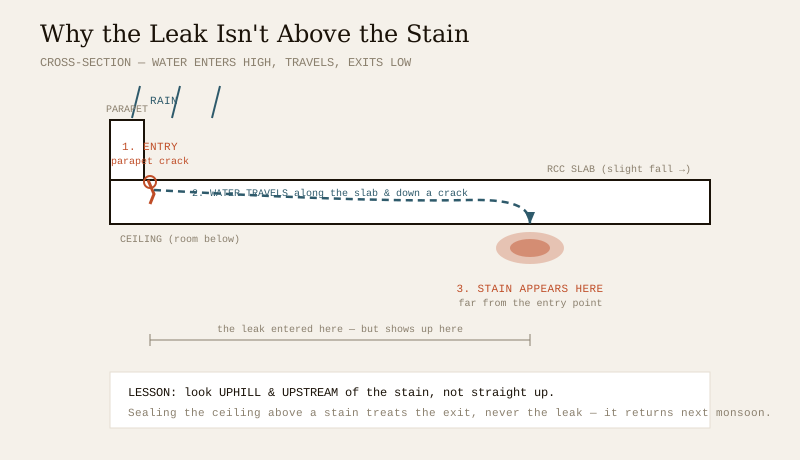
This is why chasing the stain almost never works. A contractor who slaps waterproofing coating on the ceiling directly above a stain — or worse, on the underside of the slab — is treating the symptom, not the leak. The water simply travels a little further and reappears next season, and the homeowner concludes "waterproofing doesn't work". It worked fine; it was aimed at the wrong spot.
The practical takeaways:
- Look uphill and upstream from the stain, not straight up. On a flat roof, the entry point is usually higher along the fall — often a parapet junction, a drain mouth, a crack or a pipe penetration — and the water has run to the low point over your stain.
- A leak far from any obvious roof feature is a classic travelling leak. The entry is elsewhere; the exit found the nearest crack.
- This is exactly why leaks are traced, not guessed. Fixing the exit does nothing. You have to find the entry, and that means reading the whole roof, not the ceiling.
The usual suspects — where roofs actually leak
Leaks are not random. On both flat and sloping Indian roofs, the same handful of weak points account for the overwhelming majority of leaks — and almost all of them are junctions, edges and penetrations, not the open middle of the roof. Water finds the joins.
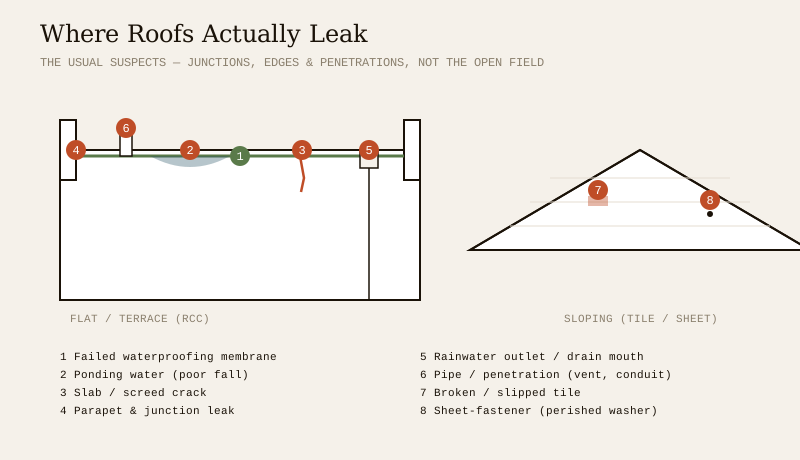
| Leak source | Where / roof type | Why it leaks | Typical fix belongs to |
|---|---|---|---|
| Failed waterproofing | Flat / terrace RCC | Membrane or coating aged, cracked, lifted or was never proper | Waterproofing contractor |
| Ponding water | Flat roofs with poor fall | Water sits for days, finds every pore and crack; the number-one flat-roof killer | Re-slope + drainage |
| Slab cracks | RCC slab & screed | Shrinkage/thermal or structural cracks open a path | Assess cause first; engineer if structural |
| Parapet & junction leaks | Flat / terrace edges | The wall-to-slab join and coping flash poorly; a very common entry | Waterproofing contractor |
| Drain / outlet leaks | Around rainwater outlets | Water pools at the mouth; the collar seal fails | Waterproofing + plumbing |
| Pipe / penetration leaks | Vents, conduits, tank feet | Anything piercing the roof breaks the membrane | Detailed re-flashing |
| Broken / slipped tiles | Sloping tiled roofs | A cracked, slipped or missing tile opens the deck | Roofing contractor |
| Sheet-fastener leaks | Metal / fibre-cement sheet | Screw holes, perished washers, wrong-side laps | Re-fasten / re-seal; sheet contractor |
The pattern is worth internalising: the open field of a roof rarely leaks; the edges and holes do. Parapet junctions, drain mouths and pipe penetrations are where an experienced eye looks first. On sloping roofs, add slipped or cracked tiles and tired fastener washers. If you can describe which of these you suspect, you can brief a contractor precisely instead of inviting a vague "full waterproofing" quote for a problem that might be one cracked drain collar.
How a leak is traced
Diagnosis moves from cheapest and safest to most involved. You can and should do the first stage; the later stages increasingly belong to a professional.
1. Interior & ground reading (safe, do this yourself). Map every stain, damp patch and drip. Note when it appears — only during rain (a rain-driven leak), or also in dry spells (possibly plumbing or condensation, not the roof). Photograph it. From the ground or a window, look for the roof features uphill of each stain. This alone often points to the culprit.
2. Visual roof inspection (professional, at height). A contractor walks the roof looking for the usual suspects — cracked or lifted waterproofing, ponding marks (a tide-line of dirt shows where water stands), open parapet junctions, choked or cracked drain mouths, damaged tiles or perished sheet washers. This is at-height work on a surface that may be wet, fragile or edged with a low parapet — not a DIY climb.
3. The flood (ponding) test. To confirm a suspected zone on a flat roof, the outlet is temporarily plugged and the area is flooded to a shallow depth for a set period while the ceiling below is watched for the leak to appear. Done carelessly it can overload a slab or flood the house, so it is a controlled test a professional runs, not a casual experiment. On sloping roofs, a hose test — wetting the roof zone by zone, low to high, while a second person watches inside — does the same job.
4. Instrument methods (specialist). For stubborn or expensive-to-open leaks, professionals use moisture meters, and on larger buildings, electronic leak detection or thermal imaging to pinpoint the wet path before anyone cuts into a finish.
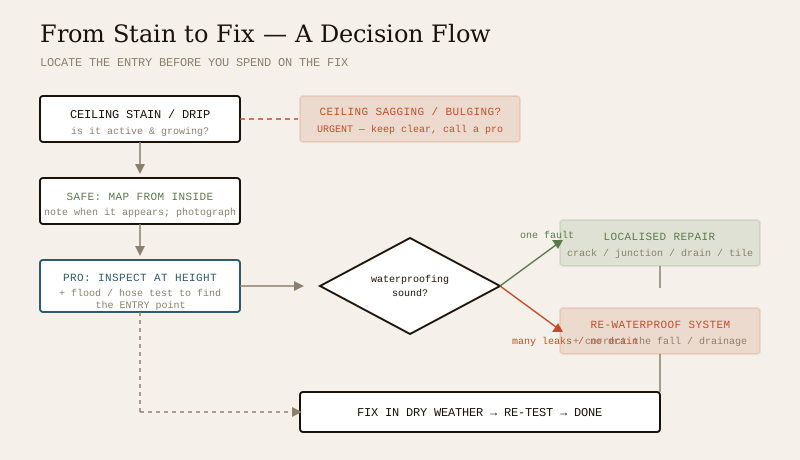
The golden rule threading through all four stages: locate the entry before you spend on the fix. Every rupee spent sealing the wrong spot is wasted, and every "mystery leak that keeps coming back" is a leak that was never actually located.
Emergency monsoon fix vs permanent repair
Leaks have terrible timing — they announce themselves mid-monsoon, exactly when a proper repair is impossible because surfaces must be clean and bone-dry for any waterproofing to bond. So think in two stages: stop the damage now, fix it properly later.
| Emergency fix (during rain) | Permanent repair (dry weather) | |
|---|---|---|
| Goal | Contain water, protect the home & occupants | Locate and eliminate the actual entry |
| Typical actions | Buckets & tarps, move belongings, switch off affected circuits, temporary tape/putty on an obvious crack from a safe position, clear a choked drain from the ground if reachable | Trace the leak, prepare a dry surface, repair the crack/junction or re-lay waterproofing, re-test |
| Lasts | Days to weeks | Years — the real solution |
| Who | Homeowner (interior/ground only) | Waterproofing / roofing contractor (+ engineer if structural) |
The one thing to resist is letting a monsoon patch become the "solution". A blob of quick-set putty smeared over a wet crack in the rain might buy a dry night — worth doing for peace of mind — but it is not a repair, and it will fail. Book the proper diagnosis and fix for the first dry spell, and be wary of anyone who wants to apply a full waterproofing system to a wet roof in July. It will not bond, and you will be paying again next year.
Two safety notes that matter in a wet-season leak: water and electricity — if water is near a light fitting, fan or wiring, switch off that circuit and keep clear; and the sagging false ceiling — if a gypsum or POP ceiling is bulging with trapped water, evacuate the space beneath it and let a professional release it safely.
Repair or re-waterproof? Making the decision
Once the leak is located, the honest question is whether to make a targeted repair or to re-waterproof a whole zone or roof. It comes down to the state of the surrounding waterproofing and how many entry points there really are.
- A localised repair makes sense when the waterproofing is otherwise sound and the leak is a single, definable fault — one cracked drain collar, one open parapet junction, one damaged tile, a short crack in an otherwise healthy membrane. Fix the fault, re-test, done.
- A full re-waterproofing makes sense when the membrane or coating is generally aged, brittle, blistered or lifting; when there are multiple leaks appearing across the roof; when ponding shows the fall itself is wrong; or when you have already patched the same roof two or three monsoons running. At that point you are chasing a system that has reached the end of its life, and patch after patch costs more than one proper job.
A useful test: if the waterproofing is failing in more than one place, or the roof cannot drain, the problem is the system, not the spot. That is a re-waterproofing decision, and it belongs to the roof waterproofing guide — often paired with correcting the drainage and the fall so water stops standing in the first place. If the leak turns out to be structural — a growing crack, a sagging slab — that is a different conversation for a structural engineer, and sometimes part of a wider roof renovation.
What you can safely do yourself — and where the line is
Diagnosis is empowering, but a roof is one of the few places in a home where amateur enthusiasm turns dangerous fast. Keep firmly to the safe side of this line.
| You can safely | Leave to a qualified professional |
|---|---|
| Map stains, damp and drips from inside the house | Any inspection or work at height on the roof |
| Note when leaks appear (rain vs dry) | Walking a wet, sloping, sheeted or fragile roof |
| Photograph and describe the pattern | Flood / ponding tests on a slab |
| Look at the roof from the ground or a window | Cutting into a slab, screed or membrane |
| Clear a drain mouth you can reach safely from the ground | Waterproofing application & crack injection |
| Contain water; switch off wet circuits; keep clear of a sagging ceiling | Any structural crack or sag assessment & repair |
| Brief the contractor precisely on what you have observed | Working near a low or absent parapet edge |
The reasoning is simple and non-negotiable: most Indian flat roofs have a low parapet or none, sloping and sheeted roofs are slippery and can give way, and roofs are almost always wet exactly when you most want to investigate. Falls from roofs are among the commonest serious home-repair injuries. Your job is the smart part — observing, mapping and describing so that the person who does go up knows exactly where to look. That division of labour finds leaks faster and keeps you safe. When in doubt, stay on the ground and call a licensed roofing or waterproofing contractor.
The one-line answer
A roof leak is far more logical than it feels: it enters at a weak point — almost always a junction, edge or penetration (failed waterproofing, ponding, a crack, a parapet or drain junction, a pipe, a slipped tile, a tired fastener) — then travels through the roof and emerges as a stain that is rarely right above the entry. So you locate the entry before you spend on the fix, reading the signs safely from inside and the ground and leaving the at-height inspection, the flood test and all waterproofing or structural work to a licensed contractor and, where needed, an engineer. Contain the damage during the monsoon, do the real repair in dry weather, and when a roof is leaking in several places or cannot drain, stop patching and re-waterproof the system — that, not another blob of putty over the stain, is the money well spent.
Where to go next
- The whole subject in one map: The Ultimate Guide to Roofing Systems.
- The layer that keeps water out: Roof Waterproofing Guide · on a flat terrace: Flat Roof Waterproofing Guide.
- Why water must move off fast: Roof Drainage Guide · Gutters & Downpipes Guide.
- The slab most leaks live on: The RCC Roof Guide.
- When patching is no longer enough: Roof Renovation & Replacement Guide.
- The whole library: Roofing Knowledge Hub.
References
- National Building Code of India (SP 7), Bureau of Indian Standards — Part 9 (Plumbing Services, including roof drainage) and Part 11 (Approach to Sustainability, rainwater management); verify the current edition via the BIS catalogue.
- IS 3067: Code of Practice for General Design Details and Preparatory Work for Damp-Proofing and Waterproofing of Buildings — Bureau of Indian Standards.
- IS 1346: Code of Practice for Waterproofing of Roofs with Bitumen Felts — Bureau of Indian Standards.
- IS 2645: Integral Waterproofing Compounds for Cement Mortar and Concrete — Specification — Bureau of Indian Standards.
- IS 456: Plain and Reinforced Concrete — Code of Practice (cracks, cover and durability of RCC slabs) — verify current status via the BIS catalogue: https://www.services.bis.gov.in/
This is an educational overview to help you diagnose and judge a roof leak, not a repair manual. Working at height, flood testing, waterproofing application, crack injection and any structural repair are qualified professional work — engage a licensed waterproofing/roofing contractor and, where the structure is involved, a structural engineer, and verify any standard's current status via the BIS catalogue before relying on it.
Export this guide
Related Guides — Deep-dive reading
Why Buildings Leak: Tracing the Paths Water Takes Into Your Home
The four sources of water in a building — rain, plumbing, ground and condensation — why the stain is never where the leak is, and the homeowner's method for tracing a leak to its true source before spending a rupee.
Structural SafetyWhen Waterproofing Blisters, Peels or Cracks: Reading a Failing Roof Coating
How to recognise the ways a terrace waterproofing layer fails — blisters and bubbles, alligatoring and surface crazing, peeling and de-bonding, pinholes, open membrane laps — what each one reveals about the root cause, and the honest recoat-versus-full-re-waterproof decision. Read it from a safe vantage; the assessment and every bit of the work belong to a licensed waterproofing contractor.
RoofingRoof Defects: A Homeowner's Field Guide (India)
The diagnostic catalog that anchors the whole subject — every common roof defect on Indian homes, pictured and named: cracks, damp and efflorescence, ponding, waterproofing blisters, sagging, spalling and rusting rebar, corrosion, algae and moss, parapet and drain-junction failures, slipped tiles and perished fasteners. For each: what it looks like, what it usually means, how serious it is, and exactly who to call.
RoofingRelated Tools — Try Free
False Ceiling Cost Estimator
Live ₹/sqft across 8 ceiling types — POP, gypsum, designer, metal, PVC, wooden — with cove and spot lighting for 20 Indian cities.
Cost CalculatorMonsoon-Readiness Checklist
Pre-rain home audit across 9 categories — terrace, drains, waterproofing, electrical, HVAC, pest, vehicles, documents.
Seasonal AuditRainwater Tank Sizer
How big should your rainwater tank be? Computes annual harvest, recommended tank capacity in litres, water-bill savings, and payback — for 10 Indian cities.
RWH Calculator