
Interactive Calculator · 2026
Rainwater Tank Sizer
How big should your rainwater harvesting tank be? Roof area, roof type, household size, city — get annual harvest, recommended tank size, water-bill savings, payback.
Roof
1076 sq.ft · typical urban home 80–200 m² (860–2150 sq.ft)
Most common Indian urban rooftop; high yield if parapet drains are clear.
Household
BIS / CPHEEO norm: 135 L/person/day for fully-plumbed urban homes. Daily household demand: 540 L.
Days of household demand the tank must carry between refills. 15–30 is typical.
City & economics
Jun–Oct (SW monsoon + NE retreat). Dry spell: ~120 days/year.
Default: Bengaluru (BWSSB, above 25 kL slab). Override if you’re in a higher slab or a gated community with internal tariff.
Tank + first-flush + filter + plumbing. Typical range ₹40,000–1,20,000.
Recommended tank capacity
Annual harvest
63.85 kL
Bengaluru roof
Peak month
12.77 kL
20% of annual
Demand coverage
32%
of annual water needs
Demand-driven size (20 days)
10.80 kL
Supply-driven size (peak month)
12.77 kL
Tank level — Jan
0 L of 16.20 kL
Tank empty — back on municipal supply this month.
Monthly rainwater supply vs household demand
Estimated profile for Bengaluru — monsoon-shaped curve scaled to annual harvest. Bars above the demand line indicate months you can fill the tank; bars below show drawdown months.
Peak month (Bengaluru): 12.77 kL — about 20% of the year’s catch arrives in one wet month.
Daily household demand: 540 L — this is the rose/terracotta bar each month.
Dry-spell carryover is what your tank exists to bridge. A larger tank lets you bank more of the green bars to draw against the brown bars during 120 dry days/year.
Economics
Annual bill savings
₹2,873
@ ₹45/kL
System cost
₹60,000
tank + fittings
Payback
20.9 years
at today's tariff
Tariffs rise ~7–10%/year; actual payback is shorter. First-flush per event: 200 L (2 mm/m² CGWB spec).
Likely mandatory in your city
BWSSB: mandatory for plots ≥ 40×60 ft (~223 m²) since 2009; ≥ 30×40 ft (~112 m²) from 2021.
Check with your architect or local authority before plan sanction — most cities enforce RWH at building-plan approval.
How this works
- Annual harvest = roof area (m²) × annual rainfall (m) × runoff × filter efficiency, minus first-flush losses. Rainfall figures are IMD long-term averages for each city.
- Runoff coefficient — fraction of incident rainfall that actually reaches the tank. Smooth non-absorbent surfaces (metal sheet, clean RCC) run off ~85–90%; porous finishes (green roof, gravel) run off 40–70%. IS 15797:2008 Table 2.
- First flush — CGWB recommends diverting 2 mm/m² of roof area per event before water enters the tank. This removes bird droppings, dust, and leaf litter that would otherwise foul the storage within weeks.
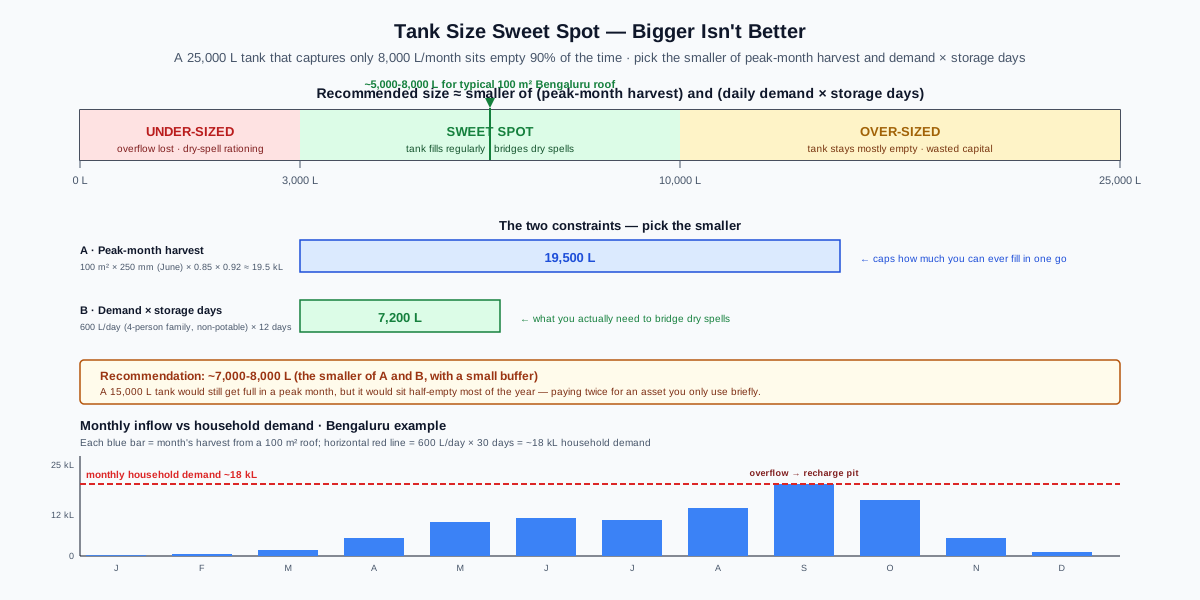
- Recommended tank size = the smaller of (peak-month harvest) and (storage-days × daily demand), with a floor at the longest dry spell. Bigger than peak-month is wasted capacity; smaller than a dry spell leaves you exposed.
- What this doesn’t include: groundwater recharge volume (additional 30–60% of roof runoff can be directed to a soak pit), partial-rainy-season reservoir effects, and quality differences by roof age. For exact compliance drawings, use your architect.
Deep-dive: Rainwater Harvesting for Indian Urban Homes — Complete Guide
Related: Biophilic Score · Plot Evaluation · Cross-Ventilation Analyzer
Indicative estimate. Local site conditions — roof slope, gutter efficiency, filter maintenance, and microclimate — can vary actual yield by ±20%. First year is usually 10–15% lower while the roof & filters “season”.
Rainwater harvesting in Indian homes
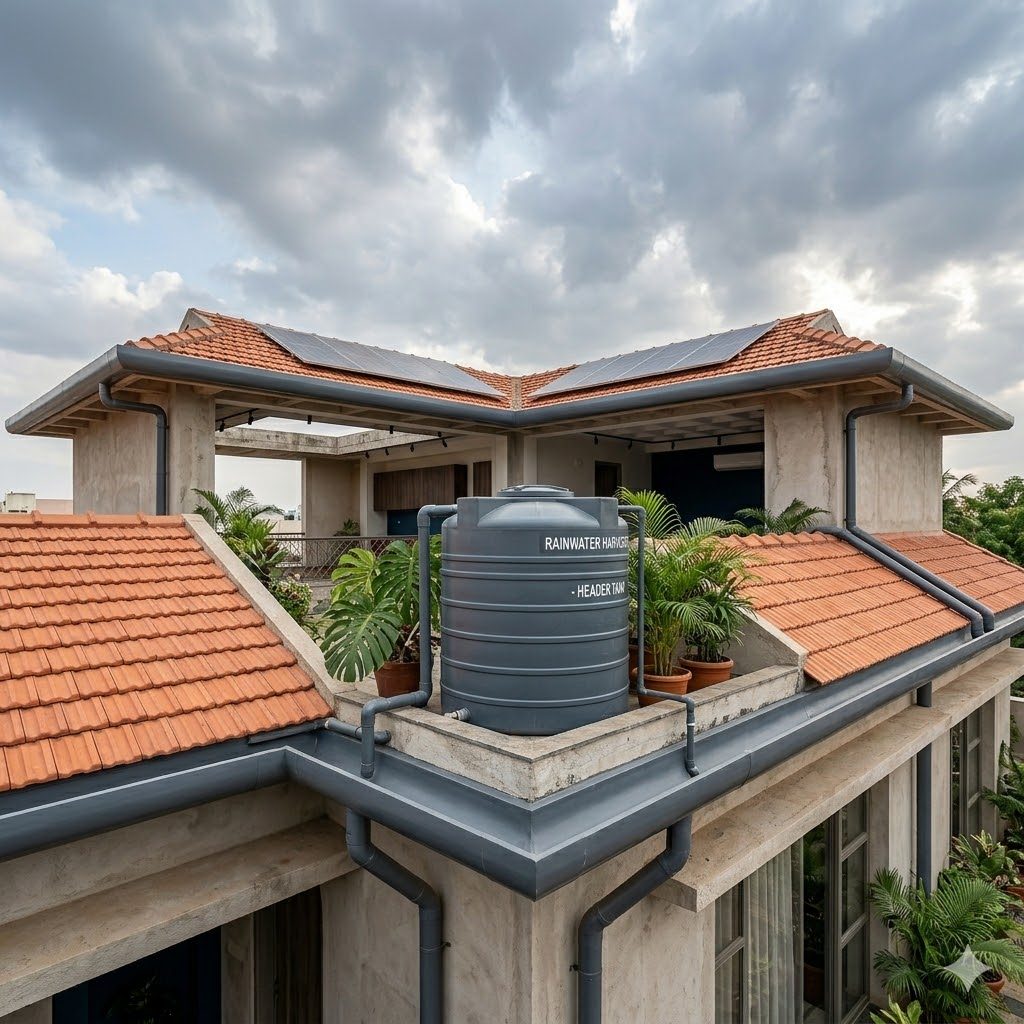
Rooftop · catchment
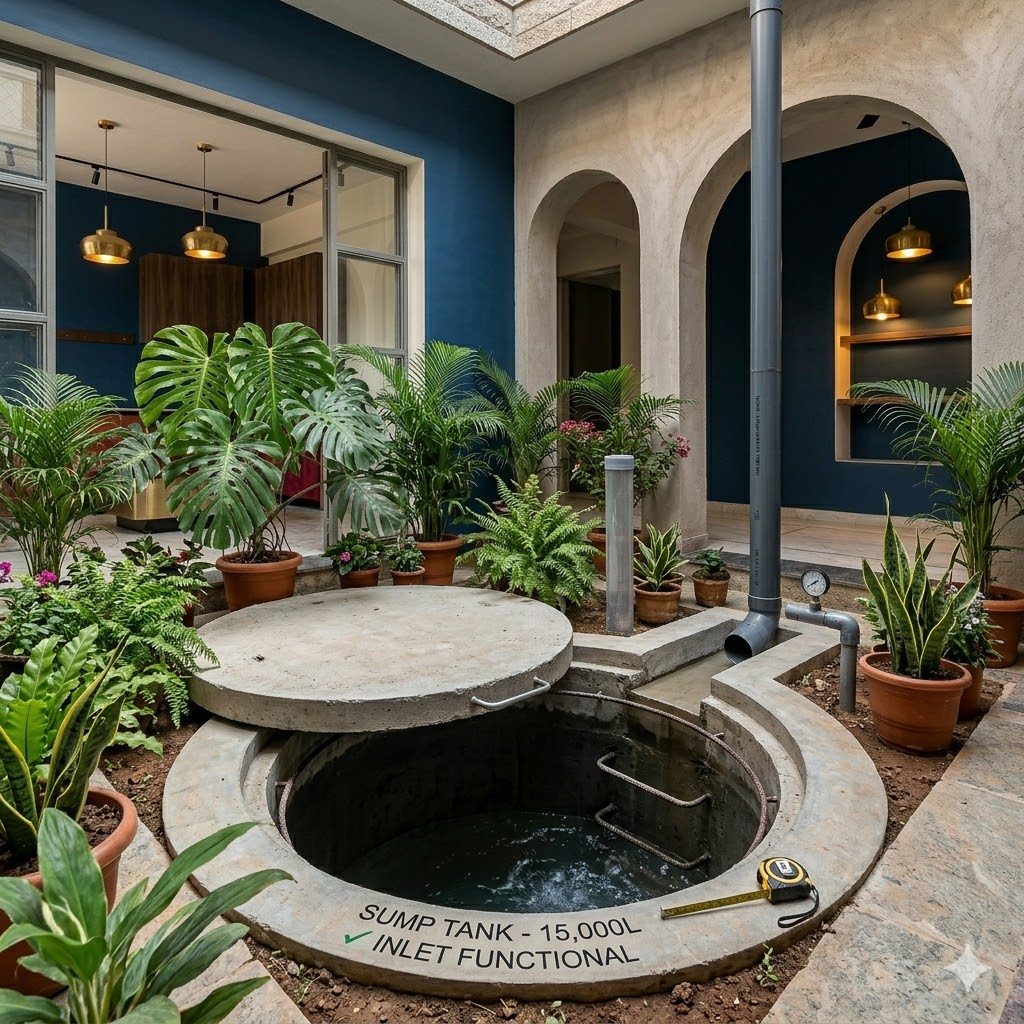
Sump · underground
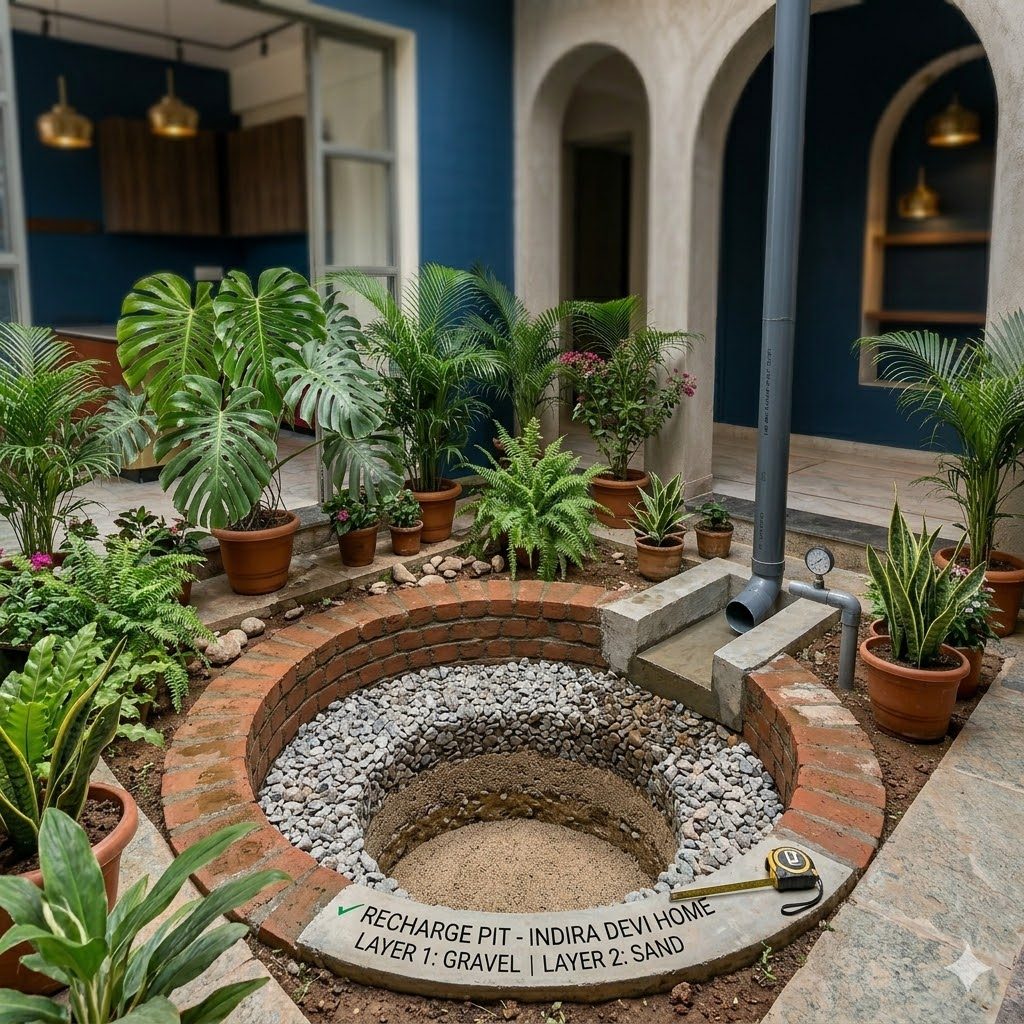
Recharge · pit
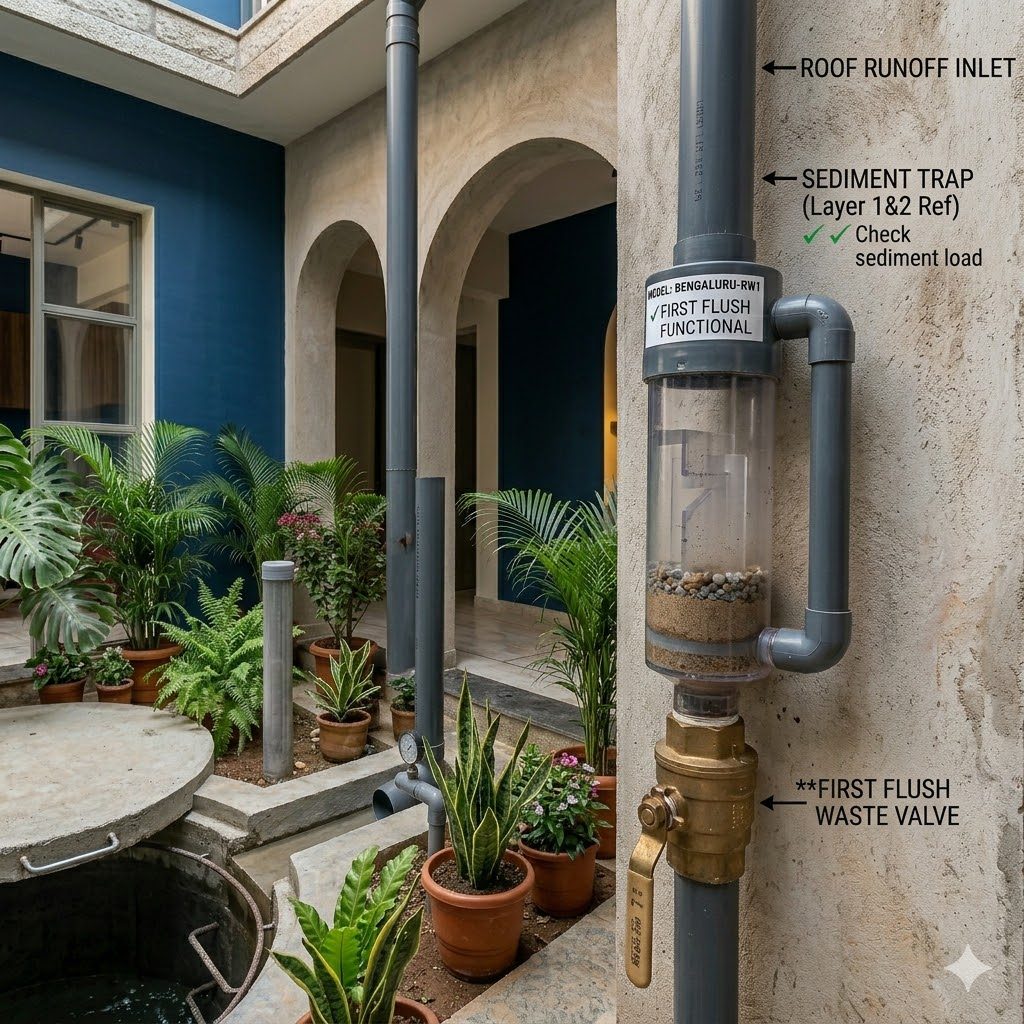
First-flush · filter
Bake rainwater into your build
DesignAI integrates rainwater harvesting into the site plan + plumbing layout.
Rainwater Harvesting in India — A Working Reference
Rainwater harvesting (RWH) is the discipline of capturing rainfall on a roof or paved surface, treating it minimally, and storing or recharging it for later use. India is uniquely positioned for residential RWH — average annual rainfall of 1,150 mm spread over a 3-5 month monsoon, combined with rising water tariffs, declining groundwater tables in major cities, and increasingly mandatory RWH provisions in plan-sanction approvals across most metros. A typical 100 m² (1,076 sqft) urban roof in India captures 75,000-150,000 litres of rainwater per year — enough to cover 6-12 months of a four-person family's non-potable water needs (flushing, gardening, washing).
The Six Components of an RWH System
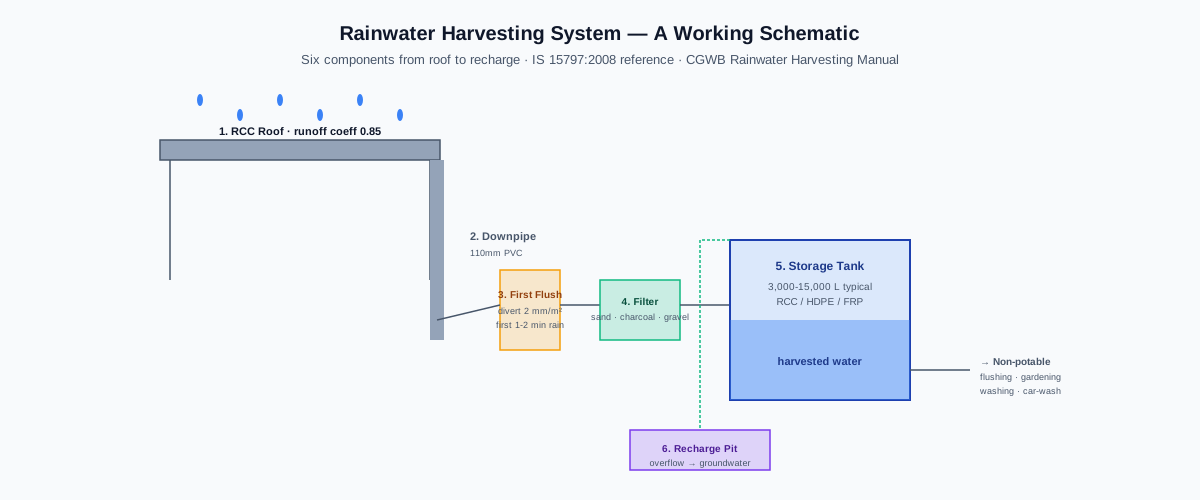
- Roof / catchment — RCC flat roofs (most Indian urban) have a runoff coefficient of 0.85; tiled / sloped roofs 0.75-0.80; metal sheets 0.90; vegetated roofs 0.30-0.50. Larger and smoother surfaces capture more.
- Downpipe — typically 110 mm PVC for residential. Sized to handle peak rainfall intensity (~10-15 cm/hr in major Indian cities during heavy monsoon).
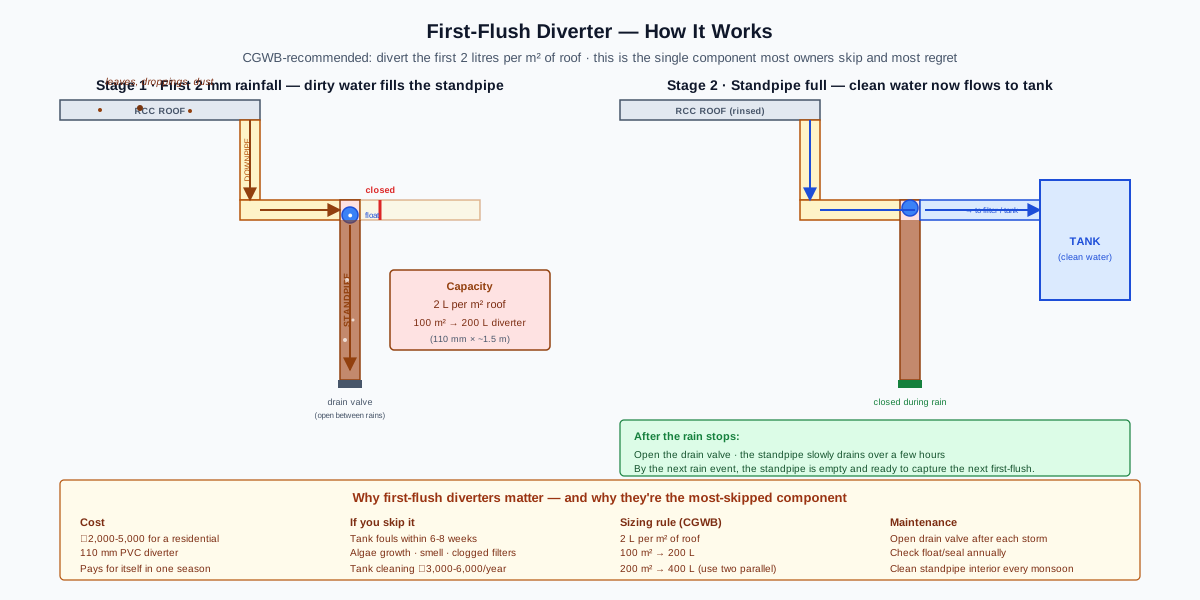
- First-flush diverter — diverts the first 1-2 mm of rainfall (carrying bird droppings, leaves, dust). CGWB recommends 2 litres per m² of roof. A simple ₹2,000-5,000 diverter prevents tank fouling and pays for itself in one season.
- Filter — typically a multi-layer sand / gravel / charcoal column. ₹5,000-10,000 for non-potable use; ₹20,000-40,000 for drinking-water-grade with UV+RO. IS 15797:2008 specifies filter media gradations.
- Storage tank — RCC (most common, 50-year life), HDPE plastic (20-25 year life, lower cost), or FRP (fibre-reinforced plastic). Sized to match peak-month harvest volume against household demand × storage days.
- Recharge pit — overflow from the tank diverts to a recharge pit (typically 1-2 m diameter, 2-3 m deep, with gravel and sand fill) that lets surplus water percolate back into the aquifer. Mandatory in most cities even if you have a tank.
Sizing the Tank — The Working Formula
Annual harvest = Roof area × Annual rainfall × Runoff coefficient × Filter efficiency. Tank size = the smaller of (a) peak-month harvest volume (so the tank actually fills) and (b) household daily demand × storage days (typically 15-20 days, to bridge dry spells). Oversizing beyond peak-month harvest is wasted capacity; undersizing below 15 days of demand means dry-spell rationing.
Worked example (typical Bengaluru home): 100 m² roof, RCC flat (runoff 0.85), 970 mm annual rainfall, family of 4 (~600 L/day non-potable). Annual harvest ≈ 75,850 L. Peak-month harvest (June, ~250 mm) ≈ 21,000 L. Daily-demand × 20 days ≈ 12,000 L. Recommended tank size: 5,000-8,000 L (smaller of peak-month and demand × storage). Tank size of 15,000 L would overflow most months and is wasted capacity.
First-Flush Diverter — The Component Owners Skip and Regret
The first-flush diverter is the single least-installed and most-consequential component of an RWH system. The first 1-2 mm of rainfall after a dry spell carries roof debris — leaves, bird droppings, dust — straight into the tank. CGWB recommends diverting 2 litres per m² of roof before clean water reaches storage. The mechanism is mechanically simple: a vertical PVC standpipe fills first, a float seals it once full, and clean water then flows past to the tank.
RWH Mandates Across Indian Cities
- Bengaluru (BWSSB) — mandatory for plots ≥ 30×40 ft (~112 m²). Without RWH provision, sale-deed registration and water connection are denied.
- Delhi (MCD/DDA) — mandatory for plots ≥ 100 m² since 2001. Enforced through plan-sanction.
- Chennai (TN state) — mandatory across the state for all buildings since 2003. The most aggressively enforced RWH mandate in India; non-compliance can result in disconnection of water supply.
- Mumbai (MCGM) — mandatory for plots ≥ 300 m² or 6 dwelling units.
- Hyderabad (GHMC) — mandatory for plots ≥ 200 m².
- Pune / PCMC — mandatory for plots ≥ 300 m².
- Ahmedabad (AMC) — mandatory for plots ≥ 500 m².
- Kolkata (KMC) — mandatory for plots ≥ 200 m².
Common Implementation Pitfalls
- Skipping first-flush diverter — the most-skipped component, the most-consequential. Tank fouls within 6-8 weeks; algae growth requires expensive cleaning.
- Oversizing the tank — 15,000-25,000 L tanks on small urban plots that capture only 8,000 L/month; the tank stays empty 90% of the time.
- No overflow to recharge pit — surplus water pools or causes localised flooding; aquifer recharge benefit lost.
- Using harvested water for drinking without RO/UV — Indian rain water is generally clean by atmospheric standards but accumulates contaminants from roof and storage. Always RO+UV for potable use; non-potable use only with simple sand+charcoal filter.
- Tank in direct sunlight without UV-stabilised material — algae growth in HDPE tanks within months. Use UV-stabilised HDPE or shade the tank.
- Failed mosquito-mesh on inlet — tank becomes mosquito breeding site. Inspect and replace mesh annually.
Cross-References
- Rainwater Harvesting for Indian Urban Homes (Guide) — comprehensive city-wise reference
- Sustainable Home Design India — RWH in broader sustainability context
- Passive Design Strategies for Indian Climate Zones
Disclaimer: RWH calculations use IS 15797:2008 and CGWB Rainwater Harvesting Manual (2023) guidance. City-specific regulations vary; verify with your local water board (BWSSB, Delhi Jal Board, MCGM, etc.) before installation. This page is for informational purposes only.
Related Guides — Deep-dive reading
Rainwater Harvesting Guide for India: Catchment, Storage, Recharge & Bye-laws
The section pillar for rainwater harvesting — why it matters for water security and groundwater, the full catchment-to-store-or-recharge chain, the two paths of using rain versus recharging aquifers, indicative yield and sizing, first-flush and filtration, maintenance, and the mandatory-RWH reality in Indian cities.
PlumbingRooftop Rainwater Harvesting
The rain that lands on your roof is a free water supply and, in most Indian cities, a legal duty. What a rooftop rainwater harvesting system is, the two paths (store it for reuse or recharge the groundwater), the parts that make it work, how much a roof can actually collect, and the maintenance that keeps it honest. Plain language, India-grounded.
RoofingRooftop Rainwater Harvesting in India: Catching Rain Off Your Roof for Storage or Recharge
A homeowner's guide to rooftop rainwater harvesting — using the roof as a catchment, sizing gutters and downpipes for your area and rainfall, first-flush and filtration, and where the water finally goes: a storage sump for use or a recharge structure for the ground.
PlumbingRelated Tools — You may also find these useful
Biophilic Design Score Calculator
Score your home across 16 biophilic criteria — daylight, plants, materials, patterns, and more.
Biophilic ScoringBathroom Cost Calculator
Estimate the all-in cost of building or renovating a bathroom — by size, quality tier and city, with a category-wise breakdown.
Bathroom CalculatorBathroom Water Savings Calculator
See the water and money saved by switching to efficient bathroom fittings — dual-flush, low-flow shower and tap aerators — per year.
Bathroom Calculator