

Rooftop Rainwater Harvesting
The rain that lands on your roof is a free water supply and, in most Indian cities, a legal duty. What a rooftop rainwater harvesting system is, the two paths (store it for reuse or recharge the groundwater), the parts that make it work, how much a roof can actually collect, and the maintenance that keeps it honest. Plain language, India-grounded.
Every monsoon, an astonishing amount of water falls on your roof, runs down the pipes, and disappears into the storm drain — often to flood the road a kilometre away while the same household pays for a tanker two months later. Rooftop rainwater harvesting is the simple, old idea of catching that water where it lands and putting it to use: storing it to drink, wash and flush, or sending it into the ground to refill the wells and borewells the whole neighbourhood depends on. It is one of the highest-return, lowest-technology things you can add to a roof.
This is the rainwater guide of the Roofing Knowledge Hub and a companion to The Ultimate Guide to Roofing Systems, where the roof appears not just as shelter but as a water source. It explains what a rooftop rainwater harvesting (RWH) system actually is, the two paths the water can take, the parts that make it work, how much a given roof can collect, what quality that water is and what it is fit for, the upkeep it needs, and the regulatory reality — because in most Indian cities RWH is now mandatory, not optional. It will not design or plumb a system for you: sizing storage, building a recharge structure and any work at height are jobs for a qualified plumber or RWH contractor.
Scope & safety. This guide helps you understand, plan, choose and judge a rooftop rainwater harvesting system. Sizing a storage tank or recharge structure to your rainfall and soil, connecting to a potable supply, and building pits, wells and roof plumbing (including any working at height) are qualified work for a plumber, a hydrogeologist or an RWH contractor. Rules and procedures vary by city and state and change often — treat every regulatory note here as a pointer to your local by-laws, never as the rule itself. Nothing here replaces a site-specific design or an on-site professional.
The one idea: catch the rain where it lands
A rooftop rainwater harvesting system does one thing: it intercepts the rain falling on your roof before it runs to waste, cleans the first dirty flush off it, and directs the rest either into storage for later use or into the ground to recharge the aquifer. Everything else is detail.
That single idea matters more in India than almost anywhere, for two reasons. First, our rainfall is intense and seasonal — a city may get its whole year's rain in forty or fifty days, so water that is not caught in that window is simply gone. Second, our groundwater is in steep decline; borewells that once struck water at 30 metres now go dry at 200. Harvesting tackles both: it banks the monsoon for the dry months and it puts water back underground. A modest terrace can yield tens of thousands of litres a year — genuinely useful water, most of it free after the plumbing is paid for.
The two paths — store it, or put it back
The first and biggest decision is what happens to the water once it is caught. There are two paths, and many homes use both.
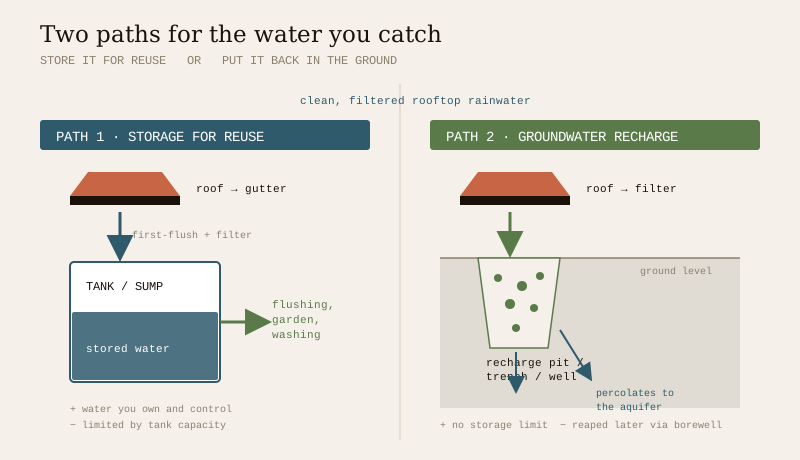
Path 1 — Storage for reuse. The rainwater is filtered and collected in a tank or sump (above or below ground) and used directly — for flushing, gardening, washing, cleaning, and, with proper treatment, even drinking. This path gives you water you own and control, which is priceless where municipal supply is erratic or tanker-dependent. Its limit is capacity: a tank only holds so much, and once it is full the overflow is wasted unless it is routed to recharge. Storage suits homes that need the water and have space for a tank.
Path 2 — Groundwater recharge. Instead of storing the water, you lead it into the ground through a recharge pit, trench, shaft or well, letting it percolate down to refill the aquifer that feeds your borewell and your neighbours'. There is no storage limit — a recharge structure can soak up huge volumes — and it is often what city by-laws actually require. The catch is that you cannot draw the water back directly; you are investing in the shared water table, and reaping it later through a borewell. Recharge suits homes on borewells, in water-stressed areas, or wherever regulations mandate it.
| Storage for reuse | Groundwater recharge | |
|---|---|---|
| Where the water goes | Into a tank / sump | Into the ground (pit, trench, well) |
| You get back | Water you can use directly | A healthier water table / borewell |
| Main limit | Tank capacity; overflow wasted | Soil must absorb; needs a borewell to reap |
| Best for | Erratic supply, tanker-dependent homes | Borewell homes, water-stressed zones |
| Often required by | Voluntary / self-interest | City & state by-laws (commonly) |
The honest answer for most Indian homes is both: store what you can use, and route the overflow — and any roof area beyond your tank's appetite — to a recharge structure. That way no drop is wasted, and you satisfy both your own need and the regulation.
What the system is made of — the parts
Whichever path the water takes, the same chain of parts carries it there. Understanding each lets you judge a quote and spot a system that skips a step.
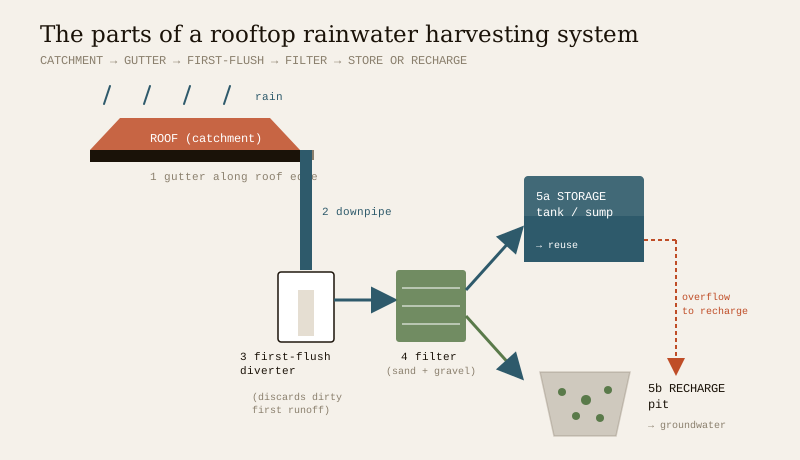
- Catchment — the roof itself. The collecting surface. A flat RCC terrace, a sloping tiled roof or a metal sheet roof all work; what matters is the plan area and the roof material (below). This is the "catchment area" in every calculation.
- Gutters & downpipes — the collection network. Channels along the roof edge and vertical pipes that gather the runoff and bring it down to one or two points. On a flat roof these are the terrace outlets and rainwater downtakes; on a sloping roof, edge gutters. Sizing them for peak rainfall is exactly the job of the roof gutters & downpipes guide and the wider roof drainage guide.
- First-flush diverter — the self-cleaning step. A simple device that diverts and discards the first few minutes of runoff — the dirtiest water, carrying the dust, bird droppings and leaves that settled on the roof since the last rain — before letting the cleaner water that follows into the system. The single cheapest thing that most improves harvested-water quality.
- Filter — the cleaning step. A sand-and-gravel filter, a mesh/cartridge filter or a proprietary unit that removes silt, leaves and grit. On the recharge path it stops the pit from silting up and clogging; on the storage path it keeps the tank clean.
- Storage tank OR recharge structure — the destination. Either a sump / tank (masonry, RCC or plastic; underground or overhead) for the storage path, or a recharge pit, trench, shaft or bore-well recharge for the ground path. Sizing this to your rainfall, roof area, demand and soil is the heart of the design — and where the rainwater harvesting calculator gives you a first estimate.
- Overflow — the safety valve. Every storage system needs an overflow, and the best place to send it is a recharge structure, so a full tank does not simply spill to waste.
How much water can a roof actually harvest?
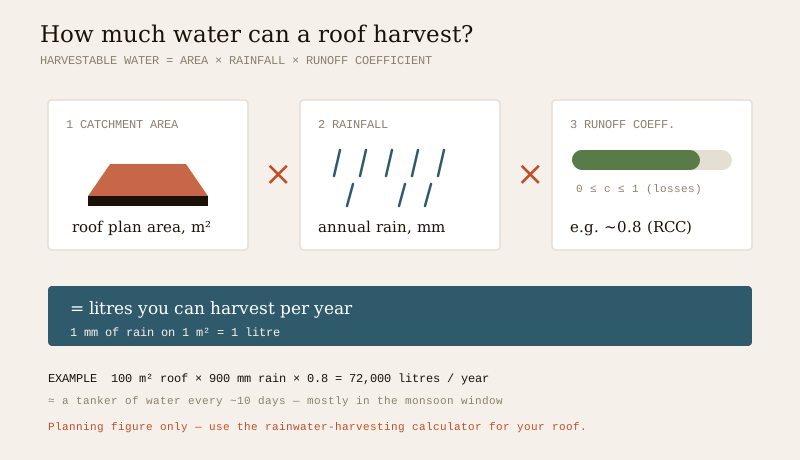
This is the number everyone wants, and it comes from a beautifully simple idea: harvestable water = catchment area × rainfall × runoff coefficient.
Read the three factors in plain terms:
- Catchment area is the roof's plan area (the footprint seen from above, in square metres) — not the sloped surface area. A bigger roof catches more.
- Rainfall is your location's rain, in millimetres per year (or per storm, for peak sizing). One millimetre of rain on one square metre is one litre — a handy fact that makes the whole sum intuitive.
- Runoff coefficient is a discount factor, between 0 and 1, for the water that never makes it to the tank — the bit that evaporates, wets the roof, or leaks at joints. Smooth, impervious roofs lose little; rough or absorbent ones lose more.
| Roof / surface | Typical runoff coefficient* |
|---|---|
| RCC / smooth concrete terrace | ~0.80–0.85 |
| Metal / GI sheet roof | ~0.85–0.90 |
| Clay / concrete tiled roof | ~0.70–0.80 |
| Gravel or green roof | ~0.40–0.60 |
*Indicative planning values — the actual figure depends on roof condition, slope and detailing. Use them to understand the idea, not as a substitute for a designer's number.
To feel the scale: a 100 m² flat RCC roof (about 1,075 sq ft) in a city receiving 900 mm of annual rain, at a runoff coefficient of 0.8, could in principle yield 100 × 900 × 0.8 = 72,000 litres a year — roughly a tanker of water every ten days through the year, most of it in the monsoon window. Real yields are lower because storage is finite and some rain comes in bursts too big to catch, but the order of magnitude is real. This guide is for understanding the idea; for an estimate tuned to your roof area and city rainfall, use the rooftop rainwater harvesting calculator.
Roof material and water quality
If you intend to store and use the water, the roof it runs off matters, because the catchment is the first thing the water touches.
- Best catchments are smooth, inert and cleanable: RCC terraces, glazed clay tiles, and coated metal sheet. They shed water fast, hold little dirt and add nothing harmful to it.
- Watch-outs. Old, flaking or heavily painted roofs can shed particles; asbestos-cement sheet is best avoided for water you will drink; a roof shaded by trees loads the water with leaves and bird droppings (and makes a good first-flush diverter essential). Fresh bitumen and some coatings can taint early runoff.
- The universal rule: the cleaner and more accessible the roof, the better the water — and a first-flush diverter plus a filter turns even an ordinary roof into a fine storage catchment.
For recharge, quality matters far less — the soil and the journey down do their own filtering — so almost any roof serves, provided grit is filtered out to keep the pit from clogging.
What harvested rainwater is fit for
Rainwater is naturally soft and, off a clean roof, often better than hard borewell water for many uses. But fit for what depends on treatment.
| Use | Fit straight off a clean roof? | Notes |
|---|---|---|
| Toilet flushing | Yes (filtered) | The easiest, highest-volume win in any home |
| Gardening / landscape | Yes (filtered) | Soft water plants often prefer |
| Washing floors, cars, utensils | Usually (filtered) | First-flush + filter recommended |
| Laundry & bathing | Often, with good filtration | Soft water lathers well; test if unsure |
| Drinking & cooking (potable) | Only after treatment | Requires proper filtration + disinfection and testing to IS 10500 |
The safe framing: treat all non-potable uses as the default — flushing, gardening and washing alone can cut a household's freshwater demand substantially. Potable use is possible but is a deliberate, tested step, needing proper filtration, disinfection (UV, chlorination or boiling) and water testing against the drinking-water standard (IS 10500). Never assume harvested water is drinkable because it looks clear; and never cross-connect a rainwater line to the mains potable supply without the correct backflow protection.
Maintenance — the honest bit
A rainwater system is simple, but it is not fit-and-forget. Almost every "our RWH doesn't work" story is a maintenance story.
- Before the monsoon: clean the roof, gutters and downpipes of leaves and dust; clear the first-flush diverter and empty its chamber; wash or replace the filter media; check that the tank and its overflow are clear.
- During the monsoon: confirm the first-flush is discharging, check the filter is not clogging, and watch that a recharge pit is actually absorbing (standing water for hours means it has silted and needs cleaning).
- Once or twice a year: desilt the recharge pit or trench, inspect and clean the storage tank, and check all mesh and screens against mosquito breeding — every tank and pit opening must be sealed or meshed so it does not become a breeding site.
- The recurring theme: the filter and the first-flush are what keep the water clean and the recharge pit alive. Neglect them and the system silently degrades — the tank turns dirty, the pit stops percolating, and people conclude "harvesting doesn't work" when in truth it was never cleaned.
Retrofitting an existing roof
You do not need a new house to harvest rainwater; most existing Indian homes can be retrofitted, and it is usually straightforward.
The good news is that a finished roof already has the two hardest parts — the catchment and the downpipes. Retrofitting mostly means intercepting those existing rainwater downtakes and leading them into a new system: adding a first-flush diverter on each downpipe, a filter, and either a storage sump (often the trickier part, needing space and digging) or a recharge pit/trench in the garden or setback. A recharge retrofit is frequently the easier of the two, since a pit can go in a corner of the plot and needs no large tank. The one thing to get right early is where the water will go — identify the storage or recharge location before you touch the plumbing, and get a plumber or RWH contractor to size it. Retrofitting fits naturally into a wider roof renovation, when the terrace is open anyway.
The regulatory angle — often mandatory, always local
Here is the part that catches many homeowners by surprise: in a large and growing number of Indian cities and states, rooftop rainwater harvesting is legally mandatory — a condition of building-plan approval, of an occupancy or completion certificate, or of a water connection, typically for plots above a certain size. Chennai's landmark rule made RWH compulsory for practically every building; many other states and municipal bodies have followed with their own versions, and some tie property-tax rebates or penalties to compliance.
But the specifics — which plots, what size of structure, what rebate or penalty, what has to be certified and by whom — vary widely by city and state, and they change. This guide deliberately states no fixed rule, because a number quoted here could be wrong for your town or out of date by the time you read it. Instead:
- Check your local municipal / development-authority by-laws and building rules for the current RWH requirement.
- Consult the Central Ground Water Board (CGWB), whose manuals and guidance on rainwater harvesting and artificial recharge are a solid technical reference, and your state ground-water authority.
- Reference the National Building Code of India (NBC / SP 7), whose plumbing and water-management parts cover rainwater, alongside your local rules.
- When in doubt, ask your architect, a licensed plumber or the local authority — and treat compliance as the floor, not the goal. Even where it is not required, harvesting pays for itself.
The regulation, in other words, is a reason to do it now — but the real reason is that a roof that harvests its own rain is a smarter, more self-reliant, more valuable roof.
The one-line answer
Rooftop rainwater harvesting catches the rain that falls on your roof — through the catchment (the roof), gutters and downpipes, a first-flush diverter and a filter — and sends it down one of two paths: storage in a tank for direct reuse, or recharge into the ground to refill the aquifer (most homes use both). How much you can harvest follows a simple sum, area × rainfall × runoff coefficient, and even a modest terrace yields tens of thousands of litres a year. Off a clean roof the water is fine for flushing, gardening and washing straight away, and drinkable only after proper treatment and testing. It needs real, seasonal maintenance — clean the roof, filter and first-flush, and desilt the pit — and in most Indian cities it is now mandatory, though the exact rules vary by city and state and change, so always check your local by-laws and the CGWB rather than any fixed figure. Understand and plan it here; hand the sizing, the pit and the plumbing to a qualified plumber or RWH contractor.
Where to go next
- The whole subject in one map: The Ultimate Guide to Roofing Systems · the library: Roofing Knowledge Hub.
- Move the water off the roof first: Roof Drainage Guide · Roof Gutters & Downpipes Guide.
- The catchment your roof is made of: RCC Roof Guide · Metal Roofing Guide.
- Estimate your yield: Rooftop Rainwater Harvesting Calculator.
- Retrofit it while the terrace is open: Roof Renovation & Replacement Guide.
References
- National Building Code of India (SP 7), Bureau of Indian Standards — Part 9 (Plumbing Services, including water supply and drainage) and its provisions on rainwater; verify the current edition via the BIS catalogue.
- Central Ground Water Board (CGWB), Ministry of Jal Shakti — manuals and guidelines on rainwater harvesting and artificial recharge to ground water: http://cgwb.gov.in/
- IS 10500: Drinking Water — Specification (the standard harvested water must meet before any potable use) — Bureau of Indian Standards.
- Local municipal / development-authority building by-laws and state ground-water rules — the binding requirement for your site; RWH mandates, rebates and procedures vary by city and state and change, so verify the current local rule.
- Verify the current edition and status of every standard via the BIS catalogue: https://www.services.bis.gov.in/
This is an educational overview. Sizing a storage tank or recharge structure to your rainfall and soil, building pits, wells and roof plumbing, connecting harvested water to any potable use, and any work at height are qualified professional work — engage a licensed plumber, hydrogeologist or rainwater-harvesting contractor, confirm the rules with your local authority and the CGWB, and verify any standard's current status via the BIS catalogue before relying on it.
Export this guide
Related Guides — Deep-dive reading
Rooftop Rainwater Harvesting Rules in India: Where It's the Law
In much of India, a rooftop rainwater harvesting system is not a green extra — it is a condition of your building sanction, completion and occupancy certificate. What the rule typically requires, the standard it points to (IS 15797), who designs and certifies it, and why the exact threshold, rebate and penalty are set by your city, not the country.
RoofingRooftop Rainwater Harvesting in India: Catching Rain Off Your Roof for Storage or Recharge
A homeowner's guide to rooftop rainwater harvesting — using the roof as a catchment, sizing gutters and downpipes for your area and rainfall, first-flush and filtration, and where the water finally goes: a storage sump for use or a recharge structure for the ground.
PlumbingRainwater Filtration & First-Flush in India: Cleaning Rain Before You Store or Recharge It
A homeowner's guide to the step that makes or breaks a rainwater harvesting system — diverting the dirty first flush, screening leaves, desilting, and choosing the right filter before the water reaches your tank or recharge pit.
PlumbingRelated Tools — Try Free
Rainwater Tank Sizer
How big should your rainwater tank be? Computes annual harvest, recommended tank capacity in litres, water-bill savings, and payback — for 10 Indian cities.
RWH CalculatorMonsoon-Readiness Checklist
Pre-rain home audit across 9 categories — terrace, drains, waterproofing, electrical, HVAC, pest, vehicles, documents.
Seasonal AuditRainwater Harvesting Calculator
Estimate how much rainwater a roof can harvest in a year from its area, your annual rainfall and a collection coefficient.
Plumbing Calculator