
Roof Safety Guide
Falls from height are among the deadliest accidents in Indian construction and home maintenance. This guide is a plain, safety-first look at why roof work is so dangerous, the hazards to respect, the protections professionals use, monsoon and heat precautions, and the small list of things a homeowner can safely do versus what to always hand to a trained pro.
There is no polite way to say this, so here it is plainly: falling from a roof can kill you, and it does — every year, across India, on building sites and at ordinary homes. Falls from height are consistently among the deadliest accidents in construction, and the roof is where most of them happen. A slip on a wet parapet, a foot through a brittle sheet, an over-reached step off a ladder — each is a fall of a few metres onto hard ground, and a few metres is more than enough. This is the one guide in the Roofing Knowledge Hub where the honest advice, more often than not, is don’t.
This guide is a companion to The Ultimate Guide to Roofing Systems, and it exists to make one idea unmissable: most roof work is trained professional work, and going up yourself is the single most dangerous thing a homeowner can do to save a small bill. We will look at why height is so dangerous, the specific hazards a roof throws at you, the protections that professionals are trained and equipped to use, the special dangers of the monsoon and the summer heat, and — carefully — the short list of things a homeowner can genuinely do safely from the ground or within strict limits, versus the much longer list to always hand over.
Scope & safety. This guide helps you understand the risks, plan safe work and judge whether a contractor is working safely. It is not a training manual, and reading it does not qualify anyone to work at height. Working on a roof — inspecting, cleaning, waterproofing, fixing tiles or sheets, installing anything — is genuinely dangerous work that belongs to trained, equipped and insured professionals. Fall protection, edge protection, scaffolding and safe access are specialist trades governed by law. When in doubt, stay off the roof and call a professional. Your life is worth incomparably more than any repair.
Why working at height is so dangerous
Height is unforgiving in a way most everyday risks are not. The reason a roof is dangerous is not clumsiness — it is physics, geometry and human nature working against you at once.
- A short fall is enough. A fall from even two to three metres — a single storey — onto concrete or paving routinely causes serious head, spine and internal injuries, or death. You do not need to fall from a tower. The edge of an ordinary Indian home is high enough.
- There is no second chance. A slip at ground level ends with a stumble. A slip at an edge ends with a fall, and once you are past the edge there is nothing you can do. The margin for error is zero.
- Surfaces betray you. Roofs are sloped, dusty, mossy, wet, hot, cluttered and often fragile. A mossy tile or an algae-slicked terrace after rain is as slippery as ice, and you cannot always see it.
- You are distracted and reaching. The whole reason you are up there — cleaning a gutter, freeing a drain, adjusting a dish — pulls your attention and your weight outward, toward the very edge or the very weak spot that is the danger.
- Rescue is hard and slow. If a fall does not kill outright, a person hanging in a harness or lying injured on a roof is extremely hard to reach and bring down quickly. Professionals plan rescue before they go up; a homeowner has no plan at all.
The golden rule follows directly: treat every trip onto a roof as genuinely risky, and default to not going. The professionals who do this daily are not braver than you — they are trained, equipped, insured and never working alone. That combination is exactly what a homeowner lacks, and it is exactly what keeps a roofer alive.
The hazards to respect
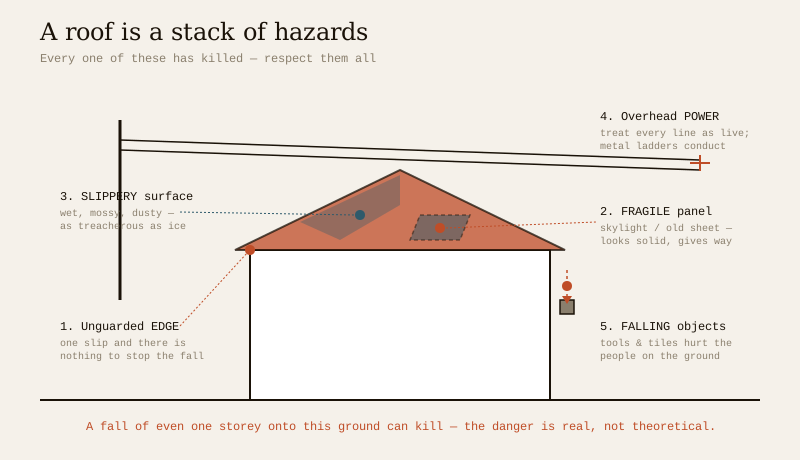
A roof is not one danger but a stack of them. Naming them is the first step to respecting them.
| Hazard | Where it bites | Why it is deadly |
|---|---|---|
| Falls from the edge | The unguarded perimeter of any roof | The classic fatal fall — one slip near an edge with no barrier |
| Falls through the roof | Skylights, brittle old asbestos/fibre-cement sheets, rotten timber, covered openings | The surface looks solid, gives way, and you fall through to the floor below |
| Slips and trips | Wet, mossy, dusty, oily or cluttered surfaces; the slope itself | Loss of footing, usually toward an edge or a weak spot |
| Ladders | Access up and down — the most common single cause of home fall injuries | Slipping, over-reaching, a foot placed wrong, an unsecured ladder sliding out |
| Overhead power | Service lines and cables running near the roof and eaves | Electrocution from a metal ladder, a pole, an antenna or a wet body touching a line |
| Falling objects | Tools, tiles, debris dropped from the roof | Injures or kills people on the ground below — the danger is not only to the worker |
| Weather | Monsoon rain, wind, and searing summer heat | Slippery surfaces, gusts that unbalance you, heatstroke and dizziness at height |
Two of these deserve special emphasis because they surprise people. Fragile roofs — old asbestos-cement or fibre-cement sheeting, plastic roof lights, corroded metal, or a skylight — will not carry a person’s weight, yet look walkable. Every year people die stepping onto a sheet or a rooflight that gives way. Never trust a sheet roof or a skylight to bear weight; professionals cover or barrier them and never step on them. And overhead power lines near a roof turn any metal ladder, pole or antenna into a lethal conductor — keep well clear, and treat every line as live.
The protections professionals use
When a trained crew works at height, they do not simply climb up and hope. They build a system of protections, chosen in a strict order of preference: first stop the fall from being possible at all, then catch it if it happens. This is why real roof work costs what it costs — a large part of the price is staying alive.
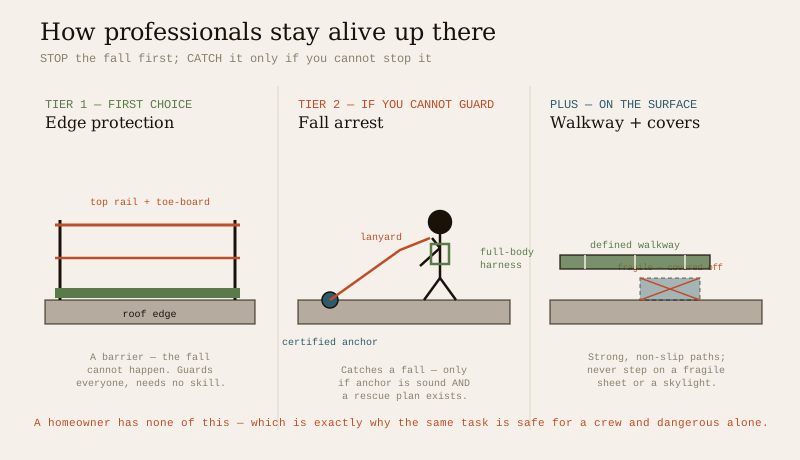
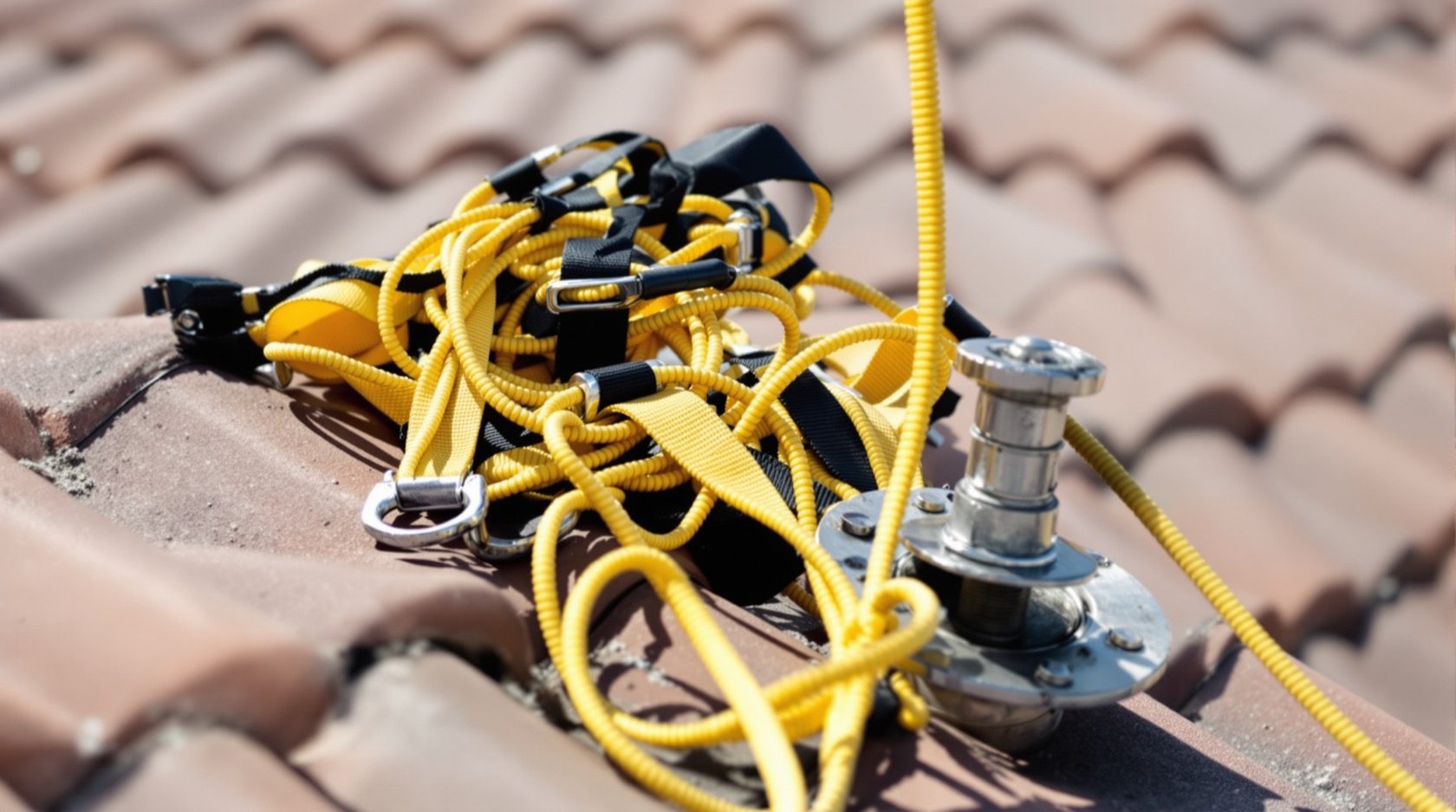
- Edge protection (guardrails). A physical barrier — guardrails with a top rail and a toe-board, or a properly designed scaffold — runs along every open edge so a fall simply cannot happen. This is collective protection: it guards everyone on the roof at once, needs no skill to benefit from, and is always the first choice.
- Fall arrest — harness, lanyard and anchor. Where an edge cannot be guarded, workers wear a full-body harness clipped by a lanyard to a certified anchor point or a lifeline. If they fall, the system arrests them before they hit the ground. It only works if the anchor is sound, the harness fits and is worn correctly, and — critically — there is a rescue plan to get a suspended person down fast. This is skilled equipment, not something to buy online and improvise with.
- Lifelines and running anchors. For work along a length of roof, a horizontal lifeline lets a worker move while staying clipped on the whole time. Designing and anchoring one is an engineered task.
- Safe access — scaffolding and secured ladders. Getting up and down safely is half the battle. Professionals use scaffolding (to IS 3696) or properly footed, tied and angled ladders, never a wobbly ladder balanced on soft ground.
- Roof walkways and crawl boards. On fragile or sloping roofs, defined walkways and crawl boards spread the load and keep feet on strong, non-slip paths — never on brittle sheets between the purlins.
- Fragile-roof covers and covered openings. Skylights, rooflights and open ducts are covered with load-bearing covers or barriered off so no one can step or fall through.
- The basics that tie it together. A helmet, non-slip footwear, a colleague present (never working alone), a check of the weather, exclusion of the area below so nothing dropped hits anyone, and a plan made before going up.
Notice the pattern: stop the fall first (guardrails, barriers), catch it only if you cannot stop it (harness and anchor). A homeowner has essentially none of this — no guardrail, no certified anchor, no colleague, no rescue plan — which is precisely why the same task that is routine for a crew is dangerous for a homeowner.
Monsoon and heat — India’s two extra dangers
India adds two seasonal multipliers to every roof hazard, and both are widely underestimated.
- The monsoon. Rain turns a roof into a skating rink. Algae, moss and lichen on tiles, terraces and copings become treacherously slippery when wet, and the film is often invisible. Wind gusts before and during storms can unbalance a person on an exposed roof. And a wet body near an overhead line or a wet electrical fitting is a serious electrocution risk. The rule is simple and firm: do not go onto a roof in the rain, in high wind, or while a surface is still wet. Wait for a dry, calm day — and the drain that is overflowing right now is not worth dying for; it can wait for the weather or a professional. Ironically, the monsoon is exactly when leaks tempt people up; resist it.
- The heat. A dark terrace or a metal roof can reach 60–65°C in an Indian summer — hot enough to burn skin through thin soles and to radiate heat that brings on dizziness, dehydration and heatstroke fast. Heat exhaustion at height is doubly dangerous, because the first symptom — light-headedness — is the last thing you want near an edge. If roof work is unavoidable in summer, it belongs in the early morning, with water, shade breaks and never alone. A hot metal roof is also more likely to be walked on carelessly because people hurry to get off it — the opposite of what safety needs.
Both seasons point the same way: the weather that most often tempts a homeowner onto the roof — a monsoon leak, a summer AC unit playing up — is exactly the weather that makes the roof most dangerous. That is a professional’s cue, not yours.
What a homeowner can safely do — and what to always hand over
Safety-first does not mean never look at your own roof. It means being ruthlessly honest about the line between what is genuinely safe from a stable, low position and what needs a trained, equipped professional. Here is that line drawn clearly.
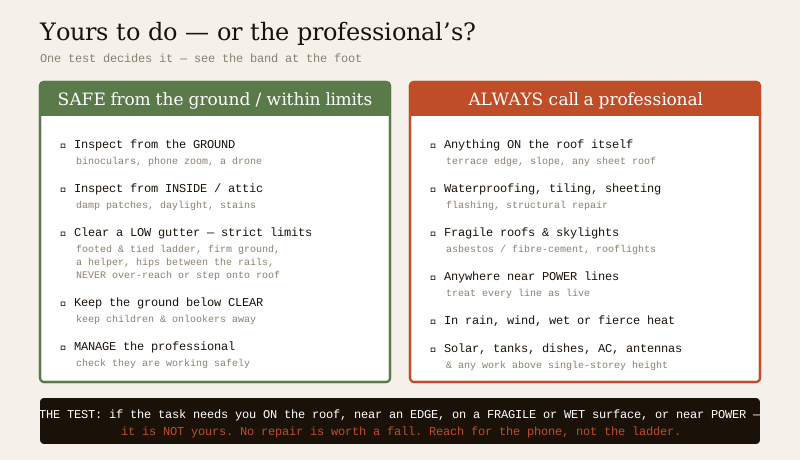
You can usually do these safely — from the ground or within strict limits:
- Inspect from the ground. Walk around the house and look up with binoculars or a phone zoom. Slipped tiles, sagging lines, blocked or overflowing gutters, damaged flashing and staining are all visible from below. A drone, if you have one, is a superb roof inspector that never leaves the ground.
- Inspect from inside. Check the underside of the roof from the top floor or attic — damp patches, daylight through gaps, stains on the ceiling and sagging tell you a great deal without ever going up. See the roof leakage diagnosis guide for what to look for.
- Clear a low, reachable gutter from a stable ladder — within limits. If, and only if, you can do so from a properly footed ladder on firm level ground, with the ladder tied or footed by a helper, staying below the point where you would need to lean out or climb onto the roof, and keeping your hips between the ladder rails — you may clear leaves from a low, easily reached gutter. The moment the task asks you to over-reach, step onto the roof, or work above single-storey height, stop and call someone. Read the gutters and downpipes guide before you start.
- Keep the ground clear and manage the professional. You can prepare the site, keep children and onlookers away from below, and check that the contractor you hire is working safely.
Always hand these to a trained professional — without exception:
- Anything that means getting onto the roof itself — walking a terrace edge, a sloping roof, or a sheet roof of any kind.
- All waterproofing, tiling, sheeting, flashing and structural repair — skilled trades in their own right (see roof leakage diagnosis and repair and the waterproofing guide).
- Anything on or near a fragile roof or a skylight — asbestos/fibre-cement sheets, rooflights, old or corroded surfaces.
- Anything near an overhead power line — treat every line as live and stay well clear.
- Anything in the rain, in wind, or on a wet or very hot surface.
- Installing or servicing rooftop equipment — solar panels, water tanks, dishes, AC units, antennas.
- Any work above single-storey height, or that needs a harness, scaffold or lifeline.
The test is simple: if the task needs you to be on the roof, near an edge, on a fragile or wet surface, or near power — it is not yours. Hand it to a professional with the training, the equipment and the insurance to do it and come home. There is no repair small enough to be worth a fall.
A homeowner roof-safety checklist
Keep this short list in mind every time the roof comes up.
| Before anything | The safe test |
|---|---|
| Can I see it from the ground or inside? | If yes, do that first — binoculars, a phone zoom, a drone, the attic. Most inspection needs no climbing at all. |
| Does the task need me on the roof? | If yes — stop. Call a professional. This is the single most important question. |
| Is it raining, windy, wet or blazing hot? | If yes — do not go up, and do not let anyone else. Wait for dry, calm, cool conditions or hand it over. |
| Is there a power line near the roof or the ladder? | If yes — keep well clear; treat every line as live; do not use a metal ladder near it. |
| Am I alone? | Never work at any height alone. If no one is with you, it waits. |
| Is the ladder footed, tied and on firm level ground? | Only clear a low gutter within limits — never over-reach, never step off onto the roof. |
| Is it fragile — an old sheet or a skylight? | Never step on it. It will not hold you. |
When more than one answer says stop, the decision has already been made for you. The right move is the phone, not the ladder.
The one-line answer
Working at height is genuinely dangerous — a fall of even one storey onto hard ground can kill — and most roof work is trained, equipped, insured professional work that a homeowner should not attempt. Respect the stack of hazards (unguarded edges, fragile sheets and skylights you can fall through, slippery wet or mossy surfaces, ladders, overhead power and falling objects), understand that professionals survive them with a system of protections (guardrails and edge protection first, then a full-body harness on a certified anchor, plus safe access, walkways and fragile-roof covers) that a homeowner simply does not have, and never go up in the monsoon or the summer heat — the very weather that tempts you up. A homeowner can safely inspect from the ground and inside and clear a low gutter from a firmly footed ladder within strict limits; everything that means being on the roof, near an edge, on a fragile or wet surface, or near power goes to a professional — because no repair is worth a fall.
Where to go next
- The whole subject in one map: The Ultimate Guide to Roofing Systems.
- Getting up and around a roof: Roof Access Guide.
- The edge that keeps a terrace safe: Terrace Safety & Parapets Guide.
- Design a roof you can actually use: Terrace Roof Design Guide.
- Find the leak without climbing: Roof Leakage Diagnosis & Repair · Clear the gutters: Roof Gutters & Downpipes Guide.
- The whole library: Roofing Knowledge Hub.
References
- National Building Code of India (SP 7), Bureau of Indian Standards — Part 7 (Constructional Practices & Safety, including safety in construction and working at height) and Part 4 (Fire & Life Safety, including parapet and protective-barrier heights); verify the current edition via the BIS catalogue.
- IS 3696: Safety Code for Scaffolds and Ladders — Bureau of Indian Standards (safe access and scaffolding for work at height).
- Building and Other Construction Workers (BOCW) Act and Rules, and applicable State Factory Rules — statutory provisions for work at height, fall protection and safety on construction and workplaces; requirements vary by state and by workplace, so confirm what applies to your project.
- IS 875 (Part 2): Design Loads (Imposed Loads) — for terrace-access and maintenance loads — and IS 2553 / relevant safety-glass standards for skylight and rooflight glazing; verify current status via the BIS catalogue: https://www.services.bis.gov.in/
This is an educational overview and a safety-awareness guide, not a training manual or a substitute for professional judgement. Working at height is dangerous, specialist work governed by law — engage trained, equipped and insured roofing and access professionals for any work on or near a roof, and verify any standard’s current status via the BIS catalogue before relying on it. When in doubt, stay off the roof and call a professional.
Export this guide
Related Guides — Deep-dive reading
Roof Access & Walkways
Someone will need to get onto your roof several times a year — to clear a drain, service the tank, wash the solar panels, check the waterproofing. Access designed into the house is far safer and cheaper than a ladder propped against a wall. This guide covers the ways up (mumty stairs, fixed ladders, hatches, loft ladders), the ways around (walkways and duckboards over fragile or waterproofed surfaces), and the guardrails and anchor points that make maintenance safe.
RoofingRoof Defects: A Homeowner's Field Guide (India)
The diagnostic catalog that anchors the whole subject — every common roof defect on Indian homes, pictured and named: cracks, damp and efflorescence, ponding, waterproofing blisters, sagging, spalling and rusting rebar, corrosion, algae and moss, parapet and drain-junction failures, slipped tiles and perished fasteners. For each: what it looks like, what it usually means, how serious it is, and exactly who to call.
RoofingRoof Leak Diagnosis & Repair
The homeowner's most common roofing crisis, calmly explained — how to read the signs (stains, damp, efflorescence, peeling paint, drips, a musty smell), why the leak is almost never right above the stain, where roofs actually leak, how leaks are traced, and the honest line between what you can safely check yourself and what needs a professional. India-grounded, monsoon-tested.
RoofingRelated Tools — Try Free
Monsoon-Readiness Checklist
Pre-rain home audit across 9 categories — terrace, drains, waterproofing, electrical, HVAC, pest, vehicles, documents.
Seasonal AuditRainwater Tank Sizer
How big should your rainwater tank be? Computes annual harvest, recommended tank capacity in litres, water-bill savings, and payback — for 10 Indian cities.
RWH CalculatorCross-Ventilation Analyzer
Estimate airflow and air changes per hour (ACH) from room size, window areas, layout, and local wind — with NBC 2016 Part 8 compliance check.
Ventilation Calculator