
The Roof Maintenance Guide
Keeping a roof healthy so it lasts its full life — the seasonal maintenance calendar, the core tasks by roof type, what a homeowner can safely do versus what needs a professional at height, a simple logbook, and how cheap upkeep prevents expensive failures. Plain language, India-grounded, monsoon-aware.
A roof asks for very little and gives a great deal in return. An hour or two, a few times a year — clearing a drain, looking for cracks, checking the waterproofing — is usually all that stands between a roof that quietly lasts its full life and one that fails a decade early. The tragedy of most roof disasters is that they were cheap to prevent and expensive to fix: a ₹0 handful of leaves left in an outlet becomes a ponded terrace, becomes a soaked slab, becomes a stained ceiling, becomes a ₹60,000 re-waterproofing job. Maintenance is the highest-return work you will ever do on a house.
This is the upkeep guide of the Roofing Knowledge Hub, and the practical companion to the Ultimate Guide to Roofing Systems. Many other guides point here because maintenance is where roofing knowledge turns into a roof that actually lasts. It will not ask you to become a waterproofing applicator or to walk a fragile roof — it will give you a calendar to follow, the core tasks by roof type, a clear line between what you can safely do and what needs a professional, and a logbook habit that protects both your roof and its warranty.
Scope & safety. This guide helps you understand, plan and judge routine roof maintenance. Structural assessment, waterproofing application, and any work at height are qualified professional work for a structural engineer and a licensed roofing contractor. Clearing, checking and logging from safe ground or terrace level is homeowner work; climbing onto a sloping, wet, mossy or fragile roof is not. A roof that sags or spalls is a structural warning — do not load it; get an engineer. Nothing here replaces a site-specific inspection.
Why maintenance matters — the cascade
Roof failures are almost never sudden. They are the last step of a slow chain that began months or years earlier with something trivial and cheap. Understanding the cascade is the whole argument for maintenance:
A blocked outlet → ponding → a tired membrane → a wet slab → corroded steel → a structural repair. Each arrow is a season or two, and each one multiplies the cost by roughly ten. Stop the chain at the first arrow — a two-minute drain clearing — and none of the rest happens.
The same logic runs through every roof type. A single slipped tile lets water into the timber below; a loose metal fastener starts a rust bloom; a hairline crack in a parapet becomes the entry point for the leak that stains the bedroom. Water is patient and relentless, and it always finds the layer you neglected. The point of maintenance is not to chase perfection — it is to catch small faults while they are still small, cheap and above the ceiling rather than after they have travelled through it.
There is a second, quieter payoff: a maintained roof keeps its rated lifespan and its warranty. A waterproofing warranty almost always requires evidence of upkeep; an unmaintained roof that fails early is a warranty a manufacturer can decline. Maintenance is what converts a roof's potential life into its actual life.
The roof maintenance calendar
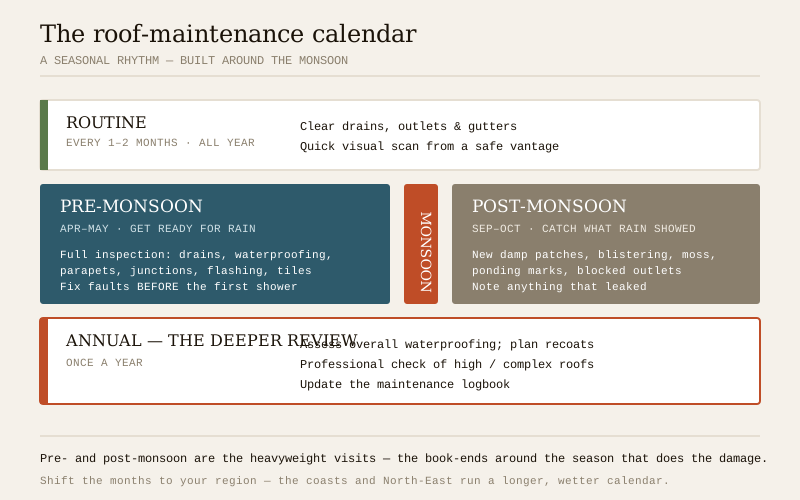
Roof maintenance in India runs on the monsoon. The single most useful habit you can build is a seasonal rhythm: light routine checks through the year, a thorough pre-monsoon inspection before the rains, a post-monsoon check to catch what the rains exposed, and one deeper annual review. Put these on a calendar and the roof effectively looks after itself.
| When | Focus | Typical tasks |
|---|---|---|
| Routine (every 1–2 months) | Keep water moving | Clear leaves and debris from drains, outlets and gutters; a quick visual scan from a safe vantage |
| Pre-monsoon (Apr–May) | Get ready for rain | Full inspection: drains, waterproofing, parapets, junctions, flashing, tiles or sheets; fix faults before the first shower |
| Post-monsoon (Sep–Oct) | Catch what the rains showed | Look for new damp patches, blistering, moss, ponding marks and blocked outlets; note anything that leaked |
| Annual (once a year) | The deeper review | Assess overall waterproofing condition, plan any recoating, professional inspection of high or complex roofs, update the logbook |
The two heavyweight visits are pre- and post-monsoon — book-ends around the season that does the damage. The pre-monsoon check is important enough to have its own dedicated walk-through: see the pre-monsoon roof inspection guide. In heavy-rain regions, add a mid-monsoon glance at the drains after the first big downpour, because that is when a marginal outlet reveals itself. Adjust the months to your region — the coasts and the North-East run to a longer, wetter calendar than the interior.
Core maintenance tasks by roof type
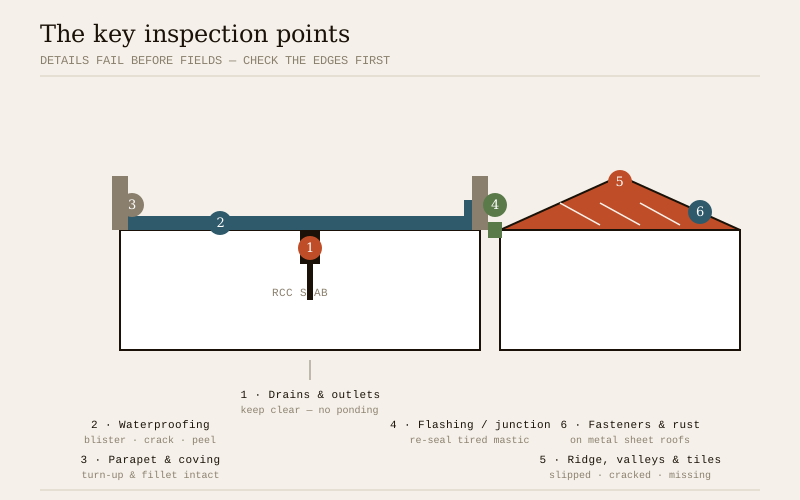
Most maintenance is the same handful of jobs done well and on time. The first four apply to almost every roof; the rest are specific to the covering you have. Know the key inspection points and you can run through them methodically.
The universal tasks — every roof:
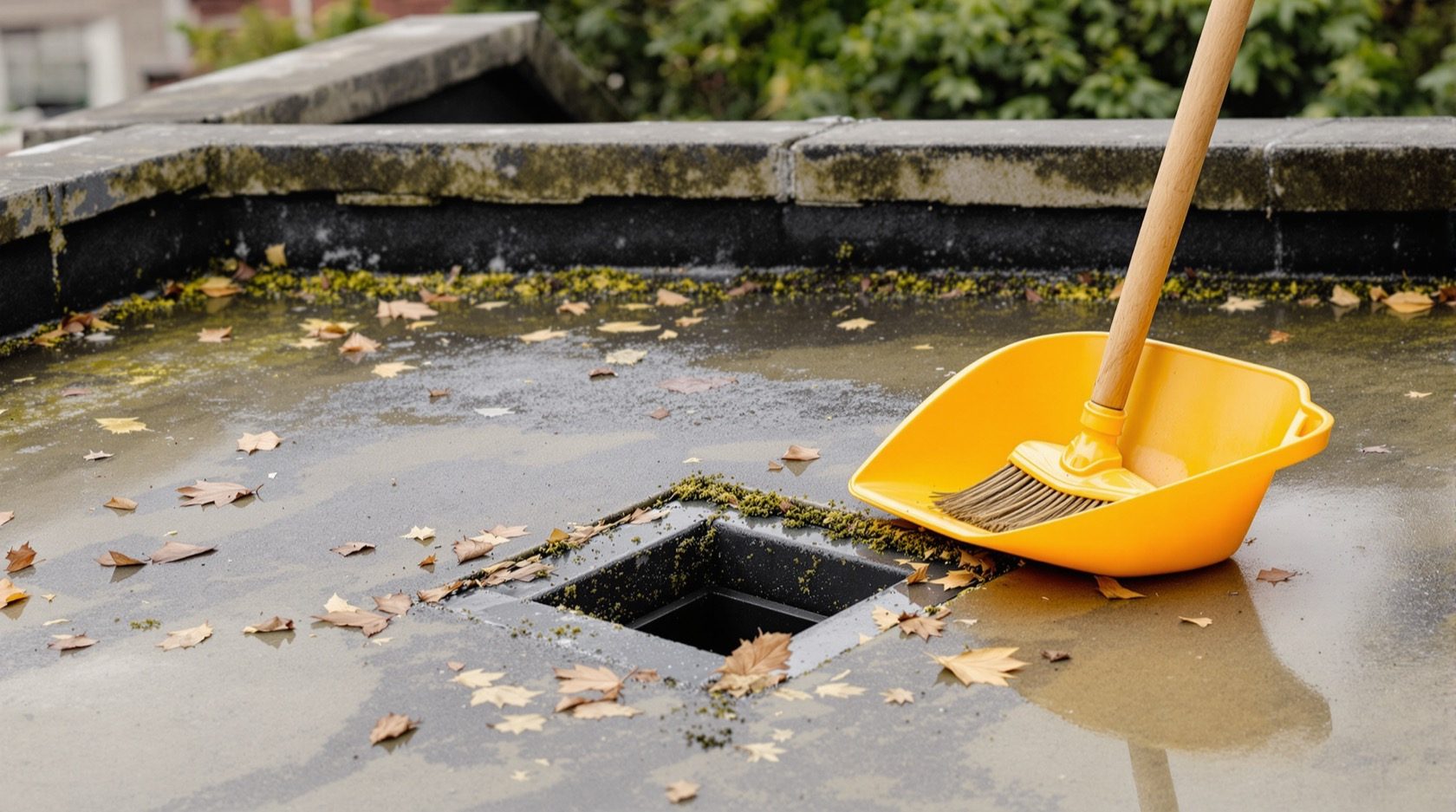
- Clear the drains, outlets and gutters. The most important, cheapest and most neglected task. Blocked outlets cause more roof failures than any material defect. Clear leaves, silt, plastic and birds' nests from every outlet, gutter and downpipe so water leaves fast. This is pure homeowner work from a safe position — do it before every monsoon and after big storms.
- Check the waterproofing. Look across the waterproofing surface for blistering, cracking, peeling, chalky brittleness, lifted edges or plants rooting in. Note where it is tiring so you can plan a recoat before it fails, not after. Re-application itself is a contractor's craft.
- Inspect parapets, junctions and flashing. Leaks start at edges and details far more often than in the open field. Check the wall-to-floor coving, the way waterproofing turns up the parapet, the sealing around pipes and drains, and the flashing at every junction and penetration. Re-seal tired mastic and cracked fillets early.
- Watch for ponding. After rain, note anywhere water sits for more than a day — ponding means the fall is wrong or an outlet is blocked, and it is the number-one killer of flat roofs.
By covering type:
| Roof type | What to watch | Homeowner action |
|---|---|---|
| RCC / flat | Cracks, ponding, damp on the underside, efflorescence, spalling | Clear drains, note cracks and damp; call a pro for recoating or any spalling |
| Clay / concrete tile | Slipped, cracked or missing tiles; moss; sagging ridge; blocked valleys | Spot from the ground or a safe vantage; a roofer replaces tiles at height |
| Metal sheet | Loose or backed-out fasteners, rust blooms, lifted or noisy sheets, tired sealant | Visually check; a roofer re-fixes, treats rust and re-seals laps |
| Green roof | Blocked drains, over-heavy saturated soil, roots at the membrane, weed invasion | Keep drains clear, weed, don't overload; specialist checks the membrane |
| Solar roof | Dust on panels, loose mounts, shading, debris trapped under arrays | Clear debris and clean panels safely; an installer checks mounts and wiring |
The honest rule across all of it: spotting and clearing is yours; anything requiring a recoat, a structural judgement, or a climb onto the covering is a professional's.
What you can safely do — and what to hand over
The most important maintenance decision is not what to do but whether it is yours to do at all. Falls from roofs are among the most common serious home-improvement injuries in India, and a roof is never worth a hospital visit. The line is simple and worth being strict about.
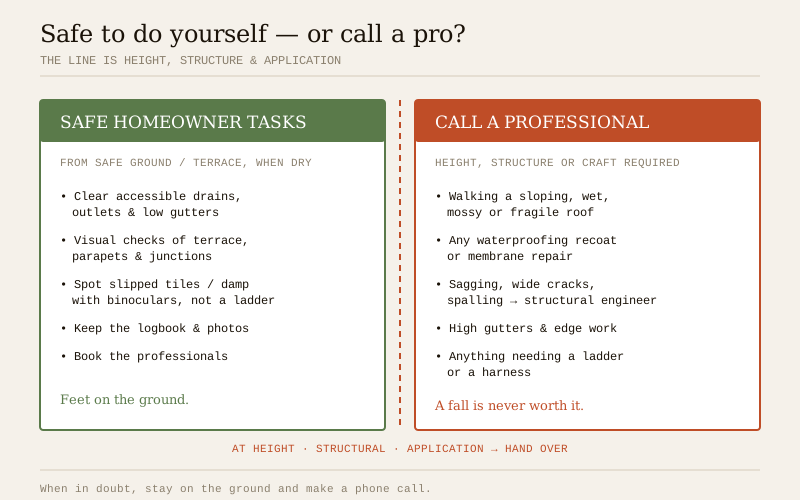
Safe homeowner tasks — from the ground, a stable terrace, or a secure vantage, in dry conditions:
- Clearing leaves and debris from accessible terrace drains, outlets and low gutters.
- Visual checks of the terrace surface, parapets and junctions from terrace level.
- Spotting slipped tiles, rust or damp patches from the ground or a window — with binoculars, not a ladder.
- Keeping the logbook, photographing changes, and booking the professionals.
Call a professional — for anything involving height, structure, or application:
- Walking, inspecting or repairing a sloping, wet, mossy, fragile or fibre-cement roof — these are exactly the roofs that give way.
- Any waterproofing recoat or membrane repair — it is a craft where the same materials last fifteen years or fail in one.
- Any sign of structural trouble — sagging, wide or diagonal cracks, spalling with exposed steel — stop and call a structural engineer.
- Clearing high gutters, working near edges, or anything you would need a ladder or harness for.
If a task needs you to be at height, it needs the discipline of the roof safety guide and the planning of the roof access guide — and for most homeowners, that means handing it to someone equipped for it. A clogged gutter is annoying; a fall is life-changing. When in doubt, stay on the ground and make a phone call.
Keep a roof maintenance logbook
The habit that separates a well-kept roof from a neglected one costs nothing: a simple logbook. A notebook, a phone note or a spreadsheet — anywhere you record what you checked, what you found, and what you did. It turns scattered, forgettable observations into a trend you can read.
A useful log entry captures: the date, the season (routine / pre- / post-monsoon / annual), what you inspected, what you found, photos of anything changing, and any action taken or professional booked. Over a few years the value compounds. You will see the crack that is slowly lengthening, the damp patch that returns each monsoon, the recoat that is now eight years old and due. You will also hold exactly the evidence a warranty claim needs — dated proof that the roof was maintained as required.
Keep alongside it the paperwork that matters: the waterproofing warranty and its conditions, the products and systems used, contractor contacts, and the date of the last recoat. When a leak does appear, this folder tells you and your contractor what is under your feet — which turns a day of guesswork into a targeted repair.
How maintenance extends lifespan and protects warranty
Every roofing material has a rated life — RCC 50 years and more, tiles 30 to 60, metal 20 to 40, a membrane 10 to 25 — but that number assumes good detailing and maintenance. Neglect routinely halves it. Maintenance is the lever that decides which end of the range you land on.
It works in three ways. First, it stops small faults becoming systemic ones — the cleared drain that never lets the terrace pond, the resealed junction that never lets the slab soak. Second, it catches the end of a layer's life in time to renew just that layer — recoating tired waterproofing before it fails is a fraction of the cost and disruption of a full renovation after it does. Third, it keeps the warranty alive: most waterproofing and roofing warranties are explicitly conditional on documented maintenance, so the logbook is not just good practice — it is what keeps the manufacturer on the hook.
The economics are stark. A few hours of upkeep a year, plus an occasional recoat, keeps a roof in service for its full rated life. Skipping it invites the failures that force a premature, far costlier replacement — and, because prices vary widely by city, quality and scale, the smart move before any recoat or repair is to get 2–3 local quotes and sanity-check them with the Roof Cost Calculator. Maintenance is, quite simply, the cheapest roofing you will ever buy.
The one-line answer
A roof lasts its full life only if you maintain it, and maintenance is cheap, simple and high-return: follow a seasonal calendar (light routine checks, a thorough pre-monsoon inspection, a post-monsoon look, one deeper annual review), do the core tasks — above all keep every drain, outlet and gutter clear, watch the waterproofing, inspect parapets, junctions and flashing, and tackle tiles, metal, RCC, green and solar upkeep as each needs — and be strict about the safe line: clearing and spotting from safe ground is yours, but anything at height, any recoat, and any structural sign belongs to a professional. Keep a logbook so you catch the crack that is growing and hold the evidence a warranty needs. Stop the cascade — blocked drain to ponding to wet slab to structural repair — at the first cheap arrow, and a roof you barely think about will quietly outlast the mortgage.
Where to go next
- Start with the whole subject: Ultimate Guide to Roofing Systems.
- The hub map: Roofing Knowledge Hub.
- The seasonal deep-dive: Pre-Monsoon Roof Inspection Guide.
- When upkeep is no longer enough: Roof Renovation & Replacement Guide.
- Diagnose a leak: Roof Leakage Diagnosis & Repair.
- Stay safe at height: Roof Safety Guide · Roof Access Guide.
References
- National Building Code of India (SP 7), Bureau of Indian Standards — Part 6 (Structural Design) & Part 3 (Development Control, Building Services), for the good-practice basis of roof upkeep and access; verify the current edition via the BIS catalogue.
- IS 456: Plain and Reinforced Concrete — Code of Practice (RCC roofs; crack and spalling assessment), Bureau of Indian Standards.
- IS 875 (Part 2): Design Loads (imposed loads) for Buildings and Structures — relevant when judging loads on a terrace or green roof — Bureau of Indian Standards.
- IS 2645: Integral Cement Water-proofing Compounds — Specification, and related waterproofing good-practice — verify current status via the BIS catalogue.
- Manufacturer maintenance schedules and warranty conditions for your specific waterproofing, tile, metal or membrane system — follow them, and get 2–3 local quotes before any recoat. BIS catalogue: https://www.services.bis.gov.in/
This is an educational overview. Structural assessment, waterproofing application and any work at height are qualified professional work — engage a structural engineer and a licensed roofing contractor for your project, and verify any standard's current status via the BIS catalogue before relying on it.
Export this guide
Related Guides — Deep-dive reading
Roof Defects: A Homeowner's Field Guide (India)
The diagnostic catalog that anchors the whole subject — every common roof defect on Indian homes, pictured and named: cracks, damp and efflorescence, ponding, waterproofing blisters, sagging, spalling and rusting rebar, corrosion, algae and moss, parapet and drain-junction failures, slipped tiles and perished fasteners. For each: what it looks like, what it usually means, how serious it is, and exactly who to call.
RoofingRoof Detailing That Doesn't Leak: The Critical Junctions
Roofs almost never fail in the open field. They fail at junctions. A professional's guide to the details that make or break a roof in India: parapet upstands and terminations, penetrations, outlets, expansion joints, abutment flashings, box gutters and valleys, falls, and the tile-roof and metal-roof details that keep water out.
RoofingRoof Leak Diagnosis & Repair
The homeowner's most common roofing crisis, calmly explained — how to read the signs (stains, damp, efflorescence, peeling paint, drips, a musty smell), why the leak is almost never right above the stain, where roofs actually leak, how leaks are traced, and the honest line between what you can safely check yourself and what needs a professional. India-grounded, monsoon-tested.
RoofingRelated Tools — Try Free
Monsoon-Readiness Checklist
Pre-rain home audit across 9 categories — terrace, drains, waterproofing, electrical, HVAC, pest, vehicles, documents.
Seasonal AuditMaterial Schedule Generator
Generate a room-wise finish schedule — walls, floors, ceilings, trim, and joinery by location.
Material ScheduleRenovation vs New Build Calculator
Compare renovating vs building new interiors city-wise across 13 work scopes with GST and per-sqft rates.
Cost Comparison