
Roof Construction Cost in India
What a roof actually costs to build in India, honestly and with ranges — the cost drivers, indicative 2026 rates per sq ft and per m² for RCC, tiled, metal and sheet roofs, what is included versus commonly extra, how city and climate move the number, hidden costs and lifecycle value. Plain language, India-grounded.
"What will the roof cost?" is one of the first questions a homeowner asks and one of the hardest to answer honestly, because the true answer is always "it depends" — on the type of roof, the area, the structure it needs, the waterproofing and insulation you specify, the finish, the labour rates in your city, the season, the scale of the job and the quality you buy. Anyone who quotes a single confident figure for "a roof in India" is guessing, and usually leaving something out.
This is the cost guide of the Roofing Knowledge Hub, and the money-side companion to the Ultimate Guide to Roofing Systems. It will not turn you into a quantity surveyor — a real budget comes from a measured design and local quotes — but it will let you understand what drives the cost, read an indicative range for each roof type, tell what is included from what is quietly extra, and judge a quote with confidence. Every figure here is an indicative 2026 range that varies by place and changes over time; treat it as a sanity-check, never a price list.
Scope & safety. This guide helps you understand, plan and budget a roof. Structural design, load calculation, waterproofing application and any work at height are qualified professional work for a structural engineer and a licensed roofing contractor. All prices below are indicative ranges only — they vary by city, quality, brand, scale and market, and change over time. Price your own roof with 2–3 local quotes and a measured design, and use the Roof Cost Calculator to sanity-check a figure. Nothing here is a fixed or authoritative price.
What actually drives the cost
Before any number means anything, understand the nine things that move it. Two roofs of the same size can differ two- or threefold once these stack up.
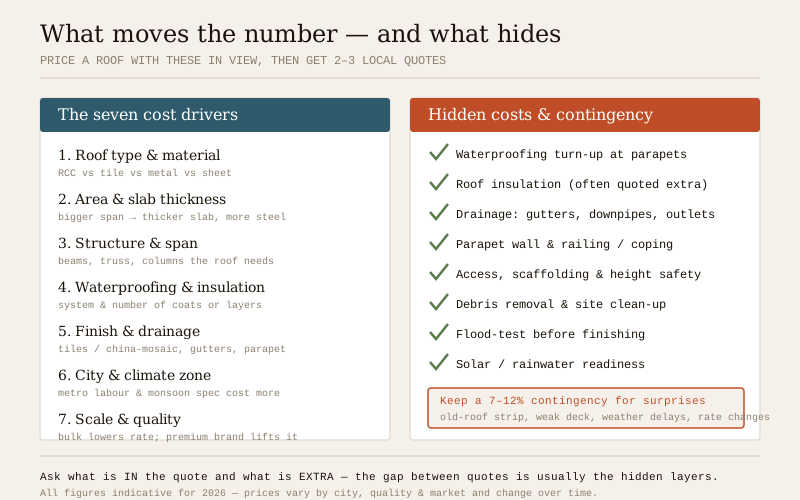
- Roof type and material. The single biggest lever. An RCC slab, a clay-tiled sloping roof, a metal-sheet roof and a fibre-cement sheet sit at very different price points and lifespans.
- Area. More square feet cost more in total, but the rate per sq ft often falls a little with scale as fixed set-up costs spread.
- Slab thickness and structure. A bigger span needs a thicker slab, more steel and sometimes extra beams or columns — the structure is usually the largest single line on a flat roof.
- Waterproofing. A basic coating, a torch-applied membrane and a premium polyurethane system are very different money — and skimping here is the classic false economy.
- Insulation. Over-deck or under-deck insulation adds cost now but pays back in cooler rooms; it is often quoted as an extra (see over-deck vs under-deck insulation).
- Finish. Plain screed versus reflective cool-roof tiles, china-mosaic, or a terrace floor built for use — the wearing course can swing the bill.
- Labour versus material split. Roughly 60–65% material and 35–40% labour on a typical RCC roof; tiled and traditional roofs are far more labour-heavy, metal-sheet roofs more material-led.
- Region and city. Metro labour and stricter monsoon specs cost more than a small town; material freight to remote or hill sites adds up.
- Scale and quality. A large job earns a better rate; a premium brand, thicker gauge or longer warranty lifts it.
Hold these in view and a quote stops being a mystery — the difference between two prices is almost always one of these drivers, most often a layer one contractor included and the other quietly dropped.
Indicative cost ranges by roof system
Here is the part everyone wants — with the honest caveat repeated: these are indicative 2026 ranges that vary by city, quality, brand and scale, and change over time. They cover the built-up roof (structure plus a basic finish) for a normal residential job. Get 2–3 local quotes before you rely on any figure.
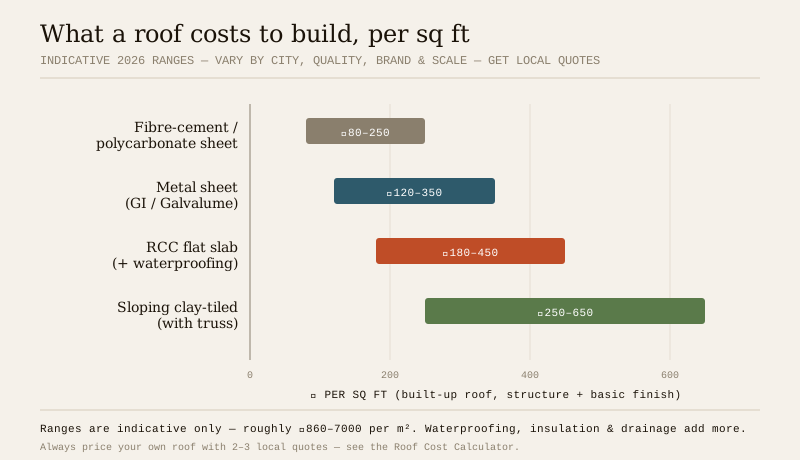
| Roof system | Indicative ₹ per sq ft | Indicative ₹ per m² | What it suits |
|---|---|---|---|
| Fibre-cement / polycarbonate sheet | ₹80–250 | ₹860–2,700 | Verandahs, parking, utility, low-cost cover |
| Metal sheet (GI / Galvalume, colour-coated) | ₹120–350 | ₹1,300–3,800 | Sheds, hill homes, sloping roofs, fast spans |
| RCC flat slab (with basic waterproofing) | ₹180–450 | ₹1,940–4,850 | The default urban flat roof / usable terrace |
| Sloping clay-tiled (with truss) | ₹250–650 | ₹2,700–7,000 | Heavy-rain regions, heritage, character homes |
A few honest notes on reading this table:
- The band is wide on purpose. The low end is a basic job in a smaller town; the high end is a premium spec in a metro. Your roof will land somewhere inside, decided by the drivers above.
- RCC is priced two ways. As a bare slab (material and labour only, often quoted per sq ft of a specific thickness) it is cheaper; the range here includes basic waterproofing and a simple finish, which is closer to what you actually pay to have a usable terrace.
- Tiled roofs carry a truss. The clay tile itself is not the main cost — the timber or steel truss, battens, underlay and skilled labour are, which is why a good sloping roof out-costs a plain slab.
- Sheet roofs need a frame. The sheet is cheap; the purlins, structure and fixings are much of the price. A bare-sheet "per sheet" quote is not the roof cost.
Convert with care: 1 m² is about 10.76 sq ft, so a per-m² rate is roughly 10.8 times the per-sq-ft rate. The Roof Cost Calculator does this and the area maths for you.
Where the money goes — the cost breakdown
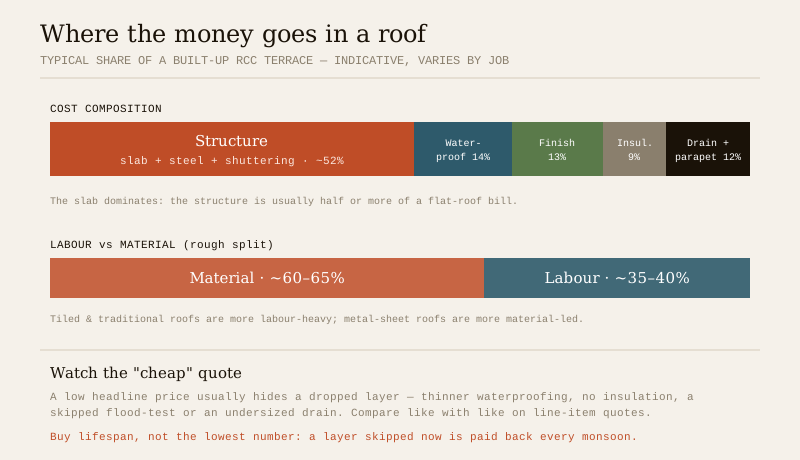
It helps to see a roof's cost split into its parts, because it shows where a cheap quote has cut a corner. For a typical built-up RCC terrace, the composition looks roughly like this.
| Component | Rough share | Why it costs what it does |
|---|---|---|
| Structure (slab, steel, shuttering) | ~50–55% | Concrete, reinforcement steel and formwork — the biggest single line |
| Waterproofing | ~12–15% | Membrane or coating system plus skilled application at details |
| Finish / wearing course | ~10–15% | Tiles, china-mosaic or reflective screed over the membrane |
| Insulation | ~6–10% | Over-deck or under-deck layer (often quoted separately) |
| Drainage & parapet | ~8–12% | Slope screed, outlets, downpipes, parapet and coping |
The lesson from the breakdown: the slab dominates a flat roof, so that is where quotes should broadly agree — the differences usually hide in the smaller layers. When one quote is much lower, look first at the waterproofing (fewer coats? a cheaper system?), the insulation (dropped entirely?), the drainage (undersized?) and the flood-test (skipped?). That is almost always where the money "saved" comes from.
What is included, and what is commonly extra
The most common source of a nasty surprise is not the headline rate — it is the line items a quote leaves out. A roof quote can look cheap because it silently excludes things you will still have to pay for.
Usually included in a roof rate: the structural slab or frame, basic waterproofing, a simple finish, and the labour to lay them.
Commonly extra — ask explicitly:
- Insulation — frequently quoted as a separate add-on, not part of the base rate.
- Full drainage — gutters, downpipes and outlets sized for peak rainfall, and the slope screed that feeds them (see roof drainage).
- Parapet and railing — the parapet wall and safety railing around a usable terrace.
- Premium finish — reflective cool-roof tiles or china-mosaic instead of plain screed.
- Access and scaffolding — a tall or awkward roof needs staging and height-safety measures that add real cost.
- Debris removal — stripping and carting away an old roof on a renovation.
- Solar and rainwater readiness — conduits, mounts and tank provisions are cheap to build in now, dear to retrofit.
- Flood-testing — ponding the terrace to prove the waterproofing before the finish; a quote that omits it is cutting the one test that matters.
The fix is simple and saves the most money of anything in this guide: insist on a line-item quote — structure, waterproofing (system and number of coats), insulation, finish, drainage, parapet, access and testing, each priced — so you can compare like with like and see exactly what a cheaper number left out.
How city and climate move the number
The same roof does not cost the same across India. Two forces pull the price:
- City and labour market. Metros — Mumbai, Delhi, Bengaluru — carry higher labour and overhead than tier-2 and tier-3 towns; the same roof can cost noticeably more in a big city. Remote and hill sites add material freight and access difficulty.
- Climate zone and specification. A roof for a high-rainfall coast or the North-East needs heavier waterproofing, better drainage and often a sloping form, which costs more than a dry-zone flat slab. A hot dry zone leans on insulation and a cool finish; a cold hill zone needs a pitched, insulated roof. Matching the roof to your climate is a cost decision as much as a comfort one.
The practical takeaway: a per-sq-ft figure from a friend in another city is a weak guide. Your number comes from your city's rates and your climate's spec — which is exactly why local quotes beat any published rate, and why the Roof Cost Calculator asks for your inputs rather than handing you a fixed price.
Hidden costs and contingency
Even a careful budget meets surprises, and roofs are especially prone to them because so much is discovered only once work starts. Keep money aside for:
- A weak deck or old roof revealed during stripping on a renovation — extra repair before anything new goes on.
- Re-sloping a terrace whose fall was always wrong, so it stops ponding.
- Weather delays — the monsoon does not care about your schedule, and a stalled job costs.
- Rate changes — cement, steel and bitumen prices move; a quote held for months may need revising.
- Details — extra flashing, coving fillets and turn-ups at parapets, drains and pipe penetrations, where roofs actually leak.
A sensible contingency is 7–12% of the roof budget, held back for these. It is not padding — it is the difference between finishing the roof properly and running out of money at the flood-test.
Cost versus lifecycle value
The cheapest roof to build is rarely the cheapest roof to own. A roof is a 20-to-75-year decision, so the honest way to compare is over its whole life, not just the day it is cast.
- Buy lifespan, not just price. A waterproofing system that lasts 15 years at a higher upfront cost usually beats a cheap coating redone every three or four. Spread over the years, the "expensive" option is often cheaper.
- Count the running savings. Insulation and a cool roof cost more now but cut cooling bills every summer for decades — a real return, not a nicety.
- Count the avoided damage. Proper drainage and waterproofing prevent the ceiling stains, damp and structural harm that cost far more to fix than they did to prevent.
- Match the roof to how long you will keep the home. A forever-home justifies spending for the long life; a short-hold home may not — but never below the threshold where it leaks.
The one place never to save is water and structure: a slab and a waterproofing layer that fail take the whole roof, and often the rooms below, down with them. Save on the finish if you must; never on the membrane, the slope or the steel.
The one-line answer
A roof in India costs what its type, area, structure, waterproofing, insulation, finish, labour, city and quality add up to — so treat any single price with suspicion and read it as a range. Indicatively for 2026, a fibre-cement or polycarbonate sheet runs about ₹80–250 per sq ft, a metal-sheet roof ₹120–350, an RCC flat slab with basic waterproofing ₹180–450, and a sloping clay-tiled roof with a truss ₹250–650 — all varying by place, quality and market and all needing local quotes. The slab dominates a flat-roof bill, with waterproofing, finish, insulation and drainage making up the rest; the surprises hide in the layers a cheap quote drops, so insist on line-item quotes, ask what is included versus extra, keep a 7–12% contingency, and judge the roof over its whole life — buying lifespan on the water and structure, and never on the membrane, the slope or the steel. Then price your own roof with the Roof Cost Calculator and two or three real quotes.
Where to go next
- Start with the whole subject: Ultimate Guide to Roofing Systems.
- The hub map: Roofing Knowledge Hub.
- Price it yourself: Roof Cost Calculator.
- Fix or re-do an old roof: Roof Renovation & Replacement Guide.
- The material choice behind the cost: RCC Roof Guide · Metal Roofing Guide.
- Match it to your weather: Roof Selection Guide for Indian Climates.
References
- Roof construction rates are market prices that vary by city, quality, brand, scale and season, and change over time — there is no single authority. All figures here are indicative 2026 ranges; get 2–3 local quotes and a measured design before relying on any number.
- National Building Code of India (SP 7), Bureau of Indian Standards — Part 6 (Structural Design) & Part 3 (Building Services); verify the current edition via the BIS catalogue.
- IS 875 (Part 2 & Part 3): Design Loads (imposed & wind) for Buildings and Structures — the loads a roof's structure is sized for — Bureau of Indian Standards.
- IS 456: Plain and Reinforced Concrete — Code of Practice (RCC slabs) — Bureau of Indian Standards.
- IS 654 (clay roofing tiles) and IS 2645 (integral cement water-proofing compounds) — relevant to tiled and waterproofed roofs; verify current status via the BIS catalogue: https://www.services.bis.gov.in/
This is an educational overview, not a price list. All prices are indicative 2026 ranges that vary by location, quality and market and change over time. Structural design, load calculation, waterproofing application and any work at height are qualified professional work — engage a structural engineer and a licensed roofing contractor, price your roof with 2–3 local quotes, and verify any standard's current status via the BIS catalogue before relying on it.
Export this guide
Related Guides — Deep-dive reading
The Truth About Cost Per Square Foot
Why a ₹/sqft interior quote is the most misleading number in Indian home costing — and how to convert it into a real BOQ
Cost & MoneyFacade Cost in India: A Per-Sq-Ft Cost & Specification Guide (2025-2026)
A candid, system-by-system breakdown of what every facade material actually costs per square foot in India — from ₹40 painted render to ₹2,500+ structural glazing — plus what drives the price and how to compare quotes fairly.
Building FacadesRoof Leak Diagnosis & Repair
The homeowner's most common roofing crisis, calmly explained — how to read the signs (stains, damp, efflorescence, peeling paint, drips, a musty smell), why the leak is almost never right above the stain, where roofs actually leak, how leaks are traced, and the honest line between what you can safely check yourself and what needs a professional. India-grounded, monsoon-tested.
RoofingRelated Tools — Try Free
Monsoon-Readiness Checklist
Pre-rain home audit across 9 categories — terrace, drains, waterproofing, electrical, HVAC, pest, vehicles, documents.
Seasonal AuditMaterial Schedule Generator
Generate a room-wise finish schedule — walls, floors, ceilings, trim, and joinery by location.
Material ScheduleCross-Ventilation Analyzer
Estimate airflow and air changes per hour (ACH) from room size, window areas, layout, and local wind — with NBC 2016 Part 8 compliance check.
Ventilation Calculator