
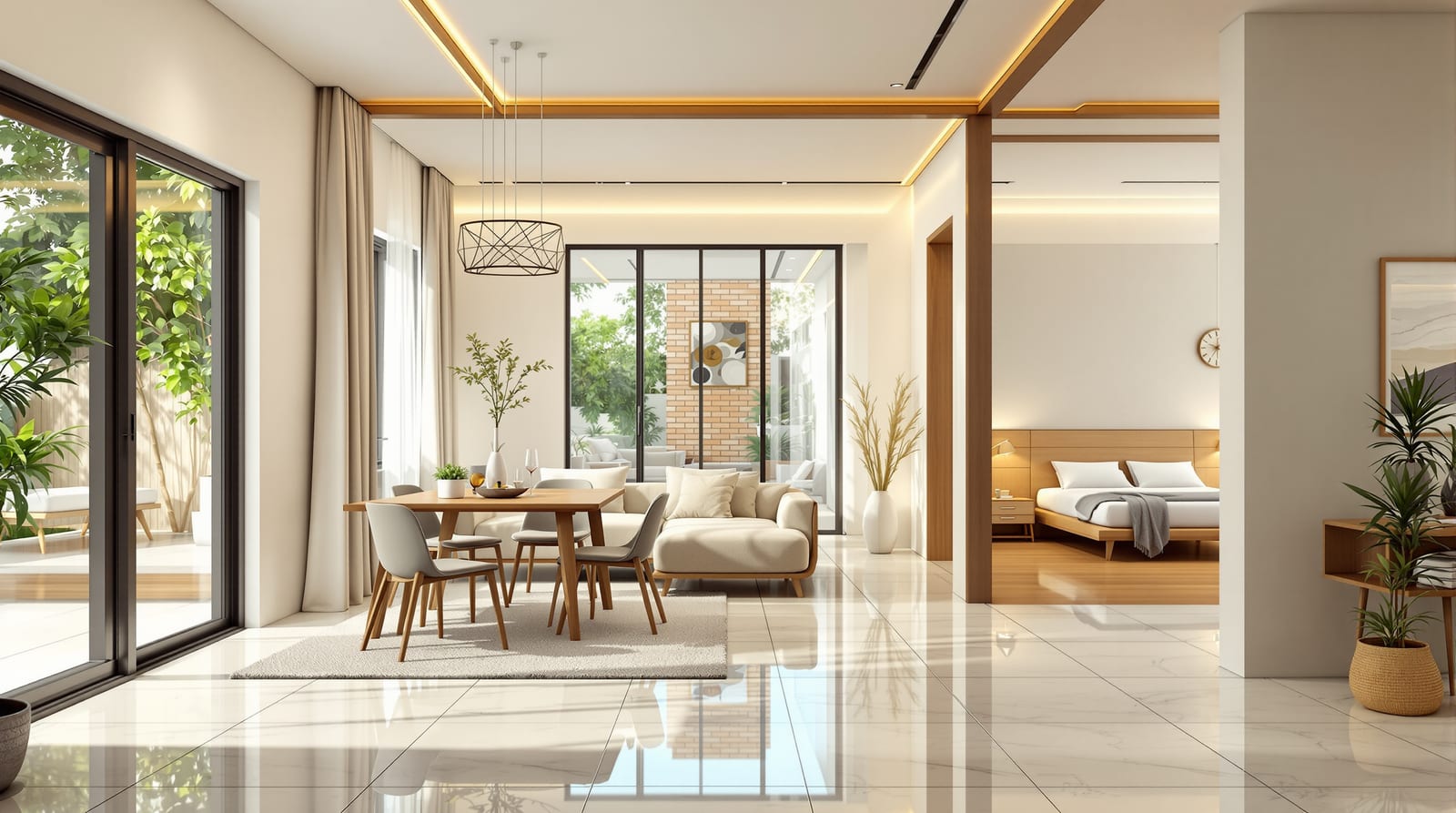
Room by Room Flooring Guide India: The Right Floor for Every Space in Your Home
A complete whole-home planning framework — the top recommended floors, ₹/sq ft, the key reason and the one mistake to avoid for the living room, every bedroom, kitchen, bathrooms, pooja room, staircase, foyer, balcony, terrace, parking and every other space in an Indian home.
No single floor is right for a whole home. The living room wants to impress, the bathroom must never be slippery, the bedroom should feel warm underfoot, the pooja room should stay light and sacred, and the parking must carry a car. The skill of flooring an Indian home is not picking one material — it is matching the right floor to each room's real demands, then making those choices sit together without looking like a sample showroom. This is the complete room-by-room decision map: for every space, the floors we recommend, what they cost per square foot in 2026, the one key reason, and the single mistake people most regret.
How to plan a whole home, not one room at a time
Most homeowners pick tiles room by room as the build progresses, and end up with a house that feels stitched together. A better method is to decide three things up front, before you buy a single box.
First, decide your continuity zones versus your zoning breaks. Continuity — running the same floor across living, dining and passages — makes a home feel larger and is the cleaner, more contemporary look. Zoning — deliberately changing material at a threshold — signals a shift in function (a warm wood bedroom off a cool vitrified hall) and is useful in larger homes. Pick one floor as your "spine" that carries the public areas, then allow three or four considered breaks for bedrooms, wet rooms and the pooja room.
Second, split your budget by traffic, not by area. Spend where feet and eyes go most — the living room, foyer and staircase — and save in low-traffic or hidden spaces like the store and utility. A sensible split for a typical home is roughly 40% on public areas, 35% on bedrooms, 15% on wet areas and the kitchen, and 10% on service and outdoor zones.
Third, mix materials sensibly. The rule that keeps a home looking designed rather than random: limit yourself to one hero stone or tile for public areas, one warm material for private rooms, and a consistent anti-skid family for all wet areas. Continuing a tone (warm greys throughout, or warm browns throughout) across different materials is what ties it together. For the underlying material trade-offs behind every choice here, keep the Complete home flooring guide and How to choose flooring open alongside this page, and use the flooring material selector to shortlist by room.
The whole-home flooring zone map
The plan below colour-codes a typical Indian home into its five flooring duties. Locate each space's colour before you read its detailed section — the colour tells you the kind of floor that space demands.
The master recommendation table
This table is the heart of the guide: every space, its top recommended floors, the 2026 ₹/sq ft band (material plus typical laying, before 18% GST), the key reason, and the one mistake to avoid. Detailed sections and links follow.
| Space | Recommended floors | ₹/sq ft | Key reason | Mistake to avoid |
|---|---|---|---|---|
| Living / drawing | Large-format vitrified, Indian marble, double-charged tile, wood feature | 90-450 | Impression + footfall durability | Over-glossy stone that shows every scratch |
| Dining | Vitrified, marble, large-format; matte or anti-skid near serving | 90-300 | Easy to clean food spills | High-gloss that turns greasy and slippery |
| Master bedroom | Engineered wood, laminate, SPC, warm-tone vitrified | 110-800 | Warm, quiet, soft underfoot | Cold high-gloss tile by the bedside |
| Other / guest bedroom | Laminate, SPC, vitrified | 90-300 | Comfort at sensible cost | Spending wood money on a rarely used room |
| Kids room | SPC, cushioned vinyl, laminate AC4 | 90-300 | Soft, warm, scratch + spill proof | Glossy tile (slip risk) or solid wood (dents) |
| Pooja room | White / light marble, light granite, kota | 100-450 | Light, sacred, easy to keep pure | Dark or busy patterned stone |
| Home office / study | Engineered wood, laminate, SPC, carpet tile | 90-800 | Warm, quiet, low glare for screens | Echoey hard tile that tires you on calls |
| Kitchen | Anti-skid vitrified, double-charged, matte porcelain | 80-300 | Grease + water + heat resistance | Polished marble (stains and etches) |
| Bathroom | Anti-skid ceramic / vitrified (R10-R11), matte porcelain | 50-300 | Slip safety when wet | Glossy or large slabs with too few grout lines |
| Utility / wash | Anti-skid ceramic, vitrified, epoxy, kota | 50-220 | Wet, hard-wearing, cheap to redo | Pretty tile wasted on a hidden wet room |
| Store room | Ceramic, kota, IPS | 50-150 | Robust and inexpensive | Overspending on an unseen floor |
| Staircase | Granite, marble, vitrified with anti-skid nosing | 80-450 | Durable + anti-slip on every tread | Polished steps with no grip groove |
| Foyer / entrance | Granite, marble, large-format PGVT | 90-450 | Impressive + tough + anti-skid in rain | Slippery polish at a wet threshold |
| Passage / corridor | Vitrified or granite, matched to the spine | 90-350 | Continuity, heavy through-traffic | A different floor that chops the home up |
| Home theatre | Acoustic carpet, dark vinyl / laminate, engineered wood | 90-450 | Sound absorption + low reflection | Hard glossy tile that bounces sound |
| Home gym | Rubber rolls / tiles, sports PU, SPC | 90-450 | Impact cushioning + grip | Tile that cracks under dropped weights |
| Balcony | Anti-skid vitrified, stone, WPC deck tiles | 90-260 | Weatherproof + non-slip in monsoon | Indoor glossy tile carried outside |
| Terrace | Heat-reflective / cool anti-skid tile, china mosaic, stone | 90-260 | Heat + waterproofing + grip | Dark floor that bakes the room below |
| Parking / garage | Paver block, VDF, epoxy, kota, anti-skid tile | 60-350 | Carries load + tyre wear + oil | Glazed tile that cracks and skids |
All bands are indicative for 2026, vary by city and grade, and exclude GST and waterproofing. For a precise split across your own plan, run the flooring budget planner; for live rates see Flooring cost per square foot.
Living, dining and passages: the public spine
These are the rooms guests see, where footfall is highest and first impressions are made. Choose one hero material here and carry it through living, dining and the connecting passage for that larger, calmer, continuous feel. The default winner in most Indian homes is large-format vitrified tile — 800x1600mm or 1200x1200mm double-charged or PGVT — because it looks like stone, resists footfall and stains, and costs far less than marble. Where budget allows, Indian marble (Makrana, Ambaji, Banswara) delivers genuine luxury, and a small wood or wood-look feature zone under a TV unit or in a reading nook adds warmth. Keep dining-area finishes matte or lightly textured so dropped oil and curry do not turn the floor into a skating rink. The full trade-offs are in Living room flooring and Dining room flooring, and the passage logic in Passage and corridor flooring.
Mistake to avoid: chasing mirror gloss. High-polish floors look stunning in a showroom but reveal every scuff, footprint and pet scratch in a lived-in home, and become a slip hazard the moment someone walks in with wet feet during the monsoon.
Bedrooms, kids and guest rooms: warm and quiet
Bedrooms reward warmth and softness because you walk them barefoot, often first thing on a cold morning. The premium answer is engineered wood (250-800/sq ft) for its genuine timber warmth; the value answer that looks almost identical is laminate or SPC (90-300/sq ft), both warmer underfoot and quieter than tile. In a kids room, prioritise cushioned vinyl or SPC — it forgives dropped toys, spilled juice and crayon, cleans in a wipe, and will not crack. Reserve solid hardwood for the master only if you truly want it; in a guest room used twice a year, vitrified or laminate is the sensible spend. See Bedroom flooring, Kids room flooring and Guest room flooring for room-specific picks, and compare warm options with Engineered wood flooring, Laminate flooring and SPC flooring.
Mistake to avoid: cold, glossy vitrified right by the bed. It feels harsh on bare feet and clinical in a room meant to feel restful — and in a kids room a polished tile plus wet feet is a fall waiting to happen.
The wet rooms: kitchen, bathrooms, utility
Wet rooms are governed by one non-negotiable: slip safety. Specify an anti-skid surface rated R10 for bathrooms and R11 for the shower zone and kitchen, in line with the principles in Anti-slip flooring for wet areas and Anti-slip flooring standards. For the kitchen, choose anti-skid vitrified, double-charged or matte porcelain — they shrug off grease, water, dropped vessels and heat far better than marble, which etches and stains the first time turmeric or lemon sits on it. For bathrooms, use small-to-medium anti-skid ceramic or vitrified; more grout lines mean more grip, and a matte finish is essential. Keep the utility and wash area practical — anti-skid ceramic, vitrified or even epoxy with a fall to the drain — and do not waste a pretty tile where only the washing machine will see it. Read Kitchen flooring, Bathroom flooring and Utility room flooring, and check ratings fast with the anti-slip principles above.
Mistake to avoid: polished marble or large glossy slabs in a wet room. They look beautiful dry and become genuinely dangerous wet, and few grout lines mean nothing for your foot to grip.
Pooja room: light, simple, sacred
The pooja room is the one space where tradition and practicality both point the same way: a light-coloured floor. White or cream marble is the classic, with light granite or kota as durable, cooler alternatives. Vastu favours placing the pooja in the north-east and keeping it light, clean and uncluttered, and a pale, simple floor supports that visually and is easy to keep spotlessly clean for daily worship. Avoid dark, heavily veined or busy patterned stone — it competes with the deities and the diyas, and tradition reads it as heavy. A plain border or a small inlaid mandala in light marble is as decorative as this floor should get. Full guidance is in Pooja room flooring, with material depth in Marble flooring.
Mistake to avoid: dark or busy stone. Beyond clashing with Vastu sentiment, it makes a small sacred space feel cramped and shows every speck of ash and oil.
Home office, study and home theatre
A home office or study wants warmth and quiet so calls sound clean and screens are easy on the eyes. The best picks are engineered wood, laminate or SPC for low echo and warmth, or carpet tile where you want maximum sound absorption and the ability to lift one stained tile rather than recarpet the room. A home theatre pushes acoustics further: acoustic carpet is the gold standard for soaking up reflections, with dark vinyl, laminate or engineered wood as harder but still low-reflection alternatives — dark tones stop the floor bouncing light onto the screen. See Home office flooring and Home theatre flooring, plus Carpet tiles for the modular route.
Mistake to avoid: hard, glossy tile in either room. It turns a study echoey and tiring on long calls, and ruins a theatre by reflecting both sound and the projector's light.
Staircase, foyer and the vertical/threshold spaces
The foyer is where the home introduces itself, so it earns a durable, impressive floor — granite, marble or large-format PGVT — but with an anti-skid finish at the threshold because shoes track in rain. The staircase is the most safety-critical floor in the house: every tread should be granite, marble or vitrified with an anti-skid nosing groove or strip on the front edge. A polished step with no grip is the single most common cause of falls in Indian homes. Match risers to treads, and keep an unbroken handrail. Detail is in Staircase flooring and Foyer and entrance flooring, with material specifics in Granite flooring.
Mistake to avoid: polished stair treads with no anti-skid groove. They are beautiful and lethal — specify a grooved or grit-strip nosing on every single step.
Outdoor and service: balcony, terrace, parking, store, gym
Outdoor floors face sun, rain and load, so the rules invert: matte and textured beats polished, and weather resistance beats looks. A balcony wants anti-skid vitrified, stone or WPC deck tiles that drain and grip in the monsoon — see Balcony flooring. A terrace needs a heat-reflective or light-toned anti-skid surface over sound waterproofing to keep the room below cooler; Terrace flooring covers the build-up. Parking must carry a car's weight and resist tyre scrub and oil — paver blocks, vacuum-dewatered concrete, epoxy or kota all work; Home parking flooring ranks them. Keep the store room cheap and tough (ceramic, kota or IPS — Store room flooring), and floor a home gym in rubber or sports PU to cushion impact and protect both your joints and the slab — Home gym flooring.
Mistake to avoid: carrying an indoor glossy tile outdoors to "match". Outdoors it skids when wet, fades, and cracks under thermal movement — always switch to an anti-skid, weather-rated material at the door.
Putting it together: a sample 3BHK split
To make this concrete, here is how a typical 3BHK might allocate floors and budget. The living, dining and passage run one large-format vitrified spine for continuity; the three bedrooms switch to warm laminate or SPC; the kitchen, three wet areas and utility share one anti-skid family; the pooja gets light marble; the staircase and foyer get granite; and the balconies get anti-skid stone-look tiles. This gives you four or five materials in total — enough variety to zone the home sensibly, few enough to look designed. Use the flooring material selector to lock your shortlist, then the flooring budget planner to price it against your carpet area, and read the Complete home flooring guide for the deeper material reasoning behind each pick.
Frequently asked questions
Should I use the same flooring throughout the house?
For the public areas — living, dining and passages — yes, one continuous floor makes a home feel larger and calmer and is the cleaner modern look. But it is a mistake to force one material everywhere: bedrooms benefit from warm wood or laminate, wet rooms need anti-skid surfaces, and the pooja room wants light stone. Aim for one continuous spine plus three or four considered breaks.
How many different floor materials is too many?
A good ceiling is four to five materials across a whole home: one hero for public areas, one warm material for bedrooms, one anti-skid family for all wet areas, one durable stone for the staircase and foyer, and one weather-rated floor outdoors. More than that starts to look like a sample showroom. Tying the tones together (all warm or all cool) matters more than matching materials exactly.
Which rooms should I spend the most on?
Spend by traffic and by eyes, not by area. The living room, foyer and staircase are seen most and used hardest, so they justify granite, marble or large-format tile. Save in the store, utility and rarely used guest room. A rough split is 40% public areas, 35% bedrooms, 15% wet areas and kitchen, 10% service and outdoor.
What is the single most important flooring rule for safety?
Anti-skid surfaces in every wet and outdoor space, and a grip nosing on every staircase tread. Slips on polished wet floors and ungrooved stairs cause most home flooring accidents in India. Specify R10-R11 rated tiles for bathrooms, kitchen, balcony and terrace, and never accept a polished stair step without an anti-skid groove or strip.
Can I mix tile and wood in the same home?
Yes, and it is one of the most successful combinations — cool vitrified or stone through the public areas and warm wood or laminate in the bedrooms, with a clean threshold strip where they meet. Keep the tones in the same family so the change reads as intentional zoning rather than a mismatch, and use a flush or low-profile transition strip so there is no trip edge.
Export this guide
Related Guides — Deep-dive reading
Foyer & Entrance Flooring in India: Best Materials, Anti-Skid Picks, Vastu & Cost
The floor that makes the first impression and takes the hardest hits — grit, monsoon mud and footfall — done durable, impressive and safe, with a dirt-trapping entry zone and Vastu welcome notes.
Flooring & SurfacesBest Bedroom Flooring in India: Warm, Quiet, Comfortable Choices
Bedrooms reward comfort over toughness — here is how to choose warm-underfoot, soft and quiet flooring for Indian homes, room by room, with 2026 costs and a Vastu note.
Flooring & SurfacesTerrace Flooring in India: Best Heat-Reflective, Waterproof Rooftop Options (2026)
An Indian terrace takes full sun, heavy monsoon and daily thermal expansion, so the floor is the second line of defence over a sound waterproofing layer and slope: cool-roof china mosaic, heat-reflective and anti-skid vitrified pavers, Kota and Tandur, deck and WPC tiles, pedestal pavers and artificial grass, with ₹/sq ft, expansion joints and the waterproofing-first rule.
Flooring & SurfacesRelated Tools — Try Free
Flooring Cost Calculator
Estimate the all-in cost of a floor — material, laying, wastage, skirting and GST — by area and material.
Flooring CalculatorFlooring Material Selector
Get the best flooring material for your room, budget and climate, with anti-slip checks for wet areas.
Flooring ToolFull-Room BOQ — Living, Bedroom, Kitchen, Bath
Room-wise BOQ across living, bedrooms, kitchen, utility, and bathrooms with line-item pricing.
Full-Room BOQ