
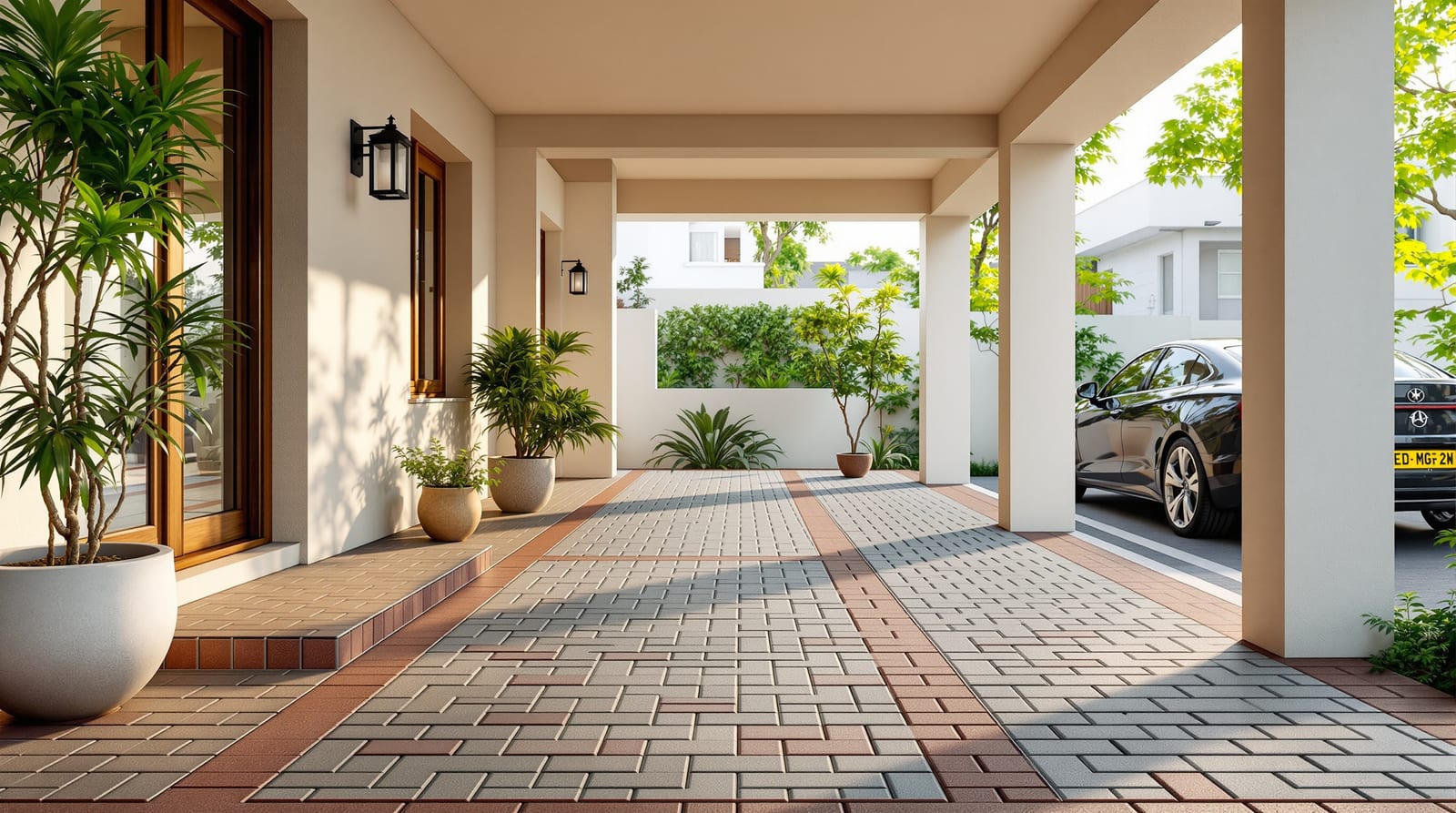
Home Parking Flooring in India: Best Surfaces for Car Porch, Driveway & Garage
How to choose a parking floor that takes vehicle load, resists tyre marks and oil drips, drains the monsoon and still looks good.
A parking floor is the hardest-working surface on your plot. It carries a tonne-and-a-half of car on four small tyre patches, soaks up oil and brake-fluid drips, takes the abrasion of grit dragged in on tyres, and has to shed monsoon water without turning into a skating rink. The pretty vitrified tile from your living room will craze, pop and stain here within a season. This guide ranks the surfaces that actually survive Indian parking — for the open driveway, the covered car porch and the closed garage — and tells you what each costs per square foot.
What a parking floor really has to survive
Before picking a material, be honest about the four loads your parking takes:
- Point load, not spread load. A car weighing 1,200-2,000 kg puts that weight through four contact patches the size of your palm. Add a loaded SUV or a visitor's heavier vehicle and the surface must resist punching and cracking — which is why thin tiles over a weak base fail.
- Grip when wet. Tyres, slippers and a wet floor are a falls hazard. For any sloped or rain-exposed parking, aim for a textured, anti-skid finish — think DIN 51130 R11 territory, never a polished mirror surface. Our anti-slip flooring standards guide explains R-ratings.
- Oil, fuel and tyre marks. Engine oil, coolant, brake fluid and hot black tyre rubber all stain. You want a surface that is either non-absorbent and wipeable (epoxy, dense concrete), or so textured/dark that drips disappear (exposed aggregate, charcoal pavers), or cheaply repairable in patches (paver blocks).
- Water and grit. Open parking needs drainage — a fall of roughly 1 in 80 to 1 in 100 toward a channel or kerb, plus joints or permeable surfaces that let water soak away rather than pool. Trapped water under tiles is the No. 1 cause of parking-floor failure in Indian monsoons. See monsoon-ready flooring.
A closed garage and an open driveway are different problems. The garage stays dry, so cleanliness and a dust-free finish (epoxy, sealed VDF) win. The open driveway gets sun, rain and heat, so drainage, UV stability and repairability (pavers, exposed aggregate, stone) win.
The top picks, ranked
1. Paver blocks (60-80 mm) — the default for open parking
Interlocking concrete paver blocks are the most common home-parking surface in India, and for good reason. Use 60 mm thickness for cars and light vehicles, 80 mm where a heavier vehicle or occasional truck is expected. They are laid dry over a compacted sub-base and sand bed — no rigid screed to crack — so the surface flexes with the ground and individual blocks can be lifted and re-laid if one cracks or sinks. The joints between blocks let rainwater drain, and the textured top is naturally anti-skid. Oil drips stain the block they land on, but you simply swap that one block. Look for IS 15658 compliant pavers of at least M30-M35 grade. Full detail in our paver blocks guide, and size your job with the paver block calculator.
2. Exposed aggregate — durable, grippy, hides drips
Exposed aggregate concrete (the cement is washed back to reveal the stone chips) gives a hard-wearing, naturally anti-skid, monolithic surface with no joints to weed. The pebbly texture grips wet tyres and disguises oil staining and tyre marks beautifully, so it ages gracefully. It is one of the best looks for a contemporary open driveway or porch. Being a poured slab it needs proper control joints and a sound base, and patch repairs are more visible than swapping a paver. See the exposed aggregate flooring guide.
3. VDF / granolithic concrete — the workhorse garage floor
For a closed garage, vacuum dewatered flooring (VDF) gives a dense, dust-resistant, very strong concrete slab that takes vehicle load with ease and can be power-floated smooth or broom-textured for grip. Granolithic (a high-strength cement-and-hard-aggregate topping) does a similar job. Both are economical, repairable and the right base if you later want to add epoxy. Read vacuum dewatered concrete flooring.
4. Epoxy coating — the clean, showroom garage
Epoxy over a sound, cured concrete or VDF slab turns a garage into a clean, dust-free, oil-proof and wipeable surface — the look you see in premium home garages and basement parking. It is non-absorbent, so oil and fuel wipe straight off, and it can be given an anti-slip broadcast for grip. Keep it for covered, dry parking: epoxy is not UV-stable and will chalk and fade in direct sun, and hot tyres can mark cheap thin coats (use a vehicle-grade system). See epoxy flooring.
5. Kota / granite — the handsome covered porch
For a covered car porch that reads as an extension of the house, natural stone is the classic Indian choice. Kota stone is tough, cheap, cool underfoot and fine for a porch — use a leather/honed (not mirror-polished) finish for grip. Granite is harder, near-stain-proof and very durable but pricier; a flamed or leathered granite gives grip plus a premium look. Keep polished stone out of rain-exposed, sloping areas. See kota stone flooring and granite flooring.
6. Heavy-duty anti-skid vitrified — only if specified for it
You can tile a parking floor, but only with thick, heavy-traffic, anti-skid (matt/structured, R11) vitrified tiles laid on a full, well-compacted bed with no voids — hollow tiles crack under point load. This suits a covered porch more than an open driveway. Standard glossy vitrified will fail. See vitrified tile flooring and anti-skid floor treatment.
Comparison: surface vs load, grip, oil, cost
The table ranks the realistic choices for home parking. Cost is indicative installed 2026 ₹/sq ft and varies with city, base prep and finish.
| Surface | Best for | Load capacity | Wet grip | Oil-stain resistance | Drainage | Cost (₹/sq ft) |
|---|---|---|---|---|---|---|
| Paver block 60-80 mm | Open driveway / porch | Excellent (spreads load) | High (textured + joints) | Medium — swap stained block | Excellent (permeable joints) | 60-150 |
| Exposed aggregate | Open driveway / porch | Excellent | High | High (hides drips) | Good (sloped slab) | 120-220 |
| VDF / granolithic | Garage, society parking | Excellent | Medium (broom finish) | Medium | Needs slope + channel | 90-220 |
| Epoxy on concrete | Covered/closed garage | Very good | Medium (add grit) | Excellent (wipeable) | Internal, drained | 120-350 |
| Kota stone (honed) | Covered porch | Good | Medium | Medium | Needs slope | 60-150 |
| Granite (flamed) | Covered porch | Excellent | High (flamed) | High | Needs slope | 130-350 |
| Anti-skid vitrified (HD) | Covered porch | Good (full bed only) | High (R11 matt) | Medium | Needs slope | 90-220 |
For a quick visual on choosing between materials by space, our room-by-room flooring guide and the broader driveway flooring guide go deeper on the outdoor side.
How the floor is built: base + slope
Most parking failures are base failures, not surface failures. The diagram shows the layered build-up that lets a thin surface carry a heavy car.
Whatever the surface, give the finished floor a fall of about 1 in 80 to 1 in 100 toward a kerb, channel or gully so water never stands. Slope away from the house, never toward it. Provide a movement/expansion joint in any large poured slab to control thermal cracking in the heat.
Open driveway vs closed garage: pick differently
- Open driveway / society parking: prioritise drainage, UV stability, grip and repairability. Best: paver blocks (also permeable, so they help groundwater), exposed aggregate, flamed granite or sandstone. Pavers and grass pavers are the friendliest for monsoon and recharge. Avoid epoxy (it fades) and polished anything.
- Covered car porch: you can be more decorative — honed kota, flamed granite, exposed aggregate or heavy anti-skid vitrified all work, with a gentle slope to throw out wind-blown rain.
- Closed garage / basement parking: stays dry, so go for a clean dust-free surface: VDF or granolithic concrete, or epoxy over it for the showroom look and easy oil clean-up. Grip matters less but still add a light anti-slip texture for safety.
Do and don't
- Do compact the sub-base properly and give a clear drainage fall — this matters more than the surface itself.
- Do choose anti-skid/textured finishes for any rain-exposed parking; reserve polished stone and glossy tiles for indoors.
- Do use 80 mm pavers (not 60 mm) where a heavier vehicle is expected, and IS 15658 graded blocks.
- Don't lay standard glossy vitrified or thin tiles on open parking — they craze, pop and get slippery.
- Don't put epoxy in the sun; it chalks and fades. Keep it covered.
- Don't slope the floor toward the house or let water pond at the gate threshold.
Care and upkeep
Hose down grit regularly so it doesn't grind the surface. Clean fresh oil drips promptly — cat litter or sawdust to absorb, then a degreaser; on epoxy and dense concrete it wipes off, on pavers you can swap the stained block. Reseal concrete and stone surfaces periodically for stain resistance — see our floor resealing guide and floor cleaning guide. Top up paver sand joints after a few monsoons so blocks stay locked.
Frequently asked questions
What is the best flooring for a car porch in India?
For an open or lightly covered porch, paver blocks (60-80 mm) or exposed aggregate are the most practical — strong, anti-skid, well-draining and repairable. For a decorative covered porch, flamed granite or honed kota stone looks premium and lasts. Avoid polished tiles and stone in rain-exposed areas.
What flooring is best for a closed home garage?
A VDF or granolithic concrete slab is the economical workhorse; coat it with a vehicle-grade epoxy for a clean, dust-free, oil-proof, wipeable showroom finish. Keep epoxy out of direct sun. See the epoxy flooring guide.
How thick should paver blocks be for car parking?
Use 60 mm interlocking pavers for cars and light vehicles, and 80 mm where a heavier vehicle, SUV or occasional truck will park or where the base is less robust. Specify IS 15658 compliant blocks of M30-M35 grade or better.
How do I stop oil stains on my parking floor?
Choose a non-absorbent or forgiving surface: epoxy and dense concrete wipe clean; dark exposed aggregate and charcoal pavers hide drips; with pavers you can replace a single stained block. Seal porous concrete and stone, and clean fresh drips quickly with an absorbent and degreaser.
How much does home parking flooring cost per sq ft in India?
Indicatively in 2026: paver blocks ₹60-150, exposed aggregate ₹120-220, VDF/granolithic ₹90-220, epoxy ₹120-350, kota ₹60-150 and flamed granite ₹130-350 per sq ft installed. Base preparation, slope and city rates shift these figures; verify current quotes locally.
Export this guide
Related Guides — Deep-dive reading
Driveway Flooring in India: Best Surfaces for Load, Wet Grip & Drainage
How to choose a driveway floor that carries vehicle weight, grips in the monsoon, sheds water and still adds kerb appeal to your home.
Flooring & SurfacesIndustrial Flooring in India: Floor Hardeners, VDF, Epoxy & PU Systems for Factories, Warehouses & Parking — Method, Flatness & Cost
Industrial flooring is the family of heavy-duty floor systems built for factories, warehouses, godowns, workshops, parking and logistics — dry-shake floor hardeners, vacuum-dewatered concrete, granolithic, epoxy and PU toppings, and polished concrete, all rated for forklift traffic, point loads, abrasion, chemicals and dust control at roughly ₹80–400 per sq ft. Here is how to choose the right system by use, with the joints, curing, flatness and cost detail.
Flooring & SurfacesTerrace Flooring in India: Best Heat-Reflective, Waterproof Rooftop Options (2026)
An Indian terrace takes full sun, heavy monsoon and daily thermal expansion, so the floor is the second line of defence over a sound waterproofing layer and slope: cool-roof china mosaic, heat-reflective and anti-skid vitrified pavers, Kota and Tandur, deck and WPC tiles, pedestal pavers and artificial grass, with ₹/sq ft, expansion joints and the waterproofing-first rule.
Flooring & SurfacesRelated Tools — Try Free
Flooring Cost Calculator
Estimate the all-in cost of a floor — material, laying, wastage, skirting and GST — by area and material.
Flooring CalculatorDriveway Flooring Cost Calculator
Estimate driveway surfacing cost — paver blocks, exposed aggregate, stamped concrete, cobblestone or grass paver.
Flooring CalculatorPaver Block Calculator
Estimate concrete paver blocks, bedding sand and cost for a driveway, path or parking by area and thickness.
Flooring Calculator