
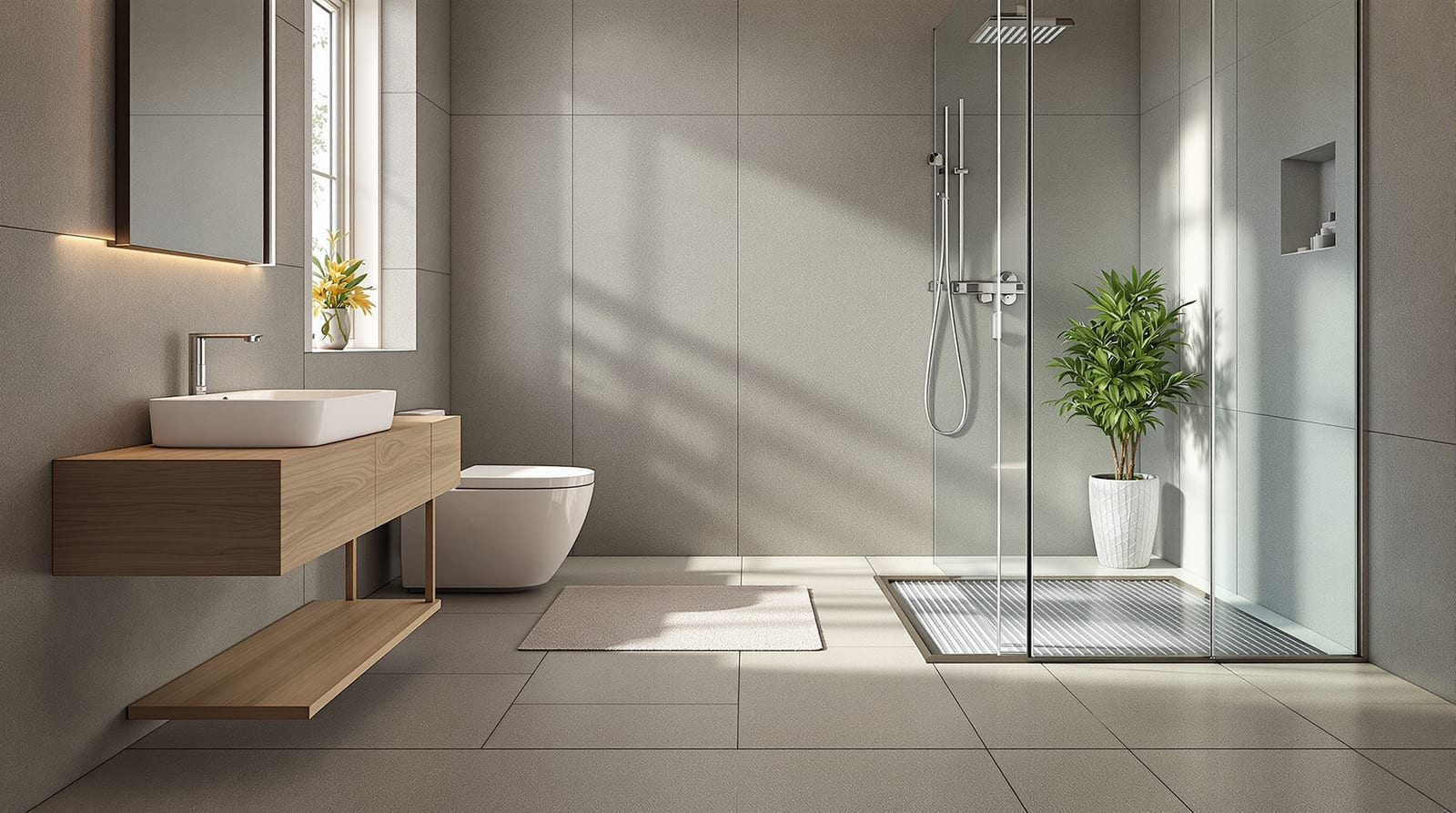
Anti Slip Flooring for Bathroom and Wet Areas in India: R-Ratings, Finishes and Genuinely Safe Tile Choices
How to choose genuinely safe flooring for bathrooms, kitchens, balconies, pools, entrances and elderly- or child-friendly homes — the R-rating system, finishes that grip wet feet, anti-skid natural stone, slope to drains and the tiles to avoid.
The single most preventable injury in an Indian home is a slip on a wet floor, and the cure is mostly a decision you make at the tile shop, not after the fall. Choosing the right slip-rated, textured surface for every area that gets wet — bathrooms, kitchens, balconies, the monsoon entrance, the pool deck, the utility — costs almost nothing extra over a glossy tile, yet it is the difference between a floor that is safe under soapy water and one that behaves like ice. This guide is about specifying genuinely safe flooring upfront: how to read the R-rating system, which finishes actually grip a wet foot, where natural anti-skid stone wins, what to refuse for a wet zone, and the slope and accessibility details that make the whole thing work.
Understanding the R-rating system
Almost every serious slip decision comes back to one number on the tile box: the R-rating. It comes from the DIN 51130 ramp test, where a tester walks across an oil-coated tile fixed to a ramp that tilts upward until they begin to slip. The steeper the angle they can hold, the higher the rating, on a scale from R9 (lowest grip) to R13 (highest). A barefoot version of the same idea, the DIN 51097 "A-B-C" wet ramp test, is used for barefoot wet areas like shower floors and pool surrounds, where C is the grippiest.
The practical translation for an Indian home is simple. Anything that gets wet should be R10 or better; bathrooms and showers want R10 to R11; outdoor, terrace and pool-surround surfaces want R11 to R12. Dry bedrooms and living rooms can stay at R9, where a smoother, easy-clean finish is fine because grip barely matters when the floor is never wet.
| R-rating | Slip resistance | Best suited to |
|---|---|---|
| R9 | Low (dry only) | Bedrooms, living rooms, dry lobbies, dry passages |
| R10 | Moderate | Kitchens, entrances, general bathroom floors, balconies |
| R11 | Good | Shower zones, wet bathrooms, covered outdoor, utility |
| R12 | High | Open terraces, pool surrounds, ramps, exposed entries |
| R13 | Very high | Industrial / commercial wet kitchens (rare at home) |
A second number you will meet in commercial and accessibility specifications is the wet pendulum test value (PTV), used in British and Australian standards. A swinging rubber foot drags across a wetted tile; a PTV of 36 or more is low slip risk, and below about 25 is high risk. The R-rating and the pendulum measure slightly different things — ramp grip with oil versus drag on a wet surface — but they agree on the essentials: a polished, glossy surface scores badly when wet, and texture pushes the score up. When in doubt, ask your dealer for the rating in writing, because the words "anti-skid" on a brochure mean nothing without a number behind them.
Finish, not just material, decides grip
Two tiles of identical body — the same vitrified porcelain — can be lethal or perfectly safe depending only on the surface finish. This is the single most misunderstood point in Indian flooring. Grip comes from micro-texture that breaks the thin film of water between foot and floor, so the finish you choose matters more than the headline material.
- Glossy / polished (full-gloss vitrified, PGVT, polished marble): mirror-smooth, beautiful when dry, dangerously slippery when wet. Keep these for dry rooms only.
- Matte: a non-reflective, slightly closed surface; a real improvement over gloss and a sensible default for general bathroom and kitchen floors at roughly R10.
- Textured / structured / "sugar" finish: a deliberately rough, raised micro-pattern pressed into the tile; the workhorse anti-skid finish for showers, balconies and wet zones, typically R10 to R11.
- Lappato (semi-polished): a partly buffed surface that looks semi-gloss but keeps some grip; a compromise for areas that want a richer look with modest wet safety — not for shower floors.
- Anti-skid grip-coated tiles: factory ranges sold expressly for bathrooms, parking and terraces, usually carrying a stated R-rating.
The same logic applies to stone. A polished granite or marble slab is slick when wet, but the identical stone given a flamed (thermally roughened), leather/leathered, sandblasted, bush-hammered or honed finish grips far better. So the rule for wet areas is not "avoid stone" or "use tile" — it is choose a textured, matte or structured finish and refuse the gloss.
The diagram: how texture grips a wet foot
The illustration below shows why a structured, matte surface is safe and a polished one is not. On a smooth glaze the water forms a continuous film that floats the foot; on a textured surface the raised micro-peaks pierce that film and the channels between them let the water escape, so the foot meets the floor and grips.
Area-by-area: what to choose for each wet zone
Different wet areas have different enemies — soap, oil, rain, chlorine, monsoon mud — so the right specification changes from room to room. Use this as a buying checklist when you brief your dealer or contractor.
| Area | Wet hazard | Target R-rating | Recommended finish and material |
|---|---|---|---|
| Bathroom floor (general) | Soapy water | R10-R11 | Matte or textured vitrified / porcelain; honed Kota or flamed stone |
| Shower / wet-room floor | Soap + standing water | R11 (barefoot C) | Small textured tiles or mosaic; structured porcelain; anti-skid stone |
| Kitchen | Oil splatter + water | R10-R11 | Textured matte vitrified; flamed granite; epoxy with anti-slip grit |
| Balcony (open / semi-covered) | Rain | R10-R11 | Anti-skid / sugar-finish porcelain; flamed/leather stone |
| Open terrace | Full rain + sun | R11-R12 | Structured anti-skid porcelain, china-mosaic, flamed stone, terracotta |
| Pool deck / surround | Constant wet + chlorine | R11-R12 (barefoot C) | Anti-skid porcelain, flamed/leather granite, exposed-aggregate |
| Entrance / foyer (monsoon) | Wet feet, dripping umbrellas | R10-R11 | Textured tile + entry mat; flamed stone; honed Kota |
| Utility / wash area | Constant water | R10-R11 | Textured vitrified, ceramic, or anti-slip epoxy |
| Staircase (especially external) | Rain + fall risk | R11 + nosing | Textured stone/tile with grit nosing strip on each tread |
A few patterns repeat across the table. Textured or matte vitrified and porcelain is the everyday answer for most Indian wet zones because it is low-maintenance, low-absorption (porcelain absorbs under 0.5 percent water per IS 15622) and comes in dedicated anti-skid ranges from Morbi and major brands. Natural anti-skid stone — flamed or leathered granite, honed Kota — is the premium choice for entrances, terraces and pool decks where you want a stone look with real grip. And in showers, smaller tiles win for a reason explained next.
Why small tiles and natural stone help
Two design choices quietly raise wet safety more than most homeowners realise.
Small tiles mean more grout, and more grout means more grip. A shower floor laid in 100 mm or mosaic tiles has many more grout lines per square metre than one laid in a single large slab, and each grout joint is a slightly recessed, textured line that the foot keys into and that channels water away. The same small-tile layout also lets the floor be sloped neatly to the drain in several facets rather than one awkward warped plane. This is why the classic safe shower floor in India is small textured tiles or mosaic, even when the walls are large-format.
Natural anti-skid stone is genuinely safe when finished correctly. Flamed granite is heated so the surface crystals pop into a rough, permanently grippy texture; leathered (leather-finish) granite has a soft, dimpled, low-sheen surface that grips wet feet without the harshness of flaming; honed Kota stone — a long-standing favourite for Indian bathrooms and verandahs — has a naturally matte, slightly porous surface that is far safer wet than any polished tile. These finishes keep their grip for the life of the stone because the texture is in the material, not a coating that wears off. For deeper material detail, see Studio Matrx on porcelain tile flooring and on selecting surfaces for the wettest room, bathroom flooring.
What to avoid in wet zones
Just as important as what to choose is what to refuse, however good it looks in the showroom.
- Polished marble and other high-gloss stone in bathrooms, around pools or at the monsoon entrance: it is slick when wet, acid-sensitive (soap and cleaners etch it), and a serious fall risk. Save polished marble for dry living and bedroom floors.
- Full-gloss polished vitrified and PGVT in any wet area: these mirror-finish tiles are the commonest cause of slippery Indian bathrooms because buyers pick them for looks without checking the finish. The same PGVT body is fine in matte or textured form — it is the gloss that is dangerous.
- Laminate on flood-prone or constantly wet ground floors: it swells and de-laminates with standing water; keep it to dry bedrooms upstairs.
- Large single slabs with no slope on a shower floor: water pools, there is little grout to grip, and the plane is hard to drain.
- "Anti-skid" tiles with no stated R-rating: treat the claim as marketing until you see R10 or higher in writing.
If you have already laid a glossy floor in a wet area and cannot replace it, you do not have to live with the danger — an acid-etch retro-treatment can raise its wet grip. That route is covered in full in the Studio Matrx guide to anti-skid floor treatment.
Slope, drainage and waterproofing make grip work
A grippy tile on a badly built wet floor is still unsafe, because standing water defeats any finish and breeds slippery slime and mould. Two construction details do the heavy lifting.
Slope to the drain. Every wet-area floor must fall toward its trap or drain at roughly 1:80 to 1:100 (about 10 to 12 mm per metre) so water clears quickly instead of pooling. In a shower, fall the whole enclosure toward a corner or linear drain; in a balcony or terrace, fall toward the outlet, away from doors. Small tiles or mosaic make this slope easy to form cleanly.
Waterproofing below the finish. A wet floor should sit on a proper waterproofing membrane (cement-polymer coatings, or integral admixtures per IS 2645) with the membrane turned up the walls. This keeps water from saturating the slab, which is what eventually loosens tiles, grows mould in the grout and makes a floor slimy and slippery. Pairing epoxy grout with anti-skid tiles in showers and kitchens is worth the extra cost because it does not absorb water or harbour mould the way cement grout does. For the climate and drainage angle in the rains, see Studio Matrx on monsoon-ready flooring, and for the broader weather logic of choosing surfaces, how to choose flooring for Indian weather.
Accessibility: elderly, child-safe and the rules
For homes with elderly parents, young children or anyone with reduced mobility, wet-area slip safety stops being a nice-to-have and becomes the priority, because a fall on a hard wet floor causes the most serious injuries. India's rules back this up. The National Building Code (NBC 2016) calls for slip-resistant floors in wet and circulation areas, and the Rights of Persons with Disabilities Act and rules (RPwD 2021) with the Harmonised Accessibility Guidelines require firm, stable, slip-resistant, level floors with thresholds no higher than about 12 mm so there is nothing to trip over, and anti-slip surfaces on ramps and accessible toilets.
In practice, for an age-friendly or child-safe home: specify R11 anti-skid tiles or honed/flamed stone in every bathroom and shower, keep transitions between rooms flush or under roughly 12 mm, add grab bars in the shower and beside the WC, lay a runner or anti-slip mat at the monsoon entrance, and avoid raised steps into wet areas. These are the same wet-grip and level-floor priorities that run through good accessible design generally, and they cost very little if you decide them before laying the floor rather than retrofitting after a fall.
Frequently asked questions
What R-rating should I choose for a bathroom floor?
Aim for R10 to R11 on the general bathroom floor and R11 (or barefoot class C) on the shower floor itself. Kitchens, balconies and entrances want R10 minimum, and open terraces and pool surrounds want R11 to R12. Dry bedrooms and living rooms can stay at R9 because grip does not matter where the floor is never wet. Always ask the dealer for the rating in writing.
Are matte tiles enough, or do I need special anti-skid tiles?
For a general bathroom or kitchen floor, a good matte vitrified or porcelain tile (around R10) is usually enough. For shower floors, pool decks, open terraces and any home with elderly residents, step up to a textured / structured "anti-skid" finish at R11, or use small tiles and mosaic whose extra grout lines add grip. Finish matters more than the headline material.
Can I use marble or polished granite in a bathroom?
Polished marble and polished granite are slippery when wet and best avoided in showers, pool surrounds and the monsoon entrance. If you love the stone look in a wet area, choose a flamed, leathered, honed or sandblasted finish instead of polished — the same stone, given a textured finish, grips wet feet well and keeps that grip for life. Honed Kota stone is a proven safe Indian bathroom choice.
Why are small tiles safer on a shower floor?
Small tiles and mosaic create many more grout lines per square metre, and each slightly recessed, textured grout joint gives the foot something to key into while channelling water away. They also let the floor be sloped to the drain cleanly. That is why the classic safe shower floor in India uses small textured tiles even when the walls are large-format slabs.
Do I need slope and waterproofing even if the tiles are anti-skid?
Yes. A grippy tile on a floor that pools water is still unsafe, because standing water defeats any finish and breeds slippery slime. Build in a fall of about 1:80 to 1:100 to the drain, lay a proper waterproofing membrane turned up the walls, and prefer epoxy grout in showers so water cannot soak the joints and grow mould.
Export this guide
Related Guides — Deep-dive reading
Monsoon Flooring in India: Slip-Safe, Quick-Dry Floors That Survive the Rains
How to choose and protect floors that stay safe and dry through the Indian monsoon — anti-skid entries, low-absorption surfaces, drainage and mould control.
Flooring & SurfacesBathroom Flooring Guide India: Anti-Skid Tiles, Stone, Vinyl & Epoxy Compared
Every bathroom floor material for Indian homes in one place — anti-skid ceramic and vitrified tiles, natural stone, mosaic, vinyl (SPC/LVT) and epoxy — with a full comparison table, slip ratings, ₹/sq ft costs and the safety and slope rules that keep a wet floor from becoming a hazard.
BathroomsAnti Skid Floor Treatment India: Make Slippery Tiles Safe Without Replacing Them, R-Ratings, Acid-Etch and Anti-Slip Coatings
How to make slippery polished floors safe in Indian homes: where slips happen, what R-ratings and the wet pendulum test mean, how anti-slip acid-etch treatment raises grip on existing tiles at ₹15-40 per sq ft, plus coatings, mats, strips, choosing anti-skid tiles upfront and accessibility rules.
Flooring & SurfacesRelated Tools — Try Free
Monsoon-Readiness Checklist
Pre-rain home audit across 9 categories — terrace, drains, waterproofing, electrical, HVAC, pest, vehicles, documents.
Seasonal AuditChild & Elder Home-Safety Audit
Room-by-room safety audit for households with children or seniors — 10 categories, 70+ checkpoints tagged by audience.
Safety AuditFull-Room BOQ — Living, Bedroom, Kitchen, Bath
Room-wise BOQ across living, bedrooms, kitchen, utility, and bathrooms with line-item pricing.
Full-Room BOQ