
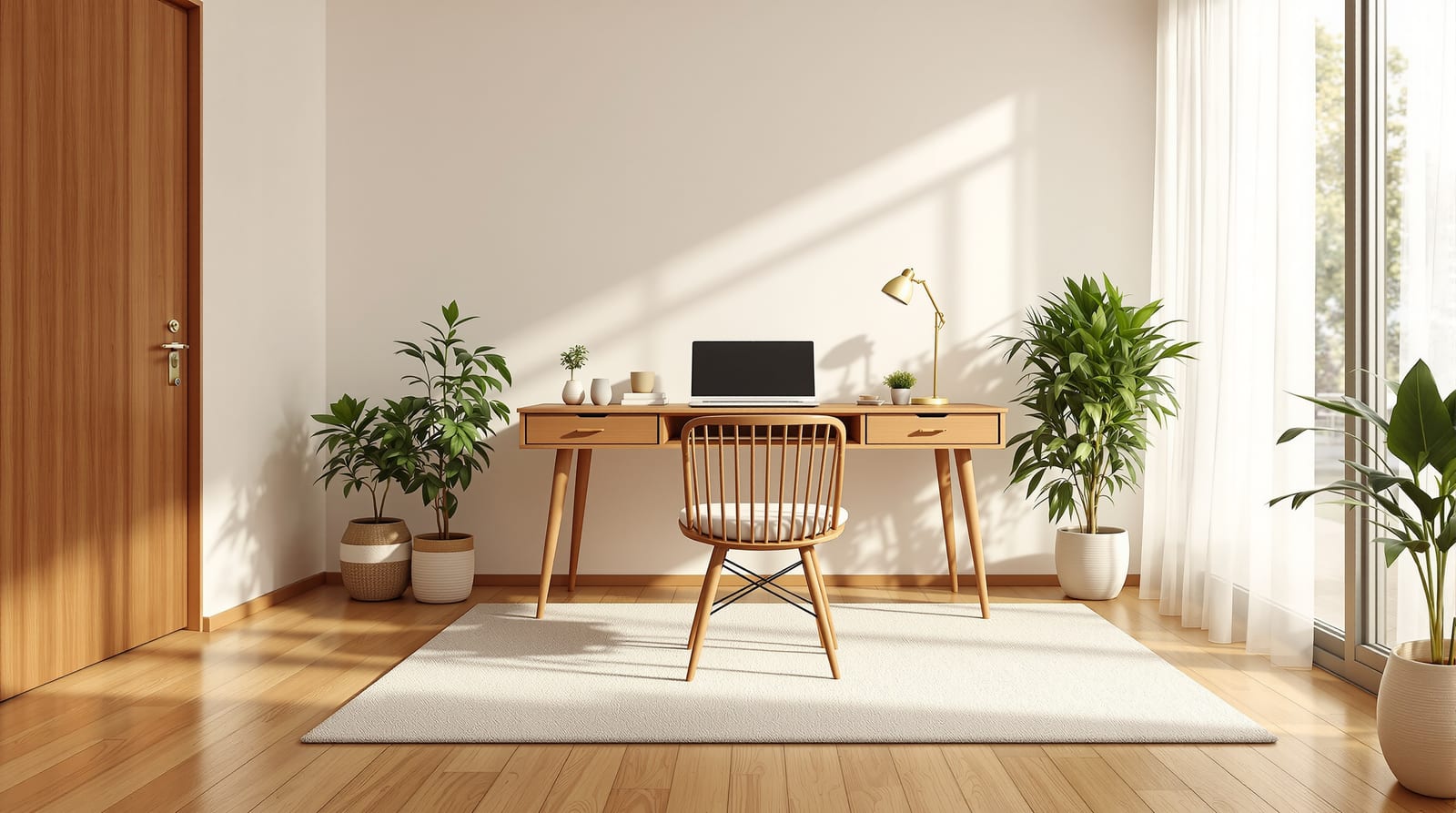
Home Office Flooring in India: Best Floors for a Quiet, Comfortable Study Room
How to choose warm, quiet, caster-friendly flooring for a work-from-home study or home office in India.
The work-from-home years turned the spare bedroom, the corner of the hall and the converted balcony into the most-used room in the house. A home office floor has a job description unlike any other room: you sit on it for eight hours, roll a caster chair back and forth a hundred times a day, take calls that pick up every echo, and need it to look calm enough to think in. Get it right and the room disappears into focus. Get it wrong and you fight a noisy, cold, scratched-up floor every working day.
This guide ranks the floors that actually suit an Indian study or home office, scores them on the four things that matter, gives 2026 rates per sq ft, and covers the practical stuff nobody mentions: the chair mat, cable management and rug zoning. For a whole-house view, start with our room-by-room flooring guide for India, and to compare specific products side by side use the flooring material selector.
What a home office floor really has to do
A study room is a dry, low-traffic, single-person space — so it does not need the slip ratings or scrub-tough surfaces of a kitchen or bathroom. Its demands are quieter and more specific:
- Warmth and comfort for long hours. Bare vitrified or stone feels cold and hard underfoot through a long working day, especially in winter mornings in the north. A floor that feels warm, or that takes a rug well, keeps you comfortable without socks-and-slippers.
- Quiet — acoustics for calls. Video calls are the new normal. Hard, reflective floors bounce sound, making your voice echo and the room sound hollow on a call. Soft or resilient floors absorb it, so you sound clear and the room feels calm.
- Chair-caster durability. The single biggest floor-killer in a home office is the office chair. Hard plastic casters dragged over the same patch for years will scuff laminate, dent soft vinyl and scratch wood. The floor must either resist casters or be protected by a mat.
- A calm, focused look — and easy cleaning. You want a surface that recedes rather than shouts, and that a quick wipe or vacuum keeps tidy without daily mopping.
Notice that slip resistance, the headline issue in wet rooms, barely matters here. That frees you to choose for comfort and quiet instead.
The floors that suit a home office, ranked
Engineered wood, laminate and SPC — the warm, quiet, caster-friendly trio
For most Indian home offices, a wood-look resilient or click floor is the sweet spot. All three feel warmer than tile, are quieter underfoot, install fast over existing floors as a floating click system, and give the calm, grounded look that suits a study.
- Laminate flooring is the value pick: a tough wear layer (look for AC4/AC5 commercial-grade) shrugs off chair casters better than you would expect, and the warm wood look is convincing. It is sensitive to standing water but a study is dry, so that is rarely an issue.
- SPC flooring (stone-plastic composite, a rigid-core vinyl) is the most caster-durable of the three — its dense core resists denting, it is fully waterproof, and it is quiet with a good underlay. Ideal if your office doubles as a guest room or sits near a balcony.
- Engineered wood is the premium choice: real timber warmth and feel, with more stability than solid wood in humid Indian conditions. It is the most caster-sensitive of the trio, so a chair mat is non-negotiable.
All three benefit hugely from a proper acoustic underlay (an IXPE or cork foam layer), which both softens caster noise and damps call echo.
Carpet tile — the quiet, swappable option
Carpet tiles are the acoustics champion. Nothing else absorbs call echo and footstep noise as well, and a carpet floor feels warm and inviting under a long working day. The home-office trick is the modular format: lay 50x50 cm tiles, and if your chair wears a track or you spill coffee, you lift and swap a single tile instead of recarpeting the room. Use a low-pile, high-density commercial loop (not a plush domestic pile) so casters roll and dust stays manageable — and vacuum weekly.
Vitrified — the durable budget default
If the room shares a floor with the rest of a tiled home, or budget is tight, vitrified tile is a perfectly sound choice. It is the most caster-proof surface here (a hard caster will never scratch it), wipes clean in seconds, and costs least. Its weaknesses are exactly the home-office priorities it does not serve: it is cold, hard and acoustically reflective. The fix is cheap and effective — a generous rug under the desk-and-chair zone restores warmth and kills echo (see rug zoning below).
Cork — the quiet, warm specialist
Cork is the under-rated home-office floor: naturally warm, springy underfoot, and one of the quietest surfaces for both impact noise and call acoustics. It eases the strain of standing at a sit-stand desk. The catch is that soft cork dents under point loads, so a chair mat is essential and heavy furniture needs coasters. It is a niche import in India but worth knowing for a comfort-first study.
Comparison: home office floors at a glance
The table below scores each option on the four home-office priorities and pairs it with an indicative installed 2026 rate. Ratings are relative to a home office, not absolute.
| Floor | Warmth & comfort | Call-quiet acoustics | Chair-caster durability | Easy cleaning | Indicative rate (₹/sq ft, installed) |
|---|---|---|---|---|---|
| Laminate (AC4/AC5) | Good | Good (with underlay) | Good (use mat) | Very good | 110-300 |
| SPC | Good | Good (with underlay) | Excellent | Excellent | 90-400 |
| Engineered wood | Excellent | Good (with underlay) | Fair (mat essential) | Good | 250-800 |
| Carpet tile | Excellent | Excellent | Good | Fair (vacuum) | 80-400 |
| Vitrified tile | Poor (add rug) | Poor (add rug) | Excellent | Excellent | 80-220 |
| Cork | Excellent | Excellent | Fair (mat essential) | Good | 150-400 |
Rates are indicative all-India 2026 figures including basic installation; imported engineered wood, cork and premium carpet tile run higher. For your city and area, run the numbers in the flooring cost calculator. The honest summary: SPC or commercial-grade laminate is the best all-round home-office floor for most budgets; carpet tile wins if calls dominate your day; engineered wood or cork if comfort and warmth are the priority; vitrified-plus-rug if you are working with an existing tiled floor.
Zoning the room: chair mat, rug and cables
A home office floor is really two zones — the active desk-and-chair zone, and the calm surround. Treat them differently.
The chair mat is the most important accessory. Under any wood, laminate, engineered or cork floor, a clear polycarbonate chair mat (roughly 90x120 cm) takes all the caster wear and protects the floor underneath for the life of the room. Buy a hard-floor mat (smooth back), not a carpet mat (gripper-spiked back) — the spiked version will damage a hard floor. On SPC or vitrified you can skip it, but even there a mat reduces the faint roll-noise that a mic picks up on calls.
Rug zoning does the acoustic and warmth work, especially over a hard floor. A wool or cotton dhurrie sized to sit under the desk and a chair-radius around it instantly tames echo, warms the underfoot feel, and visually frames the workspace. Layer the chair mat over the rug only if the rug is low-pile and flat; on a thick rug, keep the mat on bare floor beside it.
Cable management is a floor decision too. Plan the desk against the wall nearest a power point, run cables along the skirting in a trunking channel or fabric cable sleeve rather than across the floor — a cable taped across a walkway is both a trip hazard and an eyesore that ruins a calm room. If you are building from scratch, a floor box or a skirting-level socket behind the desk is the tidiest answer.
Design and comfort tips
- Choose a calm, mid-tone wood look. Light oak and warm walnut tones read as focused and unfussy on camera; very dark or very busy patterns can distract and show every speck of dust on a call.
- Match the rest of the home. If your office opens off a tiled hall, a flooring threshold strip in a matching tone makes the transition deliberate rather than abrupt.
- Mind the camera background. A floor that catches a low window will show glare on a webcam — a matte finish (most laminate, SPC and carpet) beats a high-gloss one for video.
- Underlay is not optional for floating floors. The acoustic underlay under laminate/SPC/engineered wood is what makes the difference between a floor that sounds hollow on calls and one that sounds solid.
- Plan for a sit-stand desk. If you stand part of the day, comfort underfoot matters more — cork, carpet tile or an anti-fatigue mat over a hard floor all help.
Do and don't
- Do lay a commercial-grade wear layer (AC4/AC5 laminate, thick-wear SPC) — domestic-grade wears through under a chair faster than you would think.
- Do put a hard-floor chair mat under any wood, laminate or cork floor from day one.
- Don't use high-gloss tile or polished stone in a calls-heavy office — it is cold, echoey and glares on camera.
- Don't lay solid hardwood in a humid coastal study without acclimatisation and a moisture barrier; choose engineered wood instead.
- Don't run cables loose across the floor — channel them along the skirting.
- Do keep a spare carpet tile or two if you go modular, so a stain means a swap, not a re-lay.
Care and maintenance
A home office is one of the easiest floors to keep. Vacuum or dry-mop weekly to lift dust and grit (grit under casters is what scratches floors). For laminate, SPC and engineered wood, use a barely-damp mop and the manufacturer's cleaner — never a soaking-wet mop, which can swell laminate seams. Carpet tiles want a weekly vacuum and an occasional spot-clean; lift and rotate tiles in the chair zone yearly to even out wear. Vitrified just needs a wipe. Refresh the chair mat when it clouds or cracks — it is cheaper than the floor it protects.
For a related space with its own acoustic demands, see our home theatre flooring guide, and to weigh any of these materials against each other, the flooring material selector is the quickest way to shortlist.
Frequently asked questions
What is the best flooring for a home office in India?
For most people, commercial-grade laminate or SPC is the best all-round home office floor: warm, quiet with an acoustic underlay, caster-durable, easy to clean and reasonably priced at roughly ₹110-400 per sq ft installed. If video calls dominate your day, carpet tile is quieter still; if comfort and warmth matter most, engineered wood or cork.
Is carpet or hard flooring better for a study room?
Carpet (especially modular carpet tile) is quieter and warmer, which suits a calls-heavy or comfort-first office, and you can swap a single stained tile. Hard floors like laminate, SPC and vitrified are easier to clean and more caster-durable. A common middle path is a hard floor with a wool rug zoning the desk area — you get clean-ability plus the acoustic and warmth benefits where you sit.
Do I really need a chair mat?
On wood, laminate, engineered and cork floors, yes — a clear hard-floor chair mat takes all the caster wear and is far cheaper than refinishing the floor. On SPC or vitrified a mat is optional, though it still reduces the faint roll-noise a microphone picks up during calls. Always buy a smooth-backed hard-floor mat, not a spiked carpet mat.
How do I stop my home office floor echoing on calls?
Add soft surface area. A wool or cotton rug under the desk, an acoustic underlay beneath a floating floor, or carpet tiles all absorb the sound that hard floors bounce. Combined with curtains and a bookshelf, even a tiled room can be made call-quiet without changing the floor.
How much does home office flooring cost in India?
Indicative installed 2026 rates run roughly ₹80-220 per sq ft for vitrified, ₹80-400 for carpet tile, ₹90-400 for SPC, ₹110-300 for laminate, ₹150-400 for cork and ₹250-800 for engineered wood. For a small 100-120 sq ft study the material choice swings the budget by only a few thousand rupees, so choose for comfort and quiet first; price your exact room with the flooring cost calculator.
Export this guide
Related Guides — Deep-dive reading
Dining Room Flooring in India: Spill-Proof Floors That Flow With Your Living Room
How to choose a dining-area floor that shrugs off food, drink and chair-scraping while flowing seamlessly with the adjacent living room and kitchen.
Flooring & SurfacesHow to Choose Flooring for an Indian Home: A Step-by-Step Framework (2026)
A decision framework to pick the right floor for any room — weighing traffic, water, comfort, budget, maintenance, look, climate, durability and resale, with the key natural-stone vs tile vs wood vs resilient trade-offs.
Flooring & SurfacesApartment-Friendly Home Office Design
Building a real workspace in a flat that has no spare room
Apartment LivingRelated Tools — Try Free
Flooring Material Selector
Get the best flooring material for your room, budget and climate, with anti-slip checks for wet areas.
Flooring ToolFlooring Cost Calculator
Estimate the all-in cost of a floor — material, laying, wastage, skirting and GST — by area and material.
Flooring CalculatorWindow Cleaning Cost Calculator
Estimate professional window cleaning cost per visit and per year by access and frequency.
Window Calculator