
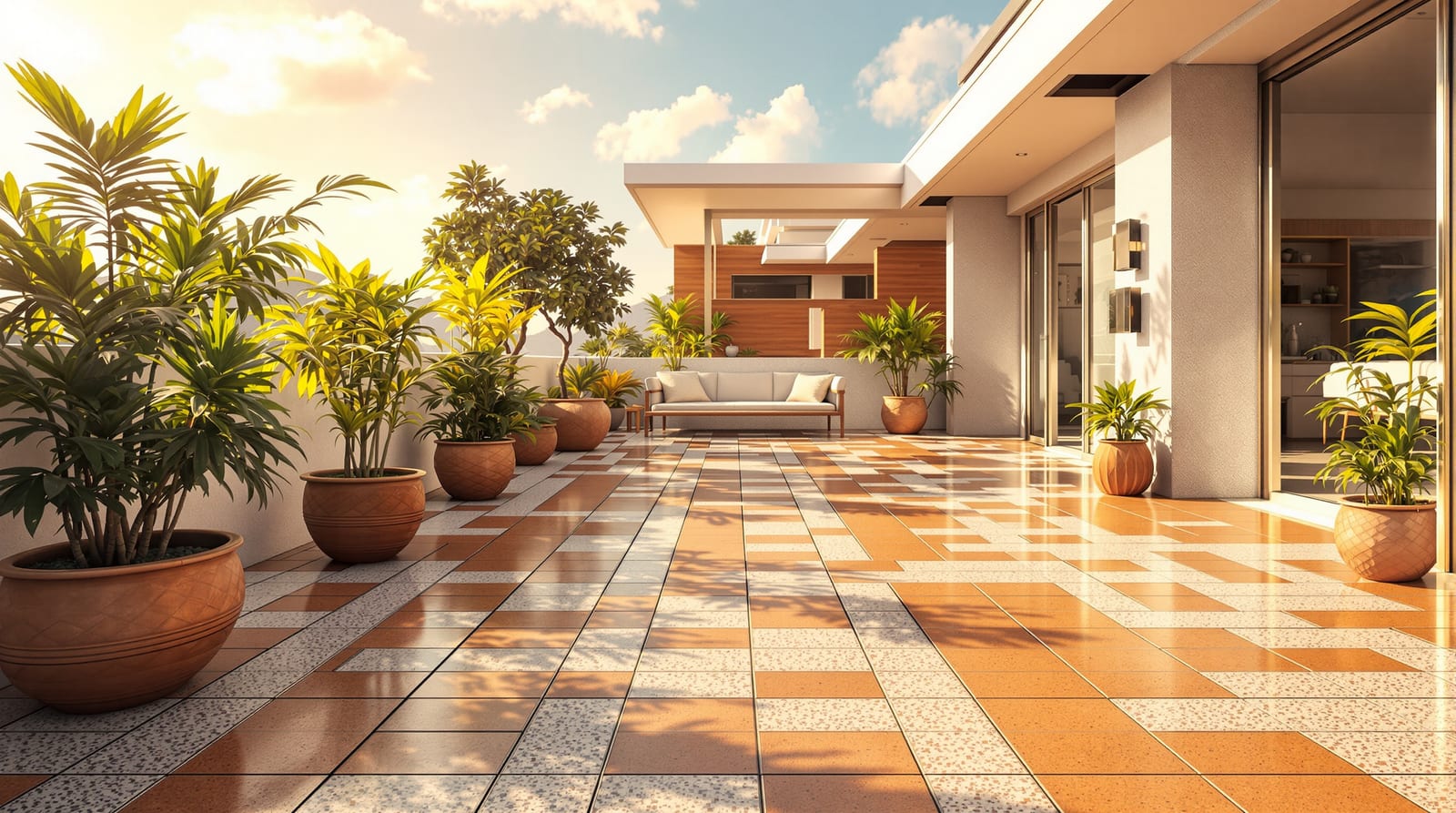
Terrace Flooring in India: Best Heat-Reflective, Waterproof Rooftop Options (2026)
An Indian terrace takes full sun, heavy monsoon and daily thermal expansion, so the floor is the second line of defence over a sound waterproofing layer and slope: cool-roof china mosaic, heat-reflective and anti-skid vitrified pavers, Kota and Tandur, deck and WPC tiles, pedestal pavers and artificial grass, with ₹/sq ft, expansion joints and the waterproofing-first rule.
A terrace is the most punished surface in the entire house. It takes the full, unbroken blast of the summer sun for ten hours a day, then absorbs the sideways fury of the monsoon, and every single night it cools and shrinks after expanding all afternoon. No other floor in your home lives through this much heat, water and movement. And here is the part most homeowners get wrong: on a terrace, the floor you walk on is not the thing keeping water out of the rooms below. The waterproofing layer underneath does that. The flooring is the armour that protects the waterproofing from sun, foot traffic and weather. Get that order of priorities wrong and the prettiest rooftop tile in the world will sit on top of a slow, expensive leak.
This guide treats a terrace floor as a system, not a single material. We will cover the waterproofing-first rule that has to come before any tile is chosen, the slope and drainage that decide whether your terrace ever leaks, the expansion-joint and heat-gain realities of an exposed roof, and then the handful of finishes that actually survive on top — cool-roof china mosaic, heat-reflective and anti-skid vitrified pavers, Kota and Tandur stone, deck and WPC tiles, dry-laid pedestal pavers and artificial grass — with honest ₹/sq ft and a recommendation. For balconies specifically, pair this with our balcony flooring guide at /guides/balcony-flooring-india, and for the wider exterior picture see the outdoor flooring guide at /guides/outdoor-flooring-guide-india.
The waterproofing-first rule (read this before you pick a tile)
The single most important sentence in this guide: flooring is laid over a sound waterproofing membrane and slope — the floor protects the membrane, it does not replace it. A terrace slab is the roof of the room beneath. If water gets through, it does not run off harmlessly the way it does on a ground-level patio; it soaks into the slab, corrodes the reinforcement, blooms as damp patches and salts on the ceiling below, and eventually cracks plaster. Repairing it means lifting the entire finished floor.
So the correct build-up, from the structural slab upward, is roughly: structural RCC slab, then a screed laid to a drainage slope (usually 1 in 80 to 1 in 100, falling toward the outlets), then the waterproofing system, then a protective screed or bedding, then your floor finish. The waterproofing can be a liquid-applied acrylic or polyurethane membrane, an APP/SBS bitumen torch-applied sheet, an integral crystalline treatment, or — in the traditional Indian system — the brick-bat coba with a china-mosaic finish that is both the waterproofing and the floor in one. Whatever the system, it is tested by ponding (flooding the terrace for 48-72 hours and checking the ceiling below) before the final finish goes down. Never let a contractor tile over an untested terrace.
A terrace finish should therefore be chosen for four jobs, in this order of importance:
- Protect and outlast the waterproofing — it shields the membrane from UV and abrasion, so it must itself be UV-stable and tough.
- Slope and drain — it must hold the slope and let water run off fast; no ponding, ever.
- Stay cool / reflect heat — an exposed roof is a giant heat collector; a reflective, light-coloured finish keeps the rooms below cooler and the slab from cooking.
- Be anti-skid and weatherproof — wet terraces are walked on, dried clothes are hung, kids play; the surface must grip when wet (target DIN 51130 R10-R11) and not absorb water.
Terrace floor build-up (section)
The diagram below shows the layered system. The flooring is only the top layer; everything below it is what actually keeps water out.
Slope, drainage and expansion — the three things that decide everything
Before materials, three site realities make or break a terrace floor in India.
Slope. Every square inch of a terrace must drain. The standard fall is between 1 in 80 and 1 in 100 toward the rainwater outlets, with no flat pockets where water can stand. Standing water is the enemy: it grows algae (slippery), breeds mosquitoes, drives efflorescence, and slowly works through any weak point in the membrane. Check the slope by hosing the terrace and watching where water pools — fix the screed before you finish.
Drainage and outlets. Outlets (khurras) must sit at the lowest points, be generously sized for cloudburst monsoon rain, and be kept clear of leaves and debris. A blocked outlet turns a sloped terrace into a swimming pool and overloads the waterproofing. Many leaks blamed on the membrane are really a clogged drain.
Thermal expansion and joints. An exposed terrace can swing from a 50°C surface at 3 pm to under 25°C by dawn — a daily expansion-and-contraction cycle that no rigid tiled field survives without relief. That is why a terrace floor needs movement (expansion) joints, typically a soft, weatherproof sealant-filled gap every 3-4 metres and around the parapet perimeter, so the floor can grow and shrink without buckling or cracking the membrane. Skipping joints is the classic cause of tented, popped terrace tiles after a couple of summers. This is also why fully bonded indoor materials — polished vitrified, marble, laminate, bonded wood — simply do not belong on an open roof.
Heat gain: why a cool-roof finish matters
An Indian terrace is a heat machine. A dark, heat-absorbing roof can run 20-30°C hotter than the air and dump that heat straight into the top-floor rooms, pushing up both discomfort and air-conditioning bills. A light-coloured, reflective terrace finish — a cool roof — reflects much of the solar radiation instead of soaking it up, keeping the slab and the rooms below noticeably cooler. This is why the traditional white-and-broken-tile china mosaic is so enduring, and why reflective light-toned pavers and high-SRI (solar reflectance index) finishes are worth paying for on a sun-baked roof. If you have a top-floor home, the heat performance of the terrace floor is not a luxury; it is comfort and running cost.
The shortlist: terrace floors that actually work
Here is how the realistic terrace finishes compare across the things that matter on a roof.
| Terrace option | Heat behaviour | Weather / drainage | Material ₹/sq ft | Best for |
|---|---|---|---|---|
| China mosaic / broken-tile waterproofing finish | Excellent (reflective cool roof) | Excellent; is the waterproofing + finish | 30-90 | Traditional cool-roof terraces; combined waterproofing + floor |
| Heat-reflective anti-skid vitrified / porcelain pavers | Good (specify light, high-SRI) | Excellent; UV-stable, low absorption | 50-200 | Usable, smart terraces; durable low-maintenance default |
| Kota / Tandur stone (honed) | Good (light tones stay cooler) | Excellent; anti-slip when honed | 35-80 | Budget, durable, natural look |
| WPC / wooden deck tiles | Moderate (gets warm; shaded use) | Good (UV-stable WPC); dry-laid, drains under | 100-300 | Warm wood look, seating zones, DIY |
| Pedestal (raised) pavers over waterproofing | Good (air gap helps) | Excellent; membrane stays accessible | 120-350 (paver + pedestal) | Premium terraces; protects and exposes membrane |
| Artificial grass (UV-treated) | Moderate (warms in sun) | Good; needs free drainage below | 60-200 | Green play / lounge corners |
Each deserves a closer look, because the right pick depends on whether the terrace is purely functional or a usable roof garden, and on your budget.
China mosaic / broken-tile cool roof — the traditional all-in-one
China mosaic (also called broken-tile waterproofing) is the classic Indian terrace finish and a genuinely brilliant piece of building science. Broken pieces of white or light glazed tile are set into a waterproofing cement mortar over a brick-bat coba slope, then grouted and cured. The result does three jobs at once: it waterproofs, it slopes and drains, and its light reflective surface acts as a cool roof, keeping the rooms below cooler. It is hard-wearing, repairable, and cheap at roughly ₹30-90 per sq ft installed depending on the coba thickness and labour. The trade-off is that it is a craft job — quality depends entirely on the mason and proper curing — and the texture, while anti-skid, is less refined than a tiled floor. For a purely functional, heat-smart terrace, it is still hard to beat.
Heat-reflective anti-skid vitrified and porcelain pavers — the usable-terrace default
If you actually want to live on the terrace — morning chai, a table and chairs, kids playing — an anti-skid matte vitrified or porcelain paver laid over a tested waterproofing membrane and protective screed is the sensible modern choice. Vitrified tiles made to IS 15622 (the dense BIa group absorbs under 0.5% water) are frost-resistant, fade-proof and tough. The two things to specify clearly: a light, reflective tone for cool-roof benefit (avoid dark colours that bake), and an anti-skid matte or rustic surface rated R10-R11 so it grips when wet. Thicker 20 mm outdoor porcelain pavers are excellent here. Expect roughly ₹50-150 per sq ft for vitrified and ₹60-200 for porcelain (material), plus adhesive, sloped screed and essential expansion joints. Read the deep dives in our vitrified tile guide at /guides/vitrified-tile-flooring-india and porcelain guide at /guides/porcelain-tile-flooring-india.
Kota and Tandur stone — budget-durable and naturally cool
For a natural, honest, matte terrace at low cost, honed Kota stone is a long-standing Indian favourite. This fine-grained Rajasthani limestone is anti-slip when honed, hides dirt, and in its lighter shades stays cooler than dark finishes; it runs about ₹35-70 per sq ft for material. Tandur (Tandoor) stone from Telangana plays a similar value role at ₹40-80 per sq ft. Keep both honed rather than mirror-polished so they grip when wet, seal them against porosity, and remember they still sit over the waterproofing and slope — the stone is the armour, not the barrier. More in our Kota stone guide at /guides/kota-stone-flooring-india.
WPC and wooden deck tiles — warm look, dry-laid and movable
For a lounge corner or roof-garden seating zone, interlocking WPC or wooden deck tiles (commonly 300 x 300 mm) clip together and sit above the finished waterproofing, with water draining through the gaps and off via the existing slope. UV-stable WPC holds colour far better than real wood outdoors. They are warm and inviting underfoot but do heat up in direct sun, so they suit shaded or part-day-sun zones rather than the whole baking roof. Because they are dry-laid and removable, they are ideal for rented top floors and for keeping the membrane accessible. Budget roughly ₹100-300 per sq ft. They are best used as zones, not as the terrace's primary weather protection.
Pedestal (raised) pavers — the premium, membrane-friendly system
The most sophisticated terrace option is a raised-access floor: large pavers (porcelain, stone or precast) sit on adjustable plastic pedestals above the waterproofing membrane, creating a perfectly level walking surface with a ventilated air gap beneath. Rainwater drains under the floor straight to the outlets, the air gap reduces heat transfer, and — crucially — any paver can be lifted to inspect or repair the membrane without demolition. It is the best system for protecting a terrace waterproofing while keeping it serviceable, at a premium of roughly ₹120-350 per sq ft for paver plus pedestals. Ideal for high-end terraces and roof decks.
Artificial grass — soft, green play corners
UV-treated artificial grass turns a corner of the terrace into a soft green play or lounge area. It must be laid over free-draining substrate so water reaches the outlets, and only UV-stabilised grades survive Indian sun without fading or going brittle. It warms in full sun and is a finish for zones, not for the whole roof, at roughly ₹60-200 per sq ft.
What to avoid on a terrace
Some materials people love indoors are wrong on a roof. Mirror-polished vitrified and marble become dangerously slippery when wet and offer no cool-roof benefit (and marble etches and stains outdoors). Laminate and bonded solid or engineered wood swell, cup and rot under sun and rain. Dark, heat-absorbing finishes turn the roof into a heater. And any fully bonded rigid field laid without expansion joints will tent and pop within a couple of summers. On a terrace, choose light, textured, UV-stable, jointed — and always over a tested membrane.
A simple recommendation
- Purely functional, heat-smart, value terrace: china mosaic / broken-tile cool roof, or honed light Kota. Cheapest, coolest, proven.
- A terrace you actually use, low maintenance: light, anti-skid (R10-R11) matte vitrified or 20 mm porcelain pavers over a tested membrane and slope, with proper expansion joints.
- Premium, serviceable roof deck: porcelain or stone pavers on pedestals — protects and exposes the membrane.
- Wood-look seating or green corners: WPC deck tiles or UV-treated artificial grass as zones, dry-laid above the finish.
Whatever you choose, the order never changes: sound slope, tested waterproofing, then the finish on top. Estimate quantities and budget with our flooring cost calculator at /utilities/flooring-cost-calculator and tile quantity calculator at /utilities/tile-quantity-calculator.
Frequently asked questions
What is the best flooring for an Indian terrace?
There is no single answer, but the two strongest defaults are china mosaic (broken-tile cool roof) for a cheap, heat-reflective, all-in-one waterproofing-plus-finish, and light, anti-skid (R10-R11) matte vitrified or porcelain pavers for a usable, low-maintenance terrace. Both must sit over a tested waterproofing layer and a proper drainage slope.
Does terrace flooring replace waterproofing?
No, and this is the most expensive mistake homeowners make. The flooring protects the waterproofing membrane from sun and wear; it does not stop water reaching the slab on its own. Always lay and pond-test a waterproofing system (or use a true integrated system like brick-bat coba with china mosaic) before the finish, and keep the slope falling to clear outlets.
How do I stop my terrace floor from making the top floor hot?
Use a cool-roof finish: a light-coloured, reflective surface such as white china mosaic, light high-SRI vitrified pavers, or light Kota stone reflects solar heat instead of absorbing it. A pedestal-paver system adds a ventilated air gap that further cuts heat transfer. Dark finishes do the opposite and should be avoided on exposed roofs.
Why do terrace tiles pop up or tent after a couple of years?
Almost always missing or inadequate expansion joints. An exposed terrace heats and cools by tens of degrees every day, so a rigid bonded tile field needs soft sealant-filled movement joints every 3-4 metres and around the parapet. Without them the tiles have nowhere to expand and buckle, often damaging the membrane below.
What slope should a terrace floor have?
A fall of about 1 in 80 to 1 in 100 toward the rainwater outlets, with no flat pockets where water can stand. Test it by hosing the terrace and watching for pooling. Good slope plus clear, well-sized outlets is what actually keeps a terrace dry; standing water is the root of most leaks and algae.
Export this guide
Related Guides — Deep-dive reading
Patio Flooring in India: Best Decks & Outdoor-Seating Floors for Weather, Grip & Looks
How to floor a patio, deck or outdoor lounge in India so it shrugs off UV and monsoon, grips wet feet, stays barefoot-friendly and still looks like a place you want to entertain.
Flooring & SurfacesBalcony Flooring in India: Best Anti-Slip Options for Sun, Rain & Dust (2026)
Balconies bake in the sun, flood in the monsoon and collect city dust — so the floor must be anti-skid, UV-stable and water-resistant: anti-skid matte vitrified, Kota and Tandur stone, WPC and wooden deck tiles, artificial grass and outdoor porcelain pavers, with ₹/sq ft, drainage slope and maintenance.
Flooring & SurfacesAnti Slip Flooring for Bathroom and Wet Areas in India: R-Ratings, Finishes and Genuinely Safe Tile Choices
How to choose genuinely safe flooring for bathrooms, kitchens, balconies, pools, entrances and elderly- or child-friendly homes — the R-rating system, finishes that grip wet feet, anti-skid natural stone, slope to drains and the tiles to avoid.
Flooring & SurfacesRelated Tools — Try Free
Monsoon-Readiness Checklist
Pre-rain home audit across 9 categories — terrace, drains, waterproofing, electrical, HVAC, pest, vehicles, documents.
Seasonal AuditFlooring Cost Calculator
Estimate the all-in cost of a floor — material, laying, wastage, skirting and GST — by area and material.
Flooring CalculatorPatio & Deck Cost Calculator
Estimate outdoor patio or deck flooring cost — porcelain pavers, WPC deck tiles, stone or exposed aggregate.
Flooring Calculator