
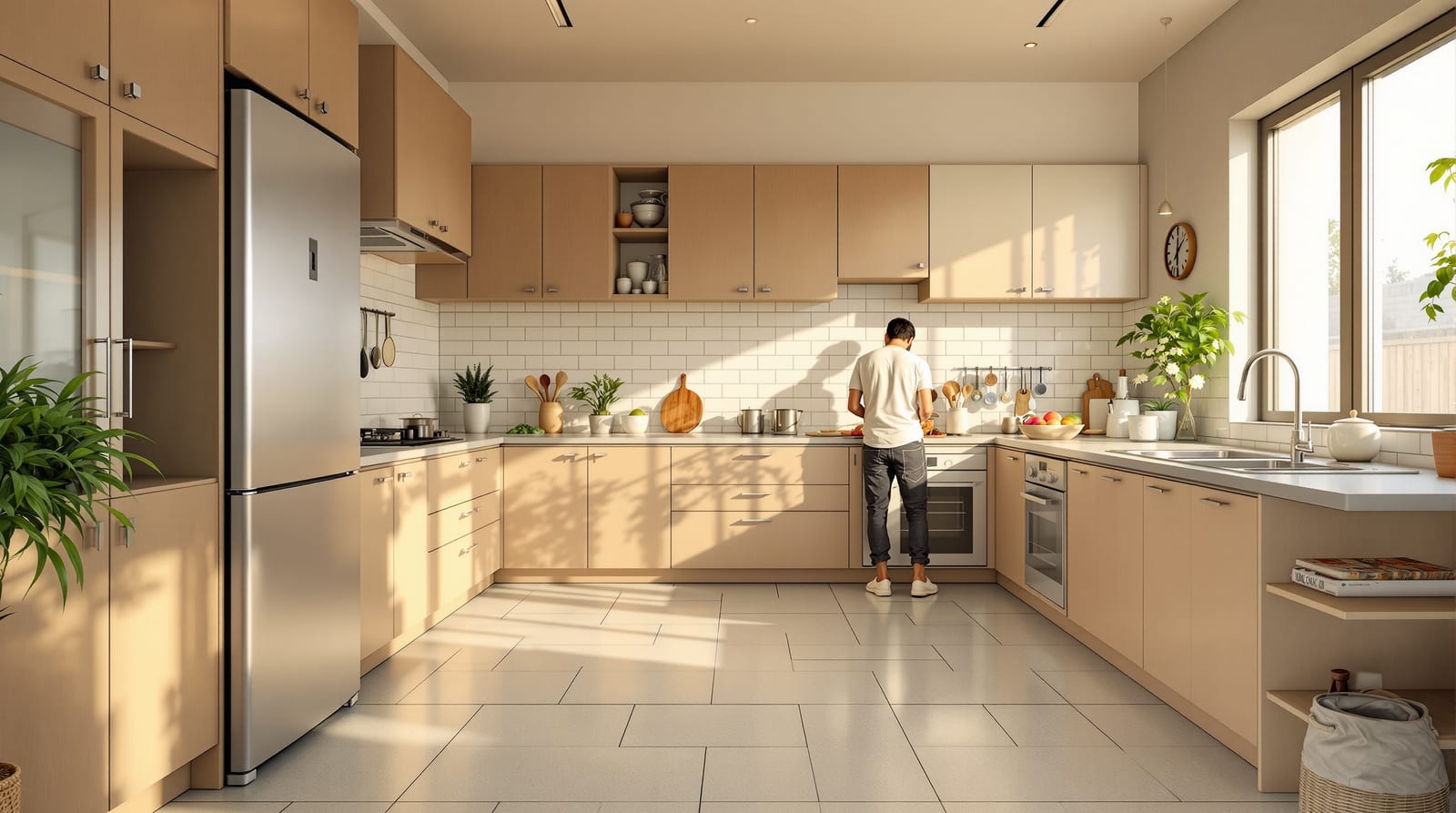
Kitchen Flooring in India: Best Anti-Slip, Stain-Proof Options & Cost (2026)
The kitchen is the toughest test any floor faces — oil, grease, turmeric, water, heat and constant traffic. Here are the best anti-slip, stain-resistant, easy-clean choices (matte vitrified, anti-skid porcelain, granite, Kota), what to avoid, grout reality and ₹/sq ft.
The Indian kitchen is the single hardest test any floor in your home will ever face. In one busy morning it can take a splash of boiling water, a slick of mustard oil, a fallen blob of turmeric paste, a dropped steel kadai, the grit tracked in from outside, and an acidic squeeze of lemon — and then get mopped twice. A floor that survives the living room can quietly fail here: it goes slippery, it stains, it etches, or the joints turn black. So the right question is not "which floor looks nicest" but "which floor stays safe, clean and intact under daily oil, grease, water and heavy use." This guide gives you the answer for Indian conditions, with honest ₹/sq ft and the trade-offs nobody mentions at the showroom.
The four things a kitchen floor must do
Before any material, fix your priorities — and in this exact order:
1. Anti-slip (the safety priority). A kitchen floor will get wet and oily. A glossy, mirror-polished surface that looks stunning in the hall becomes genuinely dangerous near a hob and sink. You want a matte / honed / textured surface with real grip, ideally rated R10 or higher on the DIN 51130 slip scale.
2. Stain and water resistant. Turmeric, oil, masala, beetroot, tea and acidic juices are relentless. The surface must resist absorption (low porosity) and shrug off stains with a wipe.
3. Durable and impact-tolerant. Dropped vessels, dragged stools, decades of footfall in a joint-family home. The floor must not chip, crack or scratch easily.
4. Easy to clean — including the joints. The floor that wins is the one your help can clean fast, every day, without the grout turning into a grease-trap.
Hold those four against any material and the shortlist almost writes itself.
The best kitchen flooring options for India
Here is the honest ranking for Indian kitchens, weighing the four priorities together. Costs are indicative 2026 material rates (₹/sq ft), plus 18% GST; laying, adhesive, grout and skirting are extra.
| Kitchen option | Anti-slip | Stain / water resistance | Durability | Easy-clean | Material ₹/sq ft | Verdict |
|---|---|---|---|---|---|---|
| Matte vitrified / GVT (anti-skid) | Very good (matte/textured) | Excellent (<0.5% absorption) | Excellent | Excellent | 40-150 | Best all-round pick |
| Anti-skid porcelain (R10-R11) | Excellent | Excellent | Excellent | Excellent | 60-200 | Best for safety + heavy use |
| Granite (honed / leather) | Good honed; slippery if mirror-polished | High | Highest | Very good | 50-250 | Premium, near-indestructible |
| Kota / Tandur stone (honed) | Excellent | Lower — needs sealing | High | Good (matte hides grime) | 30-80 | Best value, traditional |
| Polished marble | Moderate, slippery wet | Poor — stains & etches | High | Poor (porous joints) | 80-350+ | Avoid in cooking zone |
| Wood / laminate | Moderate | Poor near water | Moderate | Poor at edges | 80-700 | Avoid near sink/hob |
The pattern is clear: the kitchen rewards dense, matte, low-porosity surfaces and punishes anything porous or glossy.
1. Matte vitrified / GVT — the sensible default
For most Indian homes, a good anti-skid matte vitrified tile (often a matte-finish GVT) is the smartest kitchen floor. Vitrified tiles are fired to near-zero porosity — water absorption below 0.5% under IS 15622 — so turmeric, oil and masala sit on the surface and wipe away instead of soaking in. Choose the matte or textured finish, not the high-gloss polished version: the matte face gives grip when the floor is wet or oily, while still being effortless to mop. They are tough, cheap to maintain, available in every colour and large-format size, and need no sealing. If you want a deep dive, see our vitrified tile guide, and understand the all-important finish choice in GVT vs PGVT — the short version is that PGVT (polished) is the wrong call for the cooking zone; its mirror gloss turns slippery the moment oil or water lands on it.
2. Anti-skid porcelain — when safety is paramount
Porcelain is vitrified tile's tougher, denser cousin. A purpose-made anti-skid porcelain rated R10 or R11 gives you the best slip safety available in a tile, with the same near-zero absorption and stain resistance. It is the right choice if there are elderly members or children in the home, or simply if you cook a lot and the floor is wet often. It costs more (₹60-200/sq ft) and the textured surface needs slightly more scrubbing in the joints, but for a safety-first kitchen it is hard to beat. Full detail in our porcelain tile guide.
3. Granite — the premium near-indestructible floor
Granite is the prestige choice and arguably the most durable kitchen floor you can lay. It is an igneous stone, extremely hard, scratch- and heat-resistant, and far more stain-resistant than marble. The catch is finish: a mirror-polished granite floor is slippery when wet, so for the kitchen choose a honed (matte) or leather/flamed finish that keeps grip. Sealed granite resists oil and acid well and lasts generations — ideal for a joint-family home that wants a tough floor that also looks rich. See the granite flooring guide.
4. Kota / Tandur stone — the value workhorse
If budget rules, honed Kota stone (or its cousin Tandur) is the traditional Indian kitchen floor for good reason: tough, naturally cool, excellent anti-slip grip when honed, and brilliant at hiding everyday grime behind its dark green-grey matte. At ₹30-80/sq ft it is a fraction of granite for a large floor. The one discipline it demands is sealing — being a limestone it is porous, so seal it after laying and re-seal every 1-3 years, and never use acidic cleaners that etch it. Full guidance in the Kota stone guide.
What to avoid in the cooking zone
Two popular floors are genuinely poor choices right where you cook and wash:
- Polished marble — avoid. Marble is beautiful and cool underfoot, but it is the wrong stone for a working kitchen. It is acid-sensitive: a splash of lemon, tamarind, curd, vinegar or kitchen acid will etch a permanent dull mark, and turmeric and oil stain it because it is porous. A polished surface is also slippery when wet. If you love the marble look, keep it to the drawing room or bedrooms and put a tougher surface where the cooking happens.
- Solid wood, engineered wood and laminate — avoid near water. Wood and water are enemies. Near the sink, dishwasher and hob, repeated splashing and steam will swell, warp, stain or delaminate a wooden floor or laminate over time, and oil marks are stubborn. If you absolutely want a warm wood look in an open kitchen, use a wood-look matte vitrified tile or a fully waterproof SPC plank with sealed joints away from the wet zone — never real wood by the sink.
A reasonable middle path in open-plan layouts: lay a tough matte tile or stone in the actual cooking and washing footprint, and carry a warmer material into the adjoining dining only if you wish — but keep the wet, greasy zone on a hard, non-porous, matte surface.
The Indian-cooking grease factor
There is one variable Western flooring advice ignores completely: Indian cooking is a grease and tadka machine. Tempering oil spits, gravies splash, and a fine film of cooking aerosol settles on every surface near the hob — including the floor. Over months this turns into a sticky layer that traps dust. Two design decisions tame it:
- Pick a surface that wipes, not one that absorbs. Non-porous vitrified, porcelain and sealed granite release oily film with a normal degreasing mop. Porous, unsealed stone (raw Kota, marble) drinks it in and goes patchy.
- Mind the joints. Grease and turmeric collect in grout lines and, on an absorbent or pale grout, turn them grey-black within a year. This is the real maintenance battleground — covered next.
Grout and joints: the real cleaning reality
Every tiled kitchen floor lives or dies by its joints. Tile bodies are easy; grout is where Indian kitchens fail.
- Use epoxy grout, not cement grout, in the kitchen. Cement grout is porous: it absorbs oil, turmeric and water, stains, harbours grime and crumbles. Epoxy grout is non-porous, stain-proof, waterproof and chemical-resistant — it costs more and takes a skilled hand to apply, but in a kitchen it pays for itself by staying clean and intact for years.
- Lay tight, fine joints (2-3 mm) with large-format tiles to minimise the total length of grout line that can catch grease.
- Choose a mid-tone grout, not stark white, in a cooking zone — it forgives the inevitable.
- Big tiles, fewer joints. A 600x600 or 800x800 tile has far less joint per square metre than a 300x300, which means less to clean and fewer places for grease to lodge.
- Stone has joints too. Granite and Kota are laid with thin cement or matching slurry joints; on a working kitchen floor, sealing the stone and the joints is what keeps them from staining.
Here is what is actually happening at the surface — and why the matte, non-porous, epoxy-jointed combination wins:
What it costs to floor a kitchen in India (2026)
A typical Indian kitchen floor is small (often 60-120 sq ft), so the material upgrade is cheap in absolute money — spending a little more here for safety and stain resistance is one of the best-value decisions in the whole home. Indicative 2026 rates; all subject to 18% GST; figures vary by city and vendor:
| Item | Indicative cost | Notes |
|---|---|---|
| Matte vitrified / GVT tile | ₹40-150 / sq ft | Anti-skid matte finish; the default pick |
| Anti-skid porcelain (R10-R11) | ₹60-200 / sq ft | Best slip safety |
| Honed / leather granite | ₹50-250 / sq ft | Premium, near-indestructible |
| Honed Kota / Tandur | ₹30-80 / sq ft | Value workhorse; needs sealing |
| Tile adhesive | ₹12-30 / sq ft | Preferred over cement-sand for tiles |
| Laying labour | ₹15-60 / sq ft | More for stone and large-format |
| Epoxy grout | ₹20-50 / sq ft | Strongly recommended for kitchens |
| Skirting / cove + sealing | extra | Cove skirting eases cleaning at edges |
For a quick budget, run your area through the flooring cost calculator, work out boxes with the tile quantity calculator, and size your adhesive and grout with the tile adhesive calculator and grout quantity calculator. Always add about 5-10% wastage for cuts around cabinets and the sink.
Practical kitchen-laying notes
- Run the floor under the base cabinets, or at least to their line, so a future modular-kitchen change does not expose a tile gap.
- Build a gentle fall if there is a floor drain or a utility-wet corner, so water flows away from the cooking zone.
- Use cove (skirting) at the wall junction where possible — it eliminates the right-angle crevice where grease and water collect, and wipes clean in one stroke.
- Match grout colour to a mid-tone and specify epoxy grout in the contract, not as an afterthought.
- Seal natural stone (granite, Kota, Tandur) after laying and keep acidic cleaners off it.
- Vastu note (tradition + practical): the kitchen is traditionally associated with the south-east (Agni) corner, and many families prefer warm earthy or neutral floor tones here rather than dark or pure-black. Treat it as a preference to balance against the practical winners — a mid-tone matte tile satisfies both. Lighter floors are favoured for the north-east of the home generally.
How the kitchen differs from other rooms
Each room has its own floor logic. The kitchen is the wet-and-greasy, safety-first room, so it overlaps most with the bathroom on anti-slip and stain priorities and least with the bedroom. If you are floor-planning the whole home, compare with the living room flooring guide, the bedroom flooring guide, the bathroom flooring guide and the balcony flooring guide so finishes flow sensibly from room to room. For the big-picture method, our how to choose flooring guide and the flooring materials explainer tie it all together; for the full home, start at the complete home flooring guide.
Frequently asked questions
What is the best flooring for an Indian kitchen?
For most homes, a matte anti-skid vitrified tile (or matte GVT) is the best all-round kitchen floor: it has near-zero water absorption so turmeric and oil wipe off, a textured matte face that grips when wet, and it needs no sealing. If safety is paramount, choose an anti-skid porcelain rated R10-R11; for a premium near-indestructible floor, honed granite; for best value, honed Kota stone.
Why should I avoid glossy (polished) tiles in the kitchen?
A high-gloss or polished tile such as PGVT becomes genuinely slippery the moment water or oil lands on it — exactly the conditions a kitchen creates daily. The mirror finish also shows every scuff and water mark. Choose a matte or textured face: it grips far better, hides everyday marks, and still wipes clean easily.
Is marble a good kitchen floor in India?
No, not in the cooking zone. Marble is porous, so turmeric and oil stain it, and it is acid-sensitive, so lemon, tamarind, curd or vinegar etch permanent dull marks. Polished marble is also slippery when wet. Keep marble for the living room or bedrooms and use vitrified, porcelain or granite where you actually cook and wash.
What grout should I use for a kitchen floor?
Use epoxy grout, not cement grout. Cement grout is porous: it absorbs oil, turmeric and water, stains, and crumbles over time, turning your joints grey-black. Epoxy grout is non-porous, stain-proof, waterproof and chemical-resistant — it costs more and needs a skilled applicator, but it keeps kitchen joints clean and intact for years.
How much does kitchen flooring cost in India?
Material runs roughly ₹40-150/sq ft for matte vitrified, ₹60-200 for anti-skid porcelain, ₹50-250 for granite and ₹30-80 for Kota stone, plus adhesive (₹12-30), laying (₹15-60) and epoxy grout (₹20-50) per sq ft, all subject to 18% GST. Because most kitchens are small, the upgrade to a safer, stain-proof floor costs little in absolute money. Figures are indicative and vary by city and vendor.
Export this guide
Related Guides — Deep-dive reading
Complete Home Flooring Guide for Indian Homes (2026)
The authoritative overview of every flooring family — tiles, stone, wood, vinyl and seamless — with India ₹/sq ft costs, room-by-room logic and laying basics.
Flooring & SurfacesAnti Slip Flooring for Bathroom and Wet Areas in India: R-Ratings, Finishes and Genuinely Safe Tile Choices
How to choose genuinely safe flooring for bathrooms, kitchens, balconies, pools, entrances and elderly- or child-friendly homes — the R-rating system, finishes that grip wet feet, anti-skid natural stone, slope to drains and the tiles to avoid.
Flooring & SurfacesEpoxy Grout vs Cement Grout for Tiles in India: Which to Specify (2026)
A plain-English guide to tile grouts for Indian homes: what grout does, how cementitious grout compares with epoxy grout on cost, stain and water resistance, hygiene and durability, and exactly where each one belongs - kitchens, bathrooms, pools, dry rooms and more.
Building MaterialsRelated Tools — Try Free
Flooring Cost Calculator
Estimate the all-in cost of a floor — material, laying, wastage, skirting and GST — by area and material.
Flooring CalculatorFlooring Material Selector
Get the best flooring material for your room, budget and climate, with anti-slip checks for wet areas.
Flooring ToolModular Kitchen Budget Calculator
Live breakdown by running feet, countertop area, material tier and city — with wastage, design fee, GST.
Kitchen Calculator