
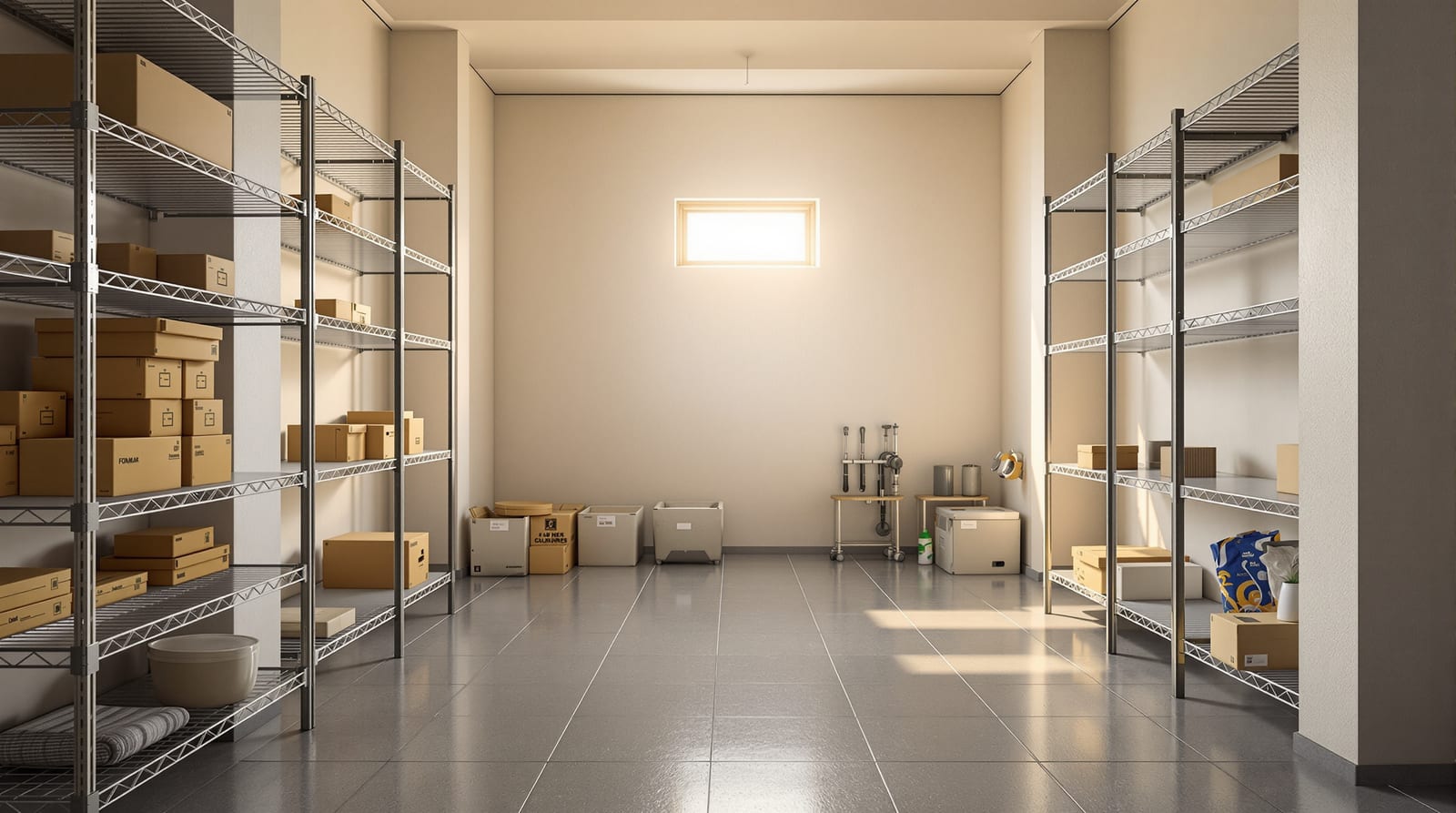
Store Room Flooring in India: Cheap, Tough, Dust-Free Floors for a Box Room
How to floor a home store room, box room or loft store on a tight budget: durable, dust- and moisture-resistant, easy to sweep and able to take heavy shelving.
A store room is the one floor in the house nobody admires and everybody relies on. It hides the suitcases, the festival decorations, the spare mattress, the rice sacks and the toolbox, often in a windowless box room or under a loft. So the brief is refreshingly simple: spend as little as possible, get a floor that is tough, easy to sweep, shrugs off dust and damp, and can carry a wall of heavy shelving without cracking. This guide ranks the cheapest sensible options for an Indian store room and tells you exactly where to save and where not to.
What a store room floor actually has to do
Forget looks. A store room floor has a short, hard-nosed checklist:
- Cheap. This is the place to use up your budget's leftovers, not blow it. Aim to stay under the cost of your living-room floor by a wide margin.
- Durable under point loads. Steel racks, trunks, gas cylinders and stacked tiles concentrate weight on small feet. The floor must not chip or crack under them.
- Dust-resistant and easy to sweep. Stored goods shed dust; a smooth, sealed, joint-free surface lets you sweep or mop in minutes instead of fighting grout lines and a powdery cement skin.
- Moisture-resistant. Box rooms and loft stores are often poorly ventilated, share a wall with a bathroom or sit over a damp plinth. A floor that resists moisture (and a habit of raising goods off it) keeps mould and rust away.
- Low-maintenance. You should never have to reseal or baby it. Lay it and forget it.
Slip rating, warmth, acoustics and grandeur, which dominate living spaces, barely matter here. That is precisely why a store room is the right place to use seconds, leftovers and the most basic finishes. For how these priorities shift room by room, see the room-by-room flooring guide for India, and for the neighbouring wet utility zone, the utility room flooring guide.
The five sensible store room floors, ranked
1. Plain vitrified or cheap ceramic tile — the easy default
A plain (single-charge or basic glazed) vitrified tile is the no-brainer for most store rooms. It is cheap, near-zero maintenance, fully water-resistant, and its glassy surface holds no dust, so a single mop pass cleans it. A budget ceramic tile does the same job for even less money. Crucially, this is the room where leftover and seconds tiles are perfectly fine, mismatched batches, lightly off-shade lots, or the spare boxes from your living-room job. Nobody is photographing the store room. Lay them tight, grout the joints, done.
Watch only one thing: tile under a concentrated point load can crack if the bed below it is hollow. Insist on a full, solid mortar bed (no spot-fixing) so heavy racks sit on fully supported tiles.
2. IPS / cement flooring — the cheapest, toughest option
Indian Patent Stone (a plain cement-concrete topping, trowelled and cured) is the lowest-cost real floor you can lay. It is monolithic, jointless apart from control grooves, takes brutal loads, and costs a fraction of tile. The only catch is the classic cement "dusting": a bare, unsealed IPS surface sheds a fine powder underfoot. Cure it well, then seal it once with a cheap floor hardener or a coat of sealer and the dusting stops. For the full method see the IPS flooring guide. For a windowless box room where you only need a hard, sweepable surface, IPS is hard to beat on price.
3. Kota stone — durable budget stone
If you want something a notch more solid and genuinely permanent, Kota stone is the classic Indian budget workhorse. It is dense, tough, takes heavy loads, resists water, and a polished or honed slab sweeps clean easily. It costs a little more than IPS or basic ceramic but lasts for decades with zero fuss, and it is widely available across India. Many homes already use Kota in utility and service areas, so a matching store room keeps things simple.
4. Epoxy coating — when you want a truly dust-free store
Where the store room holds clean goods (documents, electronics, clothes in trunks) and you hate sweeping cement grit, a thin epoxy coating over the existing concrete gives a seamless, joint-free, completely dust-free and wipe-clean surface. It is dearer than the options above and overkill for a rough lumber store, but for a tidy, sealed, hospital-clean storage room it is excellent and easy to keep spotless.
5. Bare/leftover anything — the truly zero-budget route
If the room already has a sound cement screed, the cheapest move of all is to simply seal it (floor hardener or sealer) to kill the dust and call it done, or to lay whatever leftover tiles you have lying around. A store room is the one place where "use up the seconds" is not a compromise, it is the correct answer.
Comparison: store room floors by cost, durability and dust
The table below ranks the realistic store room options. Costs are indicative installed-ish 2026 rupee-per-square-foot figures for India and vary by city, grade and labour; confirm current rates locally and with the flooring cost calculator.
| Surface | Cost (₹/sq ft) | Load / durability | Dust & cleaning | Moisture | Best for |
|---|---|---|---|---|---|
| IPS / cement (sealed) | 90-180 | Excellent under load | Sweep-clean once sealed (dusts if bare) | Good | Cheapest tough floor, box rooms |
| Ceramic (basic / seconds) | 50-110 | Good (needs solid bed) | Very easy, glazed | Excellent | Lowest-cost tiled store |
| Plain vitrified | 80-180 | Good (needs solid bed) | Easiest, glassy | Excellent | Default all-rounder |
| Kota stone | 60-150 | Excellent, permanent | Easy, honed/polished | Excellent | Durable budget stone |
| Epoxy coating | 120-300 | Very good | Seamless, dust-free, wipe-clean | Excellent | Clean, document/electronics store |
For a wider material picture, see the flooring cost per square foot guide for India cross-references and the material guides linked above. The honest summary: ceramic seconds and sealed IPS are the cheapest; Kota is the most durable budget pick; epoxy buys you a dust-free finish; plain vitrified is the easiest hands-off default.
Beat the two real enemies: moisture and dust
A store room floor rarely fails by wearing out. It fails because stored goods get damp or dusty. Two cheap habits fix almost everything.
- Raise everything off the floor. Put stored goods on steel or open racks, pallets, or at least a bottom shelf 100-150 mm clear of the floor. This single habit defeats floor-level damp, sweeping access and pest entry far more cheaply than any premium floor finish.
- Stop damp at the slab. Make sure the floor sits over a sound PCC bed with a working damp-proof course, especially in a ground-floor or loft store that shares a wall with a bathroom. A sealed topping (tile, sealed IPS, Kota or epoxy) blocks the rest. For damp-prone, poorly ventilated rooms, lean towards a fully sealed, joint-light surface and add a high louvre or vent so air can move.
- Kill the dust at source. A sealed surface plus the raise-everything habit means a five-minute sweep keeps the room clean. Bare cement is the only finish here that fights you, so seal it.
Costs and where to save
A store room is the right place to be frank about money. You do not need designer tile, anti-skid ratings, large-format slabs or wood. Spend the minimum:
- Lowest cost: seal an existing screed, or lay ceramic seconds / leftover tiles you already own.
- Cheapest new floor: sealed IPS / cement.
- Most durable for the money: Kota stone.
- Worth the upgrade only if you store clean goods: a thin epoxy coat for a dust-free, wipe-clean finish.
Put the money you save here into the rooms people actually live in. Run rough numbers with the flooring budget planner and tile quantities with the tile quantity calculator.
Do and don't
- Do use leftover and seconds tiles, mismatched batches are fine in a store room.
- Do insist on a full, solid mortar bed under tile so heavy racks do not crack it.
- Do seal bare cement / IPS once to stop the dust.
- Do raise stored goods off the floor on racks or pallets.
- Don't pay for polished marble, wood, anti-skid grades or large-format tile here, it is wasted money.
- Don't lay an unsealed cement floor and then complain about powder on everything.
- Don't ignore a shared bathroom wall, sort the damp-proofing first.
Frequently asked questions
What is the cheapest flooring for a store room in India?
Sealing an existing cement screed, or laying leftover/seconds ceramic tiles you already own, costs the least. For a new floor, sealed IPS / cement (roughly ₹90-180/sq ft) is the cheapest tough option, with basic ceramic tile close behind.
Can I use leftover or seconds tiles in a store room?
Yes, this is the ideal place for them. Mismatched batches, off-shade lots and spare boxes from other rooms are perfectly acceptable in a store room since looks do not matter. Just lay them on a full, solid mortar bed so heavy shelving cannot crack them.
How do I stop a store room floor from getting dusty?
Use a sealed, smooth surface, plain vitrified or ceramic tile, honed Kota stone, sealed IPS, or an epoxy coating. Bare cement sheds powder, so seal it once. Then a quick sweep or mop keeps it clean.
Will the floor crack under heavy shelving and stored loads?
Not if it is laid properly. IPS, Kota and concrete take heavy point loads easily. Tile is fine too, provided it sits on a full solid mortar bed (not spot-fixed), so the load is supported and the tile cannot snap over a hollow.
How do I keep stored goods dry in a damp box room?
Raise everything 100-150 mm off the floor on steel racks or pallets, make sure the slab has a working damp-proof course, lay a sealed moisture-resistant floor, and add a high vent or louvre for airflow. See the utility room flooring guide for the adjacent wet-zone detailing.
Export this guide
Related Guides — Deep-dive reading
Bathroom Flooring Guide India: Anti-Skid Tiles, Stone, Vinyl & Epoxy Compared
Every bathroom floor material for Indian homes in one place — anti-skid ceramic and vitrified tiles, natural stone, mosaic, vinyl (SPC/LVT) and epoxy — with a full comparison table, slip ratings, ₹/sq ft costs and the safety and slope rules that keep a wet floor from becoming a hazard.
BathroomsComplete Home Flooring Guide for Indian Homes (2026)
The authoritative overview of every flooring family — tiles, stone, wood, vinyl and seamless — with India ₹/sq ft costs, room-by-room logic and laying basics.
Flooring & SurfacesEpoxy Grout vs Cement Grout for Tiles in India: Which to Specify (2026)
A plain-English guide to tile grouts for Indian homes: what grout does, how cementitious grout compares with epoxy grout on cost, stain and water resistance, hygiene and durability, and exactly where each one belongs - kitchens, bathrooms, pools, dry rooms and more.
Building MaterialsRelated Tools — Try Free
Flooring Cost Calculator
Estimate the all-in cost of a floor — material, laying, wastage, skirting and GST — by area and material.
Flooring CalculatorWindow Cleaning Cost Calculator
Estimate professional window cleaning cost per visit and per year by access and frequency.
Window CalculatorCross-Ventilation Analyzer
Estimate airflow and air changes per hour (ACH) from room size, window areas, layout, and local wind — with NBC 2016 Part 8 compliance check.
Ventilation Calculator