
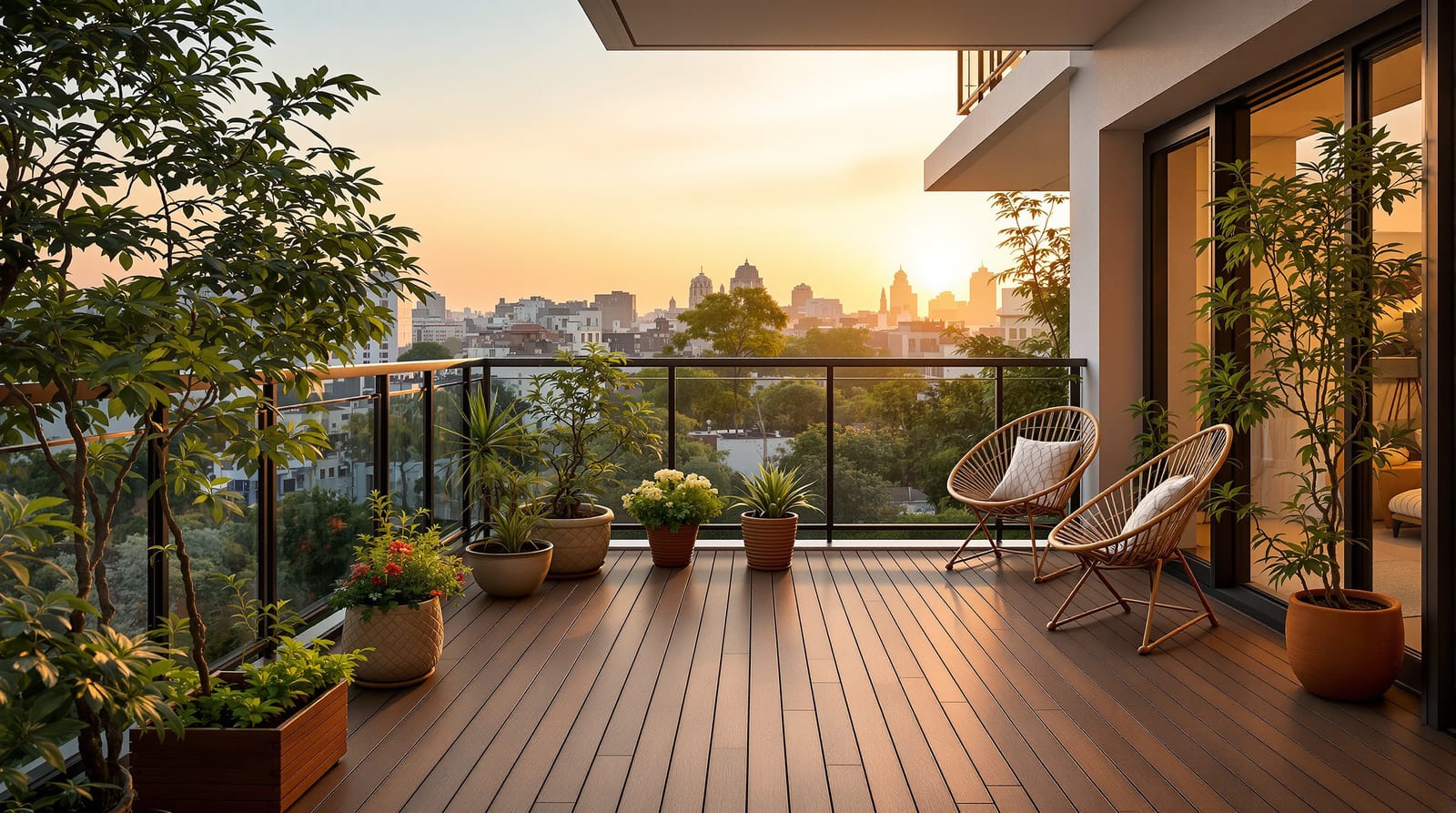
Balcony Flooring in India: Best Anti-Slip Options for Sun, Rain & Dust (2026)
Balconies bake in the sun, flood in the monsoon and collect city dust — so the floor must be anti-skid, UV-stable and water-resistant: anti-skid matte vitrified, Kota and Tandur stone, WPC and wooden deck tiles, artificial grass and outdoor porcelain pavers, with ₹/sq ft, drainage slope and maintenance.
A balcony is the one floor in your home that lives outdoors. It bakes under the summer sun, gets drenched sideways by monsoon rain, collects a fine film of city dust, and then has to stay safe to walk on when it is wet. That single combination — hot, wet, dusty and slippery — quietly rules out half the materials people instinctively reach for. The glossy vitrified tile that looks stunning in your living room becomes a skating rink the moment rain blows in; the warm engineered-wood floor you love indoors will swell, cup and rot within a few seasons of Indian weather. Choosing a balcony floor is really an exercise in matching the surface to the abuse it will take.
This guide is about that match. We will walk through what a balcony floor actually has to survive in India, the handful of materials that genuinely cope, what each costs per square foot, the all-important question of drainage slope, and a simple recommendation by look and budget. If you want the broader picture of exterior surfaces, pair this with our outdoor flooring guide at /guides/outdoor-flooring-guide-india and, for full roof terraces, the terrace flooring guide at /guides/terrace-flooring-india.
What a balcony floor must survive in India
Before any material, fix the priorities in your head. An Indian balcony floor faces four relentless pressures, and a good choice scores well on all of them.
- Anti-slip when wet — this is non-negotiable. Monsoon rain blows onto open balconies, and a wet balcony with a smooth glossy surface is genuinely dangerous, especially for children and elderly parents. Look for a textured, matte or honed surface with a DIN 51130 rating of R10 or higher (R11 is better for fully open balconies).
- UV and weather stable — direct sun for hours a day will fade dyes, yellow plastics and embrittle cheap materials. The surface must hold its colour and not crack through years of heating by day and cooling by night.
- Water and stain resistant — the material must not absorb water (which leads to algae, efflorescence and freeze-style spalling) and should resist the staining from bird droppings, fallen leaves, potting soil and tea spills.
- Drainage friendly — water has to leave the balcony, not pool on it. The floor and its slope must move rainwater to an outlet quickly so the surface dries and stays safe.
A useful rule: indoor-only materials are out. That means no mirror-polished vitrified, no marble (it etches and turns slippery), no laminate, and no solid or engineered wood laid as a bonded floor. Wood as a deck tile sitting above the slab is a different story, which we cover below.
The shortlist: balcony floors that actually work
Here is how the realistic options compare across the things that matter on a balcony.
| Balcony option | Weather / UV | Slip resistance (wet) | Material ₹/sq ft | Best for |
|---|---|---|---|---|
| Anti-skid matte vitrified / porcelain | Excellent, UV-stable | High (specify R10-R11) | 50-150 | Most apartment balconies; durable, low-maintenance default |
| Outdoor porcelain pavers (20 mm) | Excellent | Very high (R11) | 120-300 | Premium look, dry-lay over pedestals, terraces |
| Kota stone (honed) | Excellent | High | 35-70 | Budget, traditional, hard-use balconies |
| Tandur (Tandoor) stone | Excellent | High | 40-80 | Matte natural-stone look, value |
| WPC / wooden deck tiles | Good (UV-stable WPC); fades if real wood | High (grooved) | 100-300 | Warm wood look, DIY, rented flats |
| Artificial grass | Good (UV-treated only) | High | 60-200 | Green, soft, kids and pet corners |
Each deserves a closer look, because the right pick depends on your budget and the look you want.
Anti-skid matte vitrified and porcelain — the sensible default
For the overwhelming majority of Indian apartment balconies, an anti-skid matte vitrified or porcelain tile is the smart, low-drama choice. Vitrified tiles (made to IS 15622, with the BIa group absorbing under 0.5% water) are dense, frost-resistant, fade-proof and tough. The trick is to specify the anti-skid matte or rustic variant, not the polished one — ask explicitly for a tile rated R10 or R11 and run your palm over the sample to feel the grit. Porcelain takes this further with even lower absorption and harder wear, ideal if salt-laden coastal air or heavy traffic is a concern.
These cost roughly ₹50-150 per sq ft for vitrified and ₹60-200 for porcelain (material), laid on tile adhesive over a sloped screed. They demand almost no maintenance — a wash hoses off the dust — and they last for decades. If you want the deep dive, see our vitrified tile guide at /guides/vitrified-tile-flooring-india and the porcelain guide at /guides/porcelain-tile-flooring-india.
Kota and Tandur stone — budget-durable and timeless
If you like a natural, honest, matte look and want to spend less, honed Kota stone is the classic Indian balcony floor. Quarried in Rajasthan, this fine-grained limestone is anti-slip when honed, naturally cool underfoot, hides dirt with its green-grey tone, and costs only ₹35-70 per sq ft for material. It has shod verandahs, balconies and staircases across the country for generations. Tandur (Tandoor) stone from Telangana plays a similar role with a slightly different palette at ₹40-80 per sq ft. Both shrug off sun and rain; just keep them honed, not mirror-polished, so they stay grippy when wet, and seal them to cut porosity. More detail in our Kota stone guide at /guides/kota-stone-flooring-india.
WPC and wooden deck tiles — warm look, often DIY
When people picture a beautiful balcony — a low cane chair, a few plants, a wooden floor underfoot — they are usually picturing deck tiles. These are interlocking square tiles (commonly 300 x 300 mm) with a wood-look top fixed to a plastic grid base that clips together and sits above the existing slab. The water drains through the gaps and beneath the tiles, then off via the slope you already have.
The material matters enormously here. WPC (wood-plastic composite) deck tiles are the right call for India: UV-stabilised, water-resistant, dimensionally stable, and they hold their colour. They run roughly ₹100-300 per sq ft. Real-wood (teak or treated hardwood) deck tiles look gorgeous but weather fast — they grey, need oiling and eventually rot in open monsoon-soaked balconies, so reserve them for covered balconies only. Avoid laminate or solid-wood plank flooring entirely; it is an indoor product. For the indoor wood story, see /guides/wooden-flooring-india.
The big appeal of deck tiles is that they are a DIY, no-demolition, renter-friendly upgrade. You lay them dry, directly over old tiles or rough concrete, and they lift out again when you move. The catch is that a raised tile floor traps leaves and silt underneath, so plan to lift a few tiles twice a year to sweep and clear the drain.
Artificial grass and outdoor porcelain pavers — for a specific brief
Two more options solve particular problems. Artificial grass turns a balcony into a soft, green, barefoot-friendly corner that children and pets love; insist on a UV-treated outdoor turf (₹60-200 per sq ft) or it will fade and turn brittle within a year, and lay it over a draining base so water does not pool beneath. Outdoor porcelain pavers — thick 20 mm porcelain slabs — give a premium, large-format look and can be dry-laid on adjustable pedestals over a waterproofed slab, which keeps the membrane accessible. At ₹120-300 per sq ft they sit at the top of the budget but deliver the most refined finish, especially on larger terrace-balconies.
Drainage and slope: the part everyone forgets
A balcony floor fails not because the tile was wrong but because the water had nowhere to go. Get the slope right and almost any good surface will perform; get it wrong and even the best tile sits in a puddle, breeds algae and turns slippery.
The fix is a gentle, deliberate fall toward the drain outlet, built into the screed before the floor goes down. A slope of roughly 1 in 100 (about 1 cm of drop per metre, near a 1-1.5% gradient) is the practical target — enough to move water, gentle enough that furniture does not wobble. The section below shows the build-up.
A few practical rules that go with the slope:
- Keep the balcony floor below the room floor. The finished balcony level should sit a step (or at least a clear lip) lower than the adjacent room so rainwater never runs indoors. Aim to keep any door threshold accessible, ideally not more than about 12 mm high per accessibility guidance, while still keeping water out.
- Waterproof first. A balcony slab should carry a waterproofing membrane under the screed, because this floor will get wet from above. This is the single most important step for preventing leaks into the flat below.
- Mind the drain. Use a proper floor trap or scupper, keep it clear of leaves, and check that deck tiles or grass do not block it.
- Seal the edges. Where the floor meets the wall and railing, a good sealant or skirting keeps water from creeping behind the finish.
What it costs to do a balcony in India (2026)
Indicative 2026 figures, material plus the works that turn it into a finished floor. All vary by city, vendor and grade, and material attracts +18% GST.
| Item | Indicative cost | Notes |
|---|---|---|
| Anti-skid matte vitrified (material) | ₹50-150 / sq ft | Specify R10-R11 matte, not polished |
| Kota / Tandur stone (material) | ₹35-80 / sq ft | Honed finish; seal after laying |
| WPC deck tiles (material) | ₹100-300 / sq ft | DIY clip-together; UV-stable composite |
| Artificial grass (UV-treated) | ₹60-200 / sq ft | Outdoor grade only |
| Outdoor porcelain pavers (20 mm) | ₹120-300 / sq ft | Pedestal or adhesive lay |
| Tile adhesive | ₹12-30 / sq ft | ~30-40 sq ft per 20 kg bag at 3-4 mm |
| Laying labour | ₹15-60 / sq ft | More for stone and large-format |
| Sloped screed | ₹30-80 / sq ft | Forms the drainage fall |
| Waterproofing membrane | ₹40-120 / sq ft | Strongly recommended under screed |
For a quick estimate, use our flooring cost calculator at /utilities/flooring-cost-calculator, work out how many tiles you need with the tile quantity calculator at /utilities/tile-quantity-calculator, and compare options head-to-head in the flooring material comparison tool at /utilities/flooring-material-comparison. As a rough guide, a small apartment balcony done in anti-skid vitrified over a properly sloped, waterproofed screed commonly lands around ₹150-280 per sq ft fully finished — while a DIY WPC deck-tile makeover over an existing floor can be done for the cost of the tiles alone.
Maintenance: keeping a balcony floor safe and good-looking
Balcony floors are forgiving if you respect two things: drainage and grip. Keep the drain outlet clear so water never stands, and the surface stays algae-free and safe. A periodic wash with a stiff brush removes the dust film that builds up and, on stone, the early green of algae. For honed stone, re-seal every couple of years. For deck tiles, lift a few twice a year to clear leaves and silt from underneath and check the slab is draining. For artificial grass, rinse and brush the pile upright; clear leaves so it does not rot beneath. Avoid waxes and glossy sealers on any balcony surface — they cut grip exactly when you need it most.
Recommendation by look and budget
- Best all-round, low-maintenance (most people): anti-skid matte vitrified or porcelain. Durable, fade-proof, safe when wet, and cheap to keep clean.
- Tight budget, traditional look: honed Kota or Tandur stone. Indestructible, anti-slip, naturally cool, decades of service for little money.
- Warm wooden look, renting or no demolition: WPC deck tiles. Clip them down over the existing floor; take them with you when you move.
- A green, soft corner for kids or pets: UV-treated artificial grass over a draining base.
- Premium terrace-balcony: 20 mm outdoor porcelain pavers, ideally dry-laid on pedestals over waterproofing.
Whichever you pick, remember the floor is only half the job — the slope, the waterproofing and a clear drain are what keep it safe and dry for years. For the wider context, our weather-first selection guide at /guides/how-to-choose-flooring-indian-weather and the outdoor flooring guide at /guides/outdoor-flooring-guide-india are the natural next reads.
Frequently asked questions
Which is the best flooring for an Indian balcony?
For most apartment balconies, anti-skid matte vitrified or porcelain tile (rated R10-R11) is the best all-round choice: it is UV-stable, water- and stain-resistant, safe when wet and almost maintenance-free. On a tight budget, honed Kota or Tandur stone is the durable, traditional alternative. For a warm wooden look without demolition, WPC deck tiles clipped over the existing floor are ideal.
Can I use wooden flooring on a balcony?
Not as a bonded indoor-style floor — solid wood, engineered wood and laminate will swell, cup and rot in monsoon rain and sun. The balcony-safe way to get a wooden look is WPC (wood-plastic composite) deck tiles, which sit above the slab, drain through their gaps and are UV-stable. Real-wood deck tiles only suit covered balconies and need regular oiling.
Are deck tiles a good DIY option for a rented flat?
Yes. WPC or composite deck tiles clip together and lay dry directly over old tiles or rough concrete, with no demolition and no adhesive, so they are perfect for renters — you simply lift them out when you move. The only upkeep is lifting a few tiles twice a year to clear leaves and silt and to check that the drain is flowing.
What slope does a balcony floor need for drainage?
Build a gentle fall of about 1 in 100 — roughly 1 cm of drop per metre, near a 1-1.5% gradient — into the screed, running toward the drain outlet, before the floor is laid. Keep the finished balcony level a step below the adjacent room so rain never runs indoors, waterproof the slab under the screed, and keep the floor trap clear.
How do I stop my balcony floor from getting slippery in the rain?
Choose a textured surface from the start: anti-skid matte vitrified or porcelain rated R10-R11, honed (not polished) stone, grooved deck tiles, or artificial grass. Avoid mirror-polished tiles, marble and any glossy sealer or wax. Then keep the drain clear so water never stands, and wash off the dust and algae film periodically so the texture keeps doing its job.
Export this guide
Related Guides — Deep-dive reading
Terrace Flooring in India: Best Heat-Reflective, Waterproof Rooftop Options (2026)
An Indian terrace takes full sun, heavy monsoon and daily thermal expansion, so the floor is the second line of defence over a sound waterproofing layer and slope: cool-roof china mosaic, heat-reflective and anti-skid vitrified pavers, Kota and Tandur, deck and WPC tiles, pedestal pavers and artificial grass, with ₹/sq ft, expansion joints and the waterproofing-first rule.
Flooring & SurfacesAnti Slip Flooring for Bathroom and Wet Areas in India: R-Ratings, Finishes and Genuinely Safe Tile Choices
How to choose genuinely safe flooring for bathrooms, kitchens, balconies, pools, entrances and elderly- or child-friendly homes — the R-rating system, finishes that grip wet feet, anti-skid natural stone, slope to drains and the tiles to avoid.
Flooring & SurfacesPatio Flooring in India: Best Decks & Outdoor-Seating Floors for Weather, Grip & Looks
How to floor a patio, deck or outdoor lounge in India so it shrugs off UV and monsoon, grips wet feet, stays barefoot-friendly and still looks like a place you want to entertain.
Flooring & SurfacesRelated Tools — Try Free
Flooring Cost Calculator
Estimate the all-in cost of a floor — material, laying, wastage, skirting and GST — by area and material.
Flooring CalculatorMonsoon-Readiness Checklist
Pre-rain home audit across 9 categories — terrace, drains, waterproofing, electrical, HVAC, pest, vehicles, documents.
Seasonal AuditDoor Material Comparison Tool
Compare 2–4 door materials on cost, durability, maintenance, security and moisture resistance.
Comparison Tool