
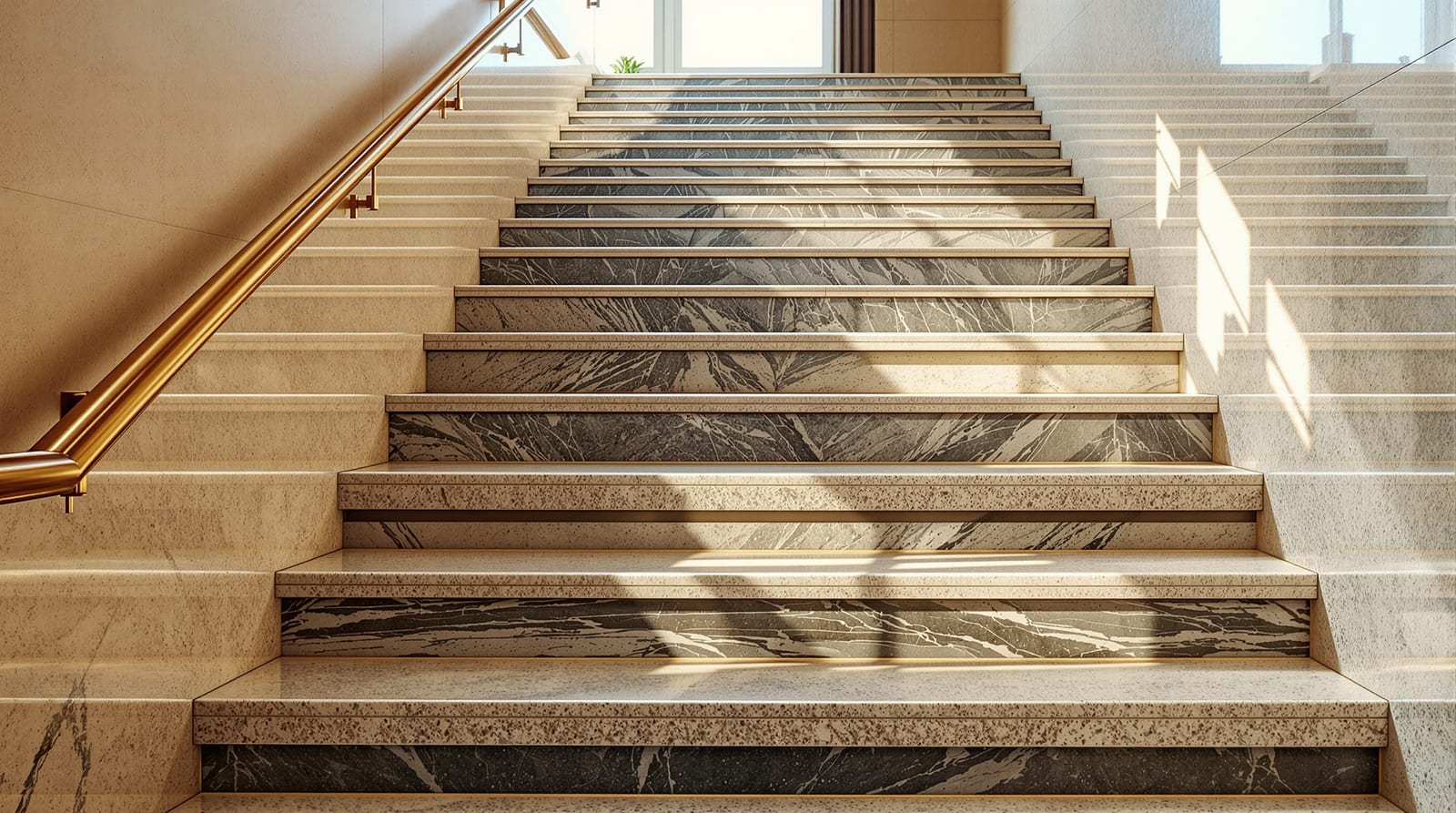
Staircase Flooring in India: Best Materials, Anti-Slip Nosing & Cost Per Step
Granite, marble, vitrified and wood for stairs — the highest-wear, highest-fall-risk surface in your home, done safely and to NBC.
A staircase is the most punished and most dangerous surface in any Indian home. Every footstep lands on the same narrow strip, often with wet monsoon feet, slippers, or a child running down two at a time. Get the floor right and the stair becomes a quiet, lifelong workhorse; get it wrong and you have a slippery, chipped, accident-waiting-to-happen at the centre of the house. This guide ranks the materials Indians actually use, then nails the safety details — anti-slip nosing, lighting and NBC-compliant tread and riser sizing — that matter far more than the colour you pick.
What makes a staircase different from any other floor
A staircase has demands no flat floor faces, so the material logic is different from a room-by-room flooring guide for living spaces.
- Concentrated wear. Foot traffic is funnelled onto the front 50-60 mm of each tread (the nosing) and the centre of the going. That strip wears, dulls and chips first. Hard, dense stone outlasts everything here.
- Fall risk. A slip on a flat floor is a stumble; a slip on a stair is a tumble down a flight. Slip resistance and a defined nosing edge are not optional — they are the whole point.
- Edge stress. The exposed front edge takes knocks from shoes, furniture being carried up, and luggage. Brittle or thin materials crack at the nose.
- Single-piece logic. Indian masons strongly prefer one slab per tread (and ideally per riser) over jointed tiles, because grout lines on a stair collect dirt, weaken the nose and read as cheap. This is why stone dominates.
- Visibility. Each step edge must be readable in low light. Contrast between tread and nosing, plus side or step lighting, prevents most domestic stair falls.
Lead with safety and durability; treat looks and budget as the next filters.
The materials, ranked for Indian stairs
1. Granite — the Indian default, and rightly so
Granite is the standard staircase material across Indian homes for good reason: it is extremely hard, comes in long single-piece treads up to 6-7 ft, resists chipping at the nose, and takes a groove or flaming for grip. A leather-finish or flamed granite nosing strip gives genuine slip resistance even when wet. It shrugs off luggage, pets and decades of footfall. See the granite flooring guide for finishes and sourcing. Expect roughly ₹130-350 per sq ft for material; on a stair the running-foot and per-step pricing below matters more.
2. Marble — the luxe choice for grand staircases
Marble gives an unmatched sense of arrival on a sweeping foyer staircase and pairs beautifully with a marble-clad foyer or entrance. But polished marble is slippery, etches with acidic spills, and shows wear on the nosing over time. If you choose marble, insist on a honed (matte) finish or a flamed/grooved nosing insert, and reserve it for lower-traffic feature stairs. Indian marble runs ₹150-450 per sq ft; Italian marble ₹350-1500+.
3. Kadappa and granite for budget
For a service stair, a rental, or a tight budget, dark Kadappa (a hard limestone) or a plain grey granite delivers stone durability at a fraction of premium cost. Kadappa's naturally matte, dense surface is reasonably grippy and hides dirt; see the Kadappa stone guide. It is the workhorse of countless Indian staircases — honest, cheap and tough.
4. Vitrified tiles with an anti-skid nosing strip
Vitrified or full-body porcelain step tiles (sold as matched tread-and-riser sets) suit modern homes that want tile continuity from the floor onto the stair. The catch: standard glossy vitrified is dangerously slick on a stair. You MUST add an anti-skid nosing — a grooved metal/PVC stair nosing profile or a recessed anti-slip strip — at every tread edge. Pair this approach with the principles in anti-slip flooring for wet areas. Tiles also mean joints, so detailing must be clean.
5. Wood — warm, beautiful, indoor-only
Engineered or solid wood treads make a stair feel warm and quiet, ideal for an internal stair in a bedroom wing or a study mezzanine. Wood is softer (dents), needs anti-slip nosing grooves or strips, and must be kept dry — never near a monsoon-exposed or external stair. Budget ₹250-800 per sq ft installed-equivalent, plus skilled carpentry.
Material comparison — per step, not per sq ft
A "step" here means one tread (the going you walk on, about 0.9-1.0 m wide x 0.27 m deep) plus one riser face. The figures below are indicative installed material cost in Indian metros, 2026 — confirm locally and with the staircase flooring calculator.
| Material | Durability (stairs) | Slip resistance | Indicative ₹/running ft | Indicative ₹/step (tread + riser) | Why / watch-out |
|---|---|---|---|---|---|
| Granite (single-piece) | Excellent | Good with flamed/grooved nosing | 350-700 | 900-2,200 | The default; chip-resistant nose, single slab |
| Indian marble (honed) | Good | Poor unless honed + grooved | 450-1,000 | 1,400-3,500 | Luxe foyer stairs; etches, slippery if polished |
| Italian marble | Good | Poor unless honed | 1,000-3,000 | 3,000-9,000+ | Statement only; high care |
| Kadappa / grey granite | Very good | Fair (matte, dense) | 180-400 | 500-1,200 | Best value stone; hides dirt |
| Vitrified step tiles | Good | Poor — needs anti-skid nosing | 250-550 | 700-1,800 | Tile continuity; add nosing strip |
| Engineered/solid wood | Fair (dents) | Fair — needs grooved nosing | 500-1,100 | 1,400-3,500 | Indoor only; warm, quiet |
Per-step figures include the riser face; open or floating stairs with exposed tread sides cost more for edge polishing.
The safety details that matter more than the material
Anti-slip nosing — the single most important detail
The nosing is the front edge of the tread, where every foot lands and most slips happen. On any stair you should specify one of:
- A grooved nosing: 2-4 parallel grooves cut 50-60 mm back from the front edge, running the width of the tread. On stone this is done with a grinder; on tiles use a pre-grooved step tile.
- A flamed or leathered nosing strip on granite/marble — a textured band that grips even when wet, with a polished body behind it.
- A metal or PVC anti-slip stair nosing profile with a rubber/carborundum insert, screwed or glued to the edge — essential on vitrified and wood.
- Colour contrast at the nose so the edge is visible. A contrasting nosing reduces falls, especially for older users.
For wet, monsoon-exposed or external stairs, treat slip resistance as a hard requirement, not a finish option.
Here is the section that good stair detailing follows:
Consistent riser height — the silent code requirement
The commonest cause of stair falls is an inconsistent step. The National Building Code (NBC 2016) requires risers and goings to be uniform within a flight; even a 10-15 mm variation trips people because the body learns the rhythm of the first two steps. For homes, aim for a riser of about 150-190 mm and a going (tread depth) of about 250-300 mm, kept identical on every step. When you clad an existing concrete stair, never let one tread end up thicker than the rest — measure the whole flight first. These dimensions also feed into accessible flooring standards when an accessible route is needed.
Lighting
Even a perfect tread is dangerous if the edge cannot be seen. Add step lights recessed into the wall or under the nosing, or a well-lit landing, and a switch at both top and bottom of the flight. Lighting plus contrast nosing is the cheapest fall-prevention you can buy.
Full cladding vs tile cladding
Two ways to surface a stair, with very different results:
- Full single-slab cladding (granite/marble/Kadappa): one slab per tread, one per riser. No joints on the walking surface, the strongest nose, the premium look. More cutting and mason skill, higher cost. This is the Indian gold standard.
- Tile cladding (vitrified step tiles): pre-sized tread and riser tiles with a matched nosing. Faster, cheaper, gives floor-to-stair continuity, but introduces grout joints and demands a bolted-on anti-skid nosing for safety. Best for budget and modern tiled homes.
Whichever you choose, the riser can be a contrasting material (a darker riser under a lighter tread reads each step clearly), and exposed open-stair sides need their edges polished or capped.
Do and don't
- Do specify anti-slip nosing on every stair, indoor or out — it is the one detail you cannot retrofit cheaply.
- Do keep every riser and going identical across the flight.
- Do use single-piece stone treads where budget allows; they outlast jointed tiles.
- Don't use polished marble or glossy vitrified without a grooved or strip nosing — it is genuinely hazardous.
- Don't put wood or laminate on an external or monsoon-exposed stair.
- Don't skip lighting and edge contrast; most home stair falls are visibility failures, not grip failures.
Care and maintenance
Stone treads need little: sweep grit (it acts like sandpaper on the nose), mop with a pH-neutral cleaner, and reseal porous stone like marble or Kadappa every 1-2 years. Vitrified needs only routine mopping but keep the nosing strip screws tight. Wood treads need a yearly check of the anti-slip strips and a recoat when the finish dulls. Re-flame or re-groove a worn stone nosing after many years rather than replacing the whole tread. For a deeper sealing routine, follow the same logic used across the materials in this cluster.
Frequently asked questions
Which is the best flooring for stairs in India?
For most homes, single-piece granite is the best all-round choice — extremely durable, available in long treads, chip-resistant at the nose, and grippy when given a flamed or grooved nosing. Marble suits grand foyer staircases, Kadappa or grey granite wins on budget, and vitrified or wood work indoors with a proper anti-slip nosing.
How much does a granite staircase cost per step in India?
As an indicative 2026 metro figure, a single-piece granite step (one tread plus its riser) costs roughly ₹900-2,200 including material and fixing, depending on the granite grade, tread width and edge work. Marble runs higher, Kadappa lower. Use the staircase flooring calculator for your exact step count.
What is anti-slip nosing and do I really need it?
The nosing is the front edge of each tread, where feet land and slips happen. Anti-slip nosing — grooves cut into stone, a flamed strip, or a screwed-on grippy profile on tiles and wood — gives traction at exactly that edge. Yes, you need it on every stair; it is the single most important safety detail.
What riser height and tread depth should a home staircase have?
Aim for a riser of about 150-190 mm and a going (tread depth) of about 250-300 mm, and keep both identical on every step in the flight as NBC requires. Inconsistent step heights are the leading cause of stair falls.
Can I use vitrified tiles on a staircase?
Yes, with care. Use matched tread-and-riser step tiles and add a grooved or bolted anti-skid nosing at every edge, because standard glossy vitrified is slippery on a stair. Keep joints clean and detail the nose well; see anti-slip flooring for wet areas for the grip principles.
Export this guide
Related Guides — Deep-dive reading
Foyer & Entrance Flooring in India: Best Materials, Anti-Skid Picks, Vastu & Cost
The floor that makes the first impression and takes the hardest hits — grit, monsoon mud and footfall — done durable, impressive and safe, with a dirt-trapping entry zone and Vastu welcome notes.
Flooring & SurfacesBasalt Flooring in India: Black Lava Stone Cost, Finishes & Use Guide
Dense, hard, low-porosity volcanic basalt gives the modern matte-black floor — here is how to choose honed, flamed or leather finishes, where it suits indoors and outdoors, and how it compares with granite.
Flooring & SurfacesAnti Slip Flooring for Bathroom and Wet Areas in India: R-Ratings, Finishes and Genuinely Safe Tile Choices
How to choose genuinely safe flooring for bathrooms, kitchens, balconies, pools, entrances and elderly- or child-friendly homes — the R-rating system, finishes that grip wet feet, anti-skid natural stone, slope to drains and the tiles to avoid.
Flooring & SurfacesRelated Tools — Try Free
Flooring Cost Calculator
Estimate the all-in cost of a floor — material, laying, wastage, skirting and GST — by area and material.
Flooring CalculatorFlooring Material Selector
Get the best flooring material for your room, budget and climate, with anti-slip checks for wet areas.
Flooring ToolMarble Flooring Cost Calculator
Estimate installed marble-floor cost — material, laying, grinding and polishing, sealing, wastage and GST.
Flooring Calculator