
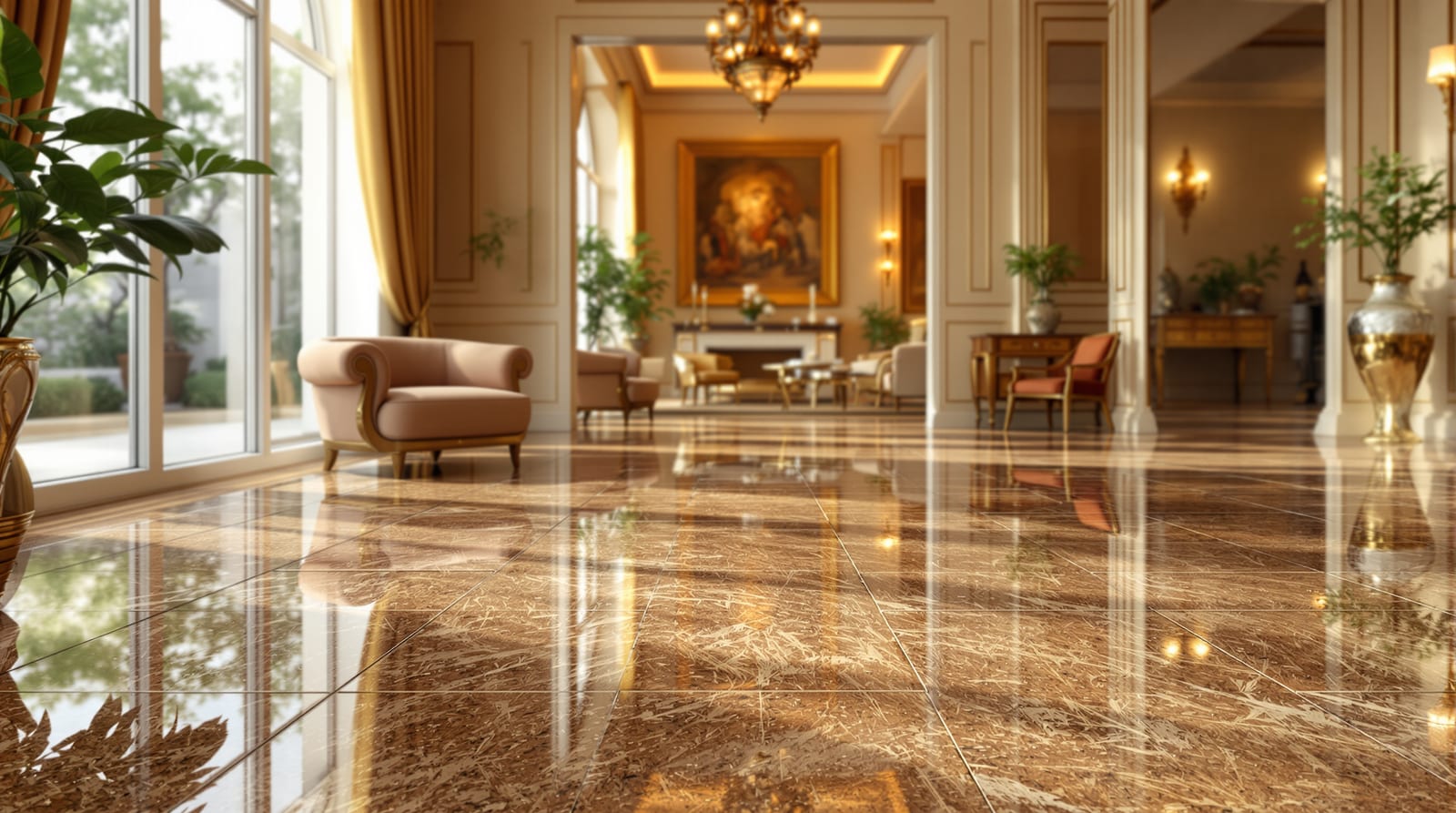
Granite Flooring in India: Colours, Finishes, Cost & Buying Guide (2026)
India is one of the world's biggest granite producers — here is the homeowner's guide to popular varieties like Black Galaxy and Tan Brown, polished vs flamed finishes, slab vs tile, ₹/sq ft costs, IS 14223, sealing and where granite beats marble and vitrified.
India quarries and exports granite to the world, which is exactly why a granite floor is one of the best-value decisions an Indian homeowner can make: the same Black Galaxy or Tan Brown that ships to Europe is available at your local stone yard, cut to your room, for a fraction of the imported-marble price. Granite is the hardest mainstream flooring stone — it shrugs off scratches, heat, stains and decades of joint-family foot traffic with almost no fuss. This guide walks through the popular Indian varieties, the four finishes, slab versus tile, real ₹/sq ft costs and where granite earns its keep against marble and vitrified tile.
Why Indian homes love granite
Granite is an igneous rock — molten magma cooled slowly underground into an interlocked crystal of quartz, feldspar and mica. That structure is why it behaves the way it does:
- Extremely hard. Granite sits at 6-7 on the Mohs scale (quartz is 7, marble only 3-4). Dragging furniture, dropping a steel tumbler or a child's cycle wheel will not scratch it the way it dents softer stone.
- Heat resistant. A hot kadhai or a tea kettle set straight on a granite counter or floor will not scorch or discolour it — useful in Indian kitchens and near pooja lamps.
- Stain resistant once sealed. Unlike marble, granite does not etch when turmeric, lemon, curd or kitchen oil touch it. With a periodic sealer it is close to stain-proof.
- Low maintenance. No yearly re-polishing the way marble often needs. A damp mop and a mild floor cleaner keep it looking new.
- Decades of life. A correctly laid granite floor routinely outlasts the building's interior fit-out — 25 to 40+ years is normal.
For a high-traffic Indian home — many feet, monsoon mud at the door, festival crowds, kids and elders — that combination of hardness, stain resistance and low upkeep is the core appeal.
The popular Indian granite varieties
India's granite belt runs across Karnataka, Andhra Pradesh, Telangana, Tamil Nadu and Rajasthan, and several globally famous colours are mined here. These are the varieties you will actually be shown at a stone yard, with indicative material-only rates (cut slab, before laying, +18% GST):
| Variety | Look | Typical use | ₹/sq ft (material) |
|---|---|---|---|
| Black Galaxy | Jet black with golden/bronze speckles (from Andhra) | Living room feature floors, counters, stairs | 120-300 |
| Absolute Black | Deep uniform black, almost no grain | Formal floors, counters, accent bands | 110-300 |
| Tan Brown | Reddish-brown with black and grey flecks | Living, dining, durable main floors | 60-150 |
| Steel Grey | Cool mid-grey with fine speckle | Modern minimal interiors, lobbies | 60-140 |
| Kashmir White | Off-white with grey-maroon garnet specks | Light NE/east rooms, marble-look at granite price | 90-220 |
| Sadarali / Sapphire Blue | Grey-blue tones | Feature areas, commercial | 100-250 |
| Local grey/green granite | Salt-and-pepper greys and greens | Budget durable floors, stairs, outdoors | 50-90 |
Premium or large-block exotic granites and book-matched pieces can run 250-500+ /sq ft. Always view the actual slabs, not a sample chip — granite varies block to block in pattern, base tone and the size and density of the speckle, so reserving your slabs from one lot keeps the floor consistent.
The four finishes — and where each belongs
The same granite block can be finished four ways, and the finish changes both the look and the slip behaviour:
- Polished — mirror gloss, deepens the colour and grain, reflects light. The default for living rooms and formal areas. Slick when wet, so it is the wrong choice for bathrooms, open balconies and pool surrounds.
- Honed — ground smooth but matte, no shine. Softer, more contemporary look; hides scuffs and water spots better than polish; slightly more slip-friendly. Good for low-sheen modern interiors.
- Flamed — the surface is heat-blasted so crystals pop into a rough, grippy texture. Strongly anti-skid and the standard for outdoor steps, ramps, driveways, terraces and wet entries in Indian homes.
- Leather (leathered) — lightly textured, low-sheen finish that keeps colour depth while masking fingerprints and water marks. Popular on dark granites like Absolute Black for a soft modern feel.
A common, smart pattern in an Indian home: polished granite indoors, flamed granite of the same family on the outdoor steps and porch — visual continuity with the right grip where it rains.
Where granite works in the home
- Living and dining — polished granite reads premium and survives furniture, footfall and festival crowds.
- Kitchen — heat- and stain-resistant, ideal for both the floor and the platform; spilled oil and masala wipe up.
- Stairs and high-traffic corridors — granite treads barely show wear over decades; a flamed nosing strip adds grip.
- Pooja and entrance — durable, easy to clean, takes a high shine.
- Outdoors (flamed) — porches, steps, terraces and pathways, where its hardness and grippy flamed finish handle monsoon and sun.
Granite is cool underfoot (less so than marble, but cooler than tile in summer) — pleasant in hot plains, neutral in coastal humidity. It is genuinely weatherproof for outdoor use when flamed and sealed.
Slab vs tile
Granite reaches the floor two ways, and the choice affects look, cost and labour:
| Form | What it is | Pros | Cons |
|---|---|---|---|
| Gangsaw slab | Large cut slab (often ~ up to 8-9 ft long), laid in big pieces | Fewer joints, grand seamless look, fewer weak lines | Heavier handling, more cutting/wastage, skilled labour |
| Tiles | Pre-cut squares (300x300, 600x600 mm etc.) | Easier to handle and lay, less wastage, lower labour | More joint lines, slightly less premium feel |
Slabs give the showcase, jointless floor most people picture when they think granite, but need a strong cement-sand bed and experienced masons. Granite tiles can be laid faster with tile adhesive over a sound screed. For large living areas, slabs; for compact rooms, stairs or DIY-adjacent jobs, tiles often make sense.
Concept: how a granite slab floor is built up
The diagram below shows the section under a cement-sand-laid granite floor and the edge detail at a skirting.
What it actually costs (₹/sq ft, 2026, indicative — varies by city and vendor)
Costs separate into the stone, then everything done to it. Treat these as benchmarks and get local quotes.
| Component | Indicative ₹/sq ft | Notes |
|---|---|---|
| Granite material (cut slab) | 50-250 | Premium/exotic 250-500+; varies by variety and block |
| Cutting / dressing / edge work | 10-40 | Mitred edges, nosing for stairs cost more |
| Laying labour | 25-60 | Slabs and large pieces cost more than tiles |
| Polishing (on-site) | 15-40 | If finishing or re-shining laid slabs |
| Skirting, grout/filler, sealer | extra | Plus 18% GST on material |
A realistic delivered-and-laid granite floor in a mid-range variety often lands around 120-250 /sq ft all-in, before GST, with premium varieties pushing higher. Add roughly 5-10% wastage for cutting (more for diagonal layouts or many small rooms). For a budget tied to your exact area, variety and finish, use the Studio Matrx granite flooring cost calculator, and compare options with the flooring cost calculator.
Standards, sealing and care
IS 14223 is the Indian Standard for polished building (granite) stone — it covers dimensions, finish and physical requirements; ask your vendor for stone that conforms, and check the slabs in person for hairline cracks, fillers and consistent colour. (Marble is covered separately under IS 1130.)
Sealing. Granite is dense but not zero-porosity. A penetrating sealer applied after laying — and re-applied every 1-3 years depending on traffic and variety (lighter granites like Kashmir White benefit more) — keeps oil and water from soaking in. Lighter and more porous granites need it more than dense blacks.
Day-to-day care is genuinely easy: dust-mop or sweep, damp-mop with a pH-neutral floor cleaner, wipe spills reasonably promptly. Avoid acidic cleaners, harsh abrasives and standing water at joints. No yearly re-polish is needed the way marble often demands — an occasional buff restores shine. For wet areas and outdoor steps, specify a flamed or honed finish so the floor is not slick (NBC 2016 and accessibility guidance favour anti-slip, level floors with low thresholds).
Granite vs marble vs vitrified — the quick verdict
| Granite | Marble | Vitrified tile | |
|---|---|---|---|
| Hardness / scratch | Hardest (6-7 Mohs) | Soft, scratches/etches | Hard, can chip |
| Stain resistance | High (sealed) | Low — etches with acid | High (low absorption) |
| Maintenance | Low | High (re-polish, sealing) | Lowest |
| Look | Speckled, deep, natural | Veined, luxurious | Any print, uniform |
| Cost ₹/sq ft (material) | 50-250+ | 80-1,500+ | 40-150 |
| Best for | Durable main floors, kitchen, stairs, outdoors | Showpiece living/foyer in dry areas | Budget-to-mid, uniform, low-upkeep |
In short: choose granite when you want a natural, near-indestructible stone floor that survives heavy use with little upkeep; marble for a softer, more luxurious veined look you are willing to maintain; and vitrified when you want the lowest cost and effort with a uniform, printable surface. Go deeper in the Studio Matrx comparisons: marble vs granite flooring, granite vs vitrified tiles, and the dedicated marble flooring guide. For the bigger picture across all materials, start with the complete home flooring guide for India.
Frequently asked questions
Is granite flooring expensive in India?
Not relative to its life. Material runs about 50-250 /sq ft for common varieties (premium up to 500+), and a laid floor often totals 120-250 /sq ft before GST. Spread over 25-40 years with almost no re-polishing, granite is one of the better-value premium floors in India — and because India produces granite, prices for local varieties stay reasonable.
Does granite flooring need polishing like marble?
No. Granite does not need the periodic re-polishing marble often requires. It arrives factory-polished (or honed/flamed), and routine care is just dust-mopping and damp-mopping. An occasional buff and a sealer every 1-3 years are usually all it needs.
Which granite is best for a living room floor?
Polished Black Galaxy and Absolute Black read as premium and modern; Tan Brown and Steel Grey are durable, warmer, forgiving everyday choices; Kashmir White gives a light, marble-like look at a granite price and suits north-east/east rooms. View actual slabs from one lot for consistent colour.
Is granite slippery? Can I use it in bathrooms and outdoors?
Polished granite is slick when wet, so it is wrong for bathrooms, open balconies and outdoor steps. For those, specify a flamed (rough, grippy) or honed (matte) finish — flamed granite is a standard anti-skid surface for Indian porches, steps and terraces.
Granite or vitrified tiles for a high-traffic Indian home?
Both are excellent for heavy traffic. Granite is a natural, harder, heat-proof stone with a premium feel and decades of life; vitrified is cheaper, lighter, faster to lay and comes in any print with the lowest upkeep. Many homes mix them — granite in living/kitchen/stairs, vitrified in bedrooms. See granite vs vitrified tiles.
Export this guide
Related Guides — Deep-dive reading
Anti Slip Flooring for Bathroom and Wet Areas in India: R-Ratings, Finishes and Genuinely Safe Tile Choices
How to choose genuinely safe flooring for bathrooms, kitchens, balconies, pools, entrances and elderly- or child-friendly homes — the R-rating system, finishes that grip wet feet, anti-skid natural stone, slope to drains and the tiles to avoid.
Flooring & SurfacesEpoxy Grout vs Cement Grout for Tiles in India: Which to Specify (2026)
A plain-English guide to tile grouts for Indian homes: what grout does, how cementitious grout compares with epoxy grout on cost, stain and water resistance, hygiene and durability, and exactly where each one belongs - kitchens, bathrooms, pools, dry rooms and more.
Building MaterialsVitrified Tile Maintenance: How to Care for Vitrified & PGVT Floors in India
Vitrified and PGVT tiles are India's most common, near maintenance-free floor; the real weak point is the cement grout, not the tile, so this guide shows the simple routine, post-construction haze and stain removal, and how to keep the gloss.
Flooring & SurfacesRelated Tools — Try Free
Flooring Cost Calculator
Estimate the all-in cost of a floor — material, laying, wastage, skirting and GST — by area and material.
Flooring CalculatorGranite Flooring Cost Calculator
Estimate installed granite-floor cost — material, cutting, laying, polishing, sealing, wastage and GST.
Flooring CalculatorApartment Furniture Size Chart
Standard furniture dimensions for Indian apartments — sofas, beds, tables, dining, storage.
Reference Chart