
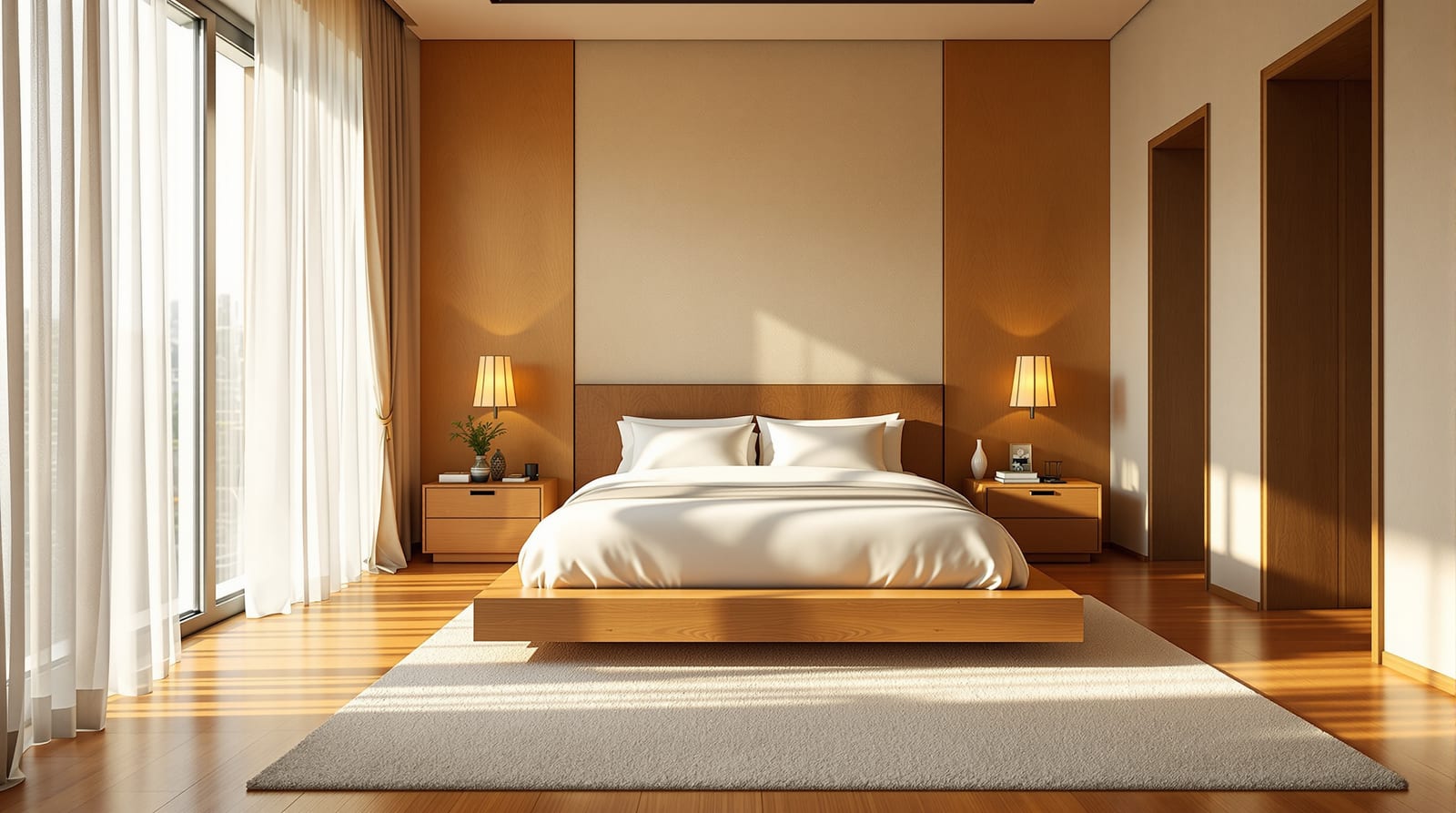
Best Bedroom Flooring in India: Warm, Quiet, Comfortable Choices
Bedrooms reward comfort over toughness — here is how to choose warm-underfoot, soft and quiet flooring for Indian homes, room by room, with 2026 costs and a Vastu note.
The bedroom is the one room where you can let comfort win. It is the floor your bare feet meet first thing in the morning and last thing at night, the floor a child sits on to play, the floor an elderly parent crosses in the dark to reach the bathroom. Unlike a kitchen or a living room, a bedroom sees almost no spills, no heavy traffic, no muddy shoes — which means you can stop optimising for sheer toughness and start optimising for how the floor feels: warm underfoot, soft to sit on, quiet to walk on. That low-traffic freedom is exactly why a bedroom is the best place in an Indian home to put wood, laminate or a wood-look plank, and the worst place to default to the same cold, hard vitrified tile you used everywhere else. This guide walks through the bedroom-specific logic, the top choices by priority, the kids-and-elderly safety angle, real 2026 costs and a Vastu note.
Why bedrooms get different rules
Most flooring advice is written for the hardest case — the room that takes the most abuse. A bedroom is the opposite. Three things change the calculus:
- Low traffic, no spills. A bedroom carries two or three people, in socks or bare feet, on a predictable path. There is no constant grit grinding the surface, no water, no oil. So scratch- and stain-resistance — the qualities that push you toward vitrified or granite elsewhere — matter far less here. A softer, warmer material will easily last a decade in a bedroom.
- You are barefoot, often sitting on the floor. Indians sit on bedroom floors far more than the Western advice assumes — folding laundry, playing with kids, doing yoga, packing a suitcase. A cold, hard tile is genuinely unpleasant for this; a warm plank or a rug is not.
- Quiet matters. A bedroom is for sleep. Hard floors transmit footstep noise and that hollow "tock" of heels; resilient floors (cork, carpet, cushioned vinyl, wood over a foam underlay) absorb it. Quiet is a feature you only appreciate at 5 a.m.
The practical upshot: in a bedroom, rank your priorities as warmth and softness first, quiet second, easy-care third, and toughness last — almost the reverse of how you would rank a kitchen.
The warm-soft-quiet logic, briefly
Why does one floor feel warm and another cold when both are at the same room temperature? It comes down to how fast the material pulls heat from your foot. Dense, conductive materials — stone, marble, vitrified tile — drain warmth quickly, so they read as cold (this is the same property that makes marble lovely in a Chennai summer and miserable on a Shimla winter morning). Wood, laminate, cork and carpet conduct heat slowly, so they sit close to skin temperature and feel warm. Softness and quiet track the same divide: a material with some give underfoot cushions your step and damps sound, while a rigid one does neither.
Top choices for an Indian bedroom
Here are the options that actually make sense for a bedroom, with where each one shines.
1. Engineered or solid wood — the warmth benchmark
Real wood is the gold standard for a bedroom: warm, quiet, soft enough to sit on, and it makes a room feel like a retreat. In India, engineered wood (a real-wood top layer over a stable plywood/HDF core) is the sensible pick over solid hardwood for most homes because its layered core resists the humidity swings that swell a solid plank after the first monsoon. Solid hardwood suits dry rooms, hill-station homes and heritage interiors. Both want a dry, well-ventilated bedroom — keep them away from a master bath splash zone, and on humid coastal ground floors lean toward a wood-look plank instead. See the deep guides on wooden flooring, engineered wood flooring and solid hardwood flooring.
2. Laminate — the warm look on a budget
Laminate gives you the warm, quiet, plank-like feel of wood at a fraction of the price, and a bedroom is its ideal habitat: low water, low traffic, lots of barefoot time. It is scratch-resistant, lays fast over an underlay (which adds cushioning and quiet), and a good AC4-class board easily outlives a bedroom's gentle use. Its one weakness — water swelling the HDF core at the joints — barely applies in a bedroom that has no spills. For most homeowners who want a warm floor without the cost of real wood, laminate is the value answer. Read laminate flooring.
3. SPC / wood-look vinyl — soft, quiet and worry-free
If your bedroom is on a humid coastal ground floor, attached to a wet master bath, or destined for kids and pets, a wood-look SPC plank is the practical winner: it has the warm wood look, a slightly resilient cushioned feel, good quiet, and a 100% waterproof core that shrugs off the one risk laminate and wood cannot. It is also genuinely comfortable underfoot — softer than tile, quieter than laminate. See SPC flooring and vinyl flooring.
4. Vitrified tile — when easy-care wins
Plenty of Indian bedrooms are simply tiled in the same vitrified tile as the rest of the flat, and that is a perfectly defensible, low-cost, near-zero-maintenance choice — especially in hot, humid cities where a cool floor is welcome and a warm one is not. Vitrified is hard, cold and a touch noisy, but a good rug fixes all three where it matters. If you want the wood feel without the wood caveats, a wood-look GVT plank tile (600x1200 or 1200x200 planks) gives a tiled bedroom the warm appearance while keeping vitrified's toughness. See vitrified tile flooring and the wooden flooring vs tiles comparison.
5. Carpet or rugs over a hard floor — softest of all
Wall-to-wall carpet is rare in India (dust, mites, humidity and cleaning make it hard to justify outside cold hill stations), but its logic — a soft, warm, sound-absorbing layer — is unbeatable for comfort. The Indian answer is almost always rugs over a hard floor: lay a tough, easy-care floor like vitrified or laminate, then place a large rug under and around the bed. You get easy cleaning everywhere the rug is not, and warm softness exactly where your feet land. It is the most flexible bedroom strategy and the easiest to refresh.
Comfort vs cost: bedroom options compared
| Bedroom option | Warm underfoot | Soft / cushioned | Quiet | Easy to clean | ₹/sq ft (material) |
|---|---|---|---|---|---|
| Solid / engineered wood | Excellent | Good | Excellent | Good | 180-1,500 |
| Laminate (over underlay) | Very good | Good | Very good | Good | 80-250 |
| Wood-look SPC / vinyl | Good | Good | Very good | Excellent | 90-350 |
| Cork | Excellent | Excellent | Excellent | Moderate | 200-500 |
| Wood-look GVT plank tile | Cool | Hard | Moderate | Excellent | 40-150 |
| Vitrified tile | Cool | Hard | Moderate | Excellent | 40-150 |
| Carpet / large rug | Excellent | Excellent | Excellent | Hard (carpet) | 40-300 |
Costs are indicative material-only 2026 figures and vary by city, brand and grade; add 18% GST, plus laying (₹15-60/sq ft), underlay, skirting and a 5-10% wastage allowance. Estimate a real bedroom with the flooring cost calculator, and weigh materials side by side with the flooring material comparison tool.
Kids' and elderly bedrooms: safety changes the answer
A child's or elderly parent's bedroom shifts the priorities from comfort-for-pleasure to comfort-for-safety, and that has concrete consequences:
- Cushioning matters most. Falls happen — toddlers learning to walk, an elderly person losing balance in the night. A floor with some give (cork, carpet, cushioned vinyl, wood over a foam underlay) softens a fall far better than tile or stone. Avoid hard, slick marble or polished granite in these rooms.
- Anti-slip, especially the path to the bathroom. The dangerous moment for an elderly user is the dark walk to an attached toilet. Keep the bedroom floor itself level (no thresholds higher than ~12 mm, per NBC 2016 and the RPwD Harmonised Guidelines), choose a surface with grip rather than a high-gloss finish, and add a non-slip backing to any rug so it cannot skid. For wet-area grip ratings, R10+ (DIN 51130) belongs at the bathroom door.
- Warmth and quiet help sleep and play. A warm, soft floor a child can sit and play on, and a quiet floor that does not echo every footstep, genuinely improves how both kids and elderly use the room.
- Low-VOC and easy to clean. Prefer low-emission products and an allergy-friendly, wipeable surface (or a washable rug) over deep-pile carpet that traps dust and mites.
In short: for a kids' or elderly bedroom, bias toward cushioned, anti-slip, level and warm — cork, cushioned wood-look vinyl, or laminate-with-underlay plus a non-slip rug are all excellent, and a slick high-gloss stone floor is the one thing to avoid.
Maintenance: bedrooms are the easy case
Because a bedroom sees no spills and little grit, maintenance is light for every option. Wood and laminate need only dry dust-mopping and the occasional barely-damp wipe — never a wet mop, and wipe spills at once so they cannot reach the joints. SPC, vinyl and vitrified are the most forgiving and take a normal damp mop happily. Wool and synthetic rugs want regular vacuuming and an annual professional clean. Use felt pads under bed and wardrobe legs on any hard floor, keep curtains or blinds to slow UV fading of wood and laminate near a sunny window, and you are done.
A Vastu note for the bedroom floor
Traditional Vastu favours lighter, warmer flooring tones in the bedroom — light wood, beige or honey laminate, soft cream stone — over very dark or cold surfaces, and aligns the master bedroom toward the south-west, where a grounded, warm floor suits the room's purpose of rest. There is a sensible practical core here: warm, light, calm flooring genuinely makes a bedroom feel restful, and the same advice to keep the lighter tones toward the north-east of a space holds up. Treat Vastu as a guide to a calm, warm, light-toned bedroom floor rather than a hard rule — the comfort logic and the tradition point the same way.
Putting it together: pick by priority
- You want the best feel and have a dry room: engineered wood, or solid hardwood in dry/hill-station homes.
- You want the warm look on a budget: laminate over a good underlay — the value sweet spot for bedrooms.
- Humid/coastal, ground floor, kids or pets: wood-look SPC or cushioned vinyl — warm, soft and worry-free.
- You want zero maintenance and a cool floor: vitrified, ideally a wood-look GVT plank, dressed with a large rug.
- Comfort above all, or a refresh-when-you-like room: any tough hard floor plus a generous, non-slip bedside rug.
For the bigger picture across every room, see the complete home flooring guide and how to choose flooring; for the room next door, compare with living room flooring.
Frequently asked questions
What is the best flooring for a bedroom in India?
For pure comfort, engineered or solid wood is the benchmark — warm, quiet and soft. On a budget, laminate over an underlay gives nearly the same feel for far less. If the room is humid, coastal or for kids, choose wood-look SPC. And if you want zero maintenance, tile it in a wood-look vitrified plank and add a rug. There is no single winner; pick by your top priority.
Is vitrified tile a bad choice for a bedroom?
Not at all — it is just the easy-care, low-cost choice rather than the comfort choice. Vitrified is hard, cool and slightly noisy, but in hot humid cities a cool floor is welcome, and a large bedside rug fixes warmth, softness and quiet exactly where your feet land. A wood-look GVT plank gives the warm look with vitrified's toughness.
Is wooden flooring practical for an Indian bedroom?
Yes, with the right product. Engineered wood handles Indian humidity far better than solid hardwood and suits most bedrooms; solid wood is best in dry or hill-station homes. Keep either away from a master-bath splash zone, dust-mop rather than wet-mop, and on humid coastal ground floors prefer a waterproof wood-look SPC plank instead.
What flooring is safest for a kids' or elderly bedroom?
Choose cushioned, anti-slip, level and warm. Cork, cushioned wood-look vinyl, or laminate over a foam underlay all soften falls and stay warm and quiet. Keep the floor level (no thresholds above ~12 mm), avoid slick high-gloss marble or polished granite, and put a non-slip backing under every rug.
Do I need carpet for a warm bedroom in India?
Rarely. Wall-to-wall carpet is hard to maintain in Indian dust and humidity outside cold hill stations. The better move is a warm hard floor — wood, laminate or wood-look vinyl — or any easy-care floor dressed with a large, washable bedside rug, which delivers the softness and warmth exactly where you stand without the cleaning burden of full carpet.
Export this guide
Related Guides — Deep-dive reading
Bathroom Flooring Guide India: Anti-Skid Tiles, Stone, Vinyl & Epoxy Compared
Every bathroom floor material for Indian homes in one place — anti-skid ceramic and vitrified tiles, natural stone, mosaic, vinyl (SPC/LVT) and epoxy — with a full comparison table, slip ratings, ₹/sq ft costs and the safety and slope rules that keep a wet floor from becoming a hazard.
BathroomsComplete Home Flooring Guide for Indian Homes (2026)
The authoritative overview of every flooring family — tiles, stone, wood, vinyl and seamless — with India ₹/sq ft costs, room-by-room logic and laying basics.
Flooring & SurfacesHow to Choose Flooring for an Indian Home: A Step-by-Step Framework (2026)
A decision framework to pick the right floor for any room — weighing traffic, water, comfort, budget, maintenance, look, climate, durability and resale, with the key natural-stone vs tile vs wood vs resilient trade-offs.
Flooring & SurfacesRelated Tools — Try Free
Flooring Cost Calculator
Estimate the all-in cost of a floor — material, laying, wastage, skirting and GST — by area and material.
Flooring CalculatorFlooring Material Selector
Get the best flooring material for your room, budget and climate, with anti-slip checks for wet areas.
Flooring ToolFull-Room BOQ — Living, Bedroom, Kitchen, Bath
Room-wise BOQ across living, bedrooms, kitchen, utility, and bathrooms with line-item pricing.
Full-Room BOQ