
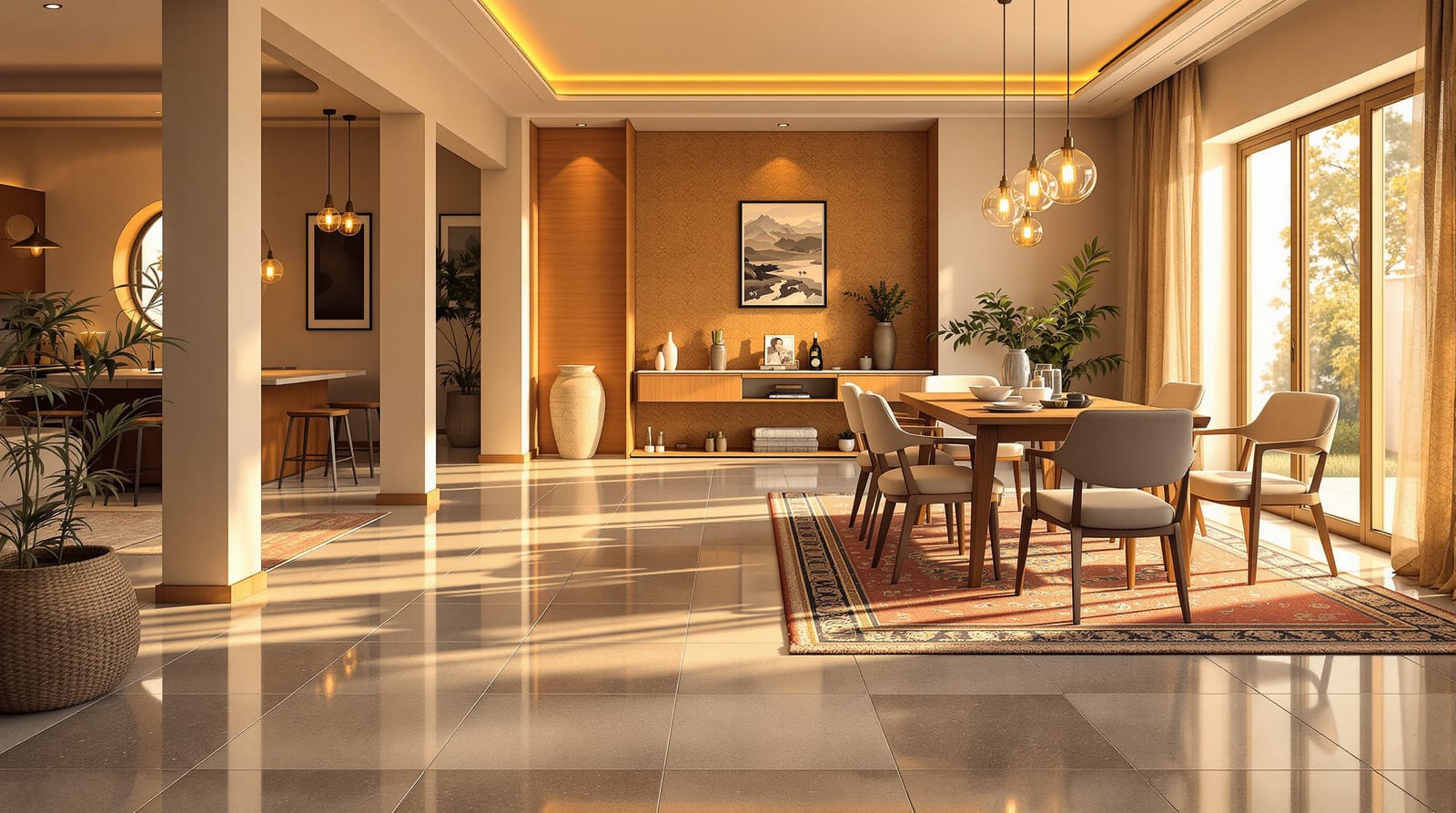
Dining Room Flooring in India: Spill-Proof Floors That Flow With Your Living Room
How to choose a dining-area floor that shrugs off food, drink and chair-scraping while flowing seamlessly with the adjacent living room and kitchen.
The dining area is where dal splashes, a glass of juice topples, gravy drips off a serving spoon and four chairs scrape back twice a day, every day. Yet in most modern Indian homes it isn't a separate room at all — it sits in one open volume with the living room and opens straight onto the kitchen. So your dining floor has a double job: survive constant food-and-drink abuse while reading as one continuous, elegant surface with everything around it. Get this balance right and the whole ground floor feels calm, generous and easy to keep clean.
What a dining-area floor actually has to survive
Before picking a material, be honest about what happens under and around that table.
- Spills and stains — turmeric, oil, wine, coffee, sambar, ketchup. The floor must wipe clean without staining or etching. This single demand rules out raw, porous or acid-sensitive surfaces in a busy family home.
- Chair-scraping — dining chairs move several times a day. Hard surfaces resist gouging but can show scuff lines; soft surfaces (real wood, laminate) dent and scratch unless protected.
- Foot and trolley traffic — the dining zone is a thoroughfare between living and kitchen. It sees more passes than almost any other floor in the house.
- Easy daily cleaning — you should be able to mop up a spill in seconds, not panic about water marks or sealing.
- Open-plan continuity — because the dining area rarely has walls, the floor must visually connect to the living room on one side and (often) the kitchen on the other. Mismatched floors chop a small home into awkward fragments.
- Looks — this is where guests are seated and fed. It is a presentation space, so the floor should feel considered, not utilitarian.
The headline takeaway: in an Indian dining area, spill-and-stain resistance plus easy cleaning matter more than warmth underfoot. That is exactly why real solid wood — beautiful as it is — is a risky choice directly under a dining table, and why wood-look tiles or rigid vinyl have become so popular: they give you the warm look without the spill anxiety.
Top picks for the dining area, ranked
1. Vitrified and large-format tiles — the default winner
For most Indian dining areas, glazed or full-body vitrified tile flooring is the smartest choice. It is near-impervious to liquids, so turmeric and oil sit on the surface and wipe away; it resists scratching from chairs; and it is the easiest of all floors to keep clean. Large-format tiles (800x800mm, 800x1600mm and 1200x600mm planks) have few grout lines, which means fewer dirt traps and a seamless, premium look that flows beautifully into the living room. Double-charged vitrified tiles handle the heaviest traffic, while polished glazed vitrified tiles (PGVT) and full-body GVT give you marble-look, stone-look or wood-look faces. At roughly 80-220 per sq ft installed, this is also the best value. Keep grout dark or epoxy-grout it so spills near the table don't stain the joints.
2. Marble and granite — when you want the room to feel special
Stone says "occasion", and a dining area is one of the few spaces where that lands. Marble flooring gives a soft, luminous elegance, while granite flooring is tougher, denser and far more stain-forgiving. The catch with marble is chemistry: acidic spills (lime, vinegar, wine, citrus, sambar) etch and dull polished marble, and oil can stain it, so a busy young family must commit to prompt wiping and periodic resealing. Granite has none of that anxiety — it shrugs off acid and oil — and reads as luxurious, especially in darker shades. If you love stone but want zero worry, granite (130-350/sq ft) under the dining table beats marble (Indian 150-450, Italian 350-1500/sq ft). Both pair naturally with a stone or large-format living-room floor.
3. Wood-look LVT, SPC and WPC — warmth without the spill risk
If you want the warmth and character of timber under your table but refuse to babysit it, rigid vinyl is the answer. Luxury vinyl tile (LVT), SPC and WPC planks photograph convincingly as oak or teak yet are 100% waterproof, stain-resistant and far softer and quieter underfoot than tile — so chairs don't clatter and dropped crockery is less likely to shatter. SPC's rigid core resists denting from chair legs better than soft sheet vinyl. At 90-400/sq ft it is mid-priced, installs fast over a flat base, and is the ideal "I want wood but it has to survive my kids" pick for the dining zone. This is the choice most interior designers now steer Indian families toward for warm open-plan grounds floors.
4. Engineered wood — beautiful, but only with discipline
Genuine engineered wood flooring (and even more so solid wooden flooring) is the warmest, most characterful surface you can have. But directly under a dining table it is the highest-maintenance option: standing liquid must be wiped immediately, chair legs need felt pads at all times, and you should expect to live with it carefully. It works best in a formal, low-traffic dining room or where the dining zone is at the edge of a larger wooden living floor. If you adore real wood, consider engineered (not solid) for stability in Indian humidity, and protect the table zone with a rug. Budget 250-800/sq ft. For a softer-budget warm look, laminate (110-300/sq ft) is more scratch-resistant on the surface but swells badly if water sits in the joints — less ideal right under a table than SPC.
Comparison: dining-area flooring at a glance
| Material | Spill / stain resistance | Look & feel | Chair-scrape resistance | Indian cost (per sq ft) | Best when |
|---|---|---|---|---|---|
| Vitrified / large-format tile | Excellent — near-impervious, wipes clean | Sleek, continuous, marble/stone/wood-look | High (may show scuffs) | 80-220 | The all-round default; flows with living + kitchen |
| Granite | Excellent — acid and oil resistant | Dense, premium, dark elegance | Very high | 130-350 | Want stone luxury with zero anxiety |
| Marble (Indian / Italian) | Fair — etches on acid, oil stains | Luminous, luxurious | Moderate | 150-450 / 350-1500 | Formal dining, owner who wipes promptly |
| Wood-look LVT / SPC / WPC | Excellent — 100% waterproof | Warm timber look, quiet, soft | High (SPC best) | 90-400 | Warm look + young family + open plan |
| Engineered wood | Poor unless wiped instantly | Genuine warm timber, characterful | Low — dents/scratches | 250-800 | Formal, careful households; rug essential |
| Laminate | Fair — swells if water sits in joints | Warm wood look, budget-friendly | Moderate (surface scratch-resistant) | 110-300 | Budget warm look, drier dining zones |
Continuity: making the dining floor flow with living and kitchen
In an open plan, the floor is the single biggest tool for making a small home feel large. The principle is simple: one continuous floor across living and dining makes the whole space read as one generous room; chopping it into different materials makes it feel small and busy.
A reliable strategy for Indian open-plan ground floors:
- Run ONE floor through living + dining. Use the same large-format vitrified, granite or SPC across both zones, with no threshold and no change of material. This is the cleanest, most spacious-looking choice.
- Let the kitchen either match or shift deliberately. Either continue the same tile into the kitchen for total flow, or make a confident, intentional change at the kitchen threshold (for example a more anti-skid, grease-friendly tile) so it reads as a design decision rather than an accident. See the demands of each in the kitchen flooring guide and the living room flooring guide.
- Zone with rugs and lighting, not with flooring changes. Define the dining "room" with a pendant light over the table and a rug under it — not by switching floor materials mid-space.
- Match the plank/tile direction. Lay planks or large tiles running the long way through the space to elongate it, and keep the same direction across zones.
The SVG below shows this continuity logic in a typical open-plan layout.
Design and protection tips for the dining zone
- Felt pads on every chair leg. This is non-negotiable on tile, stone, vinyl and especially wood. They stop the scrape lines and the clack-clack. Check and replace them twice a year.
- A rug under the table — sized right. The rug should be large enough that all chairs stay on it even when pulled out (roughly 60cm clear beyond the table edge on every side). On hard floors a rug softens acoustics, defines the zone and protects the highest-wear patch. Choose a flat-weave, washable or stain-resistant rug — a thick shaggy one under a dining table is a crumb magnet. Use a thin non-slip underlay so it doesn't slide on tile.
- Mind the grout. On tile, use epoxy grout or a dark-coloured grout near the table so spills and food don't permanently stain the joints. Tighter joints on large-format tiles mean fewer traps.
- Skip glossy mirror-polish if you have small kids. A high-gloss floor shows every smear and footprint and can be slippery when wet. A satin or matt large-format finish hides spills between mops and grips better.
- Wipe acidic spills instantly on marble. Lime, wine, vinegar, sambar and citrus etch polished marble in minutes. If you have marble, keep a cloth handy and reseal periodically.
- Plan the floor as one move. Decide the living-dining-kitchen floors together at design stage, not room by room — it is the single decision that most affects how big and how calm your home feels. The room-by-room flooring guide walks through the whole house.
Do / don't for dining-area floors
| Do | Don't |
|---|---|
| Run one continuous floor across living + dining | Switch materials randomly mid-open-plan |
| Choose waterproof, easy-clean surfaces (vitrified, SPC, granite) | Put untreated solid wood directly under the table without accepting the upkeep |
| Fit felt pads on all chair legs and re-check them | Let bare chair legs scrape a polished or wood floor |
| Use a correctly sized, washable rug under the table | Use a thick shaggy rug that traps crumbs and gravy |
| Epoxy-grout or dark-grout tile near the table | Use wide light grout joints that stain by the dining chairs |
| Wipe spills (especially acidic) promptly on stone | Leave wine, lime or oil sitting on marble |
Costs at a glance
| Option | Indian installed cost (per sq ft) | Notes |
|---|---|---|
| Large-format vitrified / GVT | 80-220 | Best value, easiest care, flows with living |
| Granite | 130-350 | Premium, stain-proof, very durable |
| Indian marble | 150-450 | Luxurious but etches on acid |
| Italian marble | 350-1500 | High luxury, highest care |
| Wood-look LVT / SPC / WPC | 90-400 | Warm look, waterproof, quiet |
| Engineered wood | 250-800 | Genuine warmth, highest upkeep at table |
| Laminate | 110-300 | Budget warm look; vulnerable to standing water |
For your own room, run the numbers in the flooring cost calculator and shortlist materials with the flooring material selector. Compare the everyday demands of each adjoining space in the living room flooring guide and the kitchen flooring guide, and see the whole-house picture in the room-by-room flooring guide.
Frequently asked questions
Is wood flooring a bad idea in a dining room?
Not bad, but high-maintenance directly under the table, where spills and chair-scraping concentrate. Real solid wood demands instant wiping and constant felt pads. If you love the look, use engineered wood (more stable in Indian humidity) in a careful household with a rug, or get the warm timber appearance with waterproof wood-look LVT or SPC instead — that is what most designers now recommend for family dining zones.
Should the dining room floor match the living room?
In an open plan, yes — run one continuous floor across living and dining for a larger, calmer, more expensive-looking home. Define the dining zone with a rug and a pendant light rather than a change of material. The kitchen can either continue the same floor or make a deliberate, confident switch to a more grease-friendly, anti-skid surface at the threshold.
Which is the most spill-proof dining floor?
Vitrified and large-format porcelain tiles and granite are the most spill- and stain-proof — they are effectively impervious, so turmeric, oil and wine wipe straight off. Waterproof rigid vinyl (SPC/WPC) is also excellent and adds warmth and quiet. Polished marble is the least forgiving because acidic foods etch it.
How do I stop chairs scratching the floor?
Fit good-quality felt or rubber pads on every chair leg and replace them every six months, lift rather than drag chairs, and place a correctly sized rug under the table to absorb the heaviest movement. Choose a satin or matt finish over high-gloss, since scuffs and scratches show far less on a textured surface.
What is the cheapest good dining-area floor?
Ceramic and standard vitrified tiles start around 50-110 per sq ft and give excellent, easy-clean spill resistance — the best value for money. For a warm wood look on a budget, laminate runs 110-300 per sq ft, but step up to SPC if there is any risk of standing water near the table, since SPC is fully waterproof.
Export this guide
Related Guides — Deep-dive reading
Bathroom Flooring Guide India: Anti-Skid Tiles, Stone, Vinyl & Epoxy Compared
Every bathroom floor material for Indian homes in one place — anti-skid ceramic and vitrified tiles, natural stone, mosaic, vinyl (SPC/LVT) and epoxy — with a full comparison table, slip ratings, ₹/sq ft costs and the safety and slope rules that keep a wet floor from becoming a hazard.
BathroomsComplete Home Flooring Guide for Indian Homes (2026)
The authoritative overview of every flooring family — tiles, stone, wood, vinyl and seamless — with India ₹/sq ft costs, room-by-room logic and laying basics.
Flooring & SurfacesGuest Room Flooring in India: Warm, Welcoming & Low-Maintenance Floors (2026)
How to choose a guest bedroom floor that looks fresh with little upkeep, feels welcoming, and never over-invests in a room used only occasionally.
Flooring & SurfacesRelated Tools — Try Free
Flooring Cost Calculator
Estimate the all-in cost of a floor — material, laying, wastage, skirting and GST — by area and material.
Flooring CalculatorAcoustic Privacy (STC) Visualizer
Indian healthcare acoustic visualizer — compare wall assemblies and noise sources, see received SPL after STC attenuation, and check FGI 2018 / IS 1950 / NABH speech-privacy compliance with live dual-canvas waveform.
Acoustic ToolFlooring Material Selector
Get the best flooring material for your room, budget and climate, with anti-slip checks for wet areas.
Flooring Tool