
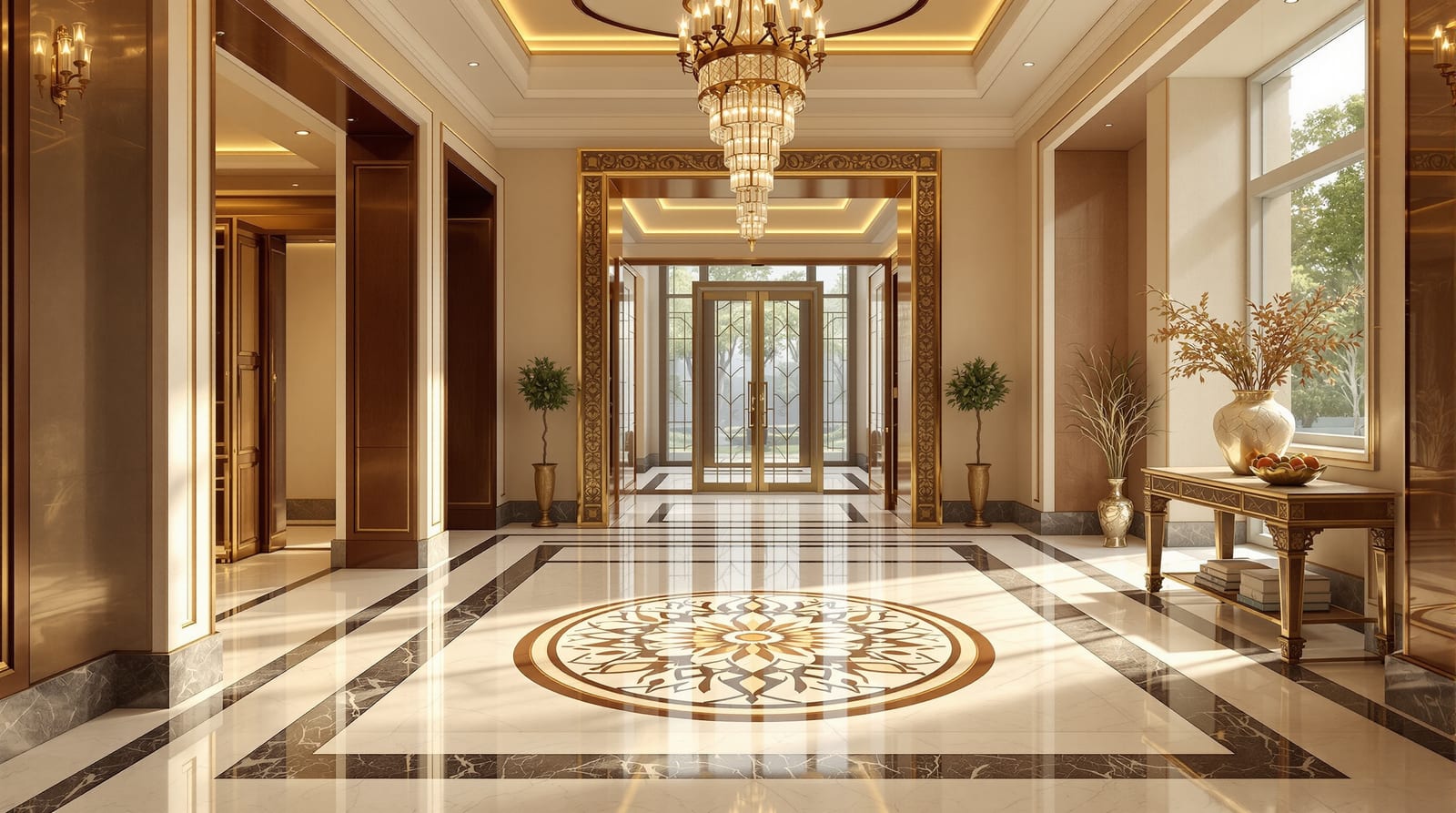
Foyer & Entrance Flooring in India: Best Materials, Anti-Skid Picks, Vastu & Cost
The floor that makes the first impression and takes the hardest hits — grit, monsoon mud and footfall — done durable, impressive and safe, with a dirt-trapping entry zone and Vastu welcome notes.
The foyer floor does two jobs that pull in opposite directions. It is the first thing every guest sees — so it has to look impressive — and it is the single hardest-working square metre in the house, taking the grit, the monsoon mud, the wet umbrellas and the constant footfall of everyone who walks in. Get it right and the entrance feels generous, clean and welcoming for decades. Get it wrong and you have a slippery, scratched, perpetually grimy floor at the very point where the home introduces itself.
This guide ranks the materials that suit an Indian entrance, explains why granite and large-format vitrified usually win, how to use marble for luxury, how to design a feature floor with a medallion or contrast border, why a dirt-trapping entry zone matters more than the tile you pick, what anti-skid really means for monsoon safety, the Vastu welcome notes worth honouring, and what it all costs.
What the entrance demands of a floor
Before you fall for a beautiful tile, list what the entrance actually throws at a floor. These demands rank your choices for you.
- Footfall and abrasion. Every person, every delivery, every visitor crosses this floor. It needs a hard, abrasion-resistant surface that will not scratch dull in a year. Soft polished marble and glossy ceramic show wear here fastest.
- Grit and tracked-in dirt. Shoes drag in sand, dust and stone grit from outside. Without a place for that grit to drop, it acts like sandpaper underfoot and scratches the floor — which is why a dirt-trapping entry zone matters as much as the material.
- Monsoon water and mud. For three to four months a year, feet, umbrellas and pets bring water and mud inside. A polished floor that is gorgeous when dry becomes dangerously slippery when wet. Slip resistance is a safety requirement at the entrance, not a nice-to-have.
- First-impression looks. This is the showpiece floor. Large formats, fewer joints, a feature medallion or a contrast border read as intentional and premium.
- Easy cleaning. It gets dirty daily, so it must wipe and mop clean fast without staining or holding grime in the joints.
- A graceful transition. The foyer floor usually meets the living-room floor a few feet in; a clean transition or a deliberate change of material defines the zone.
Hold all of this in mind and the shortlist almost writes itself: a hard, large-format, easy-clean, slip-aware floor that looks rich. That points to granite and large-format vitrified or PGVT first, marble for luxury, with anti-skid handling for the wet months.
The materials, ranked for an entrance
Granite — the durable, impressive default
Granite is the floor that quietly does everything an entrance asks. It is extremely hard and abrasion-resistant, so it shrugs off grit and footfall; it is dense and easy to clean; large slabs give a grand, low-joint look; and a single dark granite slab framing the door reads as serious and permanent. Flamed or leathered granite adds grip for the threshold and any exposed porch step, while a polished granite field inside stays impressive. For the full picture see the granite flooring guide. It is the safest all-round entrance choice in India.
Large-format vitrified and PGVT — impressive, easy, value
Large-format vitrified tiles — 800x800 mm, 600x1200 mm and bigger — give you the grand, near-seamless look of stone with fewer joints, near-zero water absorption, excellent abrasion resistance and the easiest cleaning of any floor. PGVT (polished glazed vitrified tiles) print convincing marble, stone and metallic faces, so you can have a marble-look entrance for a fraction of marble's price and upkeep. This is the most popular modern entrance floor in India: impressive, durable and forgiving. Choose a matt or textured anti-skid variant for the threshold band, and keep the high-gloss in the dry interior.
Marble — the luxury statement
Nothing says arrival like a real marble foyer — an Indian marble field with a contrasting border, or a book-matched Italian marble medallion under a chandelier. Marble is the luxury entrance, and the marble flooring guide covers grades and care. Be honest about the trade-offs: marble is softer than granite and vitrified, etches with acids and the grit of an unprotected entrance dulls its polish over time, and it is slippery when wet. Use it where the entrance is sheltered, commit to a proper mat well to keep grit off it, and seal it. For many Indian homes a marble-look PGVT delivers the look with far less worry.
Patterned, inlay and feature floors
The entrance is the one place a feature floor earns its keep. A circular medallion in contrasting stone or pre-cut tile, a double border running the room edge, a CNC water-jet inlay of granite and marble, or a terrazzo or mosaic panel all turn a plain floor into a designed welcome. Keep the pattern proportional to the foyer and let it sit within a calm field so it frames rather than overwhelms.
Comparison table
| Material | Durability | Look | Slip when wet | Indicative ₹/sq ft | Best for |
|---|---|---|---|---|---|
| Granite (polished / flamed) | Excellent | Rich, grand, permanent | Polished slippery; flamed/leathered grippy | 130–350 | The durable, impressive default; threshold in flamed |
| Large-format vitrified / GVT | Excellent | Large, modern, low-joint | Matt/textured grades grip; gloss slippery | 80–220 | Best all-round value entrance |
| PGVT (marble/stone-look) | Excellent | Marble look without marble worry | Polished gloss slippery — use matt at door | 100–250 | Marble look on a budget |
| Indian marble | Good (softer) | Luxurious, classic | Slippery — keep sheltered | 150–450 | Sheltered luxury foyers |
| Italian marble | Good (softer) | Ultimate luxury statement | Slippery | 350–1500 | Showpiece medallion under light |
| Kota / Tandur stone | Very good | Earthy, traditional, matt | Naturally matt — decent grip | 60–150 | Traditional, value, good grip |
| Terrazzo / mosaic feature | Very good | Crafted, patterned, retro-modern | Matt grades grip | 90–250 | Feature panel or whole foyer |
Costs are indicative installed-ish figures for 2026 and vary by city, brand, slab and laying; price your own foyer with the Studio Matrx flooring material selector and check the broader flooring cost per square foot in India guide.
Anti-skid: the monsoon safety priority
A polished entrance floor that sparkles in summer can be the most dangerous spot in the house during the monsoon, when wet feet, dripping umbrellas and tracked-in water turn gloss into a skating rink right where people are stepping in fast. Slip resistance at the entrance is a genuine safety issue, especially with elderly family members and children.
Handle it in three layers. First, make the threshold and the first metre inside an anti-skid surface — flamed or leathered granite, a matt or textured vitrified, or a grippy natural stone like Kota — so the wettest band underfoot has grip even when the interior field stays glossy. Second, keep the water from travelling by trapping it at the door (the mat well below). Third, where an existing polished floor is already laid, an anti-skid floor treatment chemically micro-etches the surface to raise grip without changing the look. For the full wet-area picture see anti-slip flooring for wet areas, and for monsoon-specific choices the monsoon-ready flooring guide. As a benchmark, an entrance and porch band exposed to rain wants the grip of an R10–R11 rated surface.
The dirt-trapping entry zone — the detail that protects everything
The single most effective thing you can do for an entrance floor is not about the tile at all — it is giving tracked-in grit and water somewhere to drop before they reach the polished floor. A recessed mat well does exactly that: a shallow sunken tray, typically 12–18 mm deep, set into the floor at the door and fitted with a coir or aluminium-frame entrance matting. Shoes wipe across it, grit and water fall into the recess, and the rest of the floor stays clean, dry and unscratched.
The diagram below shows a foyer floor laid out with a recessed mat well at the door, a contrast border framing a central medallion, and the transition line into the living room.
If a recessed well is not possible — a slab already cast, a rented home — a heavy surface-laid entrance mat does most of the same work; it just sits proud of the floor. Either way, an entry mat is the cheapest upgrade your foyer floor will ever get and the one that keeps grit from scratching the polish.
Design: medallion, border and the transition
The foyer is where a little floor design pays off most. A few moves used consistently across Indian homes:
- A contrast border. Run a band of darker granite or marble around the room edge, or a double pinline, to frame the field and define the foyer as a distinct zone. It is the simplest way to make a plain floor look designed.
- A central medallion. A circular or octagonal motif in the centre — pre-cut tile medallion, water-jet stone inlay, or a mosaic rosette — gives the entrance a focal point, ideally centred under a pendant light or skylight.
- Large formats, fewer joints. Bigger tiles and slabs read as more premium and are easier to keep clean; align the grid to the door and the main sightline.
- A deliberate transition. Where the foyer meets the living room, either continue the same floor for flow, or change material with a clean metal or stone strip to signal the shift. The room-by-room flooring guide covers how to plan these transitions across the whole home.
Vastu welcome notes for the entrance
The entrance, or mukhya dwar, is treated in Vastu as the mouth through which energy enters the home, so it carries more tradition than any other floor. The notes that also happen to make practical sense:
- Keep it clean, level and unbroken. A spotless, well-maintained, crack-free entrance floor is the core Vastu instruction — and it is exactly what a durable, easy-clean material like granite or vitrified delivers. Cracked or chipped thresholds are considered inauspicious and are also a trip hazard, so repair them.
- Light, bright and welcoming. Light-toned floors and good lighting at the entrance are favoured. A well-lit, light-coloured foyer floor feels welcoming and reads as larger.
- Honour the threshold. A defined threshold or step at the door, often marked with a small contrast band or stone, is traditional and practically separates outside grit from the inside floor.
- A welcome motif. A subtle rangoli-style medallion or auspicious motif at the entrance is both a Vastu nod and a design focal point.
Treat these as alignment where they suit you, not hard rules — the practical demands of durability and slip safety come first.
Do and don't
| Do | Don't |
|---|---|
| Fit a recessed mat well or heavy entrance mat to trap grit and water | Lay high-gloss polished floor right to the threshold with no anti-skid band |
| Choose hard, abrasion-resistant granite or large-format vitrified | Use soft polished marble in an exposed, unsheltered entrance without a mat |
| Make the threshold metre anti-skid for monsoon safety | Forget the elderly and children who slip first on wet gloss |
| Use a contrast border or medallion to frame the foyer | Over-pattern a small foyer until it feels busy |
| Plan a clean transition to the living-room floor | Let two random floors clash at the join with no detail |
| Keep it clean, level and crack-free (Vastu and safety) | Leave chipped or cracked entrance tiles unrepaired |
Care and maintenance
The entrance gets dirty daily, so easy care matters. Sweep or vacuum the grit out often — it is grit, not water, that scratches a floor — and damp-mop with a pH-neutral cleaner. Shake out and clean the entrance mat regularly so it keeps trapping dirt rather than spreading it. For natural stone, reseal granite and especially marble periodically per the floor resealing guide so the surface stays stain-resistant; for the general routine see the floor cleaning guide. Wipe spills, monsoon mud and any acidic splashes off marble fast to prevent etching.
Frequently asked questions
What is the best flooring for a home entrance in India?
For most homes, granite or large-format vitrified tile is the best entrance flooring: both are very hard, abrasion-resistant, easy to clean and look impressive, and they handle daily footfall and tracked-in grit far better than soft marble or glossy ceramic. PGVT gives a marble look with vitrified toughness. Use marble where the entrance is sheltered and you want a luxury statement, and always make the threshold band anti-skid for the monsoon.
How do I stop my entrance floor from getting scratched and dirty?
Trap the grit and water before they reach the floor. A recessed mat well — a shallow sunken tray at the door fitted with coir or aluminium-frame matting — catches the sand, dust and water that shoes drag in, which is what scratches the polish and spreads dirt. If you cannot recess one, a heavy surface entrance mat does most of the same job. Then sweep grit out often and reseal natural stone periodically.
Is marble a good idea for the entrance?
Marble makes a stunning luxury foyer, but be realistic: it is softer than granite, etches with acids, slips when wet and the grit of an unprotected entrance gradually dulls its polish. Use it where the entrance is sheltered from rain, commit to a proper mat well to keep grit off it, seal it, and wipe spills fast. Many Indian homes get the same look with far less worry by using a marble-effect PGVT instead.
How do I make my entrance floor safe in the monsoon?
Make the threshold and the first metre inside anti-skid — flamed or leathered granite, matt or textured vitrified, or a naturally grippy stone like Kota — so the wettest underfoot band has grip even if the interior stays glossy. Trap incoming water with a mat well, and on an existing polished floor, an anti-skid chemical treatment raises grip without changing the look. Aim for roughly R10–R11 grip at the exposed entrance.
What does Vastu say about entrance flooring?
Vastu treats the main entrance as where energy enters, so its core instruction is simple and practical: keep the entrance floor clean, level, well-lit, light-toned and free of cracks or chips. A defined threshold and a subtle welcome motif or medallion are traditional touches. These align neatly with good design — a durable, easy-clean, bright entrance floor satisfies both Vastu and everyday life.
Export this guide
Related Guides — Deep-dive reading
Mall Flooring in India: The Right Floor for Concourse, Atrium, Food Court and Anchor Stores, with Costs
Shopping malls floor millions of footfalls a year while projecting a premium image and passing slip checks — here is the floor, ₹/sq ft and key driver for the concourse, atrium feature, food court, entrance, anchor stores, lift lobbies, parking and washrooms.
Flooring & SurfacesBathroom Flooring Guide India: Anti-Skid Tiles, Stone, Vinyl & Epoxy Compared
Every bathroom floor material for Indian homes in one place — anti-skid ceramic and vitrified tiles, natural stone, mosaic, vinyl (SPC/LVT) and epoxy — with a full comparison table, slip ratings, ₹/sq ft costs and the safety and slope rules that keep a wet floor from becoming a hazard.
BathroomsVitrified Tile Maintenance: How to Care for Vitrified & PGVT Floors in India
Vitrified and PGVT tiles are India's most common, near maintenance-free floor; the real weak point is the cement grout, not the tile, so this guide shows the simple routine, post-construction haze and stain removal, and how to keep the gloss.
Flooring & SurfacesRelated Tools — Try Free
Flooring Cost Calculator
Estimate the all-in cost of a floor — material, laying, wastage, skirting and GST — by area and material.
Flooring CalculatorFlooring Material Selector
Get the best flooring material for your room, budget and climate, with anti-slip checks for wet areas.
Flooring ToolMarble Flooring Cost Calculator
Estimate installed marble-floor cost — material, laying, grinding and polishing, sealing, wastage and GST.
Flooring Calculator