
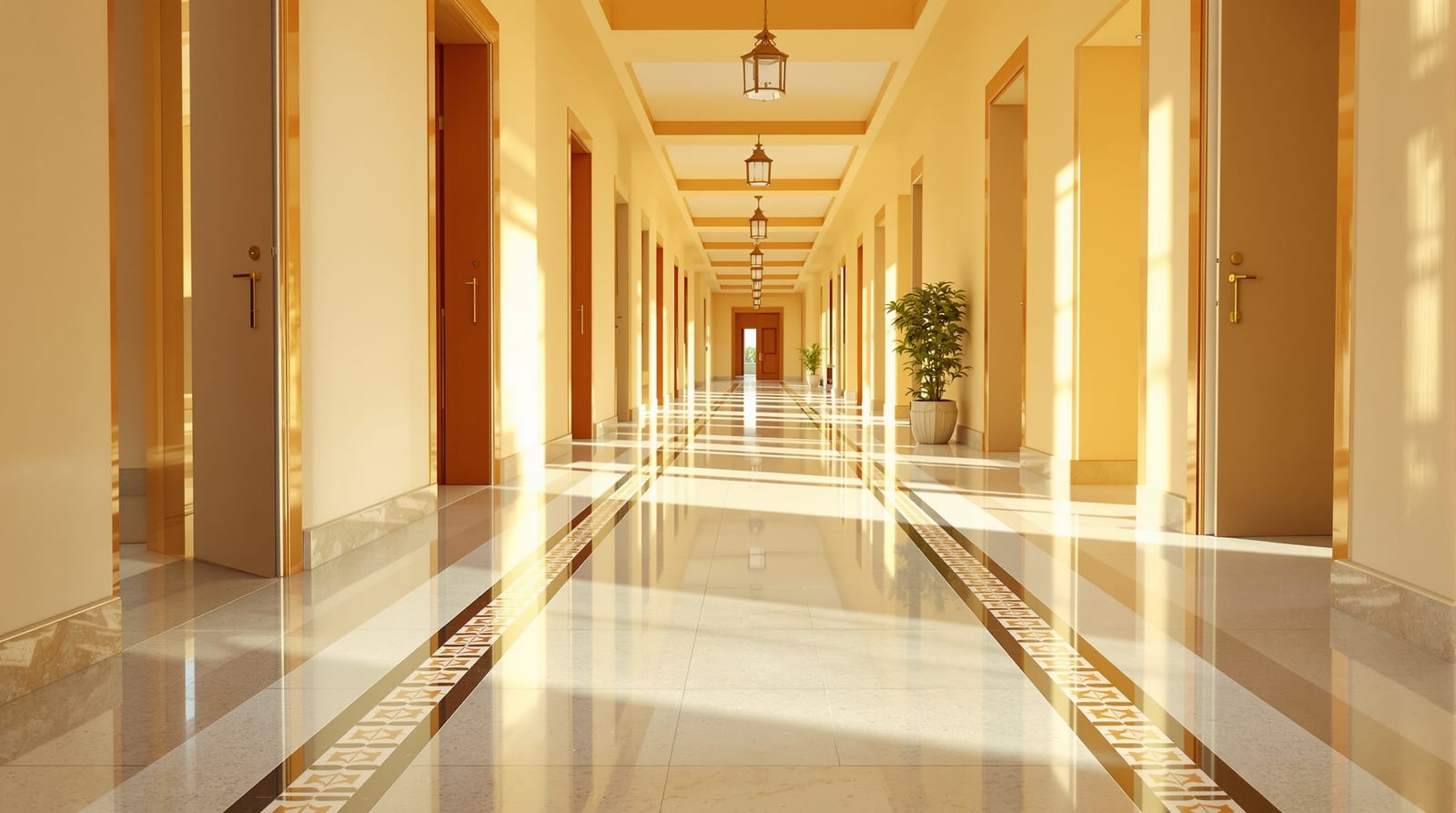
Corridor Flooring in India: Best Passage & Hallway Floors for Durability and Flow
Passages and corridors are the busiest, most-walked strips in any Indian home — here is how to floor them for durability, visual continuity and safe turns.
The passage is the floor nobody designs and everybody walks. Every trip from bedroom to kitchen, every guest heading to the washroom, every suitcase dragged in at 2 a.m. crosses this one narrow strip — which makes the corridor the highest-traffic, most-abused square footage in the whole house. Get its flooring right and the home reads as one continuous, generous space; get it wrong and a scuffed, mismatched passage chops the plan into disconnected boxes.
Corridors ask two things at once: durability (they take more footfall per square foot than any room) and continuity (they are the visual thread that ties rooms together). This guide ranks the materials that deliver both for an Indian home, shows how directional layout can make a tight passage feel longer, and covers anti-skid at turns, the runner-rug option, lighting and real ₹/sq ft.
What a corridor floor actually has to survive
Before picking a material, understand the brief a passage sets — it is unlike any room:
- Concentrated traffic. A 1 m wide corridor funnels the footfall of every adjoining room through a narrow band. Wear, scuffing and grit-grinding happen 3–5x faster than in a bedroom. Scratch and abrasion resistance matter more than anywhere except the kitchen and foyer.
- Dragged loads. Trolley bags, vacuum cleaners, furniture being shifted between rooms — corridors take point loads and dragging that gouge soft surfaces.
- Visual sightline. You see a corridor end-on, as one long plane, often the first thing visible from the living room or foyer. Joints, colour shifts and dirt show brutally on a continuous run.
- Turns and thresholds. Passages bend at junctions and meet door thresholds, bathroom edges and the occasional step — the exact spots where a slip happens. Anti-skid and a level (or compliant) threshold matter here.
- Low natural light. Internal corridors are often the darkest part of the plan, so a floor that bounces light (or at least does not swallow it) helps the space feel open.
So the winning corridor floor is hard, scratch-resistant, easy to clean, visually quiet enough to flow, and safe at its turns. For the deeper material trade-offs behind these picks, see how to choose flooring in India and flooring materials explained.
The golden rule: continuity first
The single most powerful corridor decision is to carry the same floor through from the adjoining rooms. When the living-room and corridor floors are the same material, colour and finish, the eye reads no boundary — the home feels larger and calmer. A change of material at every doorway does the opposite: it visually shrinks each space and dates the home.
There are two legitimate strategies, and you should pick one deliberately rather than by accident:
1. Continuity (the flow approach). Run the adjacent room's floor — usually vitrified tile, granite or marble — straight through the passage. Best for most homes, especially smaller ones, because it maximises the sense of space. Pair it with living room flooring and the room-by-room flooring guide so the whole house coordinates.
2. Feature strip (the deliberate accent). Treat the corridor as a designed band — a contrasting stone or tile border, a running pattern, or a defined runner inset. This works in larger homes and bungalows where the passage is wide enough to be an event in itself, and where a foyer or entrance already sets a formal tone you want to echo.
The mistake is doing neither: a corridor in a third, unrelated tile that matches no adjoining room. If in doubt, choose continuity.
Material recommendation table
Costs are indicative installed ₹/sq ft for India in 2026; verify locally before budgeting.
| Material | Durability | Continuity / flow | ₹/sq ft (installed) | Why it works in a corridor |
|---|---|---|---|---|
| Double-charged / GVT vitrified | Excellent | Excellent — matches most rooms | 90–220 | Hard, scratch-resistant, huge format and plank options; the default for flow |
| Granite | Outstanding | Very good | 130–350 | Near-indestructible, takes dragging and grit; great for a durable feature band |
| Marble | Good (needs care) | Excellent (luxe flow) | 150–450 | Seamless, light-reflecting elegance; reserve for low-grit, dry passages |
| Large-format porcelain | Excellent | Excellent | 120–300 | Few joints on a long run; stone/wood looks without the upkeep |
| Engineered / laminate wood | Good–Fair | Warm, cosy flow | 110–800 | Warm underfoot, quiet; choose AC4/AC5 wear rating, keep dry |
| Kota / Tandur stone | Very good | Calm, traditional | 60–150 | Cool, tough, budget-friendly; honed (not polished) for grip |
For a deeper material-by-material comparison and to model your own quantities and budget, use the flooring material comparison and flooring cost calculator.
Directional layout: make a narrow passage feel longer
How you lay the tile matters as much as which tile. Run plank-format or rectangular tiles lengthwise, parallel to the direction of walking, and the lines pull the eye down the corridor — it reads longer and more generous. Lay them across the width and you visually chop and shorten it. A subtle contrasting border along both edges frames the run and disguises the wall-to-floor junction, a classic bungalow corridor move.
Safety: anti-skid at turns, steps and thresholds
Corridors look low-risk, but slips happen exactly where they bend, meet a bathroom edge or step down to a sunken room. Three rules:
- Matt or honed finish, not high-gloss, at any junction. A polished mirror floor on a turn is a fall waiting to happen, especially when someone steps in from a wet bathroom. Specify a tile with a DIN 51130 rating of R10 or higher at corridor mouths near wet areas. See anti-slip flooring for wet areas.
- Keep thresholds flush. The NBC 2016 and RPwD 2021 accessibility norms cap a threshold lip at 12 mm; a flush transition is safest and lets a continuous floor read as one plane. Tripping on a 25 mm marble saddle between corridor and room is a common, avoidable injury.
- Mark any step. If the passage steps up or down, add a contrasting nosing strip and good light at that point. For full stair runs off a corridor, follow staircase flooring.
The runner-rug option
A fabric or jute runner down a corridor is more than decoration. It absorbs footfall noise (hard floors echo in a narrow tunnel), protects a softer floor like marble or wood from grit-grinding, and defines the walking path with colour and warmth in an otherwise plain space. Choose a low-pile runner with a non-slip underlay or grip backing — a sliding rug on a polished floor is itself a slip hazard. Washable cotton dhurries and flatweave jute suit Indian dust and cleaning routines, and can be lifted and beaten. A runner is the easy way to get the look of a feature corridor over an existing continuous floor without re-laying anything.
Lighting: the floor's silent partner
Corridors are usually the darkest strip in the plan, and a great floor disappears in the gloom. Wash the floor with light to make it work:
- Cove or skirting-level LED grazing the floor elongates the passage and highlights a directional layout or border beautifully.
- A run of recessed downlights down the centre line keeps the path evenly lit and avoids the dark-patch effect that makes a corridor feel like a tunnel.
- Warm-white (3000K) flatters stone and wood; very cool light makes a corridor feel clinical. Matt floors hide the glare from these fittings; high-gloss floors throw hotspots and reflections that can dazzle.
Do and don't
- Do carry the adjacent room's floor through for continuity, unless you are deliberately designing a feature strip.
- Do run plank/rectangular formats lengthwise to elongate the passage.
- Do specify matt/anti-skid (R10+) at turns and at bathroom/wet-area mouths.
- Do keep thresholds flush (max 12 mm) for safety and flow.
- Don't use a third, unrelated tile that matches no adjoining room.
- Don't put high-gloss polished marble on a turn near a wet area.
- Don't lay a runner without a grip backing on a slick floor.
- Don't leave the corridor under-lit — the best floor is wasted in the dark.
Care and maintenance
Corridors collect the most grit, so they need the most frequent dry-mopping — loose sand is what scratches a floor over years. A daily dry sweep or microfibre pass, plus a damp mop with a pH-neutral cleaner, keeps vitrified, granite and porcelain looking new. Marble and natural stone need a gentler routine and periodic sealing — see floor cleaning and floor resealing. Place a coir or microfibre mat at the corridor's entry points (especially off the foyer) to trap grit before it reaches the run. A well-chosen runner doubles as both protection and a dirt filter.
Frequently asked questions
Should the corridor floor match the rooms or be different?
For most homes, match it — running the same vitrified, granite or marble through the passage makes the whole house feel bigger and more cohesive. Only design a deliberate contrasting feature strip if the corridor is wide and you want it to read as a designed band, echoing a formal foyer.
What is the most durable flooring for a high-traffic corridor?
Granite and double-charged vitrified tiles are the toughest practical choices — both shrug off dragging, grit and constant footfall. Large-format porcelain is a close third and gives a near-seamless run. Reserve marble and wood for lighter-traffic or more formal passages, and protect them with a runner.
How do I make a narrow corridor look wider or longer?
Lay plank or rectangular tiles lengthwise so the joint lines lead the eye down the passage, keep the floor light in tone, add a slim contrasting border to frame the run, and wash the floor with cove or downlight illumination. Continuity with the adjoining room also visually removes boundaries.
Is a polished or matt floor better for a passage?
Matt or lightly honed is safer and more practical for corridors — it hides scratches and footmarks and grips better at turns. Save high-gloss for grand, dry, formal passages well away from bathrooms, and never on a bend near a wet area.
What does corridor flooring cost in India?
Expect roughly ₹90–220/sq ft installed for vitrified, ₹130–350 for granite, ₹150–450 for Indian marble and ₹60–150 for kota stone, before borders or feature strips. Model your exact run with the flooring cost calculator.
Export this guide
Related Guides — Deep-dive reading
Foyer & Entrance Flooring in India: Best Materials, Anti-Skid Picks, Vastu & Cost
The floor that makes the first impression and takes the hardest hits — grit, monsoon mud and footfall — done durable, impressive and safe, with a dirt-trapping entry zone and Vastu welcome notes.
Flooring & SurfacesComplete Home Flooring Guide for Indian Homes (2026)
The authoritative overview of every flooring family — tiles, stone, wood, vinyl and seamless — with India ₹/sq ft costs, room-by-room logic and laying basics.
Flooring & SurfacesGuest Room Flooring in India: Warm, Welcoming & Low-Maintenance Floors (2026)
How to choose a guest bedroom floor that looks fresh with little upkeep, feels welcoming, and never over-invests in a room used only occasionally.
Flooring & SurfacesRelated Tools — Try Free
Flooring Cost Calculator
Estimate the all-in cost of a floor — material, laying, wastage, skirting and GST — by area and material.
Flooring CalculatorFull-Room BOQ — Living, Bedroom, Kitchen, Bath
Room-wise BOQ across living, bedrooms, kitchen, utility, and bathrooms with line-item pricing.
Full-Room BOQAcoustic Privacy (STC) Visualizer
Indian healthcare acoustic visualizer — compare wall assemblies and noise sources, see received SPL after STC attenuation, and check FGI 2018 / IS 1950 / NABH speech-privacy compliance with live dual-canvas waveform.
Acoustic Tool