
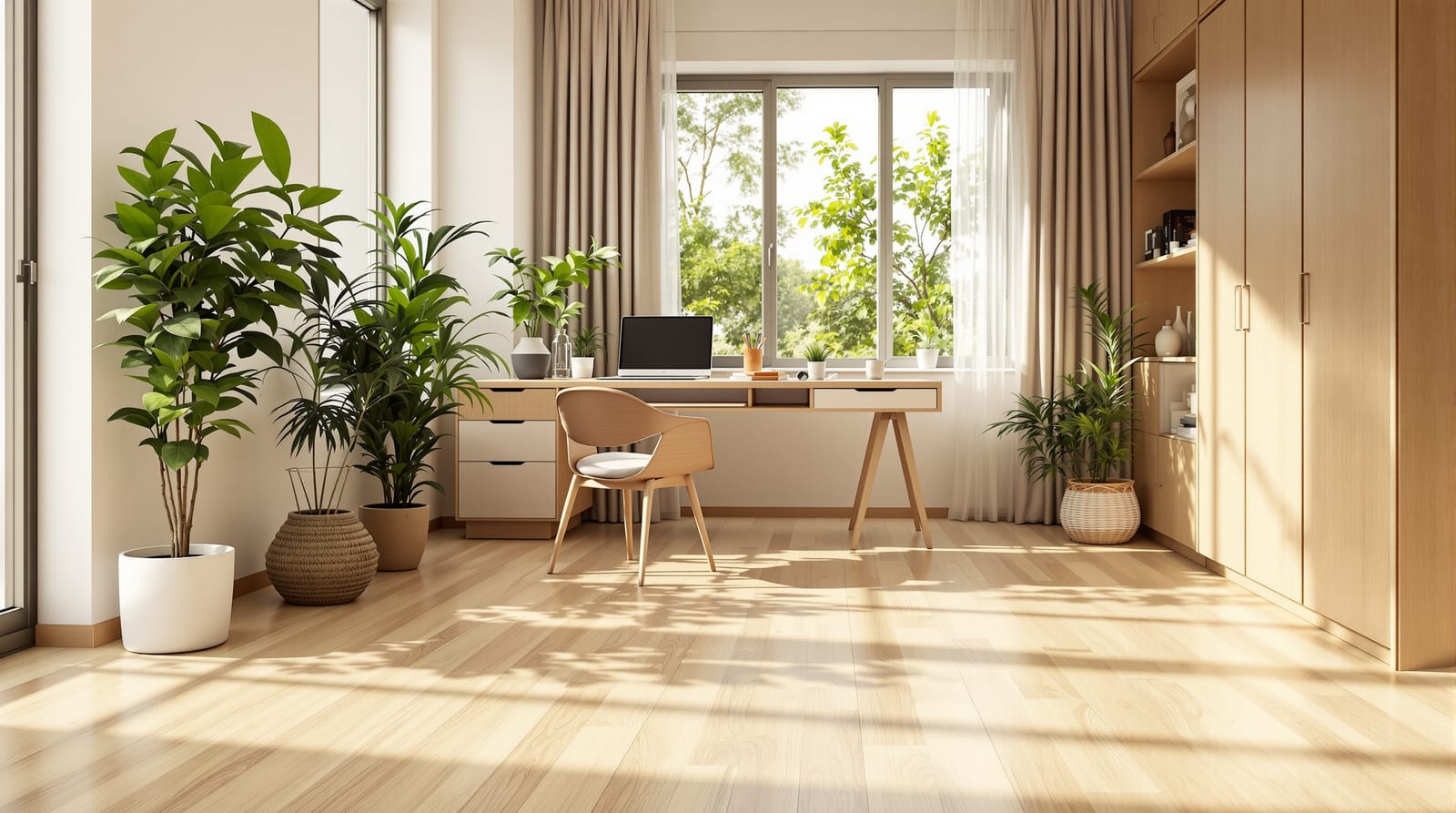
Laminate Flooring in India: AC Ratings, Cost, Brands & the Honest Limits (2026)
The budget wood-look floor for Indian homes — an HDF core with a printed decor and tough melamine wear layer, click-lock floating install over underlay, DIY-friendly and fast, with the water and refinishing caveats made plain.
Laminate is the budget wood-look floor that put timber-style flooring within reach of ordinary Indian homes. It is not real wood at all — it is a tough engineered sandwich: a high-density fibreboard core, a photographic decor layer printed to look like oak, walnut or teak, and a clear melamine wear layer hard enough to take years of foot traffic. At roughly ₹80-250 per square foot it costs a fraction of solid or engineered wood, clicks together over an underlay in a day or two, and is genuinely DIY-friendly. The catch is water: ordinary laminate swells at the joints if it gets soaked, and it can never be sanded and refinished. This guide gives you the honest picture — AC wear ratings, real costs, brands, where laminate wins, where it fails, and how it stacks up against SPC and engineered wood.
What laminate flooring actually is
A laminate plank is four bonded layers, and understanding them explains everything laminate does well and badly.
1. Wear layer (top): a clear, super-hard melamine resin film, often with aluminium-oxide particles. This is what you walk on, and its toughness is graded by the AC rating. It resists scratches, scuffs, fading and stains.
2. Decor layer: a high-resolution photograph of timber (or stone, or concrete). Modern presses also emboss texture in register with the print, so the grain you see is the grain you feel.
3. Core: high-density fibreboard (HDF) — compressed wood fibres and resin. It gives the plank its strength and dimensional stability, and it carries the milled click-lock profile on its edges. It is also laminate's weak point, because HDF swells if water sits in it.
4. Backing layer: a balancing sheet that stops the plank cupping and adds a moisture barrier from below.
Because the planks lock edge-to-edge and float over an underlay rather than gluing down, the whole floor expands and contracts as one mat. That is why laminate goes down fast and can be lifted if you move — but also why it needs an expansion gap at every wall.
AC wear ratings explained — the one number to check
The AC rating (Abrasion Class, from the European EN 13329 standard) tells you how much traffic the wear layer can take before it dulls. It runs AC1 to AC5/AC6. For Indian homes, ignore AC1-AC2 (they are wall-panel grade) and buy AC3 or higher. Pair the rating with the room's real traffic.
| AC rating | Abrasion class | Best use in an Indian home | Typical thickness |
|---|---|---|---|
| AC1-AC2 | Light / moderate domestic | Avoid for floors — wall panels, low-use cupboards only | 6-7 mm |
| AC3 | General domestic | Bedrooms, study, light-traffic living rooms | 7-8 mm |
| AC4 | Heavy domestic / light commercial | Living/dining, hallways, joint-family homes, home offices, small shops | 8-10 mm |
| AC5 | Heavy commercial | High-traffic flats, showrooms, cafes, busy entrances | 10-12 mm |
| AC6 | Very heavy commercial | Intensive retail, public floors (rare in homes) | 12 mm |
Two practical rules for India. First, in a typical apartment, AC4 is the sweet spot — it shrugs off grit tracked in from the street, kids, and joint-family footfall, for only a small premium over AC3. Second, thickness is not the same as AC rating, but they tend to travel together: a 12 mm AC5 plank also feels more solid and quieter underfoot than a thin 7 mm board. Always ask for the AC number in writing — it is the single best predictor of how the floor will look in five years.
Why laminate works for Indian homes (and the honest limits)
Laminate earns its place for clear reasons:
- Price. At ₹80-250/sq ft it is the cheapest way to get a convincing wood look, far below solid hardwood (₹250-1,500) or engineered wood (₹180-700).
- Speed and low mess. Click-lock planks float over the existing floor with no wet cement, no curing, no dust. A bedroom can be done in an afternoon, and there is no demolition if you are laying over a sound tile or screed.
- DIY-friendly. With a level subfloor, an underlay, a spacer kit and a tapping block, a confident homeowner can lay laminate themselves — a real saving on labour.
- Hard-wearing surface. The melamine wear layer resists scratches, scuffs and sun-fading better than real wood varnish, and a damp mop is usually all the cleaning it needs.
- Warm and quiet. Over a good underlay it feels warmer and softer underfoot than tile or stone, which many families prefer in bedrooms.
Now the limits, stated plainly so there are no surprises:
- Water is the enemy. Standard laminate has an exposed HDF core at the joints. Spills wiped up quickly are fine, but standing water, wet mopping or a leak that sits overnight soaks into the joints and the core swells permanently — the edges lift and peak. Keep ordinary laminate out of bathrooms, kitchens with frequent splashing, and entrances that get wet in the monsoon. Water-resistant grades (a waxed/sealed core and tighter joints) buy you more time against splashes, but no laminate is fully waterproof the way SPC is.
- It cannot be refinished. The wood look is a printed photo, not solid timber. When the wear layer finally dulls or a plank is damaged, you cannot sand and re-coat it — you replace planks or the floor. Solid and engineered wood can be sanded back; laminate cannot.
- It can sound hollow. A floating floor over a thin or skipped underlay echoes and clicks underfoot. A quality 2-3 mm underlay (foam, or rubber/cork for better acoustics) and a flat subfloor are non-negotiable for a solid feel.
- Edges can chip and humidity matters. In very humid coastal homes the plank edges can swell slightly over years; acclimatise planks on site for 48 hours and always leave the expansion gap.
For the wider wood-look decision across all four families, start at wooden flooring in India.
Cost in India — material, install and the all-in number
Laminate is priced per square foot for the plank, with underlay, beading/skirting and labour on top. Numbers below are indicative and vary by city, brand and grade; add 18% GST.
| Item | Indicative cost (₹/sq ft) | Notes |
|---|---|---|
| Laminate plank, AC3 7-8 mm | 80-130 | Bedrooms, light traffic |
| Laminate plank, AC4 8-10 mm | 120-200 | The everyday sweet spot |
| Laminate plank, AC5 10-12 mm / water-resistant | 180-250 | High-traffic or splash-prone |
| Foam / rubber-cork underlay | 15-40 | Essential — never skip |
| Matching beading / skirting | 20-60 (per running ft) | Covers the expansion gap |
| Installation labour | 20-50 | Less than tile; DIY saves this |
A realistic all-in figure for an AC4 floor with underlay, skirting and professional laying lands around ₹180-300/sq ft. Compare that with engineered wood (often ₹350-700+ all-in) and you see why laminate dominates the budget wood-look segment. Price your exact area with the wooden flooring cost calculator and the flooring cost calculator, and add roughly 5-8% for wastage (more for diagonal layouts).
Brands available in India
The Indian laminate market spans imported premium ranges to value domestic boards:
- Pergo — the brand that effectively invented laminate; premium AC4-AC5 ranges with strong wear and realistic decors, at the top of the price band.
- Action Tesa — a large Indian player offering widely available, value-for-money laminate and HDF products across AC3-AC5.
- Greenlam / Greenply — established Indian laminates and surfaces maker with floor laminate ranges and good retail reach.
- Other names you will see include Square Foot, Welspun, Pergo-comparable European imports, and various Malaysian and Chinese AC4 boards sold under house brands.
Buy on the AC rating, plank thickness, water-resistance claim and warranty rather than the badge alone — a well-specified mid-range AC4 board often outperforms a thin premium AC3.
Installation — the floating click-lock method
Laminate's appeal is its install. The essentials:
1. Subfloor must be flat and dry. Level the existing tile or screed to within about 3 mm over 2 m; high spots telegraph through and stress the joints. Lay a damp-proof membrane on ground-floor or new screeds.
2. Lay the underlay across the whole area — this cushions the floor, dampens sound and evens out minor imperfections.
3. Acclimatise the planks flat in the room for 48 hours so they match the home's temperature and humidity before locking them.
4. Leave an expansion gap of about 8-12 mm at every wall and fixed object, using spacers. The floating mat must be free to move; trapped planks buckle.
5. Click the planks at an angle, tapping home with a block, staggering end joints by at least 300 mm for strength and looks.
6. Cover the gap with skirting or beading; add transition strips at doorways and never fix skirting through the planks (that pins the floating floor).
Get the subfloor and underlay right and the floor feels solid for years; skip them and it sounds hollow and joints fail. For where wood-look fits room by room, see bedroom flooring in India and the broader living room flooring in India.
Maintenance — easy, with one rule
Laminate is low-maintenance if you respect water:
- Sweep or vacuum regularly; grit is the main scratch risk.
- Damp-mop only — a well-wrung mop, never a soaking wet one, and never a steam mop (it forces moisture into the joints).
- Wipe spills immediately, especially near plank edges.
- Use felt pads under furniture and a doormat at entrances to trap street grit.
- No wax or polish — the melamine surface needs none and they only build up.
There is no sanding, sealing or re-coating cycle — which is both the convenience and the limit of laminate. When it wears out, you replace it.
Laminate vs SPC vs engineered wood
The three budget-to-mid wood-look options solve different problems. SPC (stone-plastic composite) is the waterproof rigid vinyl that has taken share from laminate; engineered wood is real timber on a plywood base. Here is the honest comparison for Indian homes:
| Factor | Laminate | SPC | Engineered wood |
|---|---|---|---|
| Surface | Printed decor + melamine | Printed decor + PVC wear layer | Real wood veneer (sandable once or twice) |
| Core | HDF (wood fibre) | Stone-plastic composite (rigid PVC) | Plywood / HDF + hardwood top |
| Water resistance | Splash-resistant at best; HDF swells if soaked | Fully waterproof (PVC core) | Resists humidity better than solid wood; not waterproof |
| Best wet-area use | Avoid bathrooms / wet mopping | Kitchens, utility, even bathrooms | Keep out of wet areas |
| Feel underfoot | Warm, can sound hollow without underlay | Firm, slightly colder, quiet | Warmest, most authentic |
| Refinishable | No | No | Yes (limited) |
| Cost ₹/sq ft (material) | 80-250 | 90-250 | 180-700 |
| Lifespan in Indian homes | 8-15 years | 12-20 years | 15-25+ years (with care) |
The short version: choose laminate for the cheapest convincing wood look in dry rooms; choose SPC when waterproofing matters (kitchens, humid coastal flats, families that wet-mop); choose engineered wood when you want real timber warmth and the option to refinish, and your budget allows. Dig deeper in SPC vs laminate flooring in India, SPC flooring in India, and engineered wood flooring in India.
Frequently asked questions
Is laminate flooring waterproof?
No. Standard laminate is splash-resistant if you wipe spills quickly, but its HDF core swells permanently if water sits in the joints, so it must stay out of bathrooms, splash-heavy kitchens and wet-mopped areas. Water-resistant grades survive splashes longer but are still not waterproof. If you need a true waterproof wood-look floor, choose SPC instead.
What AC rating should I buy for an Indian home?
AC3 is fine for bedrooms and light-traffic rooms; AC4 is the all-round sweet spot for living rooms, hallways and joint-family homes, handling everyday street grit for only a small premium; AC5 suits very high-traffic flats or light commercial use. Always confirm the AC number in writing.
Can laminate flooring be laid over existing tiles?
Yes — that is one of its strengths. As long as the tile floor is sound, flat and dry, you lay an underlay and float the laminate straight over it with no demolition. Level any uneven tiles or wide grout lines first, and account for the small rise in floor height at doorways.
How long does laminate flooring last in India?
A good AC4 laminate, kept dry and laid over a proper underlay and flat subfloor, lasts roughly 8-15 years in an Indian home. The wear layer outlasts real-wood varnish, but because it cannot be refinished, you replace planks or the floor when it finally dulls or a board is water-damaged.
Is laminate or SPC better for Indian flats?
SPC is the safer choice where water is a risk — kitchens, utility areas, humid coastal homes and families who wet-mop — because its PVC core is fully waterproof. Laminate is the better pick for dry bedrooms and living rooms where you want the warmest-feeling, most convincing wood look at the lowest price. See the full side-by-side in our SPC vs laminate guide.
Export this guide
Related Guides — Deep-dive reading
Engineered Wood Flooring in India: Layers, Wear Layer, Install & Cost (2026)
Engineered wood is a real-wood top veneer bonded over a cross-laminated plywood or HDF core, which makes it far more dimensionally stable than solid wood in Indian humidity — the practical way to get a genuine timber floor here. This guide covers the layer build-up, wear-layer thickness, click vs glue-down install, where it suits, ₹/sq ft, brands and maintenance.
Flooring & SurfacesWooden Flooring in India: Solid, Engineered, Laminate & Wood-Look SPC Compared (2026)
The decision-oriented hub for wood floors in Indian homes — the three families plus wood-look SPC, the warm look, honest monsoon-and-termite caveats, where wood works, finishes, installation types, ₹/sq ft ranges and maintenance.
Flooring & SurfacesCork Flooring in India: Warm, Quiet, Eco Floors for Bedrooms, Study & Kids' Rooms
Why cork is genuinely sustainable (bark is harvested while the tree lives on), the comfort and acoustic benefits, the natural look, ₹200-500/sq ft, click-floating vs glue-down tiles, sealing, and the dent, moisture and sun-fade caveats every Indian homeowner should know.
Flooring & SurfacesRelated Tools — Try Free
Wooden Flooring Cost Calculator
Estimate installed wood or wood-look floor cost — solid, engineered, laminate or SPC — with underlay and skirting.
Flooring CalculatorWindow Maintenance Cost Calculator
Estimate annual window upkeep by frame material — yearly, per-window and 5-year cost.
Window CalculatorWindow Material Comparison Tool
Compare uPVC, aluminium, wood, steel and composite windows on cost, life, upkeep and insulation.
Compare