
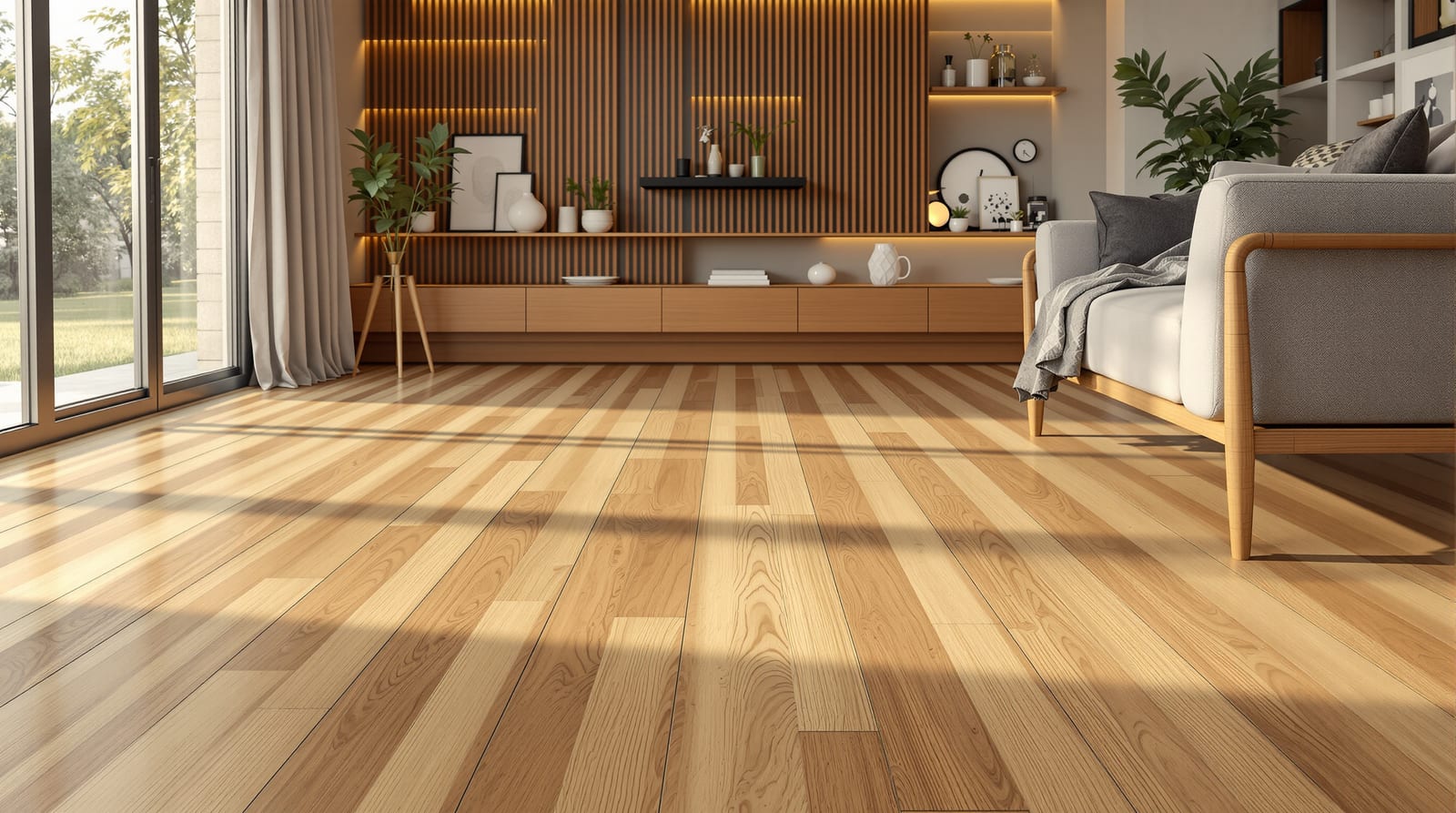
Engineered Wood Flooring in India: Layers, Wear Layer, Install & Cost (2026)
Engineered wood is a real-wood top veneer bonded over a cross-laminated plywood or HDF core, which makes it far more dimensionally stable than solid wood in Indian humidity — the practical way to get a genuine timber floor here. This guide covers the layer build-up, wear-layer thickness, click vs glue-down install, where it suits, ₹/sq ft, brands and maintenance.
If you want the warmth of a real timber floor in an Indian home but have heard the horror stories — solid wood planks cupping, gapping and creaking through the monsoon — engineered wood is the answer the industry actually built for this problem. It is genuine hardwood on top, bonded over a cross-laminated plywood or HDF core that resists the swelling and shrinking that wrecks solid planks in our humidity swings. You get a true wood floor you can sand and refinish, at roughly a third to a half the price of solid hardwood, installed in days rather than weeks. This guide explains the layer build-up, how wear-layer thickness decides the floor's lifespan, click versus glue-down installation, where engineered wood belongs (and where it does not), real ₹/sq ft costs, brands and upkeep.
What engineered wood actually is
The single most useful thing to understand is the construction, because every advantage flows from it. An engineered plank is a sandwich of three functional parts:
- The wear layer (top veneer) — a slice of real hardwood: European oak, American walnut, teak, maple, acacia and so on. This is what you see, walk on, and what can be sanded and refinished. It carries the real-wood grain, knots and tone. Thickness ranges from about 0.6 mm (a thin "veneer" grade) up to 4-6 mm on premium planks.
- The core — usually multiple thin plies of birch/poplar/eucalyptus plywood glued with their grain at right angles (cross-laminated), or a high-density fibreboard (HDF) core. The cross-grain build is the secret: each layer restrains the next from moving, so the plank stays flat and stable when humidity changes. A plywood core is generally tougher and more moisture-tolerant than an HDF core.
- The backing (balancing) layer — a thin veneer on the underside that balances the stresses so the plank does not curl, plus on click planks the milled locking profile sits on the edges.
The result behaves much more like a stable manufactured board than a slab of solid timber, while the surface is still 100% real wood. That is the whole pitch, and in Indian conditions it is a strong one.
Why it is the practical real-wood choice in India
Solid hardwood is a single piece of timber, so it moves as one body: it drinks moisture from monsoon air and swells, then dries and shrinks in winter or under air-conditioning. In a Mumbai or Kochi flat, that cycle shows up as cupped boards, popped gaps and creaking within a couple of years unless the install and climate control are near-perfect. Engineered wood's cross-laminated core fights exactly this movement, so it tolerates Indian humidity, AC-on/AC-off swings and coastal damp far better. It is the reason most architects here specify engineered over solid for any real-wood floor.
The other practical wins: it installs faster (often as a floating click floor over underlay in a day or two per room), it can go over many existing subfloors without a long acclimatisation-and-nail ritual, and it costs far less than solid. For a fuller comparison of all timber options see our wooden flooring guide for India; for the solid-wood side of the story see solid hardwood flooring in India and the head-to-head engineered wood vs solid wood.
Wear-layer thickness: the number that decides everything
When a salesperson quotes "12 mm engineered oak", that total thickness matters less than the wear layer — the real-wood top slice. It governs both how premium the floor feels and, crucially, how many times it can be sanded and refinished over its life. Each professional sanding removes roughly 0.5-1 mm, and you need to leave enough wood above the core.
| Wear layer | What it means | Refinishing | Typical use |
|---|---|---|---|
| 0.6-1 mm | Thin veneer grade, budget engineered | None — sanding would cut through | Light-use bedrooms, rentals, tight budgets |
| 2-3 mm | Mid-range, most common quality tier | 1-2 light refinishes | Bedrooms, living rooms, family homes |
| 4-6 mm | Premium thick-veneer | 3-4 refinishes; lasts decades | Living/dining, long-term homes, near solid-wood life |
A floor with a 0.6 mm wear layer is essentially refinish-once-never — when it wears, you replace it. A 4 mm wear layer behaves almost like solid wood for sanding purposes and can comfortably last 25-30 years with periodic refinishing. If you are choosing a real-wood floor for the long term, spend on the wear layer, not the total board height.
Click vs glue-down: two ways to install
Engineered wood goes down in one of two systems, and the choice affects feel, cost and repairability.
- Click (floating) install. Planks lock edge-to-edge over a thin foam or rubber underlay and simply "float" — they are not fixed to the subfloor. Fastest and cleanest to lay, no adhesive mess, easy to lift and replace a damaged plank, and the underlay softens footfall sound. It is the popular DIY-friendly and rental-friendly route. The trade-off is a very slightly hollow underfoot feel and the need for a flat, dry, level subfloor. Leave a 10-12 mm expansion gap around the room walls, hidden by skirting.
- Glue-down install. Each plank is bonded to the subfloor with a flexible flooring adhesive. It feels the most solid and "permanent" underfoot, has no hollow sound, and is the right call over large open areas, with underfloor heating, or where you want maximum stability. It costs more in labour and adhesive and is harder to lift later.
Either way the subfloor must be flat (typically within ~3 mm over 2 m), dry and clean — a self-levelling screed over a rough cement floor is common Indian practice. Always acclimatise the planks in the room for 48-72 hours before laying, and keep them off direct wet areas.
Where engineered wood belongs — and where it does not
Engineered wood is a dry-area floor. It excels in:
- Bedrooms — warm, quiet underfoot, the classic use. See our bedroom flooring guide.
- Living and dining rooms — with a thicker wear layer and ideally glue-down for high traffic. See living room flooring.
- Studies, home offices, dressing rooms, hotel-style master suites.
It is the wrong choice for:
- Bathrooms, balconies, terraces and open areas — standing water and rain will swell even a stable core over time. Use anti-skid vitrified, porcelain or stone there (see bathroom flooring).
- Kitchens — possible with care, but spills, grease and water make tile or stone the safer Indian choice (see kitchen flooring).
- Ground-floor rooms with rising damp unless a proper damp-proof membrane is in place.
For a broader real-wood-vs-hard-surface view, see wooden flooring vs tiles.
Cost in India: ₹/sq ft
Engineered wood sits between laminate and solid hardwood. Indicative material-only rates (before laying, +18% GST; rates vary by city and vendor):
| Tier | ₹/sq ft (material) | What you get |
|---|---|---|
| Entry engineered (thin 0.6-1 mm veneer, HDF core) | 180-300 | Budget real-wood look, light use, no refinishing |
| Mid-range (2-3 mm oak veneer, plywood core) | 300-500 | The sweet spot for most homes; 1-2 refinishes |
| Premium (4-6 mm veneer, wide planks, plywood core) | 500-700+ | Near-solid-wood life, imported oak/walnut, multiple refinishes |
On top of material, budget laying labour and adhesive/underlay at roughly ₹40-90/sq ft depending on click versus glue-down and plank size, plus skirting/beading and edge trims. For a complete quote tuned to your room and grade, use our wooden flooring cost calculator and the general flooring cost calculator.
Engineered vs solid wood vs laminate
This is the comparison most homeowners actually need. All three give a wood look; only two are real wood, and they trade off stability, refinishing and cost very differently.
| Factor | Engineered wood | Solid hardwood | Laminate |
|---|---|---|---|
| Surface | Real wood veneer | 100% real timber | Printed photo of wood under melamine/resin |
| Stability in Indian humidity | High (cross-laminated core) | Low — cups/gaps without tight control | High (HDF core, no real wood to move) |
| Refinishing | 1-4 times (depends on wear layer) | Many times (it is all wood) | Never — replace when worn |
| Lifespan | 15-30+ years | 30-100 years | 8-15 years |
| Water/wet-area tolerance | Poor (dry areas only) | Poor | Poor-moderate (water-resistant grades exist) |
| Install | Click float or glue-down, fast | Nail/glue, slow, acclimatise long | Click float, fastest, DIY |
| ₹/sq ft (material) | 180-700 | 250-1,500 | 80-250 |
| Best for | Real wood in Indian flats, bedrooms/living | Heritage, long-term, climate-controlled homes | Budget wood look, rentals, light use |
In short: choose engineered when you want a genuine wood floor that will survive Indian humidity at a sensible price; choose solid only if you want a multi-generation floor and can control the climate; choose laminate when budget rules and you accept it is a print, not real wood. For the printed-floor option in depth, see laminate flooring in India.
Brands available in India
You will commonly see engineered wood from international names like Kährs, Quick-Step, Pergo, Mikasa, Action Tesa, Greenply, Square Foot, Floor Decor, Welspun and various imported European-oak ranges sold through stone-and-tile galleries and dedicated wood-flooring studios in metros. As with all wood, judge the plank by its wear-layer thickness, core type (insist on knowing plywood vs HDF), finish and warranty rather than by brand alone — a 3 mm plywood-core plank from a mid name often outperforms a 1 mm HDF plank from a premium one.
Maintenance: keeping it looking new
Engineered wood is low-fuss but not no-fuss:
- Sweep or vacuum (hard-floor setting, no beater bar) regularly; grit is what scratches the finish.
- Damp-mop only — a well-wrung microfibre mop with a wood-floor cleaner. Never flood it with water and never use a soaking pocha; standing water is the enemy.
- Mop up spills immediately, especially in dining areas.
- Felt pads under furniture legs, mats at entries to trap monsoon grit and water, and avoid dragging heavy items.
- Manage humidity where you can — ceiling fans and AC help; in very damp coastal homes a stable wear layer earns its premium.
- Refinish when the surface dulls or scratches show (only if the wear layer is thick enough): light sand and re-coat brings it back to new. This is the advantage no laminate can match.
Treated this way, a good engineered-oak floor stays handsome for 20-30 years and can be brought back to life rather than ripped out.
Frequently asked questions
Is engineered wood real wood?
Yes — the top wear layer is a genuine slice of hardwood (oak, walnut, teak and so on), so the surface you see and walk on is 100% real wood. Only the core beneath is engineered plywood or HDF for stability. This is different from laminate, where the wood look is a printed photograph.
How many times can engineered wood be refinished?
It depends entirely on the wear-layer thickness. A thin 0.6-1 mm veneer cannot be sanded at all; a 2-3 mm layer takes one or two light refinishes; a premium 4-6 mm layer can be refinished three or four times over decades. Each sanding removes roughly 0.5-1 mm, so thicker is better for the long term.
Can engineered wood be used in Indian bathrooms or balconies?
No. Engineered wood is a dry-area floor. Standing water, rain and constant damp will eventually swell even a stable core. Keep it to bedrooms, living and dining rooms, and use anti-skid vitrified, porcelain or stone in bathrooms, balconies and terraces.
Is engineered wood better than solid wood in India?
For most Indian homes, yes. The cross-laminated core makes engineered wood far more dimensionally stable in our humidity and AC swings, it costs much less, and it installs faster. Solid wood lasts longer and refinishes more times, but only pays off in climate-controlled, long-term homes. See our engineered wood vs solid wood comparison.
Click or glue-down — which should I choose?
Click (floating) is faster, cleaner, easy to repair and great for bedrooms and DIY-minded homeowners. Glue-down feels more solid underfoot, suits large open living areas and underfloor heating, and is the more permanent option — but costs more in labour and is harder to lift later.
Export this guide
Related Guides — Deep-dive reading
Laminate Flooring in India: AC Ratings, Cost, Brands & the Honest Limits (2026)
The budget wood-look floor for Indian homes — an HDF core with a printed decor and tough melamine wear layer, click-lock floating install over underlay, DIY-friendly and fast, with the water and refinishing caveats made plain.
Flooring & SurfacesSolid Hardwood Flooring in India: Species, Cost, Refinishing & the Humidity Caveats (2026)
Real solid timber planks of teak, oak, merbau or walnut give the deepest premium feel and can be sanded and refinished for decades — but in India's humidity they need acclimatisation, expansion gaps and the right rooms. Here is the honest homeowner's guide, with species, Janka hardness, ₹/sq ft and how it compares with engineered wood.
Flooring & SurfacesWooden Floor Installation in India: Nail-Down, Glue-Down & Floating Methods
How solid and engineered wood floors are actually laid in Indian homes — acclimatising planks, moisture barriers, the three fixing methods, expansion gaps and labour rates that decide whether your floor stays flat or cups.
Flooring & SurfacesRelated Tools — Try Free
Flooring Cost Calculator
Estimate the all-in cost of a floor — material, laying, wastage, skirting and GST — by area and material.
Flooring CalculatorApartment Furniture Size Chart
Standard furniture dimensions for Indian apartments — sofas, beds, tables, dining, storage.
Reference ChartFull-Room BOQ — Living, Bedroom, Kitchen, Bath
Room-wise BOQ across living, bedrooms, kitchen, utility, and bathrooms with line-item pricing.
Full-Room BOQ