
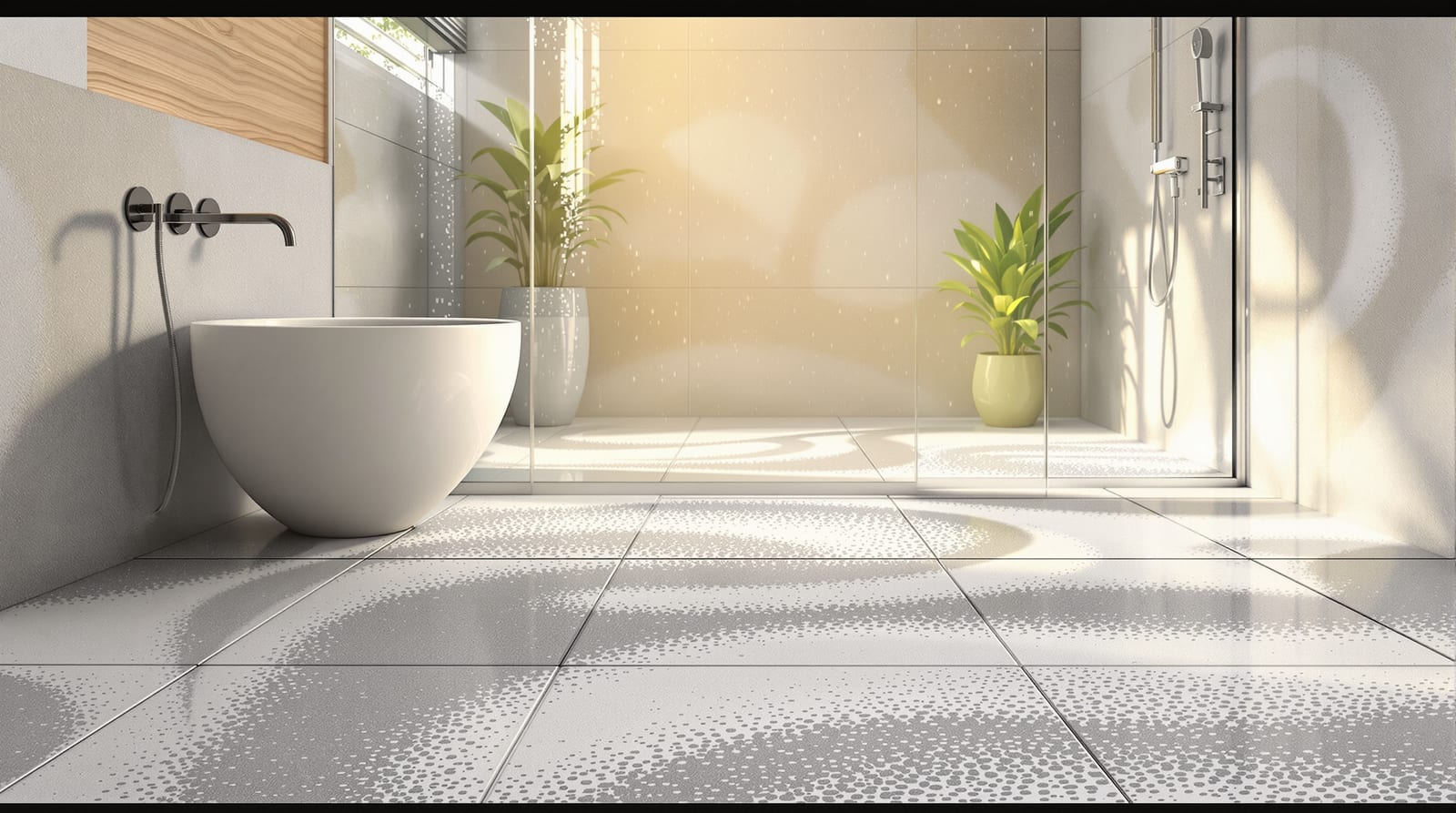
Bathroom Flooring in India: Best Anti-Slip Options, Slope & Cost (2026)
A wet, slip-critical room where safety comes first — anti-skid matte vitrified, ceramic, porcelain and honed kota over polished tiles, with R-ratings, slope-to-drain, waterproofing, grout, thresholds and ₹/sq ft.
The bathroom is the one floor in your home where a wrong choice is not just a maintenance headache — it is a safety risk. Wet feet, soap film, a constant film of water and an ageing parent or a toddler in the family turn a glossy floor into a fall waiting to happen. This guide treats the Indian bathroom floor the way it deserves: anti-slip first, waterproof always, easy to clean, and sloped so water actually leaves the room. We cover the best materials with honest slip ratings, the tile size and grout choices that grip, the slope-to-drain and waterproofing detail underneath, thresholds, anti-fungal grout, and real ₹/sq ft numbers.
The non-negotiable: anti-slip comes before looks
Every other room in your home can lead with appearance. The bathroom cannot. A bathroom floor is wet for hours a day, coated in shampoo and soap residue, and used by the most fall-vulnerable members of the household — elderly parents in a joint family, young children, pregnant women. Falls on bathroom floors are one of the most common household injuries in India, and a hip fracture in an elderly parent is a life-changing event. So the order of priorities is fixed:
1. Anti-slip — a textured, matte surface that grips wet feet.
2. 100% water-resistant body — a material that does not soak, swell, stain or grow mould.
3. Slope and drainage — the floor must actively shed water to the drain.
4. Easy to clean — no porous, fungus-friendly surfaces in a perpetually damp room.
5. Looks — last, and never at the expense of the four above.
The single most important specification is the slip rating. Under the German DIN 51130 system used across the Indian tile trade, surfaces are graded R9 to R13 by the angle at which a person starts to slip. For bathrooms you want R10 as the minimum and R11 (or better) for shower floors and homes with elderly users. The wet-barefoot equivalent is the DIN 51097 A/B/C "ramp" rating — aim for B or C for shower zones. India's own framework, the NBC 2016 and the RPwD Harmonised Guidelines 2021, call for slip-resistant, level floors with thresholds of 12 mm or less and accessible wet areas — anti-skid tile meets this cleanly while a polished tile fails it.
The practical translation: avoid polished, glossy, mirror-finish surfaces on a bathroom floor. Polished PGVT, polished marble and polished granite look stunning in a living room and become an ice rink the moment they are wet. They belong on bathroom walls, not bathroom floors.
Best bathroom flooring options, ranked by slip and water
Here is the honest field. Costs are material only, indicative and vary by city, brand and lot; add 18% GST, plus laying labour (₹15-60/sq ft), tile adhesive (₹12-30/sq ft), grout, skirting and the waterproofing system below.
| Bathroom floor option | Slip rating (wet) | Water resistance | ₹/sq ft (material) | Verdict |
|---|---|---|---|---|
| Anti-skid matte vitrified (GVT, R10-R11) | R10-R11, good | Excellent (BIa <0.5%) | 50-140 | Best all-round choice for most Indian bathrooms |
| Anti-skid ceramic floor tile | R10, good | Good (glazed, sealed body) | 35-80 | Budget-friendly, fine for low-traffic baths |
| Structured / textured porcelain (R11-R12) | R11-R12, excellent | Excellent (<0.5%) | 60-160 | Best for premium and elderly-safe wet rooms |
| Small-format mosaic (50-100 mm) | High (lots of grout grip) | Excellent | 80-250 | Ideal for shower floors and curved slopes |
| Honed / leather-finish kota stone | Good when honed | Good (dense, needs sealing) | 30-70 | Budget durable natural look; never use polished |
| Honed Tandur (Shahabad) stone | Good when honed | Good (seal joints) | 35-80 | Traditional, grippy, cool underfoot |
| Anti-skid Indian marble (honed only) | Moderate | Stains/etches; needs sealing | 80-350 | Avoid on floors; etches with acid cleaners |
| Polished PGVT / polished marble / granite | Poor when wet | Excellent body | 70-350+ | Walls only — dangerous on a wet floor |
| Solid or engineered wood, laminate | Poor, and water-damaged | Fails in wet areas | 80-1,500 | Never use in an Indian bathroom |
The clear winners for the floor are anti-skid matte vitrified, textured porcelain, small mosaics for the shower, and honed kota or Tandur for a natural budget look. For the full vitrified family see vitrified tile flooring in India; for the dense, low-absorption tile that excels in wet rooms see porcelain tile flooring in India; for the budget glazed option see ceramic tile flooring in India; for the kota option see kota stone flooring in India.
Why tile size and grout matter more here than anywhere else
In a dry room, a big seamless tile with thin grout lines looks best. In a bathroom, the logic flips. Smaller tiles mean more grout lines, and grout lines are grip. A floor of 300x300 mm anti-skid tiles, or a shower base of 50x50 mm mosaics, gives the foot far more texture and traction than one big slick tile. The grout joints also help the floor follow the gentle slope to the drain — a single large tile cannot bend, so it ponds water in the middle while small tiles step down toward the gully.
So the bathroom rule is the opposite of the living-room rule:
- Bathroom dry floor: 300x300 mm or 300x600 mm anti-skid matte tiles. Easy to slope, plenty of grip.
- Shower / wet zone floor: 50x50 to 100x100 mm mosaics on a mesh sheet, which curve to the slope and pack in grout-line grip.
- Walls: here you can go large and glossy — 300x600, 600x600 or 600x1200 polished tiles for a luxurious, easy-wipe wall, because nobody walks on a wall.
Grout choice is the other half. Ordinary cement grout in a perpetually wet bathroom is the place mould, mildew and black fungus take hold. Specify epoxy grout for shower floors and ideally the whole bathroom — it is non-porous, water- and stain-proof, and anti-fungal by nature, so it does not blacken or harbour mildew the way cement grout does. If budget forces cement grout, choose a polymer-modified, water-resistant grout with an anti-fungal additive and reseal it periodically. Narrow joints (2-3 mm) with a quality grout outperform wide cement joints.
The layers under the tile: slope, waterproofing and skirting
A bathroom floor is a system, not a surface. Get the build-up underneath right and the tile will last decades; get it wrong and you have seepage into the slab, damp on the ceiling below and a re-do that means demolishing the whole bathroom.
Working from the slab up, the bathroom floor should have:
- A waterproofing membrane over the structural slab, turned up the walls 150-300 mm (and full height in the shower) so water cannot creep behind the tile and into the wall. Use a cementitious crystalline coating, an acrylic/PU liquid membrane or an SBS bituminous membrane, and pond-test it for 24-48 hours before tiling — fill the bathroom with 25-50 mm of water and check the ceiling below for damp. This test alone prevents the most expensive bathroom failure in India.
- A sloped cement screed that creates a fall of roughly 1:80 to 1:100 (about 10-12 mm per metre) toward the floor drain. The slope is the whole point: a perfectly level bathroom floor ponds water, breeds mould and stays slippery. The drain sits at the lowest point; everything falls toward it.
- The drain (floor trap / gully) set slightly below the surrounding tile so water always finds it. Linear / channel drains along one wall make sloping a large wet room easier than a central point drain.
- Tile laid on adhesive (not the old thick cement-sand dab method, which leaves voids that trap water under the tile). A full-coverage tile-adhesive bed bonds the tile and leaves no hollow pockets for seepage.
- A tiled or coved skirting at the wall-floor junction, ideally with the waterproofing carried up behind it, so the weakest joint in the room — where wall meets floor — is sealed.
- A threshold at the door kept to 12 mm or less (NBC / RPwD accessibility limit) with a small lip or a water stop so shower water does not run out into the bedroom. A frameless glass-partition wet room with a linear drain is the modern, level-access way to achieve this.
For the building-shell view of how this fits a finished home, the cluster also covers flooring finishes and specification in India.
Materials to actively avoid on a bathroom floor
It is as important to know what to keep out:
- Polished PGVT, polished marble, polished granite: beautiful, deadly when wet. Use them on walls; never as the floor you stand on.
- Solid hardwood, engineered wood, laminate: wood and water are enemies. Even "water-resistant" laminate swells, warps and grows mould in a room that is wet for hours daily. There is no scenario where wood-based flooring belongs in an Indian bathroom floor.
- Untreated or polished marble on the floor: marble etches and stains with acidic bathroom cleaners and limescale removers, dulls with soap, and is slippery when polished. If you love the marble look, use a marble-look anti-skid porcelain instead.
- Large slick tiles with minimal grout: even matte, a very large tile on a bathroom floor reduces grout-line grip and resists sloping. Keep tiles modest in size on the floor.
- Cheap soluble-salt "vitrified" without an anti-skid finish: the absorption can exceed 0.5% and the surface is often glossy — wrong on both counts for a wet room.
A safety-first spec for elderly and accessible bathrooms
If anyone in the household is elderly, recovering from surgery, visually impaired or a wheelchair user, raise the bar:
- Specify R11 floor tiles minimum, R12 in the shower, with a DIN 51097 class B or C wet-barefoot rating.
- Use small mosaics in the shower for maximum grip and easy sloping.
- Keep the floor level / step-free with a linear drain and a frameless partition — no kerb to trip on, no 12 mm threshold if you can avoid it.
- Add epoxy grout so the floor never grows the slick black mildew film that makes any tile slippery.
- Plan for grab bars and a shower seat at the same time as the floor — the floor and fittings are one safety system.
This is exactly the territory the RPwD Harmonised Guidelines 2021 and NBC 2016 accessibility provisions are written for, and it costs little extra to build in at the tiling stage versus retrofitting after a fall.
Cost: what a bathroom floor really adds up to
Per square foot, the tile is often the smallest line. For a typical Indian bathroom of 35-45 sq ft, budget across the whole system:
- Anti-skid floor tile: ₹35-160/sq ft material depending on ceramic vs vitrified vs porcelain (mosaics for the shower base run higher per sq ft but cover a small area).
- Tile adhesive: ₹12-30/sq ft; one 20 kg bag covers ~30-40 sq ft at 3-4 mm.
- Epoxy grout: a premium over cement grout but the right call for a wet room.
- Waterproofing system: budget separately as a per-bathroom or per-sq-ft cost — it is the cheapest insurance in the house and the most expensive thing to skip.
- Laying labour: ₹15-60/sq ft, at the higher end for mosaics, slopes and small bathrooms with many cut edges.
- Skirting, threshold, drain and sundries: add a small lump sum.
Because a bathroom is small, spending a little more per sq ft for a properly anti-skid, low-absorption tile and epoxy grout barely moves the total bill — and it is the difference between a safe, dry, mould-free room and a recurring problem. Price your exact area with the flooring cost calculator, work out boxes with the tile quantity calculator, and size your adhesive and grout with the tile adhesive calculator and grout quantity calculator.
For how bathroom choices fit the rest of the home, see the room siblings kitchen flooring in India, balcony flooring in India and terrace flooring in India, and to choose between materials head to head, ceramic vs porcelain tiles in India.
Frequently asked questions
What is the best flooring for an Indian bathroom?
Anti-skid matte vitrified or textured porcelain floor tiles, rated R10-R11 or higher, are the best all-round choice — fully water-resistant, easy to clean and grippy when wet. For the shower base, small mosaics (50-100 mm) add the most grip and follow the slope best. Honed kota or Tandur stone is a good budget natural option. Always pair the tile with a sloped, waterproofed screed and epoxy grout.
What slip rating should bathroom tiles have?
Aim for DIN 51130 R10 as the minimum for a bathroom dry floor and R11 (or R12) for shower floors and homes with elderly users; the wet-barefoot DIN 51097 equivalent is class B or C. This also satisfies NBC 2016 and RPwD 2021 accessibility expectations for slip-resistant, level wet-area floors. Avoid polished PGVT, marble or granite on the floor — they are dangerously slippery when wet.
Are smaller tiles really safer in a bathroom?
Yes. Smaller tiles mean more grout lines, and grout lines give your wet foot texture and grip. They also let the floor follow the gentle slope to the drain, which a single large tile cannot do — so small tiles drain better and pond less. Use 300x300 mm anti-skid tiles on the dry floor and 50-100 mm mosaics in the shower.
Why does a bathroom floor need a slope, and how much?
Without a slope, water sits in flat spots, stays slippery and breeds mould; the floor must actively shed water to the drain. Build a fall of about 1:80 to 1:100 — roughly 10-12 mm per metre — in the screed toward the floor drain, with the drain set at the lowest point. A linear/channel drain makes sloping a large or level-access wet room easier.
Should I use epoxy grout in the bathroom?
For a wet room, yes — at least in the shower and ideally throughout. Epoxy grout is non-porous, water- and stain-proof and anti-fungal, so it will not blacken with mildew the way cement grout does in a perpetually damp bathroom. If budget forces cement grout, use a polymer-modified, water-resistant grout with an anti-fungal additive and reseal it periodically.
Can I use marble or polished granite on the bathroom floor?
Use them only on the walls. On the floor, polished marble and granite are slippery when wet, and marble additionally etches and stains with acidic bathroom cleaners and limescale. If you want the marble look underfoot, choose a marble-effect anti-skid porcelain instead — it gives the appearance with the slip resistance and water resistance a bathroom floor demands.
Export this guide
Related Guides — Deep-dive reading
Anti Slip Flooring for Bathroom and Wet Areas in India: R-Ratings, Finishes and Genuinely Safe Tile Choices
How to choose genuinely safe flooring for bathrooms, kitchens, balconies, pools, entrances and elderly- or child-friendly homes — the R-rating system, finishes that grip wet feet, anti-skid natural stone, slope to drains and the tiles to avoid.
Flooring & SurfacesEpoxy Grout vs Cement Grout for Tiles in India: Which to Specify (2026)
A plain-English guide to tile grouts for Indian homes: what grout does, how cementitious grout compares with epoxy grout on cost, stain and water resistance, hygiene and durability, and exactly where each one belongs - kitchens, bathrooms, pools, dry rooms and more.
Building MaterialsBathroom Flooring Guide India: Anti-Skid Tiles, Stone, Vinyl & Epoxy Compared
Every bathroom floor material for Indian homes in one place — anti-skid ceramic and vitrified tiles, natural stone, mosaic, vinyl (SPC/LVT) and epoxy — with a full comparison table, slip ratings, ₹/sq ft costs and the safety and slope rules that keep a wet floor from becoming a hazard.
BathroomsRelated Tools — Try Free
Flooring Cost Calculator
Estimate the all-in cost of a floor — material, laying, wastage, skirting and GST — by area and material.
Flooring CalculatorChild & Elder Home-Safety Audit
Room-by-room safety audit for households with children or seniors — 10 categories, 70+ checkpoints tagged by audience.
Safety AuditGrout Quantity Calculator
Estimate grout in kg and cost by tile size, joint width and thickness — cement or epoxy grout.
Flooring Calculator