
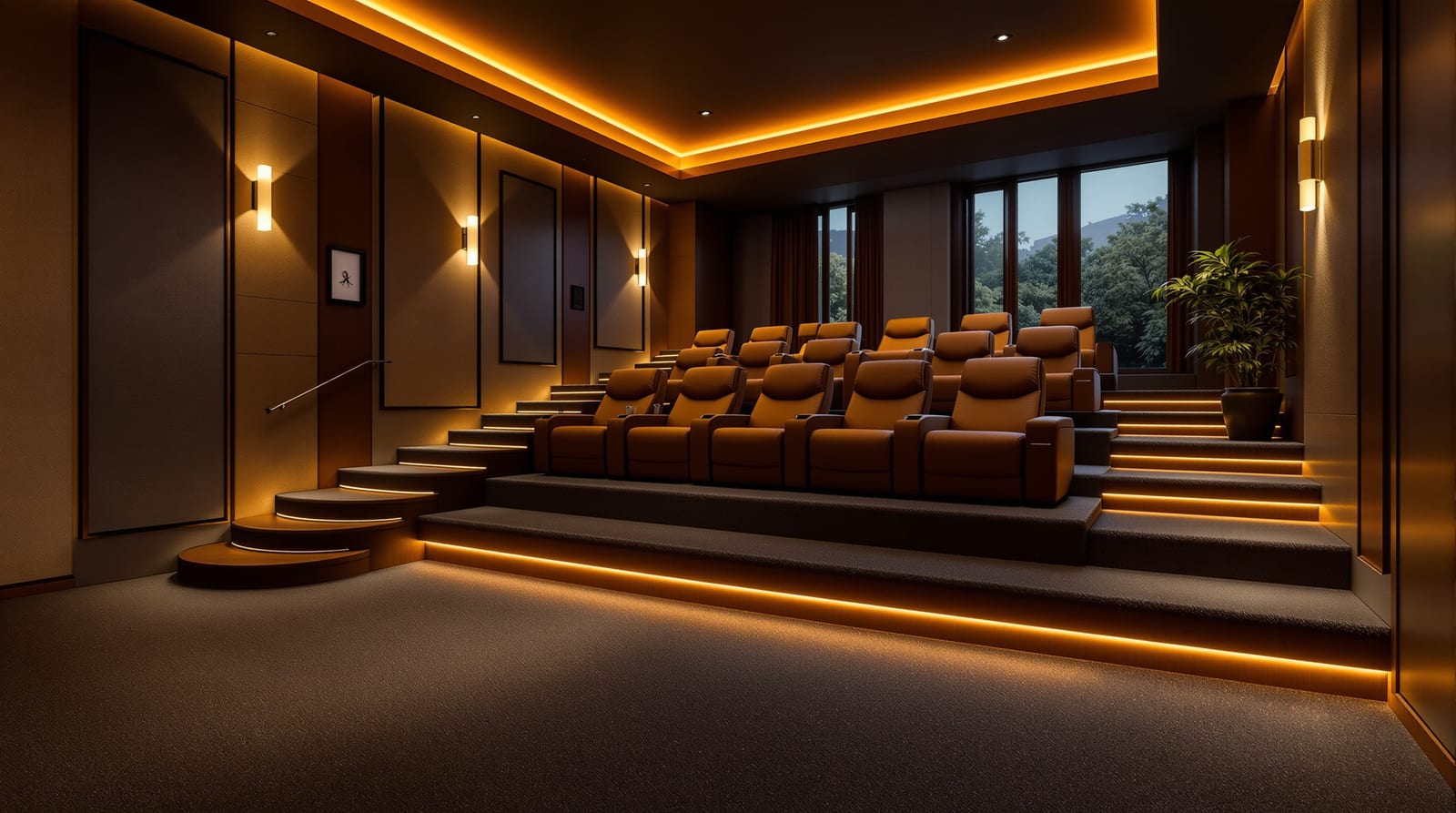
Home Theatre Flooring in India: Best Acoustic, Glare-Free Floors for a Media Room
Carpet, acoustic underlay, dark engineered wood and LVT — flooring tuned for sound absorption, ambience and hidden cables in an Indian home theatre.
A home theatre is the one room in your house where the floor is judged by your ears as much as your eyes. The wrong surface bounces sound, throws screen light back at your face and turns a premium projector setup into an echoey, glary disappointment. Get the floor right and the room goes quiet, dark and immersive — exactly what you paid the AV dealer for.
This guide ranks flooring for a dedicated home theatre or media room in Indian homes, where the priorities flip from the rest of the house: acoustics and ambience lead, durability and slip resistance follow. We cover why carpet usually wins, why every hard floor needs an acoustic underlay and rugs, how dark non-reflective colours kill glare, and how stepped riser seating and cable routing change what you lay.
What a home theatre demands from its floor
A media room is acoustically and visually unlike any other space in the house. Before you pick a material, understand the five demands it places on the floor:
- Sound absorption. Hard floors (tile, polished stone, bare wood) reflect mid and high frequencies, creating slap echo and a "live" room that muddies dialogue. Soft, fibrous or resilient surfaces absorb that energy. Acousticians talk about NRC (Noise Reduction Coefficient, 0 to 1): bare vitrified tile is around 0.01 to 0.05, a cut-pile carpet over felt underlay can reach 0.30 to 0.55. The floor is one of the six surfaces in the room — treating it is the cheapest big win you have.
- Impact and footfall quiet. Walking to your seat mid-film should be silent. Resilient floors and underlays cut impact (footstep) noise that hard floors transmit straight into the room and the floor below.
- No screen glare. A glossy or light-coloured floor reflects the bright screen and any ambient light, washing out blacks and bouncing light onto faces and walls. Theatre floors want to be dark and matte — a light-absorbing surface, not a mirror.
- Cable and clutter concealment. Subwoofer cables, speaker runs, power and HDMI all cross the floor. Carpet, rugs and raised-step construction hide and protect them; dark floors hide them visually.
- Comfort and warmth. You sit here for two to three hours. Bare feet, kids on the floor, a slightly soft underfoot feel and acoustic warmth all matter more than in a passage. Step (riser) seating adds a level-change that the floor must turn safely and continuously.
Crucially, durability and heavy-traffic slip resistance — the things that drive your living-room or foyer floor — barely register here. A media room sees light, indoor, shoes-off traffic.
The ranked picks for an Indian home theatre
1. Carpet (or carpet tiles) — the natural winner
Wall-to-wall carpet is the default for purpose-built cinema rooms worldwide for good reason. It is the single best sound absorber you can put underfoot, it is warm and dark, it hides cables and seam-free runs of it kill footfall noise. Choose a dense, dark, low-to-medium cut pile (deep grey, charcoal, burgundy or midnight blue) over a felt or foam acoustic underlay for maximum NRC. Carpet flooring over a good pad is the classic theatre floor. If you want the same absorption with easier repair and cable access — useful when speakers and amps get re-routed — carpet tiles let you lift one square to reach a cable and swap a stained tile rather than re-laying a whole room. In India, expect roughly ₹80–₹400 per sq ft installed depending on pile and quality.
2. Acoustic underlay — non-negotiable under ANY floor
This is the most important line in this guide: whatever you lay on top, lay an acoustic underlay beneath it. Under carpet, a felt or rubber crumb pad lifts absorption and softens the step. Under wood, laminate or LVT, a dense foam, rubber or cork acoustic underlay dramatically cuts impact noise and the hollow "drum" of a floating floor. It also helps level minor screed irregularities. Budget ₹15–₹60 per sq ft for a decent acoustic mat or pad; it is cheap insurance for the rest of the spend.
3. Dark engineered wood, laminate or LVT — for the wood-look crowd
Many Indian homeowners want a media room that reads as a warm, premium lounge rather than a black box, and prefer a hard-but-warm floor dressed with rugs. That works well if you keep it dark and matte and treat it acoustically:
- Engineered wood flooring in a dark, low-sheen oak or walnut over an acoustic underlay gives a luxe, warm, dimensionally stable floor (better than solid wood for India's humidity swings). Around ₹250–₹800 per sq ft.
- Luxury vinyl tile (LVT), SPC and WPC give a dark wood look that is quieter than tile, cheaper than real wood, water-tolerant and easy to clean — a very practical media-room floor over an acoustic pad. Around ₹90–₹400 per sq ft.
- Laminate is the budget version of the same idea; pick a dark, matte décor and a good underlay.
The catch: hard floors are reflective. You must lay large dark area rugs in the seating zone and add wall/ceiling acoustic treatment to compensate for the absorption you lose versus carpet.
4. Cork — the quiet specialist
Cork flooring is the underrated dark-horse pick: it is naturally resilient, warm, and one of the quietest hard-ish floors you can buy, absorbing both footfall and a little airborne sound. A dark-stained or sealed cork floor over an underlay gives a soft, silent, comfortable surface that sits between carpet and wood. Around ₹150–₹400 per sq ft.
What to avoid
Skip bare vitrified tile, polished stone, marble, granite and any high-gloss surface as the finished theatre floor. They echo badly and reflect screen light. If your media room is a converted space that already has tile, do not rip it out — instead float an acoustic underlay and carpet, or lay big dark rugs over the seating area and absorb the room with wall panels.
Material comparison for a home theatre
| Floor | Sound absorption | Ambience / glare | Approx ₹/sq ft | Best for |
|---|---|---|---|---|
| Wall-to-wall carpet + pad | Excellent (NRC up to ~0.55) | Dark, matte, no glare; hides cables | 80–400 | Purpose-built dedicated cinema |
| Carpet tiles + pad | Excellent | Same, plus lift-a-tile cable access | 80–400 | Rooms with frequent AV re-cabling |
| Cork (dark, sealed) | Very good | Warm, low-sheen | 150–400 | Quiet, comfortable hard-ish floor |
| Dark engineered wood + underlay + rugs | Moderate (needs rugs/panels) | Premium lounge look, keep matte | 250–800 | Media room doubling as a lounge |
| Dark LVT / SPC / WPC + underlay + rugs | Moderate (needs rugs/panels) | Practical, water-tolerant, dark | 90–400 | Budget-to-mid wood look, easy care |
| Laminate (dark, matte) + underlay + rugs | Moderate (needs rugs/panels) | Budget dark wood look | 110–300 | Tight budgets |
| Vitrified tile / polished stone | Poor — echoes | Reflective, glare risk | 80–350 | Avoid as finish; cover with carpet/rugs |
Add ₹15–₹60 per sq ft for acoustic underlay under any of the above. For a full-room view of how rooms differ, see the room-by-room flooring guide.
Riser step seating, acoustic layers and cable routing
Most good home theatres put the second row of seats on a raised platform (a "riser") so rear viewers see over the front row. That platform is usually a stud or ply box, 200–450 mm high, that the floor finish wraps up and over. The diagram below shows how the layers stack — acoustic underlay, finish, and the riser step — and where cables hide.
Practical notes for the build:
- Carpet wraps the riser for a seamless, quiet step. If you use a hard floor, add a contrasting (but dark) nosing and a discreet LED step light strip for safety in the dark — people walk in and out during a film.
- Route cables before you finish the floor. A shallow conduit or channel in the screed, or the hollow inside the riser box, carries subwoofer, speaker and power runs out of sight. Carpet and carpet tiles let you cross cables under the floor finish and lift access later; under hard floors, plan conduit in advance.
- Keep the floor a level, continuous dark plane in the main seating zone so the eye is drawn to the screen, not the floor.
Design and ambience tips
- Go dark and matte. Charcoal, deep grey, burgundy, midnight blue or dark walnut. Avoid gloss, light beige, white marble and reflective polished surfaces that bounce screen light.
- Hard floor? Add rugs and panels. A large dark rug under the seats restores absorption and warmth; wall and ceiling acoustic panels do the rest. The floor alone cannot fix a hard room.
- Light the floor, not the screen. Recessed floor or step lighting and dimmable cove lighting let people move safely without washing out the picture.
- Mind the threshold. Keep the doorway threshold low and flush (NBC and accessibility practice favour thresholds under ~12 mm) so a level change at the door does not trip anyone entering a dark room.
- Plan the subwoofer. A resilient floor and underlay help, but very heavy bass can rattle loose finishes — fix skirting and trims well and isolate the sub on a pad.
Do and don't
- Do lay an acoustic underlay under every floor type, without exception.
- Do choose dark, matte, non-reflective colours.
- Do route and conceal cables before finishing the floor.
- Do wrap riser steps in the finish and add discreet step lighting.
- Don't finish the room in bare vitrified tile, marble or any gloss surface.
- Don't rely on the floor alone — pair it with rug, wall and ceiling treatment.
- Don't forget warmth and comfort; this is a sit-down, shoes-off room.
Care and maintenance
Carpet and carpet tiles want regular vacuuming and prompt spot-cleaning of spills (popcorn butter, drinks); a media room sees food, so keep a stain treatment handy and consider stain-resistant nylon. Dark wood, laminate, LVT and cork need only dry dust-mopping and a damp (not wet) wipe — and dark matte surfaces show dust and lint more than busy patterns, so light, frequent cleaning keeps them looking right. Re-seal cork per the maker's schedule. Keep the acoustic underlay dry; in humid or monsoon-prone Indian rooms, ensure the slab is moisture-tight before laying any floor.
Frequently asked questions
Is carpet really the best flooring for a home theatre?
For a dedicated, purpose-built cinema room, yes. Carpet over an acoustic pad gives the best sound absorption, the darkest non-reflective surface, the warmest feel and the easiest cable concealment. If you want a wood look instead, choose a dark matte engineered wood, LVT or cork over an acoustic underlay and add large dark rugs plus wall and ceiling acoustic panels to make up the absorption you lose.
Do I need an acoustic underlay if I'm using carpet anyway?
Yes. A felt or rubber-crumb pad under carpet raises its sound absorption, softens footfall, cuts impact noise to the floor below and helps level minor screed irregularities. Under hard floors (wood, laminate, LVT) an acoustic underlay is even more important to stop the hollow drum effect. Budget around ₹15–₹60 per sq ft for it.
Why should a home theatre floor be dark?
A light or glossy floor reflects the bright screen and any ambient light, washing out the picture's blacks and bouncing light onto faces and walls. A dark, matte floor absorbs stray light, deepens contrast and keeps your attention on the screen — the same reason cinema floors and walls are dark.
Can I put a home theatre over my existing vitrified tile?
Yes, without demolition. Tile echoes and reflects light, so either float an acoustic underlay and lay carpet over it, or place large dark area rugs across the seating zone and absorb the room with wall and ceiling panels. Both approaches fix the acoustics and glare without ripping out the existing floor.
How much does home theatre flooring cost in India?
As a rough 2026 guide: carpet or carpet tiles ₹80–₹400 per sq ft, cork ₹150–₹400, dark LVT/SPC/WPC ₹90–₹400, laminate ₹110–₹300 and dark engineered wood ₹250–₹800 — plus ₹15–₹60 per sq ft for an acoustic underlay under any of them. Riser carpentry, step lighting and cable conduit are extra. Rates vary by city, quality and room size.
Export this guide
Related Guides — Deep-dive reading
How to Choose Flooring for an Indian Home: A Step-by-Step Framework (2026)
A decision framework to pick the right floor for any room — weighing traffic, water, comfort, budget, maintenance, look, climate, durability and resale, with the key natural-stone vs tile vs wood vs resilient trade-offs.
Flooring & SurfacesBest Bedroom Flooring in India: Warm, Quiet, Comfortable Choices
Bedrooms reward comfort over toughness — here is how to choose warm-underfoot, soft and quiet flooring for Indian homes, room by room, with 2026 costs and a Vastu note.
Flooring & SurfacesFlooring Materials Explained: Every Type for Indian Homes (2026)
One scannable reference to every flooring material family — tiles, natural stone, wood, resilient and seamless — with look, durability, water resistance, ₹/sq ft cost band and where each suits Indian homes.
Flooring & SurfacesRelated Tools — Try Free
Flooring Cost Calculator
Estimate the all-in cost of a floor — material, laying, wastage, skirting and GST — by area and material.
Flooring CalculatorDoor Material Comparison Tool
Compare 2–4 door materials on cost, durability, maintenance, security and moisture resistance.
Comparison ToolMaterial Schedule Generator
Generate a room-wise finish schedule — walls, floors, ceilings, trim, and joinery by location.
Material Schedule