
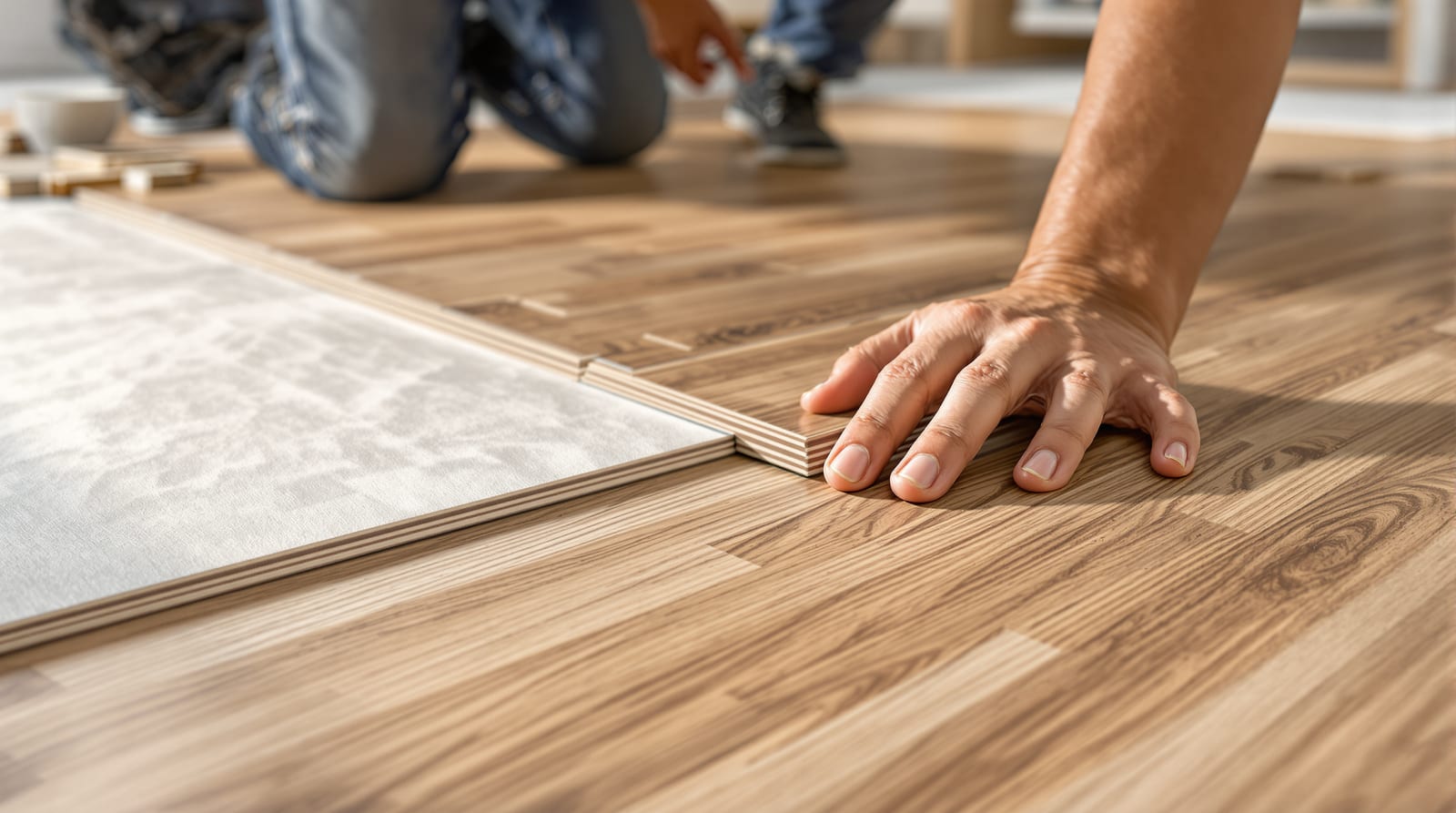
SPC Flooring in India: The Rigid Waterproof Click-Floor Explained
Stone-plastic composite flooring — 100% waterproof, dent-resistant and DIY-clickable — and why Indian homes and rentals are switching to it.
SPC flooring has quietly become the default answer when an Indian homeowner wants a wood-look or stone-look floor that will not warp, swell or stain — and that can go down over an existing tile floor in a weekend without breaking a single wall. Short for stone-plastic composite (you will also see "stone-polymer composite" and "solid-polymer core"), SPC is a rigid, dense, 100% waterproof click-floor that solves most of the problems that made earlier vinyl and laminate floors a gamble in India's heat, humidity and monsoon. This guide explains exactly what it is made of, how thick the layers should be, what it costs per square foot in 2026, where it works, how it goes down, and how it stacks up against WPC, laminate and LVT.
What SPC flooring actually is
SPC is a multi-layer engineered plank or tile built around a rigid mineral-plastic core. The core is roughly 60-70% finely ground limestone (calcium carbonate) blended with PVC resin and stabilisers, then extruded under heat into a board that is hard, heavy and dimensionally stable. On top of that core sits a printed decor film (the wood-grain or stone pattern), then a clear transparent wear layer, and usually a factory-attached acoustic underlay on the underside. The planks lock together with a click joint along their edges — no glue, no nails, no cement.
The "stone" in stone-plastic composite is what sets it apart from older flexible vinyl. That limestone-loaded core makes SPC stiff rather than bendy. A flexible LVT plank will follow every bump and hollow in your subfloor and telegraph it through; a rigid SPC plank bridges minor unevenness and stays flat. That rigidity, plus the all-plastic-and-stone makeup, is the whole reason SPC has taken off so fast.
The layer build-up
A good SPC plank is the sum of four or five layers, each doing a specific job. The diagram below shows a typical section and the click joint that ties planks together.
- UV / PU top coat: a thin factory finish that resists scuffs, stains and sunlight fade — important for Indian homes with big windows and strong daylight.
- Wear layer: a clear protective film, measured in mils or mm, that takes the abrasion of footfall, furniture and grit. This is the single most important number to check (more below).
- Decor film: a high-resolution printed image of timber or stone, usually embossed-in-register so the texture lines up with the grain you can see.
- Rigid core: the dense limestone-PVC board that gives SPC its strength, stability and waterproofing.
- Attached underlay: many SPC ranges come with a pre-bonded IXPE or EVA foam pad that quietens footfall and forgives a little subfloor roughness.
Why SPC is surging in Indian homes
Several SPC strengths line up neatly with what Indian buyers struggle with.
100% waterproof. The core is plastic and stone — it does not absorb water, swell or delaminate. Spills, mopping, monsoon humidity and the odd overflowing washing machine do not damage it. This is the headline reason it is replacing laminate, which swells permanently if water sits in the joints.
Rigid, so it bridges minor unevenness. Indian floors are rarely dead-flat; you often lay over old vitrified tiles or an uneven IPS screed. SPC's stiff core spans small dips and grout lines that would show through flexible vinyl. (You still need to level genuine humps and deep hollows — rigid is not magic.)
Dimensionally stable in heat and humidity. Calcium-carbonate-loaded cores expand and contract far less than older vinyl when a Chennai or Delhi room swings from a cool morning to a 40°C afternoon. Less movement means fewer gaps and lifted edges. Good brands still specify a small perimeter expansion gap and an acclimatisation period.
Click-DIY and renter-friendly. Planks float and lock together over the existing floor with no adhesive, so there is no demolition, no cement, minimal dust and a fast install. For rented flats it is a genuine option — some homeowners even lift and reuse it when they move.
Scratch and dent resistant; quiet. The hard core and wear layer shrug off chair legs, pet claws and dropped vessels far better than soft vinyl or wood, and the attached underlay keeps it quieter than tile underfoot.
Where SPC suits — and where it doesn't
SPC works almost anywhere in an Indian home, office, clinic or retail space: living rooms, bedrooms, kids' rooms, home offices, kitchens, even bathrooms and balconies that are covered and not subject to standing water. It is excellent for high-traffic and joint-family homes because it resists dents and is easy to clean.
The honest limits: do not lay floating SPC where water genuinely pools and sits for long periods (open terraces in full monsoon, wet-floor bathrooms with poor drainage). The plank itself is waterproof, but standing water can creep under a floating floor through the perimeter and sit on the subfloor. Outdoors in direct, harsh sun SPC can also expand and is generally not recommended uncovered — for open balconies and terraces, anti-skid porcelain or stone is the safer call. And as with any floating floor, it needs a reasonably level, clean, dry base.
Wear-layer thickness — the number that matters most
The wear layer decides how long an SPC floor looks new. It is quoted in mils (thousandths of an inch) or mm. Match it to traffic:
| Wear layer | Approx. mm | Best for | India context |
|---|---|---|---|
| 12 mil | 0.30 mm | Light residential | Low-traffic bedrooms, guest rooms, rentals on a budget |
| 20 mil | 0.50 mm | Standard residential | Most homes — living rooms, kitchens, joint-family use |
| 22-28 mil | 0.55-0.70 mm | Heavy / light commercial | Home offices, clinics, shops, very high traffic |
For a normal Indian home, aim for a 0.50 mm (20 mil) wear layer; do not buy the cheapest 0.30 mm range for living areas or kitchens. Total plank thickness usually runs 4-6 mm (excluding the underlay); thicker planks feel more solid and lock more reliably, but thickness is not a substitute for wear-layer thickness.
IXPE underlay
IXPE (cross-linked polyethylene foam) is the premium acoustic pad you will see bonded to better SPC planks; EVA is the cheaper alternative. An attached underlay cuts hollow footstep sound, adds a touch of warmth and comfort, and helps the floor sit evenly over small imperfections. If your planks already have an attached pad, do not add a second loose underlay — doubling up makes the click joints flex and can fail them.
What SPC costs in India (2026)
Prices are indicative and vary by city, brand, decor and wear-layer grade; material only unless stated, plus 18% GST. Installation of a floating click floor is light — figure roughly ₹20-50/sq ft for labour, plus a self-levelling skim only if the base needs it, plus skirting and beading.
| Item | Indicative cost (₹/sq ft) |
|---|---|
| SPC plank — entry (0.3 mm wear, thin core) | 90-130 |
| SPC plank — standard (0.5 mm wear, 5-6 mm) | 130-200 |
| SPC plank — premium / commercial grade | 200-250 |
| Self-levelling underlayment (if base is poor) | 25-60 |
| Floating click install (labour) | 20-50 |
| Skirting / beading + transition strips | as per run |
That ₹90-250/sq ft material band puts SPC above laminate and most basic vinyl, roughly level with LVT, and a little below WPC. For a typical 600 sq ft flat done in a standard SPC, an all-in figure of around ₹150-280/sq ft fitted (material + labour + sundries) is realistic. Use the flooring cost calculator and the flooring material comparison to firm up a number for your floor.
How SPC is installed
SPC goes down as a floating floor — the planks lock to each other, not to the subfloor. The sequence is simple but the prep is everything:
1. Prepare the base. It must be clean, dry and level. SPC can lay over existing vitrified tiles, IPS, screed or plywood, provided the surface is sound. Level deep hollows or humps with a self-levelling compound; vacuum thoroughly.
2. Acclimatise. Leave the boxes flat in the room for 24-48 hours so the planks reach room temperature before laying.
3. Lay the underlay only if your planks do not have an attached pad; add a moisture barrier (DPM sheet) over fresh or ground-floor screeds prone to rising damp.
4. Click the planks starting from the longest straight wall, staggering end joints by at least 200-300 mm, and leave a 6-10 mm expansion gap around the entire perimeter and against fixed objects.
5. Finish by covering the gap with skirting or beading and fitting transition strips at doorways.
Because there is no curing cement, the floor is walkable immediately — one of SPC's biggest practical wins over a tiled floor that ties up the room for days.
Brands available in India
You will find SPC from international names and a growing list of Indian and imported ranges: Pergo, Greenlam (Mikasa), Action Tesa, Square Foot, Floor Factory, Welspun, Squarefoot, plus many imported Chinese and Vietnamese ranges sold under local brand labels. Specification matters more than badge — always confirm the wear-layer thickness (target 0.5 mm), core thickness, whether an IXPE underlay is attached, and the warranty before you buy. Cheap unbranded SPC with a 0.3 mm wear layer and a brittle core is where most complaints come from.
SPC vs WPC vs LVT vs laminate
All four are popular wood-look floating floors in India, but they are built differently and fail differently. SPC and WPC are the two "rigid core" options; LVT is flexible vinyl; laminate has a wood-fibre core.
| Feature | SPC | WPC | LVT | Laminate |
|---|---|---|---|---|
| Core | Limestone + PVC (rigid, dense) | Wood-flour + PVC + foam (rigid, lighter) | Flexible PVC | HDF wood fibre |
| Waterproof | Yes (100%) | Yes (100%) | Water-resistant to waterproof | No — swells if wet |
| Hardness / dent | Hardest, most dent-resistant | Slightly softer, warmer underfoot | Softer, shows subfloor | Hard top, but core fails with water |
| Bridges unevenness | Yes (rigid) | Yes (rigid) | No (follows the base) | Partial |
| Underfoot feel | Firm, slightly cooler | Softer, warmer, quieter | Soft | Firm |
| Install | Click, floating | Click, floating | Glue-down or click | Click, floating |
| Cost ₹/sq ft (material) | 90-250 | 100-300 | 120-350 | 80-250 |
| Best for | Most rooms, high traffic, kitchens | Comfort + warmth, bedrooms | Budget/glue-down, subfloors that are flat | Dry living areas, lowest budget |
In short: choose SPC for the toughest, most waterproof, most dent-resistant rigid floor; choose WPC if you want a slightly softer, warmer, quieter feel and will pay a bit more; choose LVT for glue-down jobs or where flexibility helps; and choose laminate only for dry rooms on a tight budget. Read the full breakdowns in our WPC flooring guide, luxury vinyl tile (LVT) guide and the head-to-head SPC vs laminate flooring guide, and see where these sit in the wider vinyl flooring guide.
For the bigger picture across every floor type, start with the complete home flooring guide for India and the how to choose flooring guide.
Frequently asked questions
Is SPC flooring good for Indian climate and monsoon?
Yes. SPC is one of the best-suited engineered floors for India because its stone-plastic core is 100% waterproof and dimensionally stable through heat and humidity. It handles monsoon damp, frequent mopping and temperature swings far better than laminate or solid wood. The only caveat is that floating SPC is not for open terraces or wet-floor bathrooms where water stands; use anti-skid porcelain or stone there instead.
What wear-layer thickness should I buy for SPC?
For a normal home, choose a 0.50 mm (20 mil) wear layer; that is the sweet spot for living rooms, bedrooms and kitchens. Light-use rooms can manage 0.30 mm (12 mil), while home offices, clinics and shops should go 0.55 mm (22 mil) or more. The wear layer, not the total plank thickness, decides how long the floor keeps looking new.
Can SPC flooring be laid over existing tiles?
Yes — this is one of its biggest advantages. SPC floats over existing vitrified tiles, IPS or screed with no demolition, provided the surface is clean, dry and reasonably level. Fill any deep hollows or grout lines with a self-levelling compound first, leave a perimeter expansion gap, and the floor is walkable the same day.
How is SPC different from WPC?
Both are rigid waterproof click-floors, but SPC has a denser limestone-PVC core that is harder, more dent-resistant and thinner, while WPC has a wood-flour-and-foam core that is lighter, softer and warmer underfoot. SPC is the tougher choice for high traffic and kitchens; WPC trades a little durability for comfort and quiet, usually at a slightly higher price.
What does SPC flooring cost in India?
Expect roughly ₹90-250 per sq ft for the planks (material only, plus 18% GST), with standard 0.5 mm-wear ranges around ₹130-200. Add about ₹20-50/sq ft for the floating-click labour, plus skirting, beading and a self-levelling skim if the base needs it. Figures are indicative and vary by city, brand and grade.
Export this guide
Related Guides — Deep-dive reading
Laminate Flooring in India: AC Ratings, Cost, Brands & the Honest Limits (2026)
The budget wood-look floor for Indian homes — an HDF core with a printed decor and tough melamine wear layer, click-lock floating install over underlay, DIY-friendly and fast, with the water and refinishing caveats made plain.
Flooring & SurfacesCork Flooring in India: Warm, Quiet, Eco Floors for Bedrooms, Study & Kids' Rooms
Why cork is genuinely sustainable (bark is harvested while the tree lives on), the comfort and acoustic benefits, the natural look, ₹200-500/sq ft, click-floating vs glue-down tiles, sealing, and the dent, moisture and sun-fade caveats every Indian homeowner should know.
Flooring & SurfacesEngineered Wood Flooring in India: Layers, Wear Layer, Install & Cost (2026)
Engineered wood is a real-wood top veneer bonded over a cross-laminated plywood or HDF core, which makes it far more dimensionally stable than solid wood in Indian humidity — the practical way to get a genuine timber floor here. This guide covers the layer build-up, wear-layer thickness, click vs glue-down install, where it suits, ₹/sq ft, brands and maintenance.
Flooring & SurfacesRelated Tools — Try Free
Flooring Cost Calculator
Estimate the all-in cost of a floor — material, laying, wastage, skirting and GST — by area and material.
Flooring CalculatorCross-Ventilation Analyzer
Estimate airflow and air changes per hour (ACH) from room size, window areas, layout, and local wind — with NBC 2016 Part 8 compliance check.
Ventilation CalculatorFull-Room BOQ — Living, Bedroom, Kitchen, Bath
Room-wise BOQ across living, bedrooms, kitchen, utility, and bathrooms with line-item pricing.
Full-Room BOQ