
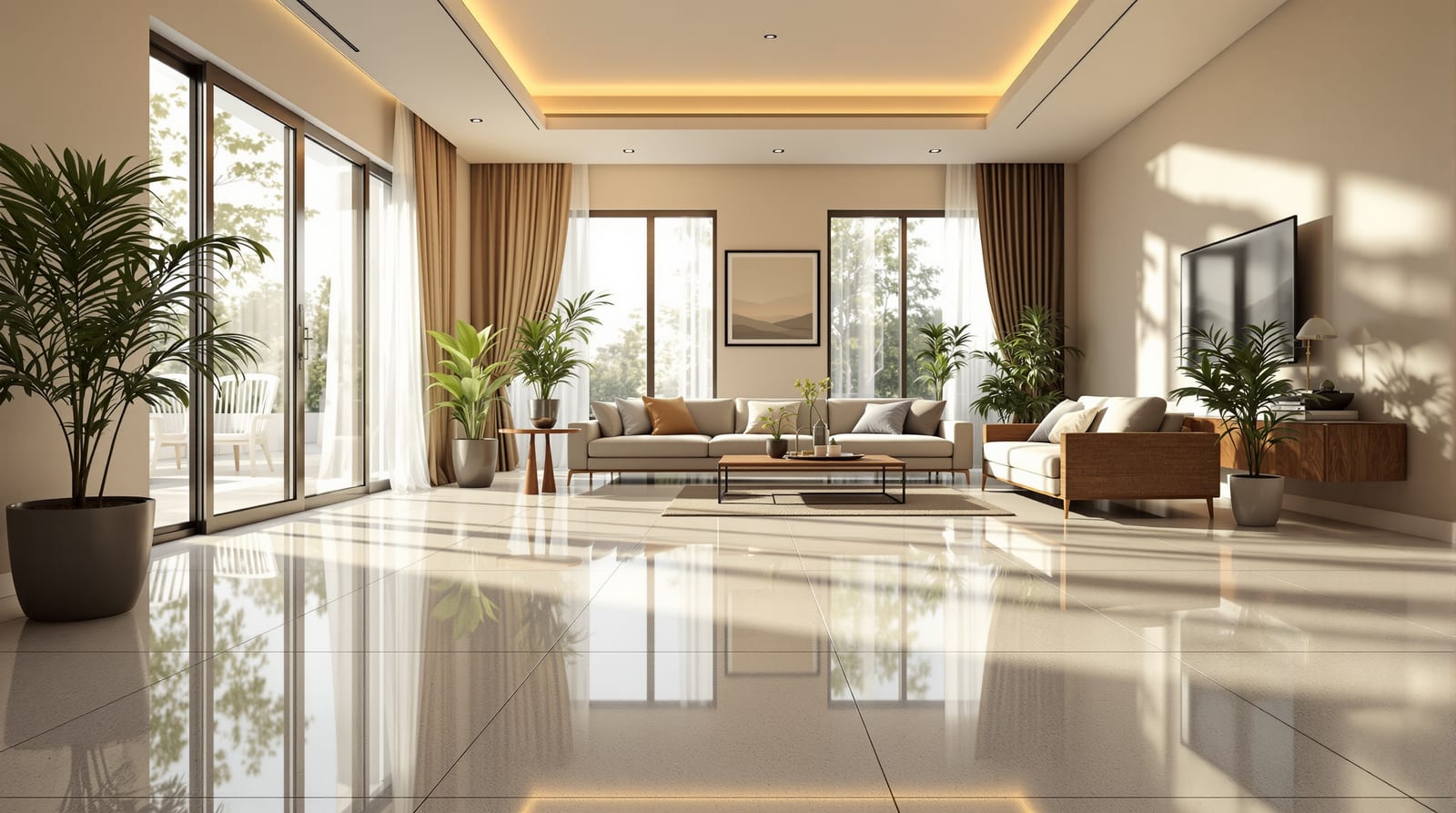
Complete Home Flooring Guide for Indian Homes (2026)
The authoritative overview of every flooring family — tiles, stone, wood, vinyl and seamless — with India ₹/sq ft costs, room-by-room logic and laying basics.
Flooring is the single largest continuous surface in your home, the one decision you walk on every day for the next twenty years — and the one that is most painful to redo. Get it right and the floor disappears quietly under family life: monsoon mud wipes off, a dropped steel tumbler leaves no mark, and the surface still looks fresh after a decade of joint-family traffic. Get it wrong and you live with cold complaints, slippery bathrooms, hairline cracks and a maintenance bill that never ends. This is the master guide that orients you across the whole decision — the material families, how to weigh cost against durability and maintenance, room-by-room logic for Indian conditions, and how to actually budget a floor in 2026 rupees. From here you can branch into the deep guides on each material.
The five flooring families
Almost every floor sold in India belongs to one of five families. Understanding the families first — before you fall in love with a specific tile — keeps you from comparing apples to oranges.
- Tiles (fired clay). Ceramic, vitrified (GVT, PGVT, double-charged, full-body) and porcelain. The default Indian floor: durable, water-resistant, huge range of looks, low maintenance. Vitrified tiles dominate new homes for good reason. See vitrified tile flooring, ceramic tiles and porcelain tiles.
- Natural stone. Granite, marble, kota, Tandur, sandstone. Premium, characterful, repolishable for generations — but heavier on cost and (for marble) on maintenance. India quarries some of the world's best stone. See granite flooring and marble flooring.
- Wood. Solid hardwood, engineered wood, laminate, bamboo. Warm underfoot and unmistakably premium, but humidity-sensitive — a real consideration in coastal and monsoon India. See wooden flooring.
- Resilient. Vinyl, LVT, SPC, WPC, cork, carpet. Soft, quiet, waterproof (the rigid cores especially), fast to lay over existing floors. The fastest-growing family. See vinyl flooring and SPC flooring.
- Seamless. Epoxy, microcement, polished concrete, IPS and red-oxide. Joint-free, contemporary, poured or troweled in place. See epoxy flooring and microcement flooring.
If you want a deeper walk through every material with pros and cons, read flooring materials explained. For the decision framework — matching material to your priorities — read how to choose flooring.
Master comparison: cost, durability, maintenance, best use
This is the table to keep open while you shop. Costs are indicative 2026 material rates in ₹ per square foot, before laying, and vary by city, brand and vendor. All prices attract 18% GST, and laying, adhesive, grout, skirting and polishing are extra (covered below).
| Material family | Material ₹/sq ft | Durability | Maintenance | Wet area / anti-skid | Best use |
|---|---|---|---|---|---|
| Ceramic tile | 30–80 | Good | Very low | Glazed matt OK | Budget rooms, walls, light traffic |
| Vitrified (GVT/PGVT) | 40–150 | Excellent | Very low | Matt/anti-skid grades | Living, bedrooms, whole home |
| Double-charged vitrified | 45–90 | Excellent (wears deep) | Very low | Yes | High-traffic, commercial-grade homes |
| Porcelain | 60–200 | Excellent | Very low | R10+ available | Premium, large-format, outdoor |
| Granite | 50–250 (premium 250–500) | Outstanding | Low (occasional seal) | Flamed/leather = anti-skid | High-traffic, kitchens, stairs, joint-family |
| Indian marble | 80–350 | Very good | Medium (seal/polish) | Not for wet areas | Living rooms, foyers, temples |
| Italian marble | 250–1,500+ | Very good | High (etches with acid) | No | Luxury living, statement spaces |
| Kota / Tandur stone | 30–80 | Very good | Low | Yes (naturally matt) | Verandahs, balconies, budget durable |
| Terrazzo / mosaic | 60–200 | Very good | Low–medium | Yes | Heritage look, durable common areas |
| Solid hardwood | 250–1,500 | Good (refinishable) | High | No | Bedrooms (dry climates) |
| Engineered wood | 180–700 | Good | Medium | Limited | Bedrooms, studies |
| Laminate | 80–250 | Moderate | Low | No (swells) | Budget bedroom warmth (dry) |
| Vinyl / LVT | 40–350 | Good | Very low | Yes (waterproof) | Kids/elderly rooms, quick reno |
| SPC / WPC | 90–300 | Very good | Very low | Yes (waterproof core) | Whole-home wood-look, wet-tolerant |
| Epoxy | 80–300 | Very good | Low | Yes (seamless) | Modern open-plan, utility |
| Microcement | 250–800 | Good | Medium (re-seal) | Yes (sealed) | Contemporary seamless look |
| Polished concrete | 100–400 | Excellent | Low | Honed = anti-skid | Industrial-modern, large areas |
A quick read of the table: vitrified tiles and granite are the workhorses of Indian homes because they combine excellent durability with very low maintenance at a sane price. Marble buys you beauty and cool-underfoot comfort but asks for care. Wood buys you warmth but worries about water. Resilient and seamless families are the modern entrants — waterproof, fast, increasingly convincing.
How to think: cost vs durability vs maintenance vs look
A floor has four costs, not one, and homeowners usually fixate on the first:
1. Purchase cost — the ₹/sq ft you see on the price list.
2. Installed cost — purchase plus laying, adhesive/cement, grout, skirting, wastage and GST. This is typically 1.4–1.8x the tile price for tiles, and more for stone.
3. Maintenance cost — sealing, polishing, re-grouting, replacing damaged planks over the floor's life. Marble and microcement carry this; vitrified and granite barely do.
4. Replacement cost — what it costs to rip out and redo if you chose wrong. The real reason to get it right once.
Hold these against three honest questions. How hard will this floor be used? A nuclear couple's study and a joint family's living room are different planets — for the latter, lean granite, double-charged vitrified or SPC. How wet does it get? Bathrooms, balconies, kitchens and coastal homes need anti-skid, water-resistant surfaces — never solid wood. How much upkeep will you actually do? Be honest: if you will not re-seal marble, do not buy marble for a high-spill zone. Match the material to the life you live, not the showroom photo. The how to choose flooring guide turns this into a step-by-step framework.
Room-by-room logic for Indian homes
There is no single best floor — there is a best floor per room. Here is the practical Indian playbook.
- Living / dining room — the showpiece and the high-traffic zone. Large-format vitrified (600x600, 800x800, 600x1200) for value and looks, or marble/granite for a premium foyer. See living room flooring.
- Bedrooms — comfort and warmth matter more than abrasion resistance. Vitrified, engineered wood, laminate or SPC all work; wood-look adds warmth. See bedroom flooring.
- Kitchen — spills, oil, dropped utensils. Anti-skid matt vitrified, porcelain or granite. Avoid high-gloss (slippery when wet) and avoid wood. See kitchen flooring.
- Bathrooms — anti-skid is non-negotiable. Small matt ceramic/vitrified (R10+), or anti-skid porcelain, with a fall toward the drain. Never marble (etches) or wood. See bathroom flooring.
- Balconies and terraces — full sun, monsoon, thermal movement. Anti-skid vitrified/porcelain, kota or sandstone; on terraces, weatherproof and falls toward outlets. See balcony flooring and terrace flooring.
- Pooja room — tradition favours light stone or marble. Vastu prefers lighter floors and good light in the NE/E — frame this as both custom and the practical fact that light floors lift a small sacred space.
Climate, wet areas and anti-skid — the India layer
India is not one climate, and your floor should know it. In hot, dry regions, marble and light stone are prized because they stay cool underfoot through brutal summers. In coastal and high-humidity belts (Mumbai, Kerala, Goa, Chennai), salt-laden air and monsoon moisture rule out solid wood and reward vitrified, porcelain and stone. In monsoon-heavy areas, anti-skid surfaces at entrances, balconies and bathrooms prevent the slips that send elderly family members to hospital. How to choose flooring for Indian weather goes deeper on climate matching, and outdoor flooring covers exposed surfaces.
Slip resistance is measured by DIN 51130 R-ratings (R9 smooth to R13 coarse). For wet zones — bathrooms, balconies, kitchens, outdoor steps — specify R10 or higher; R11–R13 for ramps and pool surrounds. India's NBC 2016 and the RPwD Harmonised Guidelines 2021 require anti-slip, level floors with thresholds ≤12 mm for accessibility — a small detail that matters enormously for ageing parents and wheelchair users. On the tile-grade side, IS 15622 classifies tiles by water absorption: vitrified tiles absorb <0.5% (stain- and water-resistant, ideal for floors and wet areas), while ceramic absorbs more (better suited to walls and light-traffic dry rooms).
How a floor is actually built — the layers
What you see is the finish; what protects you from cracks and hollow tiles is everything beneath it. Here is the typical build-up, from the structural slab up.
The two laying methods you will be quoted reflect the bedding layer in that section:
- Traditional cement-sand bed — a thick mortar bed (typically 20–40 mm) laid wet, tiles tapped in. Forgiving on uneven sub-floors, familiar to every Indian mason, cheap on material. But thicker, heavier, slower to cure, and more prone to hollowness and de-bonding if the mix is poor.
- Tile adhesive (thin-set) — a polymer-modified cement adhesive troweled at 3–4 mm over a properly levelled surface. Mandatory for large-format tiles, vitrified, glass mosaic and over existing floors. Stronger bond, fewer hollow tiles, faster, but needs a flat substrate (hence the screed). One 20 kg bag covers roughly 30–40 sq ft at 3–4 mm. Use the tile adhesive calculator to estimate bags.
For large-format and vitrified tiles, insist on adhesive — it is the single biggest predictor of a floor that does not go hollow.
How to budget your floor (₹/sq ft, the honest way)
A floor quote that only mentions the tile price is incomplete. Build your budget in layers:
| Cost component | Indicative ₹/sq ft | Notes |
|---|---|---|
| Material (tile/stone/wood) | 30–1,500+ | From the master table above |
| GST on material | +18% | Always added |
| Laying labour | 15–60 | More for stone, large-format, herringbone |
| Adhesive or cement-sand bed | 12–30 (adhesive) | Adhesive premium over traditional bed |
| Grout / pointing | small | Epoxy grout costs more, lasts longer |
| Skirting | per running ft | Usually 4 inch, same material |
| Wastage | +5–10% | More for diagonal/herringbone (up to 15%) |
| Polishing (stone) | extra | Marble/granite need on-site polish |
A worked example for a 1,000 sq ft flat in mid-range vitrified: tile at ₹70 + 18% GST ≈ ₹83, plus laying ₹30, plus adhesive ₹20, plus grout/skirting/wastage ≈ ₹15 — roughly ₹148/sq ft installed, or about ₹1.48 lakh for the flat, before premium rooms. Swap one room to marble and the number climbs fast. For a full cost breakdown by material read flooring cost 2026, and price your specific home with the flooring cost calculator and tile quantity calculator. Always buy 5–10% extra from the same batch — dye lots vary, and matching tiles two years later is nearly impossible.
Putting it together
Most Indian homes land on a sensible blend: large-format vitrified across living and bedrooms for value and looks, granite or anti-skid matt vitrified in the kitchen, small anti-skid tiles in bathrooms, kota or porcelain on balconies, and a marble or granite statement in the foyer or pooja room. That blend is not a compromise — it is the floor matching each room's real job. Use this guide as your map, then dive into the specific material and room guides linked throughout to lock the details.
Frequently asked questions
Which flooring is best for Indian homes overall?
For most homes, vitrified tiles are the best all-round choice — durable, water-resistant, low-maintenance, value-priced and available in endless looks. Granite is the premium workhorse for high-traffic and joint-family homes. Marble and wood are beautiful but ask for more care and the right climate. Match the material to each room rather than chasing one floor for the whole house.
Is marble or vitrified tile better for an Indian living room?
Both are excellent. Marble gives a cool, luxurious, naturally premium surface that can be repolished for generations, but it stains and etches with acid and needs sealing. Vitrified tile is virtually maintenance-free, stain-resistant, cheaper and now mimics marble convincingly. Choose marble for the look and willingness to maintain it; vitrified for fuss-free durability. See the marble-vs-vitrified comparison guide for the full trade-off.
Should I use tile adhesive or traditional cement-sand?
Tile adhesive for any large-format or vitrified tile and for tiling over existing floors — it bonds stronger at 3–4 mm and prevents hollow tiles. Traditional cement-sand still works for small ceramic tiles and very uneven sub-floors, and costs less on material. For modern tiles, adhesive is the safer, longer-lasting choice and well worth the small premium.
How much extra tile should I buy for wastage?
Order 5–10% extra for straight laying, and up to 15% for diagonal, herringbone or heavily cut layouts. Crucially, buy it all in one purchase so it comes from the same batch and dye lot — colours drift between batches, and an exact match months later is rarely possible.
What flooring is safe and anti-skid for bathrooms and balconies?
Use small-format matt or anti-skid tiles rated R10 or higher (DIN 51130), with the floor sloped toward the drain. Anti-skid vitrified, porcelain, kota and natural stone all suit wet zones. Avoid marble (etches and slips) and wood (swells) in bathrooms. Keeping thresholds ≤12 mm also meets accessibility guidance and protects elderly family members.
Export this guide
Related Guides — Deep-dive reading
Anti Slip Flooring for Bathroom and Wet Areas in India: R-Ratings, Finishes and Genuinely Safe Tile Choices
How to choose genuinely safe flooring for bathrooms, kitchens, balconies, pools, entrances and elderly- or child-friendly homes — the R-rating system, finishes that grip wet feet, anti-skid natural stone, slope to drains and the tiles to avoid.
Flooring & SurfacesFlooring Materials Explained: Every Type for Indian Homes (2026)
One scannable reference to every flooring material family — tiles, natural stone, wood, resilient and seamless — with look, durability, water resistance, ₹/sq ft cost band and where each suits Indian homes.
Flooring & SurfacesBathroom Flooring Guide India: Anti-Skid Tiles, Stone, Vinyl & Epoxy Compared
Every bathroom floor material for Indian homes in one place — anti-skid ceramic and vitrified tiles, natural stone, mosaic, vinyl (SPC/LVT) and epoxy — with a full comparison table, slip ratings, ₹/sq ft costs and the safety and slope rules that keep a wet floor from becoming a hazard.
BathroomsRelated Tools — Try Free
Flooring Cost Calculator
Estimate the all-in cost of a floor — material, laying, wastage, skirting and GST — by area and material.
Flooring CalculatorMarble Flooring Cost Calculator
Estimate installed marble-floor cost — material, laying, grinding and polishing, sealing, wastage and GST.
Flooring CalculatorWooden Flooring Cost Calculator
Estimate installed wood or wood-look floor cost — solid, engineered, laminate or SPC — with underlay and skirting.
Flooring Calculator