
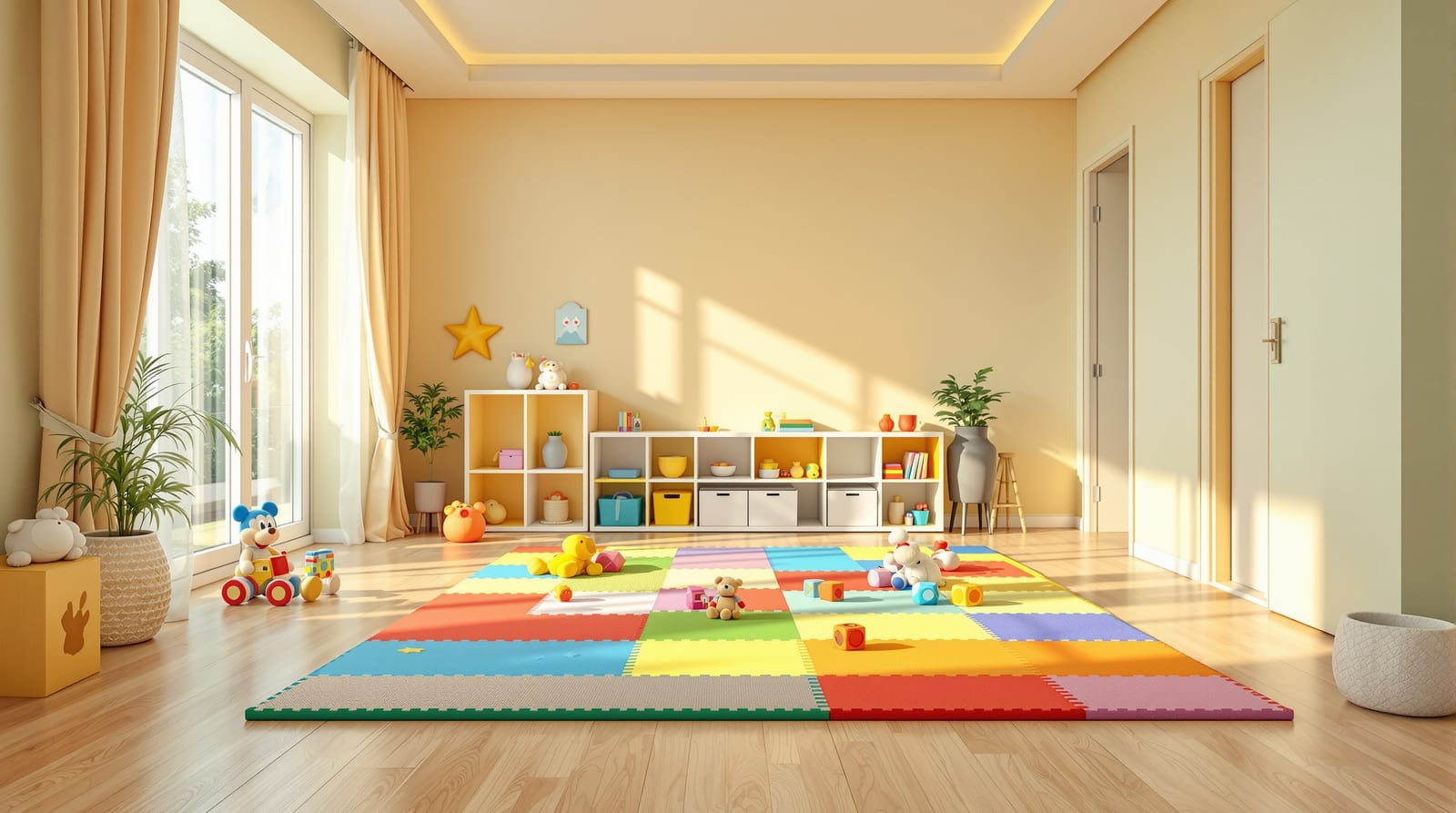
Kids Room Flooring in India: Safe, Soft & Easy-Clean Floors (2026)
How to choose a children's room floor that is warm, non-slip, low-VOC and tough enough for crayons, spills and play.
A children's room is the one space in the house where the floor is also a play surface, a crawling track, a drawing canvas and an occasional crash mat. So the brief is unusual: the floor must be soft and warm underfoot, grippy when little feet run, easy to wipe after the inevitable spill, and made of materials that do not off-gas harmful fumes into a room where a child sleeps ten hours a night. Get those four things right — safety, comfort, cleanability and low toxicity — and looks take care of themselves.
This guide ranks the floors that actually suit an Indian kids room, flags what to avoid, and gives honest 2026 rupee-per-square-foot costs so you can match the floor to the room and the budget.
What a kids room floor really has to do
Before picking a material, set the priorities in the right order. A children's room is not a living room, and the usual "looks first" logic flips.
- Safety first. Floors should be non-slip even when a child runs in socks, free of sharp transitions or hard high-gloss surfaces, and ideally cushioned enough to soften a toddler tumble. Rounded skirting and flush thresholds (the NBC 2016 and RPwD 2021 guidance of keeping thresholds under 12mm is a good homeowner rule of thumb) prevent trips.
- Warmth and comfort. Indian floors are often cold hard stone — fine for a hall, miserable for a baby crawling in December or sitting cross-legged to build blocks. Warm-to-touch materials (wood, laminate, cork, vinyl, foam) make a real day-to-day difference.
- Easy, repeated cleaning. Crayon, slime, poster paint, milk, vomit, the lot. You want a surface you can wipe or mop in seconds, with no grout lines to trap grime and no fabric to stain permanently.
- Low toxicity (low-VOC). Children breathe faster and spend more time near the floor than adults, so indoor air matters more here than anywhere. Choose low-VOC adhesives and finishes — look for phthalate-free vinyl and products carrying GREENGUARD Gold, FloorScore or comparable certification. See our dedicated guide to low-VOC flooring in India for what to ask suppliers.
- Durability against abuse. Toy cars, dropped blocks, dragged furniture, dog claws — the floor should resist scratches and dents and still look decent after years.
With those demands set, here are the floors that meet them, ranked for a typical Indian children's bedroom.
The best floors for a kids room, ranked
1. Vinyl / LVT / SPC — the all-round winner. For most Indian families this is the sweet spot. Modern vinyl flooring is warm underfoot, waterproof (spills wipe away), naturally cushioned, and comes in playful wood, pastel and patterned looks kids love. Luxury vinyl tile (LVT) adds a thicker, more realistic wear layer that shrugs off toy-car races and dragged chairs. SPC flooring, with its rigid stone-polymer core, is the toughest of the family — dent-resistant, dimensionally stable through Indian heat, and click-lock for a seam-free, easy-clean finish. Insist on phthalate-free, low-VOC grades.
2. Cork — quiet, soft and naturally warm. Cork flooring is the unsung hero of children's rooms: it is springy underfoot (gentle on falls), naturally warm, sound-absorbing (muffles the running and the dropped toys), and made from a renewable bark. It needs a good sealant against spills, but for a calm nursery or a sleep-focused bedroom it is hard to beat.
3. Foam / rubber interlocking play tiles — pure cushion for toddlers. For a baby-and-toddler zone, foam interlocking tiles (and their tougher rubber cousins) give the most cushioning of anything here. They are cheap, soft, washable, often come in alphabet and number designs, and can be lifted and reconfigured as the child grows. Use them as a play-mat zone over a harder base floor rather than wall-to-wall — choose certified non-toxic, formamide-free foam.
4. Laminate — the budget warm floor. Laminate flooring gives a warm wood look at the lowest cost of the warm options. Choose a high AC-rating (AC4+) for scratch resistance and a water-resistant board, since laminate's weakness is standing water at the joints. Good value for an older child's room where spills are less frequent.
5. Washable area rugs — the soft layer on top. Whatever the base floor, a large washable cotton or polypropylene rug defines a play zone, adds softness and warmth, and goes straight into the machine when the paint lands. Use a non-slip underlay so it cannot slide. Rugs let you keep an easy-clean hard floor underneath while still giving a soft sit-down surface.
Comparison: kids room floors at a glance
The table ranks each option on the four things that matter in a children's room, with indicative installed 2026 costs.
| Floor | Safety (slip / cushion) | Warmth & comfort | Easy to clean | Toxicity (VOC) | Durability vs crayons & abuse | ₹/sq ft (installed) |
|---|---|---|---|---|---|---|
| Vinyl / LVT | Good grip, some cushion | Warm | Excellent — wipe/mop | Low if phthalate-free, certified | Very good; crayon wipes off | 90–250 |
| SPC | Good grip, firm | Warm | Excellent | Low, certified grades | Excellent — dent & scratch resistant | 130–400 |
| Cork | Springy, soft, grippy | Very warm | Good (sealed); avoid soaking | Low (natural, low-VOC sealant) | Good; can dent under sharp loads | 200–500 |
| Foam play tiles | Maximum cushion | Warm | Good — lift & wash | Choose certified, formamide-free | Fair; for play zone, not wall-to-wall | 40–120 |
| Rubber tiles | High cushion & grip | Warm | Very good | Low-odour grades only | Excellent — very tough | 120–450 |
| Laminate (AC4+) | Firm, low slip | Warm | Good; avoid standing water | Low (E1/E0 boards) | Good; scratch-resistant top layer | 110–300 |
| Washable rug (over base) | Soft; needs anti-slip pad | Very warm | Excellent — machine wash | Low (cotton/PP) | Replaceable layer | 60–200 |
Costs are indicative for 2026 and vary by city, brand and grade — confirm with local suppliers or our flooring cost calculator. For a whole-home view of which floor suits each room, see the room-by-room flooring guide for India.
A simple safe-zone layout
A practical kids room layers a wipe-clean warm base floor with a cushioned play zone and a washable rug — so spills are easy and falls are soft, without committing the whole floor to one material.
What to avoid in a kids room
- Hard, cold stone. Granite, kota and polished marble are durable and beautiful, but cold, unforgiving in a fall and slippery when wet. Save them for the hall, not the nursery — or cover with rugs and mats if already laid.
- High-gloss, slippery finishes. Glossy vitrified or polished surfaces become skating rinks for running socks. If you must use tiles, pick a matt, anti-skid (R10+) finish — see anti-slip flooring for wet areas in India.
- High-VOC products. Cheap unbranded vinyl, solvent-heavy adhesives and high-formaldehyde laminate can off-gas for months. Always ask for certification.
- Deep grout lines and textured tiles. They trap crayon wax, food and grime and are miserable to clean. Smooth, seamless surfaces win here.
- Wall-to-wall fitted carpet. It traps dust and allergens — a problem in India's dust and pollen — and stains permanently. Use a washable rug instead.
Care and maintenance
Kids rooms get cleaned often, so pick a routine you can actually keep up. Vinyl, LVT and SPC need only a damp microfibre mop with a mild, child-safe cleaner; crayon and most marks lift with a little baking-soda paste or a melamine sponge. Cork wants a barely-damp mop and a re-coat of sealant every few years. Foam and rubber tiles can be lifted and washed individually. Laminate must never be flooded — wipe spills fast. Wash rugs monthly or whenever they look grubby, and keep a non-slip pad underneath. Felt pads under furniture legs and a no-shoes rule keep grit out and scratches down.
Do and don't
- Do put safety, warmth, cleanability and low-VOC ahead of looks.
- Do demand phthalate-free, certified (GREENGUARD Gold / FloorScore) materials.
- Do layer a cushioned play zone and a washable rug over a wipe-clean base.
- Do keep transitions flush and skirting rounded.
- Don't lay cold hard stone or high-gloss slippery tile in a small child's room.
- Don't use deep-grout or heavily textured surfaces that trap crayon and grime.
- Don't skip certification to save a few rupees — this is a sleeping room.
Frequently asked questions
What is the safest flooring for a kids room in India?
A warm, non-slip, low-VOC floor with some cushion. Phthalate-free vinyl, LVT or SPC over the whole room, with a foam-tile play zone and a washable rug on top, gives the best mix of grip, softness, easy cleaning and clean indoor air. Avoid cold stone and high-gloss tiles.
Is vinyl flooring safe for children?
Yes — provided you choose certified, phthalate-free, low-VOC grades (GREENGUARD Gold or FloorScore). Modern vinyl and SPC floors are warm, waterproof, cushioned and very easy to keep clean, which is why they top most kids room recommendations. Steer clear of cheap unbranded vinyl that may off-gas.
How do I get crayon and stains off the floor?
On vinyl, LVT and SPC, most crayon and marker lifts with a little baking-soda paste or a melamine (magic) sponge and a damp mop. Wipe spills quickly so nothing sets, and avoid harsh solvents that can dull the finish. Smooth, seam-free surfaces clean far faster than grouted or textured tiles.
How much does a kids room floor cost?
For a typical 100–120 sq ft Indian kids room, expect roughly ₹90–250 per sq ft for vinyl/LVT, ₹130–400 for SPC, ₹200–500 for cork and ₹110–300 for laminate, plus a few thousand rupees for a washable rug and foam play tiles. Use our flooring cost calculator for a room-specific estimate.
Is cork or foam better for a toddler?
Foam interlocking tiles give the most cushioning for a crawling, tumbling toddler and are cheapest, but they suit a defined play zone rather than the whole room. Cork is warmer, quieter and more grown-up looking as a full floor. Many families use both — a cork or vinyl base with foam tiles over the play area.
Export this guide
Related Guides — Deep-dive reading
How to Clean Bathroom Tiles (India): Shine, Hard-Water Film & Soap Scum
A practical, India-first routine for cleaning bathroom tiles and keeping them glossy — the daily squeegee habit, weekly wash, monthly deep clean, and the safe cleaner for each tile type, including the golden rule that natural stone must never meet acid.
BathroomsComplete Home Flooring Guide for Indian Homes (2026)
The authoritative overview of every flooring family — tiles, stone, wood, vinyl and seamless — with India ₹/sq ft costs, room-by-room logic and laying basics.
Flooring & SurfacesCork Flooring in India: Warm, Quiet, Eco Floors for Bedrooms, Study & Kids' Rooms
Why cork is genuinely sustainable (bark is harvested while the tree lives on), the comfort and acoustic benefits, the natural look, ₹200-500/sq ft, click-floating vs glue-down tiles, sealing, and the dent, moisture and sun-fade caveats every Indian homeowner should know.
Flooring & SurfacesRelated Tools — Try Free
Flooring Cost Calculator
Estimate the all-in cost of a floor — material, laying, wastage, skirting and GST — by area and material.
Flooring CalculatorFlooring Material Selector
Get the best flooring material for your room, budget and climate, with anti-slip checks for wet areas.
Flooring ToolApartment Furniture Size Chart
Standard furniture dimensions for Indian apartments — sofas, beds, tables, dining, storage.
Reference Chart