
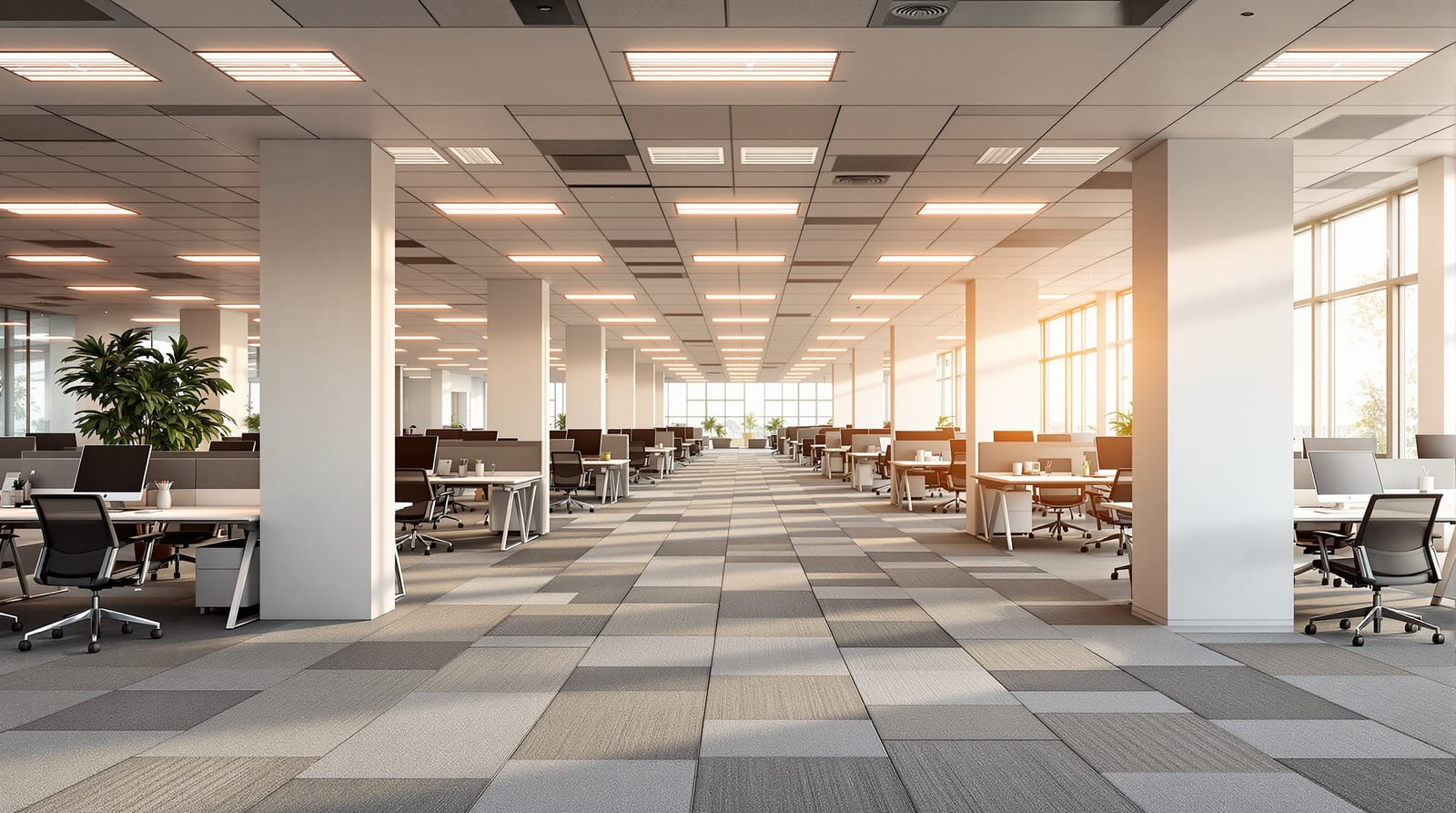
Carpet Tiles in India: Modular 50x50 cm Carpet Squares for Offices, Co-working & Commercial Floors — Types, Backing, Cost & Install
Carpet tiles — modular 50x50 cm (and 25x100 cm) backed carpet squares — are the go-to soft floor for offices, co-working spaces, IT and retail because a single stained tile can be lifted and swapped instead of recarpeting the whole room. Here are the backing types, install methods, acoustic and anti-static options, costs of ₹60–300 per sq ft, pros, cons and how they compare with broadloom carpet.
Carpet tiles are exactly what they sound like — soft carpet supplied not as one giant roll but as small, rigid-backed squares you lay like tiles. The standard size is 50x50 cm, with 25x100 cm planks a stylish alternative, and the whole point of them is modularity: if one tile gets a coffee stain, you lift that one square and drop in a fresh one, instead of recarpeting the entire room. That single idea is why carpet tiles, not broadloom, now floor most Indian offices, co-working spaces, IT parks, retail showrooms and even some study rooms and home offices.
This guide explains how carpet tiles are built, the backing types that matter most, how they are installed over almost any flat floor, the acoustic and anti-static options, where they suit and where they don't, costs of ₹60–300 per sq ft, and how they stack up against wall-to-wall broadloom carpet.
What carpet tiles are and why modular wins
A carpet tile is a square (or plank) of carpet — a tufted or needle-punched pile face bonded to a stiff, dimensionally stable backing. The backing is the clever part: it is heavy and rigid enough that the tile lies dead flat on its own, holds its shape, and resists curling, so tiles can be laid loose or lightly fixed without stretching, grippers or underlay. Sizes are standard and interchangeable, so tiles from the same range slot together seamlessly and stack neatly for transport and storage.
Modularity is the whole sales pitch, and it is a genuine one:
- Individually replaceable. Spill ink, drag a chair leg, or burn a square — you replace that one tile, not the floor. Buy a few extra boxes at the start as "attic stock" and a damaged tile is a five-minute swap.
- Low waste on install. Square tiles cut neatly around columns, walls and odd corners, and offcuts often start the next row. Wastage is typically 5–10 percent versus the larger offcuts you lose with a broadloom roll.
- Easy install over any flat floor. Tiles drop straight onto screed, existing tiles, vitrified, plywood, raised-access panels or old hard floors — no stretching machines or specialist carpet-fitters needed.
- Access to the floor below. Lift tiles to reach cables, leaks or under-floor services, then drop them back — which is exactly why carpet tiles pair so naturally with raised access flooring in IT offices and data-adjacent spaces.
- Mix patterns and colours. Lay two or three shades to mark walkways, breakout zones or branding, or run a plank format in a herringbone-style layout. Design freedom that a single-colour roll cannot match.
Add to that even wear (rotate or swap tiles from low-traffic zones into worn walkways) and the case for offices is overwhelming.
How a carpet tile is built: face plus backing
Every carpet tile is two layers working together — the pile you see and the backing you don't. The backing is what separates a good commercial tile from a cheap one, so it deserves the detail.
The face is usually nylon (the toughest, best for heavy traffic), polypropylene/PP (cheaper, stain-resistant, lighter duty) or PET/polyester (soft, often recycled). It comes as cut pile (plush, softer), loop pile (tighter, more durable, hides traffic — the office default) or a textured loop. Heavier face weight and denser tufting mean better wear and a higher price.
The backing holds the tile flat and decides where the tile belongs. The three families you will be quoted in India are below.
| Backing type | What it is | Feel & performance | Best use | Indicative cost (₹/sq ft) |
|---|---|---|---|---|
| Bitumen (PVC-free) | Heavy bitumen-and-filler backing, the commercial workhorse | Very stable and flat, lays loose, hard-wearing | Offices, IT parks, corridors, heavy traffic | ₹90–250 |
| PVC / thermoplastic | Flexible PVC compound backing | Stable, moisture-tolerant, good acoustics | Commercial, retail, areas with rolling loads | ₹100–280 |
| Cushion-backed | Backing with a foam/PU cushion layer | Softer underfoot, best sound absorption, warmer | Premium offices, hospitality, study/home rooms | ₹150–300 |
| Fibreglass-reinforced | Glass-fibre layer within bitumen/PVC backing | Maximum dimensional stability, no shrink/grow | Large open floors, big offices | adds to above |
Most loop-pile commercial tiles you see in Indian offices are bitumen-backed with a fibreglass reinforcement layer — that combination is what keeps a thousand tiles dead flat across a large open floor through humid summers without gapping or doming. Choose PVC or cushion backing where you want more comfort, warmth and quiet, accepting the higher price.
How carpet tiles are installed
Installation is fast and forgiving compared with broadloom, but the sub-floor still matters: tiles want a clean, dry, flat, hard surface. Any unevenness telegraphs through, and trapped damp can cause adhesive failure or odour, so a screed must be properly cured and a self-levelling skim is worth it on rough floors. There are three common fixing methods.
- Peel-and-stick tabs / dots. Self-adhesive tabs or small dabs of adhesive at the corners hold tiles to each other and lightly to the floor — quick, low-mess, and easy to lift a single tile later. The most popular method for offices and DIY.
- Tackifier (releasable adhesive). A thin coat of pressure-sensitive "tackifier" is rolled over the whole floor and left to go tacky; tiles press down, grip firmly, yet peel up cleanly for replacement. This is the proper commercial method — secure underfoot, still modular.
- Loose-lay. Heavy bitumen-backed tiles in small or low-traffic rooms can sit purely by weight and friction, with adhesive only at doorways and the perimeter. Fastest of all and fully reusable, but only for stable, low-movement areas.
Tiles are laid from the centre of the room outward to keep cut tiles even at the edges. Crucially, each tile has a pile-direction arrow on the back, and the way you orient those arrows is a design decision:
Laying every arrow the same way (monolithic) gives a smooth, broadloom-like sheet. Turning every other tile 90 degrees (quarter-turn) creates a subtle checkerboard that hides traffic, dirt and slight shade variation between dye lots — which is why it is the safe default for big offices. Brick/ashlar and random layouts add more pattern, and planks let you run herringbone-style lines.
Where carpet tiles suit — and where they don't
Carpet tiles are made for commercial and high-churn spaces, and that is where they shine:
- Offices and IT parks — the classic use: quiet, comfortable, replaceable, and lift-up access to floor cabling and raised-access panels.
- Co-working spaces — frequent layout changes and heavy footfall suit modular, swappable tiles.
- Retail showrooms and hospitality — warmth and acoustics with the option to mark zones in different colours.
- Home offices and study rooms — a small, comfortable, sound-dampening floor you can lay yourself with peel-and-stick tabs, and replace a stained square cheaply.
- Over raised access flooring — purpose-built to be lifted for service access.
They are a poor choice in wet and humid areas — bathrooms, kitchens, balconies, ground floors with rising damp — because trapped moisture breeds mould, odour and adhesive failure. India's dust and allergen load also means carpet of any kind needs disciplined vacuuming, so allergy-prone households should think twice. And while carpet tiles are tougher than they look, sharp grit dragged in from outside still abrades the pile, so entrance matting matters.
Acoustic and anti-static options
Two technical upgrades make carpet tiles punch above ordinary soft flooring.
Acoustic performance is a real reason offices choose carpet over hard floors. Carpet tiles absorb impact sound (footsteps, chair scrapes) and soften reverberation in open-plan rooms, cutting the hard-surface clatter of vitrified or stone floors. Cushion-backed tiles are the best absorbers; even standard bitumen-backed tiles dramatically out-perform any tile or polished floor for a calm, quiet workspace. Where noise control is the priority, pair them with acoustic ceilings.
Anti-static / ESD tiles are made with conductive yarn or a conductive backing so they bleed off the static charge that builds up as people walk — important around electronics, server rooms, control rooms and electronics assembly, where a static discharge can damage sensitive equipment. They sit between ordinary carpet tiles and dedicated conductive vinyl: comfortable and quiet, but charge-dissipating. For genuinely critical zones, Studio Matrx covers proper anti-static and ESD flooring separately.
Carpet tiles cost in India
Carpet tiles are sold per square foot or per box (a box typically covers a fixed area of 50x50 cm tiles). Indicative 2026 ranges, varying by city, brand, face weight and backing (add 18 percent GST; adhesive/tackifier and laying are usually extra unless quoted supply-and-fix):
| Grade | Indicative cost (₹/sq ft) | Notes |
|---|---|---|
| Entry / light commercial (PP face, thin pile) | ₹60–110 | Home offices, light-traffic rooms, budget fit-outs |
| Standard commercial (nylon loop, bitumen-backed) | ₹110–200 | The office workhorse; good wear and value |
| Premium / cushion-backed / branded | ₹180–300 | Best comfort, acoustics, design ranges |
| Anti-static / ESD or designer plank ranges | ₹200–300+ | Conductive yarn or specialist looks |
Imported and branded ranges (the well-known global modular-carpet names, and Indian and regional suppliers) sit at the top; locally made PP tiles anchor the bottom. To estimate boxes, tiles and budget for your own room, use the Studio Matrx carpet tile calculator, and for a wider price view across every floor type the cluster's flooring cost per square foot benchmarks place carpet tiles alongside mid-range vinyl and laminate.
Carpet tiles versus broadloom carpet
Both are soft floors, but they solve different problems. Broadloom is wall-to-wall carpet off a wide roll, stretched over underlay and grippers; carpet tiles are modular squares. The honest comparison:
| Factor | Carpet tiles | Broadloom carpet |
|---|---|---|
| Replacement | Swap one stained tile | Patch shows; often recarpet the room |
| Install | DIY-friendly, fast, no stretching | Needs skilled carpet-fitters, underlay, grippers |
| Waste | Low (5–10 percent) | Higher offcut waste |
| Seamless look | Faint grid lines visible up close | Fully seamless, plush |
| Access below | Lift tiles to reach cables/leaks | Whole carpet must come up |
| Design | Mix colours, zones, planks, patterns | Single field, borders harder |
| Best for | Offices, commercial, high-churn, raised floors | Bedrooms, hospitality, luxury, quiet rooms |
| Cost | ₹60–300/sq ft | ₹40–500/sq ft |
In short, broadloom wins on plush, seamless luxury for bedrooms and hospitality suites; carpet tiles win on practicality, repairability and serviceability for any working floor — which is why offices almost always choose tiles. Studio Matrx covers broadloom carpet flooring in its own guide if a seamless luxury floor is what you are after.
Care and maintenance
Carpet tiles are low-fuss but not no-fuss. Vacuum regularly — daily in busy offices, weekly at home — to lift the grit that wears pile, and use barrier matting at entrances to stop dirt travelling in. Treat spills immediately by blotting (never rubbing) and spot-clean with a mild carpet cleaner; the rigid backing means water does not soak into an underlay the way it does with broadloom. Periodic professional low-moisture or encapsulation cleaning keeps a commercial floor fresh. The killer feature remains replacement: keep a box of attic stock, and any tile that is permanently stained or damaged simply gets swapped — five minutes, no fitter, no disruption.
How carpet tiles fit the rest of your flooring choices
Carpet tiles are one branch of the soft-and-resilient floor family. Broadloom carpet is the seamless, plush, roll-laid alternative for bedrooms and luxury rooms. PVC roll/sheet flooring is the hard-wearing hygienic option for hospitals, schools and labs where carpet's dust and damp issues rule it out. Raised access flooring is the panel-and-pedestal system carpet tiles are most often laid over in IT offices, so cables and air can run beneath. Anti-static and ESD flooring is the specialist conductive route for server rooms and electronics zones beyond what conductive carpet tiles offer. For the full map of seamless, resilient, paving and technical floors and where modular carpet sits among them, the Studio Matrx specialty flooring guide pulls the whole landscape together.
Frequently asked questions
What size are carpet tiles?
The standard carpet tile is 50x50 cm (about 20x20 inches), the size used in most Indian offices. A popular plank format is 25x100 cm, which lets you lay herringbone, brick and linear patterns. Some ranges also offer 60x60 cm and 25x25 cm. Tiles within a range are interchangeable so they slot together seamlessly.
Can you lay carpet tiles over existing flooring?
Yes — carpet tiles drop straight onto almost any clean, dry, flat, hard floor: screed, vitrified or ceramic tiles, plywood, old hard floors and raised-access panels. The sub-floor must be sound and level, because bumps telegraph through. Avoid laying over damp floors, as trapped moisture causes odour and adhesive failure.
How much do carpet tiles cost in India?
Indicatively ₹60–300 per sq ft in 2026. Entry-level polypropylene tiles run ₹60–110, standard nylon-loop commercial tiles ₹110–200, and premium cushion-backed, designer or anti-static ranges ₹180–300 or more. Adhesive or tackifier and laying are usually extra. Use the Studio Matrx carpet tile calculator for your own room.
Are carpet tiles better than broadloom carpet?
For offices and any working floor, yes — because a single stained or worn tile can be lifted and replaced instead of recarpeting the room, install is faster and DIY-friendly, waste is lower, and you can lift tiles to reach cables below. Broadloom still wins for a seamless, plush, luxury feel in bedrooms and hospitality suites.
Do carpet tiles need glue?
Not always. Heavy bitumen-backed tiles can be loose-laid by weight in small or low-traffic rooms with adhesive only at doorways and the perimeter. For most installs you use either self-adhesive peel-and-stick tabs or a releasable tackifier rolled over the floor — both hold tiles firmly yet let you peel a single tile up later for replacement.
Export this guide
Related Guides — Deep-dive reading
Cork Flooring in India: Warm, Quiet, Eco Floors for Bedrooms, Study & Kids' Rooms
Why cork is genuinely sustainable (bark is harvested while the tree lives on), the comfort and acoustic benefits, the natural look, ₹200-500/sq ft, click-floating vs glue-down tiles, sealing, and the dent, moisture and sun-fade caveats every Indian homeowner should know.
Flooring & SurfacesEpoxy Grout vs Cement Grout for Tiles in India: Which to Specify (2026)
A plain-English guide to tile grouts for Indian homes: what grout does, how cementitious grout compares with epoxy grout on cost, stain and water resistance, hygiene and durability, and exactly where each one belongs - kitchens, bathrooms, pools, dry rooms and more.
Building MaterialsPVC Roll & Sheet Vinyl Flooring in India: Homogeneous vs Heterogeneous Rolls, Heat-Welded Seamless Floors for Hospitals, Labs & Schools — Types, Cost & Care
PVC roll (sheet vinyl) flooring lays in wide rolls that are glued down and heat-welded into a near-seamless, water-tight, hygienic surface — the standard floor for hospitals, operation theatres, labs, clinics, pharma and schools, and a budget option for homes and rentals. Here are the types, costs of ₹60–250 per sq ft, install method, where it suits, pros, cons and care.
Flooring & SurfacesRelated Tools — Try Free
Acoustic Privacy (STC) Visualizer
Indian healthcare acoustic visualizer — compare wall assemblies and noise sources, see received SPL after STC attenuation, and check FGI 2018 / IS 1950 / NABH speech-privacy compliance with live dual-canvas waveform.
Acoustic ToolFalse Ceiling Cost Estimator
Live ₹/sqft across 8 ceiling types — POP, gypsum, designer, metal, PVC, wooden — with cove and spot lighting for 20 Indian cities.
Cost CalculatorFlooring Cost Calculator
Estimate the all-in cost of a floor — material, laying, wastage, skirting and GST — by area and material.
Flooring Calculator