
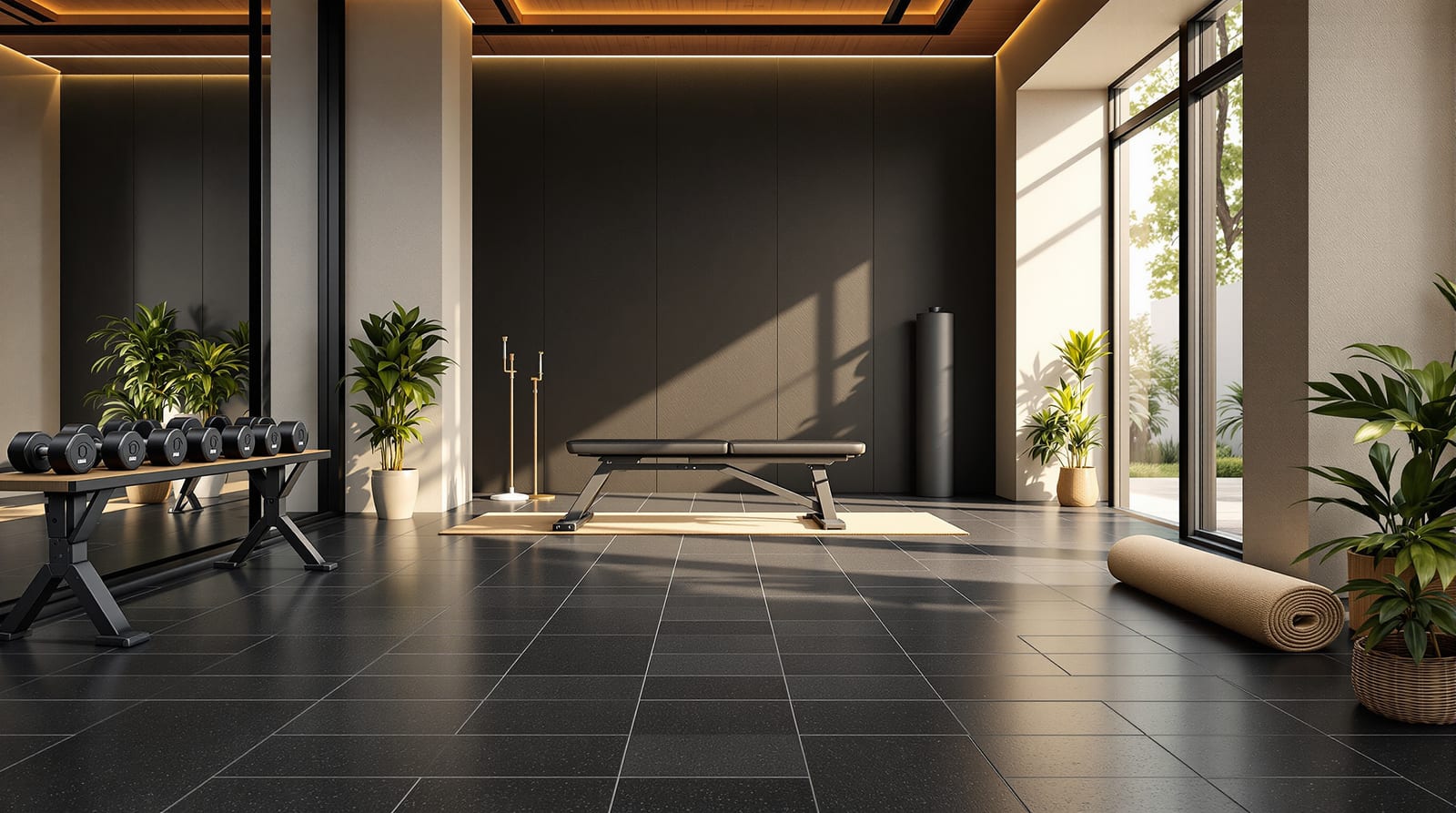
Home Gym Flooring in India: Best Floors to Protect, Cushion and Grip (2026)
Rubber rolls and tiles, foam interlocking mats, vinyl/SPC for cardio and turf strips for sleds — thickness, ₹/sq ft and DIY guidance for an Indian home gym.
A home gym lives or dies on its floor. Bare vitrified tiles crack when a dumbbell slips, marble chips, a wood floor dents under a squat rack, and every dropped plate booms through the slab to the flat below. The right gym floor does four jobs at once: it protects the subfloor, cushions your joints, absorbs the impact of dropped weights, and grips so you do not skid mid-lunge — all while being quick to wipe down. This guide ranks the floors that work in an Indian home gym, the exact thickness for lifting versus cardio versus yoga, what to lay over your existing tile or slab, and what it costs per sq ft in 2026.
What a home gym floor actually has to survive
Before picking a material, map the demands of your space — a spare bedroom, a balcony, a terrace shed or a basement each behaves differently.
- Impact and point load. A 20 kg plate dropped from a deadlift lockout delivers a huge instantaneous force. The floor must spread and absorb it so neither the slab nor the dumbbell is damaged. This is the single demand that rules out most "pretty" floors.
- Joint cushion. Burpees, jumps, lunges and bodyweight circuits punish knees and wrists on a hard floor. A little give matters.
- Grip (slip resistance). Sweat plus a glossy tile equals an accident. You want a matte, high-friction surface even when damp.
- Subfloor protection. Most Indian home gyms sit on top of an existing finished floor — vitrified tile, granite, kota or an IPS slab. The gym layer is usually a removable, non-bonded protective skin so you do not destroy the original floor (important if you rent or may reconvert the room).
- Noise to neighbours. In an apartment, dropped weights transmit as structure-borne thud. Thicker rubber and a lifting platform are your only real defence — and a courtesy to the flat below.
- Easy clean and humidity. Indian sweat, monsoon damp and dust mean the floor must wipe down and not grow mould. Closed-cell materials win; open foam in a humid Mumbai or Chennai room can get funky.
For the deeper logic of matching floor to room, see the room-by-room flooring guide for India.
The contenders, ranked
1. Rubber rolls and tiles — the gold standard
Recycled-rubber rolls and interlocking rubber tiles are what commercial gyms use, and for good reason: they shrug off dropped weights, grip when wet, deaden noise and protect whatever is underneath. Tiles (typically 1m x 1m interlocking, or heavy 500 x 500 mm) are the DIY-friendly choice — you can lift and re-lay them, and replace a damaged one. Rolls (1.2-1.5m wide) give a near-seamless surface with fewer joints for sweat to seep into, but are heavy and need two people. Thickness is everything: 6-10mm for general training and machines, 15mm for free weights, and 20-25mm (or a dedicated platform) under a power rack where you drop loaded barbells. Go for EPDM-speckled or solid black; the cheap crumb-rubber smell fades in a week with ventilation. This is the all-rounder most home gyms should build around — read the full rubber flooring guide for India and size a job with the rubber flooring calculator.
2. Foam / EVA interlocking mats — cheap, light, DIY
EVA foam interlocking tiles (the jigsaw "puzzle mats", usually 600 x 600mm at 10-25mm) are the entry point: featherweight, soft underfoot, dirt cheap, and you click them together yourself in an afternoon. They are perfect for yoga, stretching, bodyweight, kids' play and light dumbbell work. What they are NOT good for: heavy weights. A dropped plate dents or splits foam, and a loaded rack leg sinks in and tips. Treat foam as a comfort layer for a low-impact zone, not a lifting surface. Compare options and density in the foam interlocking tiles guide for India.
3. Vinyl / SPC — the cardio-zone floor
Under a treadmill, cross-trainer, spin bike or rowing machine you do not need impact absorption — you need a hard, stable, easy-to-clean, attractive surface that machine feet sit flat on. A rigid-core SPC click floor or sheet/LVT vinyl is ideal here: warm-looking, water-resistant, sweat-wipes-off, and far kinder on the eye than black rubber across a whole room. Many home gyms run vinyl/SPC as the base floor for the cardio and "studio" half, with rubber tiles dropped on top only in the free-weight corner. See SPC flooring for India and the broader vinyl flooring guide.
4. Turf strip — for sled pushes and functional drags
A 1-1.5m wide artificial-turf strip down one side gives you a surface for sled pushes/drags, prowler work, bear crawls and plyometrics, and protects the floor from the abrasion those movements cause. It is a niche add-on, not a whole-floor solution — lay it as a lane beside your rubber. This sits in the family of purpose-built sports flooring systems used in India.
Activity to floor to thickness — quick recommendation
The biggest mistake is one floor everywhere. Zone your room by activity and match the floor and thickness to each zone.
| Activity / zone | Recommended floor | Thickness | Why |
|---|---|---|---|
| Heavy free weights, deadlifts, power rack | Rubber rolls/tiles, or a lifting platform | 15-25mm (or platform) | Absorbs dropped plates, protects slab, cuts noise to neighbours |
| General strength, dumbbells, machines | Rubber rolls/tiles | 8-12mm | Good impact + grip without over-spending |
| Cardio (treadmill, bike, rower, cross-trainer) | Vinyl / SPC base | 4-6mm | Hard, flat, stable under machine feet; easy to clean |
| HIIT, jumps, functional | Rubber tiles | 10-15mm | Cushions landings, grips through sweat |
| Yoga, stretch, mobility, kids | EVA foam interlocking | 15-25mm | Soft, warm, cheap, DIY; not for weights |
| Sled / prowler / drags | Turf strip (over rubber) | turf + 8mm | Glide surface + abrasion protection |
What to lay it over (subfloor)
Almost any sound Indian floor works as a base, because the gym layer floats on top:
- Vitrified tile, granite, kota, IPS, polished concrete — all fine and stable. Just make sure the surface is level, clean and dry. Rubber and foam go straight on top, non-bonded, so the original floor is preserved. See polished concrete flooring if you are finishing a raw basement or shed slab as the base.
- Wooden or laminate floor — protect it with a moisture barrier and a continuous mat; do not drop weights directly even with rubber over a thin laminate. A heavy platform spreads the load.
- Raw RCC slab (terrace shed, basement) — power-float or screed it level first, or pour a thin self-levelling layer, then lay rubber. An uneven slab makes tiles rock and machines wobble.
- Terrace / balcony gym — keep the existing waterproofing intact; use interlocking rubber tiles you can lift to inspect drainage, and check our monsoon-ready flooring guide for damp-prone areas.
A 2-3mm closed-cell underlay or a vapour sheet under rubber over any tiled floor adds a little extra acoustic and moisture buffer.
Cost in India (2026, indicative ₹/sq ft, supplied + laid)
| Floor | ₹/sq ft | Best for | DIY? |
|---|---|---|---|
| EVA foam interlocking (10-25mm) | 35-120 | Yoga, light, kids | Yes — click together |
| Rubber tiles, interlocking (8-15mm) | 120-300 | General + free weights | Yes — modular |
| Rubber rolls (6-15mm) | 130-350 | Seamless main floor | Two-person job |
| Heavy rubber / platform (20-25mm) | 280-450 | Drop zone under rack | Partly — heavy |
| Vinyl / SPC (cardio base) | 90-300 | Treadmill / studio half | SPC click = yes |
| Artificial turf strip | 90-220 | Sled / functional lane | Yes |
Costs move with rubber density (EPDM-speckled costs more than plain crumb), thickness and city. For a full breakdown across materials see the flooring cost per square foot guide for India. A typical 120 sq ft spare-room gym — rubber drop zone + vinyl cardio half + a foam yoga corner — lands around ₹18,000-35,000 in flooring, comfortably DIY over a weekend.
If you are kitting out a full commercial-grade or society fitness room rather than a home corner, the demands (continuous footfall, liability, fixed platforms) shift — see the gym and fitness centre flooring guide for India.
Design and DIY tips
- Buy 10% extra rubber tiles for edge cuts and future replacements; dye-lots vary.
- Acclimatise and ventilate. Unroll rubber and run a fan for a few days; the initial smell off-gasses and fades.
- Build a lifting platform (two layers of ply topped with rubber, hardwood strip in the centre) if you deadlift heavy — it spreads load, saves your slab and dramatically cuts the boom to neighbours.
- Mind ceiling height in lofts and lifts: thick foam plus a tall person plus an overhead press needs headroom.
- Keep cardio on hard floor. Treadmills "walk" and rock on soft foam — they need a flat, firm base.
- Use double-sided tape or interlock edges so tiles do not creep during burpees.
Do and don't
- Do put the thickest rubber where weights actually land, not uniformly everywhere.
- Do keep the floor matte and wipeable; sweat on gloss is a fall risk.
- Don't drop loaded barbells on bare tile, foam or laminate — you will crack the floor, the foam or both.
- Don't use open-cell carpet/foam in humid coastal rooms; it traps sweat and grows mould.
- Don't glue rubber permanently to a rented or premium floor — keep it liftable.
Care and cleaning
Sweep or vacuum grit weekly so it does not abrade the surface. Mop rubber and vinyl with a mild pH-neutral cleaner and water — avoid harsh solvents and oil-based cleaners, which degrade rubber. Dry promptly in monsoon. Lift interlocking tiles a couple of times a year to clear dust and check the floor beneath for trapped moisture. Our floor cleaning guide for India covers safe products for each surface.
Frequently asked questions
What thickness of rubber flooring do I need for a home gym?
For general training and machines, 8-12mm is plenty. For free weights and the area where you drop dumbbells, go 15mm. Under a power rack where you drop a loaded barbell, use 20-25mm or build a dedicated lifting platform. Cardio zones need no cushion — a hard 4-6mm vinyl/SPC base is better there.
Is rubber or foam flooring better for a home gym?
Rubber for anything involving weights — it absorbs impact, protects the floor and grips when sweaty. EVA foam is cheaper, lighter and softer, but it dents and splits under heavy weights, so reserve it for yoga, stretching, bodyweight and kids. Many home gyms use both: rubber in the lifting corner, foam in the yoga corner.
Will a home gym damage my existing tile or wood floor?
Not if you protect it. A non-bonded rubber layer (15mm+ in the drop zone, or a lifting platform) shields vitrified tile, granite or wood from dropped weights and rack-leg point loads. Never drop barbells onto bare or thinly covered floors. Keep the gym layer removable so the original floor stays intact.
How do I reduce the noise to the flat below my apartment gym?
Use thicker, denser rubber (20-25mm) under the drop zone, add a closed-cell acoustic underlay beneath it, and build a plywood-and-rubber lifting platform that spreads the load. Avoid dropping weights altogether where you can — lower them under control. These steps cut structure-borne thud far more than thin mats alone.
Can I install home gym flooring myself?
Yes — this is one of the most DIY-friendly floors. EVA foam and interlocking rubber tiles simply click together over a clean, level floor; budget a weekend for a spare room. Rubber rolls are heavy and want two people. Only a poured screed or a permanently bonded floor needs a contractor.
Export this guide
Related Guides — Deep-dive reading
Gym Flooring India: Commercial Fitness-Centre Floors by Zone, with Thickness and Costs
How to floor a commercial gym in India zone by zone — heavy rubber for free-weights and drop zones, vinyl or rubber rolls for cardio, artificial turf for the functional lane, sprung wood or cushioned vinyl for the studio, cork or foam for yoga, and anti-slip vitrified or LVT for reception and lockers — with thickness, impact, noise, grip, hygiene and ₹/sq ft for each.
Flooring & SurfacesEngineered Wood Flooring in India: Layers, Wear Layer, Install & Cost (2026)
Engineered wood is a real-wood top veneer bonded over a cross-laminated plywood or HDF core, which makes it far more dimensionally stable than solid wood in Indian humidity — the practical way to get a genuine timber floor here. This guide covers the layer build-up, wear-layer thickness, click vs glue-down install, where it suits, ₹/sq ft, brands and maintenance.
Flooring & SurfacesComplete Home Flooring Guide for Indian Homes (2026)
The authoritative overview of every flooring family — tiles, stone, wood, vinyl and seamless — with India ₹/sq ft costs, room-by-room logic and laying basics.
Flooring & SurfacesRelated Tools — Try Free
Flooring Cost Calculator
Estimate the all-in cost of a floor — material, laying, wastage, skirting and GST — by area and material.
Flooring CalculatorMonsoon-Readiness Checklist
Pre-rain home audit across 9 categories — terrace, drains, waterproofing, electrical, HVAC, pest, vehicles, documents.
Seasonal AuditRubber Flooring Calculator
Estimate rubber flooring rolls, tiles or interlocking mats and cost for a gym, play area or utility space.
Flooring Calculator