
Layered Security Design: A Defence-in-Depth Guide for Indian Homes
Why no single lock, camera or wall is ever enough — and how concentric layers cover each other's failures. The five rings of a protected home, how each maps to Deter-Detect-Delay-Respond, designing redundancy, weakest-link thinking, and balancing physical, electronic and procedural measures across flats, villas and communities.
The single most expensive mistake in home security is believing that one good thing is enough. A heavy front door on a house with an open side window. A wall of cameras that nobody watches, guarding a gate left unlocked. A smart lock protecting a room whose window has no grille. Each of these is a genuine improvement, and each fails completely the moment an intruder simply walks around it.
The idea that fixes this is old, borrowed from castle-builders and later from military and industrial security: defence in depth, also called layered security. Rather than betting everything on one barrier, you arrange many modest barriers in series, so that defeating one only brings the intruder up against the next. This guide is the concept piece behind the ultimate guide to home security in India — it goes deeper into why layers work, how to arrange them, and how to keep them in balance, so that your plan is a system rather than a pile of gadgets.
Scope & safety. This guide helps you plan, decide and coordinate the shape of your defences. Fire and smoke detection and alarm, electronic access control and electric locks, mains electrical work, and structural elements (grilles, gates, safe rooms) are life-safety-critical — specify them, then have a licensed professional design, install and certify them, and never let any security fitting block a fire-escape route.
Why one layer is never enough
Every barrier has a failure mode. A lock can be forced. A camera can face the wrong way, or its recorder can be full, or the power can be out. A grille can be missing from one window. A guard can step away. An alarm can be ignored. None of this means the measure is bad — it means every measure is fallible, and a plan that depends on any single one inherits that one's weakest moment.
Layering answers fallibility with compensation: the layers are chosen so that the failure of one is caught by another. If the gate is somehow passed, the outdoor camera still records the approach. If the camera is missed, the door contact still trips the alarm. If the alarm is ignored, the bolted safe still protects what matters most. No layer has to be perfect, because it is not carrying the whole load alone.
There is a second, quieter benefit. Layers multiply, not add. If each of four independent layers has even a modest chance of stopping or exposing an intruder, the chance that all four fail together is small — which is why a home with a lit street, a locked gate, a grilled window, an interior sensor and a safe is disproportionately harder to victimise than the sum of its parts suggests.
The concentric layers of a protected home
Defence in depth becomes concrete when you draw it onto your actual home as concentric rings. An intruder approaching your valuables has to cross each one in turn, and each ring buys warning and delay for the ones inside it.
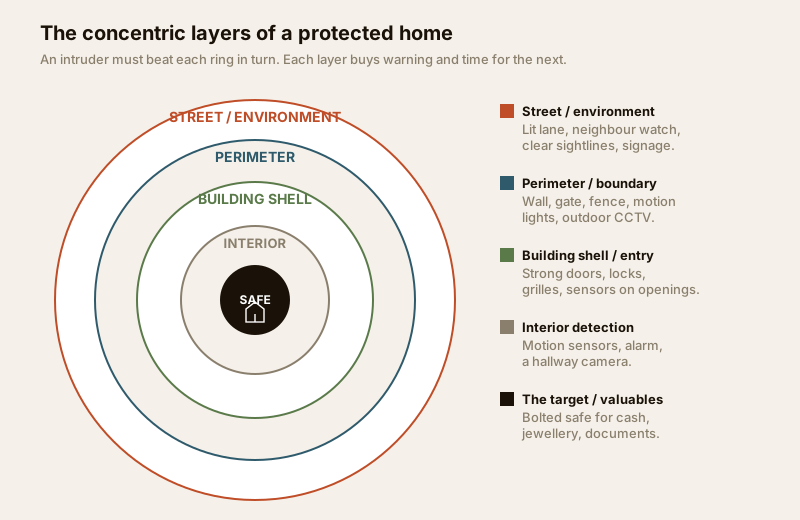
1. Street / environment — the public edge: the lane, the streetlight, the sightlines, the neighbours who would notice a stranger. You do not own this ring, but you influence it — a lit, overlooked, lived-in-looking frontage is deterrence you get almost for free.
2. Perimeter / boundary — the compound wall, gate, fence or hedge that marks where your property begins, plus its motion lighting and outdoor cameras. In a flat this belongs to the society; in a villa it is yours to own.
3. Building shell / entry points — every door, window, balcony, grille and skylight: the physical skin of the building where hardening does its work.
4. Interior detection — inside the shell: motion sensors, an alarm, a hallway camera, so that even a breach is caught quickly.
5. The target / valuables — the innermost ring: a bolted-down safe for jewellery, cash and documents, so that even a successful intruder leaves with little.
Which rings you personally own depends on your home. A standalone house owns all five; a flat effectively starts at ring 3 while the society runs the outer two — a distinction we return to below.
How each layer maps to the four D's
Layers describe where protection sits; the four D's — Deter, Detect, Delay, Respond — describe what each measure does. The two are not rivals; they are the warp and weft of the same cloth. A complete plan places a measure in most of the cells of the grid below, and reads the empty cells as gaps.
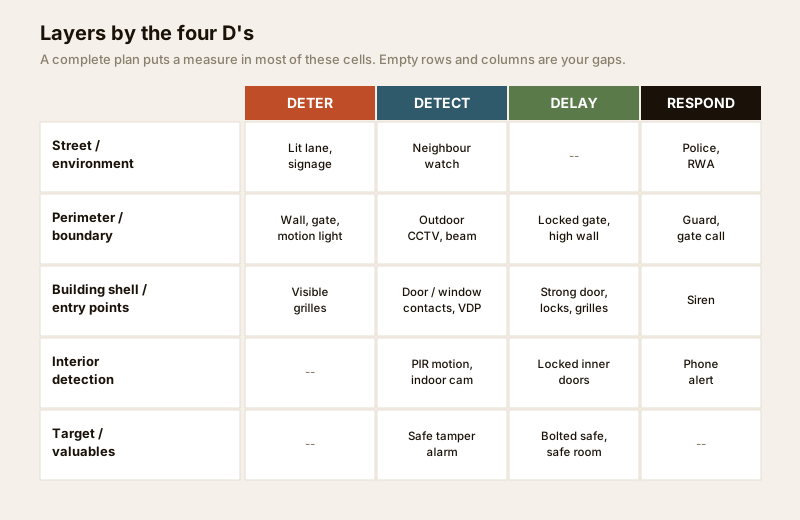
| Layer | Deter | Detect | Delay | Respond |
|---|---|---|---|---|
| Street / environment | Lit lane, visible signage, kept frontage | Alert neighbours, a watch group | — | Police, RWA on call |
| Perimeter / boundary | High wall, locked gate, motion lights | Outdoor CCTV, beam/fence sensor | Wall height, locked gate, no climbing aids | Guard, gate intercom |
| Building shell / entry | Visible grilles, a strong-looking door | Door/window contacts, video door phone | Solid door, mortise + deadbolt, grilles | Siren on breach |
| Interior detection | — | PIR motion sensors, indoor hallway camera | Locked internal doors | Phone alert to you |
| Target / valuables | — | Safe tamper alarm | Bolted fire-and-burglary safe, safe room | — |
Read the grid two ways. Down a column: if your whole "Respond" column is empty except one phone alert, a detection nobody acts on is wasted. Across a row: if the "Building shell" row has cameras (Detect) but a flimsy door (weak Delay), you will know you are being robbed without being able to slow it down. The Deter-Detect-Delay-Respond model is introduced in the master guide; here the point is that you want coverage across both dimensions — layers and D's.
Designing redundancy: catch the defeated layer
Redundancy is what makes depth more than decoration. The design goal is simple to state: arrange things so that when a layer fails, the next layer catches it — ideally the failure is not just stopped but revealed, so a response can begin.
A few practical patterns:
- Detect behind delay. Put a sensor inside every barrier that can be forced. A grille slows an intruder (Delay); a window contact or interior PIR behind it means the attempt also raises the alarm (Detect + Respond). The barrier buys time; the sensor makes sure someone uses it.
- Two unlike measures per critical point. For the main door, pair a physical measure (mortise lock plus deadbolt in a strong frame) with an electronic one (a video door phone so you never open to a stranger). Unlike measures rarely fail for the same reason.
- Independent power and paths. In a country of frequent power cuts, a system that dies with the mains is a single point of failure. Battery or UPS backup on cameras, alarm panels and gate systems keeps a layer alive when the grid drops. The electrical hub covers wiring and backup safely.
- Fallback at the core. The safe is the deliberate last redundancy — it assumes every outer layer might be beaten and still protects the few things that are truly irreplaceable.
Redundancy does not mean buying two of everything — it means no single failure, one dead camera or one forgotten lock, should hand an intruder a clean run to the centre.
Weakest-link thinking
Here is the uncomfortable truth that layered design forces you to confront: an intruder does not experience your average security — they experience your weakest link. They walk the perimeter, mentally, and take the easiest path in. A beautifully hardened front door is irrelevant if the dark side window has no grille.
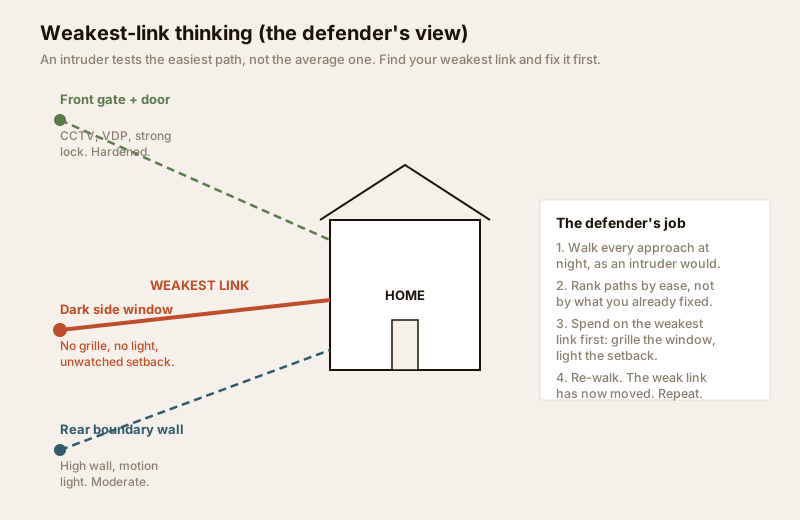
The defensive discipline is to think like the person choosing the path — purely to find and close it, never to exploit it:
1. Walk every approach at night, as an intruder would. Where is it dark? Which opening has no grille? Where can the boundary be climbed with a bin or a parked vehicle? Which door is habitually left on the latch?
2. Rank paths by ease, not by what you have already fixed. It is tempting to keep improving the door you are proud of. Discipline means spending on the path you have been avoiding.
3. Fix the weakest link first. Grille the window, light the setback, lock the gate. Cheap, high-impact fixes almost always beat another expensive camera.
4. Re-walk — the weak link has moved. Once the side window is grilled, the easiest path is now somewhere else. Security is iterative: you are always closing the current easiest path.
The home security risk scorecard turns this walk into a ranked list of gaps, and the security risk assessment guide sets out the full method. A structured risk assessment is simply weakest-link thinking done on paper before you spend.
Balancing the layers
The opposite failure of a weak link is a lopsided plan — pouring money into one layer while another stays open. The classic Indian example is a household with four cameras and a smart lock whose compound gate does not actually latch, or whose ground-floor window has no grille. Spending is emotional; balance is deliberate.
A quick balance check exposes the common lopsided setups. Find yours in the left column and read across.
| The lopsided setup | What is over-built | What is starved | The rebalancing move |
|---|---|---|---|
| "Camera collector" | 4-6 CCTV cameras, cloud plan | Locks, grilles, door strength (Delay); response plan | Fix the main door and window grilles before adding camera five |
| "Fortress door" | Steel security door, multiple locks | Windows, boundary, interior detection | Grille accessible windows; add one interior motion sensor |
| "Gadget home" | Smart lock, sensors, app alerts | Physical barriers; anyone actually responding | Agree who acts on an alert; harden the shell |
| "Wall and gate only" | 7-foot wall, heavy gate | Detection and response once the wall is passed | Add outdoor CCTV and a shell alarm behind the wall |
| "All procedure" | Great habits, neighbour watch | Physical and electronic layers for when habits slip | Add basic hardware so one forgotten lock is not fatal |
Balance is not about spending equally on every layer — the right split depends on your risks and which layers you own. It is about making sure no layer is left at zero while another is gold-plated. A modest presence in every ring beats a wall in one and a hole in the next.
How physical, electronic and procedural measures interlock
Cutting across the layers are three families of measure, and depth needs all three woven together:
- Physical — doors, locks, grilles, gates, walls, safes. These are the Delay backbone; they are also the most permanent and the least dependent on power or attention.
- Electronic — CCTV, video door phone, alarm, sensors, smart locks. These are the Detect layer and part of Deter; they turn a silent intrusion into a known event and carry the alert outward.
- Procedural — locking habits, key discipline, absence management, neighbour and RWA coordination. The cheapest and most-neglected family, and the one that decides whether the other two are actually used.
The families interlock within each ring. At the perimeter, a wall (physical) plus a camera (electronic) plus a guard's visitor log (procedural) is far stronger than any one alone. At the shell, a grille (physical) plus a window contact (electronic) plus a nightly lock-up routine (procedural) closes the gap that each would leave open by itself. A plan that is all-physical is deaf; all-electronic is brittle; all-procedural collapses the first tired evening someone forgets. Weaving the three across every layer is what turns depth into resilience.
Applying the model to your home
The layered model is universal, but which layers you own changes with your home type — and getting that boundary right is half the battle.
- Flats and apartments. The society or RWA owns the outer rings — the boundary, the main gate, the guards, much of the grounds and common-area CCTV. Your personal defence effectively begins at ring 3, your front door, plus your balcony and windows. Your leverage on the outer layers is coordination, not construction: push the RWA on gate discipline, visitor logs and working cameras. See the security guide for apartments.
- Villas and independent houses. You own all five rings and must consciously plan each — the boundary wall and gate, the grounds and lighting, the shell, interior detection and the safe. The freedom is total and so is the responsibility; nothing is somebody else's job. See the security guide for villas and independent houses.
- Gated communities. Here the outer layers are a shared asset — perimeter, entry gates, patrols and command centre are run collectively, and your job is to both use them well and secure your own unit behind them. See the security guide for gated communities.
Whichever you are, name the rings you own, then apply the same discipline inside them: fill the four-D grid, build redundancy, fix the weakest link, keep the layers balanced.
When to bring in a professional
You can plan the shape of your layered defence yourself — the rings, the balance, the priorities. But hand the following to licensed professionals to design, install and certify:
- Fire and smoke detection and alarm — life-safety-critical; design and commissioning per the National Building Code fire and life-safety provisions and local municipal bye-laws. No security layer may ever obstruct a fire-escape route.
- Electronic access control and electric locks — poorly installed electric locks can trap people during a fire; specify, then use a competent installer.
- Mains electrical work — cameras, gates, alarms and backup power need proper wiring; use a licensed electrician (see the electrical hub).
- Structural perimeter and safe rooms — grilles, security gates and safe rooms must be anchored, correctly detailed and fire-escapable; work to a proper detail with a competent fabricator, and cross-check the structural safety guide and building regulations and compliance.
Your job is to set the brief and coordinate the layers; theirs is to make each one safe, code-compliant and reliable.
Key takeaways
- No single measure is enough. Every barrier has a failure mode; layers work by compensating for each other, so no one failure gives a clean run to the centre.
- Map both dimensions. Draw your home as five concentric rings, and fill the Deter-Detect-Delay-Respond grid for each — empty cells are your gaps.
- Design redundancy. Put detection behind every delay, pair unlike measures at critical points, back up power, and treat the safe as the deliberate last resort.
- Fix your weakest link first. An intruder takes the easiest path — walk your home at night, rank paths by ease, close the easiest, then re-walk.
- Keep the layers balanced and interlocked. Never leave a ring at zero while another is gold-plated, and weave physical, electronic and procedural measures across every layer.
- Own the right rings for your home — front door in a flat, all five in a villa, the shared perimeter in a gated community — and route life-safety work to professionals.
Where to go next
- Start here: The Ultimate Guide to Home Security in India and the Security Knowledge Hub.
- Find your weakest link: Security Risk Assessment Guide and the risk scorecard tool.
- Apply it to your home type: apartments, villas and independent houses, or gated communities.
- Related: Building Security Systems Guide, or browse all guides.
References
- National Building Code of India (SP 7), Bureau of Indian Standards — fire and life-safety provisions relevant to alarms, egress and safe rooms; verify the current edition via the BIS catalogue.
- Local municipal building bye-laws and housing society bye-laws — govern boundary walls, gates, and CCTV in common areas; check your city and society rules.
- Local police station and residents' welfare association (RWA) guidance on neighbourhood watch, visitor logs and verified staff.
This is an educational overview for planning and decision-making. Fire and smoke detection and alarm, electronic access control, mains electrical work and structural perimeter elements are qualified professional work — engage licensed professionals for design, installation and certification, and verify any standard's current status via the BIS catalogue before relying on it.
Export this guide
Related Guides — Deep-dive reading
The Ultimate Guide to Home Security in India
The one guide that makes home security make sense — why it matters here, the Deter-Detect-Delay-Respond mental model, the five layers of a protected home, the physical, electronic and procedural measures, and a tiered budget to start from. Plain language, India-grounded.
SecuritySecurity for People Living Alone in India (2026): Calm, Practical Habits When There Is No Second Person to Notice
Living alone is an ordinary and growing part of Indian life - the student in a new city, the working single, the elder whose children are abroad, the person after a separation. It does not call for fear. It calls for a few deliberate habits, because there is no second person in the home to notice trouble, raise the alarm, or catch an accident. This is calm self-reliance, layer by layer.
SecuritySecurity Guide for Villas and Independent Houses in India
Securing a standalone house where the entire perimeter and every entry point is yours to own. The layered Deter-Detect-Delay-Respond model applied to a full villa: boundary wall and gate, garden and approach, ground-floor and upper doors and windows, terrace and garage, service entries, domestic help, and the empty-house problem.
SecurityRelated Tools — Try Free
Home Security Risk Scorecard
Score your home across six security layers — perimeter, entry points, lighting, detection, alarm and habits — and get a prioritised action plan.
Security ScorecardSecurity Backup Power Calculator
Size a UPS/inverter and battery to keep CCTV, NVR, router and alarm running through a power cut — load, Ah, VA and cost.
Backup PowerAccess-Control Battery-Backup Calculator
Size the standby battery so an access system keeps running through a power cut, with an egress life-safety note.
Battery Backup