
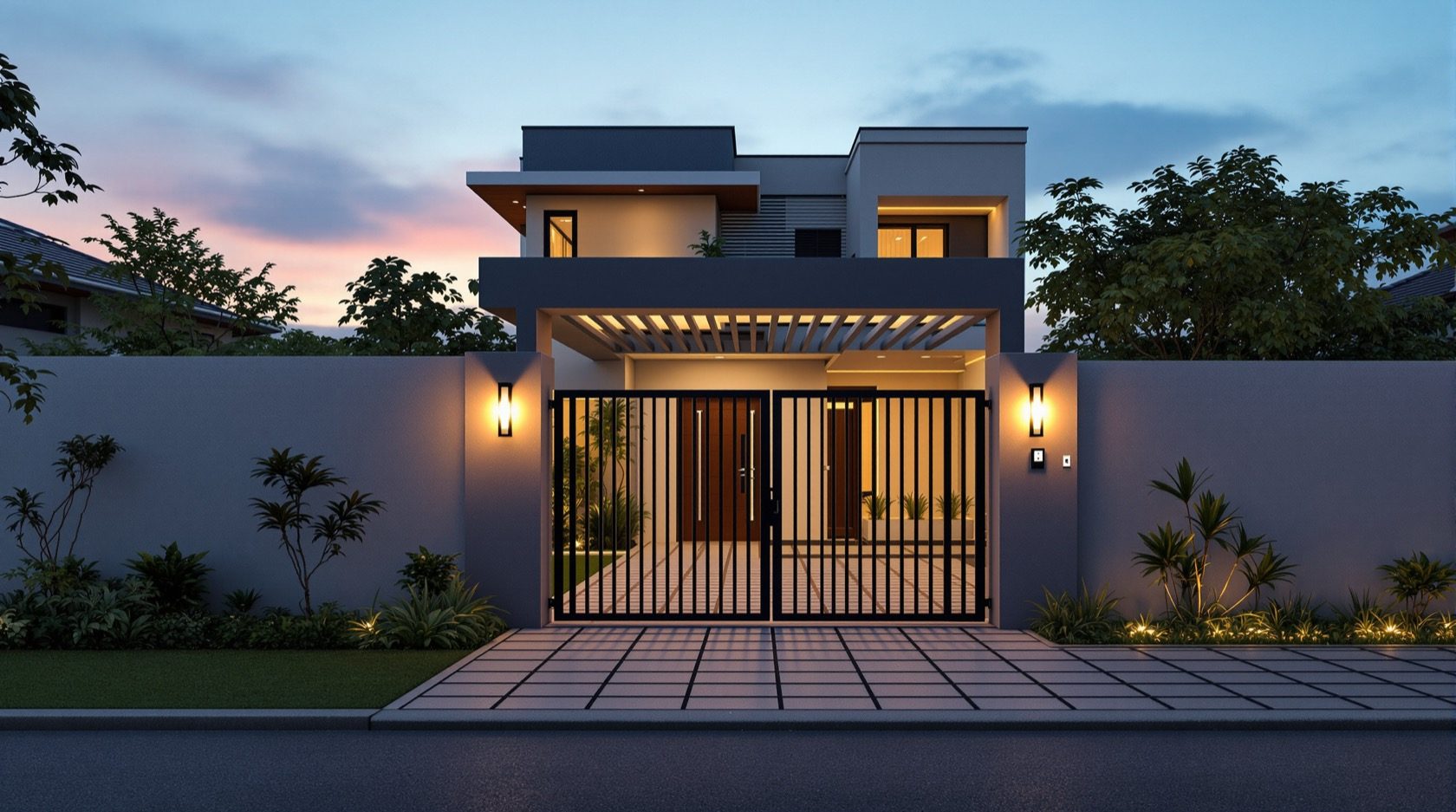
Security Guide for Villas and Independent Houses in India
Securing a standalone house where the entire perimeter and every entry point is yours to own. The layered Deter-Detect-Delay-Respond model applied to a full villa: boundary wall and gate, garden and approach, ground-floor and upper doors and windows, terrace and garage, service entries, domestic help, and the empty-house problem.
A flat hands most of its outer defences to somebody else. The society runs the boundary, the gate and the guard; your responsibility begins at your own front door. A villa or independent house is the opposite — every metre of the compound wall, every window on every floor, the terrace, the garage, the back lane and the empty afternoons are all yours to plan for. That is more freedom and more surface to defend, and it is why a standalone home needs a deliberate, layered plan rather than a lock bought in a hurry.
This guide takes the general principles from the ultimate guide to home security in India and makes them specific to a full house on its own plot. It will help you assess where your house is weak, plan its defences in layers, choose the right systems, and coordinate the fabricators, electricians and neighbours who make it hold — and it will tell you clearly which decisions are yours and which belong to a licensed professional.
Scope & safety. This guide helps you plan, decide and coordinate. Fire detection and alarm, electronic access control and electric locks, mains electrical work, and structural perimeter elements (grilles, gates, terrace doors, safe rooms) are life-safety-critical: specify them, then have a licensed professional design, install and certify them. Security hardware must never compromise a fire escape — every floor needs a way out. Nothing here replaces a site-specific assessment.
Why a standalone house is different
The intruder's logic does not change between a flat and a villa — most break-ins are opportunistic, and the job of security is to make yours the hard house on the street. What changes is how much of the problem is yours.
- You own the whole perimeter. A compound wall that is low, un-topped or backed by a dark setback is an open invitation, and there is no society guard patrolling it.
- You have far more entry points. Multiple ground-floor doors and windows, a back or kitchen door, balconies, first-floor windows reachable from the boundary wall, a terrace, skylights, and a garage — each is a door an opportunist can try.
- The house is often visibly alone. No shared lobby, no neighbours across a landing. When the family travels for a festival or a second home sits shut for weeks, the emptiness is obvious from the street.
- Approaches are yours to light and watch. The driveway, the garden, the side setbacks and the service lane are all on your plot — and all dark and unwatched unless you plan otherwise.
Indian conditions sharpen each of these. Power cuts can blind a system without backup. Dust and monsoon shorten the life of cheap outdoor cameras and locks, so outdoor-rated hardware matters. And a house set back behind a wall gives an intruder cover once they are inside the gate — which is exactly why the layers behind the wall matter as much as the wall itself. Score your own weak points first with the home security risk scorecard and the deeper method in the security risk assessment guide.
The four D's, applied to a whole house
Every good measure does one of four jobs — Deter, Detect, Delay, Respond — and a villa needs all four working from the boundary inward.
- Deter — a lit, well-kept, walled compound with a locked gate, visible cameras and a lived-in look. Most opportunists leave here.
- Detect — cameras you actually watch, a video door phone at the gate, and sensors that turn a silent entry into a known event.
- Delay — strong doors, good locks, grilles and a wall high enough not to be casually vaulted, buying minutes for the response.
- Respond — neighbours, a WhatsApp street group, the local police station, and a plan the household has rehearsed.
The whole point is that no single measure is enough. A great gate with a dark garden behind it, or a wall of cameras nobody monitors, each fails alone. The mental model, and how the physical, electronic and procedural families map onto these four jobs, is laid out in full in the ultimate guide to home security in India.
Map the layers onto your plot
Defence in depth becomes concrete when you draw it on your actual site. A standalone house owns all five concentric layers, and an intruder has to beat each in turn.
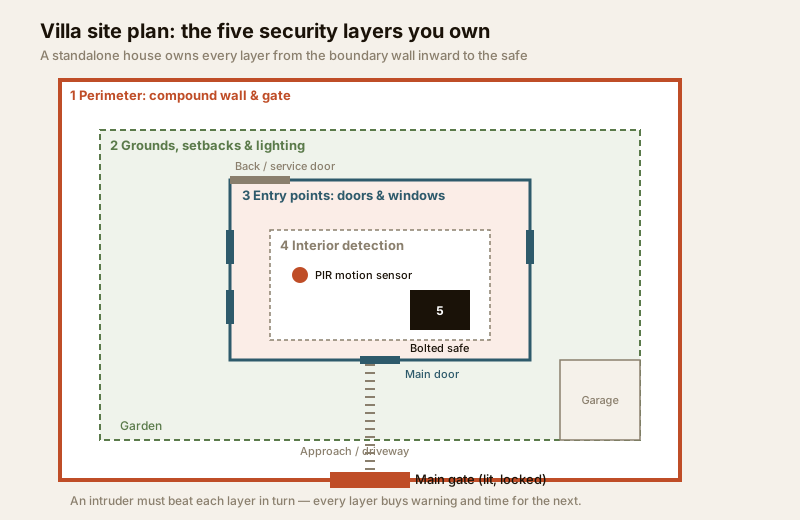
1. Perimeter — compound wall and gate. The wall high enough not to be vaulted, topped where bye-laws allow, with no climbing aids (bins, low sheds, parked scooters, tree limbs) left against it. The gate must actually lock, and a pedestrian wicket should not be a weaker point than the main leaf.
2. Grounds, setbacks and lighting. The driveway, garden and side setbacks kept clear of hiding spots, lit with motion floodlights, and watched by outdoor cameras. Dark side-setbacks are the classic villa blind spot.
3. Entry points — the shell. Every door and window on every floor: main door, back and kitchen doors, ground-floor windows, balconies, upper windows, terrace door and skylights.
4. Interior detection. PIR motion sensors, an alarm and a hallway camera inside the shell, so even a breach is caught quickly.
5. Valuables and safe. A fire-and-burglary safe bolted to the structure for jewellery, cash and papers.
Hardening every entry point, floor by floor
A villa's defining challenge is the number of entry points. The discipline is simple: count every one, and give each a measure. Miss one and you have handed an opportunist the easy way in.
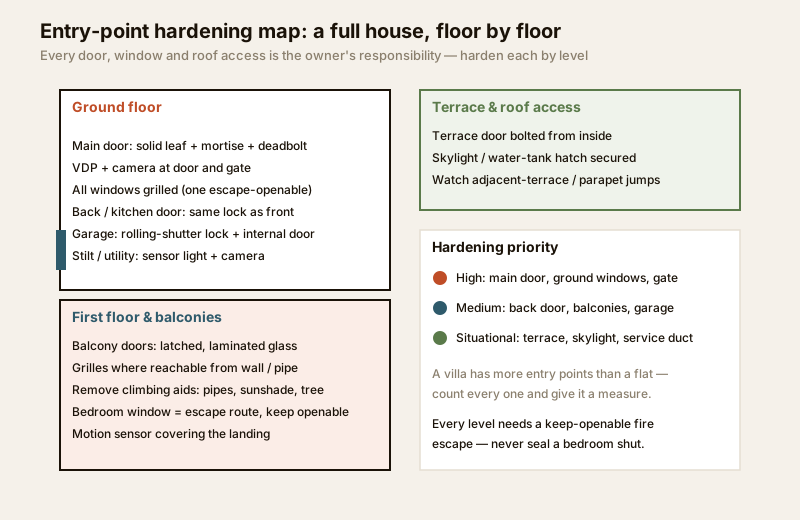
- The main door — a solid leaf (seasoned hardwood, engineered, or a certified steel security door) in a strong, well-anchored frame, with a mortise lock plus a deadbolt. The frame and hinges matter as much as the leaf. A video door phone lets you see who is there before opening.
- Back, kitchen and service doors — the most-forgotten weak point. Give them the same lock quality as the front. A flimsy rear door defeats a strong front one.
- Ground-floor windows — grilles on every accessible window, with at least one per floor designed as an escape-openable grille for fire safety.
- Balconies and first-floor windows — reachable from a boundary wall, a drainpipe, a sunshade ledge or a parked vehicle. Remove climbing aids, latch balcony doors, and grille the windows a determined climber could reach.
- Terrace and roof — the terrace door bolted from the inside, water-tank hatches and skylights secured, and an eye on jumps from an adjacent terrace or a shared parapet.
- Garage — a rolling shutter that locks, an internal connecting door treated as a real entry point, and a light and camera on the garage approach.
The threat below is ordered the way you should spend — highest impact first.
| Entry point | Typical villa risk | Priority | Recommended measure |
|---|---|---|---|
| Main door | Forced, or opened to a stranger | High | Solid leaf + anchored frame + mortise + deadbolt + VDP |
| Ground-floor windows | Un-grilled, facing dark setback | High | Grilles (one escape-openable per floor) |
| Compound wall & gate | Low, un-topped, climbing aids nearby | High | Height + locked gate + clear the base |
| Back / kitchen / service door | Weaker lock than the front | Medium | Match the main-door lock; sensor light |
| Balconies & first-floor windows | Reachable via wall, pipe, ledge | Medium | Remove climb aids; latch; grille reachable ones |
| Garage | Unlocked shutter, weak inner door | Medium | Shutter lock + internal door + camera |
| Terrace & skylight | Access from adjacent roof | Situational | Bolt terrace door inside; secure hatches |
Lighting and cameras for the whole plot
On a standalone plot, lighting is the cheapest security you can buy and cameras are only as good as their placement. Aim both at the ground an intruder must cross — the gate, the driveway, the approaches and every dark corner — not at open sky.
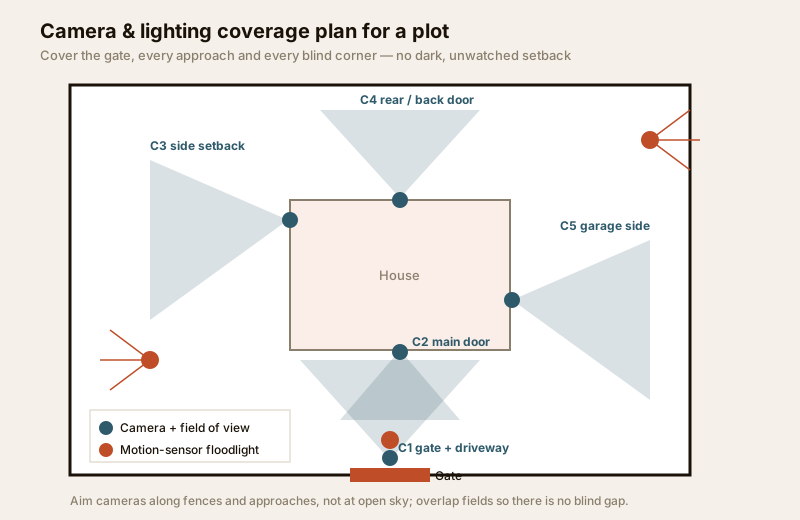
- Motion-sensor floodlights at the gate, along both setbacks, over the back door and at the garage — a light that snaps on as someone enters is both a deterrent and an alert.
- Cameras on the gate and driveway, the main door, each side setback, the rear/back door and the garage side, with fields of view that overlap so there is no blind gap. Feed them to a recorder (DVR/NVR) with enough storage and phone viewing.
- Backup — a UPS or battery so a power cut does not blind the system, which matters more for a house with no shared backup supply.
Coverage and placement beat megapixels every time. Scope how many cameras a plot your size needs, and where, with the CCTV camera coverage calculator before you buy. Where you want electronic gate access or intercom integration, the access control system designer and access control cost estimator help you scope it for a professional, and the wider connected layer is in the smart home guide.
People: domestic help and visitors
A villa runs on people coming and going — maids, cooks, gardeners, drivers, delivery and service staff. This is a procedural layer, and it is the cheapest and most-neglected one.
- Vet and record domestic staff — verify identity and references, keep a record, and register long-term help with the local police station where that facility exists.
- Control keys and access — no keys under the mat or in the meter box, limited copies, rekeying or revoking PIN/app access whenever staff change. A smart lock with an audit log tells you who came and went.
- A gate protocol — a video door phone so nobody is admitted unseen, and a simple household rule that deliveries and unknown visitors are verified before the gate opens.
- Never announce absence — do not broadcast travel plans, and brief household staff not to tell callers the family is away.
The empty-house problem
The single biggest risk multiplier for a villa is being obviously empty — for a festival, a holiday, or because it is a second home shut for weeks. An empty standalone house with an unlit garden and a piled-up gate is the easiest target on the street. The goal is to make an empty house look lived-in and watched.
- Make it look occupied — timers or smart plugs that turn lights on in the evening, and no visible signal that the house is shut.
- Clear the tells — hold or redirect newspapers and post, so nothing piles up at the gate.
- Appoint a keyholder — a trusted neighbour, relative or caretaker who checks the house, varies the signs of life, and can respond to an alert.
- Lean on the street — a neighbourhood or RWA WhatsApp group and a word to the local police station before a long absence.
- Watch remotely — cameras and an alarm with phone alerts so you know the moment something is wrong, wherever you are.
For a second home used only occasionally, treat monitored alarms and a paid caretaker as part of the plan, not a luxury.
A villa security package by budget
You do not need everything at once. Build a ladder — get the fundamentals right, then add depth. The ranges below are indicative all-India figures for a standalone house; they shift with plot size, brand, quality and installation.
| Tier | Typical spend | What it covers | Best for |
|---|---|---|---|
| Essential | Rs 40,000 - 1,00,000 | Strong main + back door locks, ground-floor grilles, a gate that locks, a video door phone, 3-4 entry cameras with recorder, motion floodlights at the dark corners, a bolted safe, and firm locking habits | Owned independent houses on a tight first phase |
| Standard | Rs 1,00,000 - 2,50,000 | Everything above, plus a 5-8 camera CCTV set covering the full perimeter, a smart lock with audit log, a wireless alarm with door/window contacts and indoor motion, UPS/battery backup, and light timers for absences | Most family villas |
| Comprehensive | Rs 2,50,000 - 6,00,000+ | Everything above, plus a monitored or integrated alarm, perimeter beams or fence sensors, analytics CCTV covering every approach, electronic gate access and intercom, and a professionally designed safe room | Large plots, second homes, high-value contents, higher-risk locations |
Each tier contains the one below. Do not skip Essential to buy an expensive camera — a costly camera on a flimsy back door is worse value than a good deadbolt on it.
When to bring in a professional
Plan and decide these yourself — but do not design, wire or certify them yourself:
- Fire detection and alarm — life-safety-critical; must be designed and commissioned per the National Building Code fire and life-safety provisions and local municipal bye-laws.
- Electronic access control and electric gate locks — poorly installed electric locks can trap people in a fire; specify, then use a licensed installer, and keep every floor's escape route openable.
- Mains electrical work — cameras, gates, floodlights and alarms need proper wiring; use a licensed electrician (see the electrical hub).
- Structural perimeter — compound walls, grilles, security gates, terrace doors and safe rooms must be anchored and fire-escapable; use a competent fabricator working to a proper detail (see structural safety), and check what your local building regulations and bye-laws allow for wall height and gate design.
Your job is to assess the risk, set the brief, choose the systems and coordinate the trades. Theirs is to make it safe, code-compliant and reliable.
Key takeaways
- A villa owns every layer — the whole perimeter and every entry point is yours, so plan from the compound wall inward, not just at the front door.
- Count every entry point — main, back, kitchen and garage doors, all windows on every floor, balconies, terrace and skylights — and give each one a measure.
- Light and watch the whole plot — motion floodlights on the dark corners and overlapping cameras on the gate, approaches and setbacks beat a single fancy camera.
- The empty house is the biggest risk — make it look lived-in, clear the tells, and appoint a keyholder before every long absence.
- Build a ladder — get the Essential fundamentals right, phase upward, and route life-safety work to licensed professionals. Start with the risk scorecard.
Where to go next
- Start with the master model: The Ultimate Guide to Home Security in India.
- Assess your own risk: Security Risk Assessment Guide and the risk scorecard tool.
- Building or buying new? Security Planning for New Homes.
- Retrofitting? Security Upgrades for Existing Homes.
- Living in a flat instead? Browse the Security Knowledge Hub or all guides.
References
- National Building Code of India (SP 7), Bureau of Indian Standards — fire and life-safety provisions relevant to alarms, egress and safe rooms; verify the current edition via the BIS catalogue.
- Local municipal building bye-laws — govern compound wall height, gates, and CCTV placement; check your city's rules before building or topping a boundary wall.
- Local police station guidance on domestic-staff verification and neighbourhood watch for standalone homes.
This is an educational overview for planning and decision-making. Fire detection and alarm, electronic access control, mains electrical work and structural perimeter elements are qualified professional work — engage licensed professionals for design, installation and certification, and verify any standard's current status via the BIS catalogue before relying on it.
Export this guide
Related Guides — Deep-dive reading
The Ultimate Guide to Home Security in India
The one guide that makes home security make sense — why it matters here, the Deter-Detect-Delay-Respond mental model, the five layers of a protected home, the physical, electronic and procedural measures, and a tiered budget to start from. Plain language, India-grounded.
SecurityEntry and Exit Assessment for Indian Homes
How to audit every way IN and OUT of your home or building — a complete inventory of doors, gates, windows, balconies and forgotten access points, rated for how easily each could be used to get in and how well it serves escape in an emergency, turned into a hardening priority list.
SecurityGate Security in India (2026): Making the Main Entrance the Strongest Point, Not the Weakest
The main gate is the one gap in every boundary and the number-one weak point of any perimeter — here is how to make the leaf, the access decision and the discipline around it as strong as the wall it sits in.
SecurityRelated Tools — Try Free
CCTV Camera Coverage & Count Calculator
Estimate how many CCTV cameras you need, the NVR channels, storage in TB for your retention period, and an indicative all-in cost with GST.
CCTV CalculatorHome Security Risk Scorecard
Score your home across six security layers — perimeter, entry points, lighting, detection, alarm and habits — and get a prioritised action plan.
Security ScorecardAccess-Control Battery-Backup Calculator
Size the standby battery so an access system keeps running through a power cut, with an egress life-safety note.
Battery Backup