
Microwave Sensors in India (2026): Radar Motion Detection Explained
How microwave (radar) motion sensors work, why they hold up in Indian heat where PIR struggles, the honest trade-offs, and how to place them well and pair them with PIR to avoid false alarms.
Most home motion sensors in India are PIR — passive infrared — and they work by sensing the heat a moving body gives off against a cooler background. That is a brilliant, cheap, low-power idea, right up until an Indian afternoon in May turns the whole room to forty-five degrees and a warm human body no longer stands out against a warm wall. When the heat contrast fades, a PIR sensor gets slower and less certain exactly when you might most want it alert.
Microwave sensors solve that problem from a completely different direction. Instead of passively reading heat, a microwave sensor is active: it emits a low-power, high-frequency radio signal — a microwave — into the room and listens for the echo. When the echo comes back changed, it knows something moved. Because it does not care about temperature at all, it keeps working when a PIR is squinting. This guide, part of Studio Matrx's burglar alarm hub, explains how radar detection works, where a microwave sensor genuinely earns its place, the honest trade-offs, and how to place and pair it so it protects rather than nags.
Scope & safety. This guide helps you understand, choose and place a motion sensor well — not defeat one. It describes how detection works so you can position a sensor for reliable coverage and few false alarms. Mounting at height, and any mains or panel wiring, is a licensed installer's job — see the electrical hub. Indoor motion sensing touches privacy: where a sensor "sees" and what an alarm system logs is personal data under the Digital Personal Data Protection Act, 2023. This is educational guidance, not legal advice.
How a microwave sensor actually detects movement
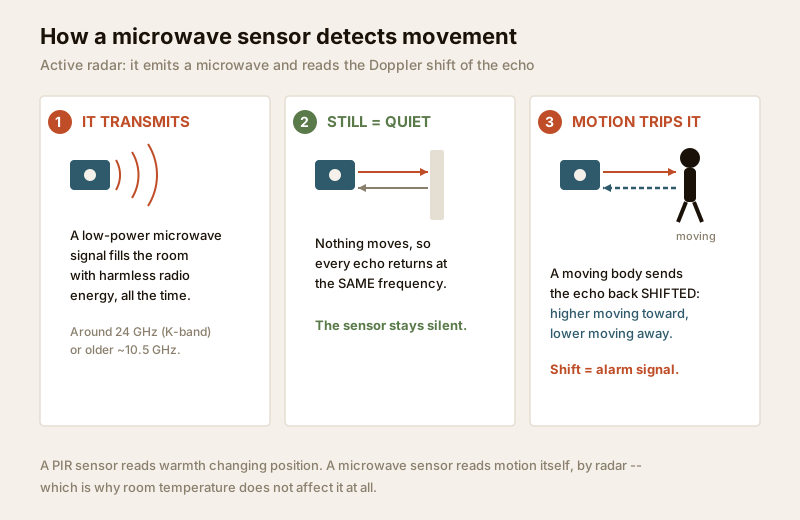
The physics is the same one that lets a traffic-police radar gun clock a speeding car, shrunk into a small plastic box on your wall. It rests on the Doppler effect: when a wave bounces off something that is moving toward or away from the source, the reflected wave comes back at a slightly different frequency.
Here is the sequence:
1. It transmits. A tiny antenna inside the sensor continuously emits a low-power microwave signal — commonly in the licence-exempt K-band around 24 GHz, or older units near 10.5 GHz — filling the room with an invisible, harmless field of radio energy.
2. The signal bounces. Those waves reflect off everything: walls, furniture, floor, and any person in the room.
3. It listens for a change. If the room is still, every echo returns at exactly the frequency it left at, and the sensor stays quiet. The moment a person moves, the waves bouncing off them return shifted in frequency — higher if they step toward the sensor, lower if they step away.
4. It decides. The sensor's electronics measure that frequency shift. A shift large enough, and lasting long enough, means a real moving body — and it signals the alarm panel.
That is the key mental model: a PIR sensor sees warmth changing position; a microwave sensor senses motion itself, by radar. One is passive and reads heat; the other is active and reads movement. That single difference explains every strength and every weakness that follows.
The emitted power is very low — far below a mobile phone's transmission and well within international safety limits for continuous exposure — so a domestic microwave sensor is not a health concern for the people living with it.
Where a microwave sensor beats PIR
If PIR is the sensible default for most Indian homes — and it is, for reasons of cost and power that the PIR sensors guide covers — then a microwave sensor is the specialist you reach for when PIR's weaknesses bite. Its advantages all flow from being active radar rather than a passive heat reader.
- It ignores temperature. This is the headline. A microwave sensor's performance does not sag in a hot room, so it holds up through a forty-five-degree Indian summer, near a kitchen, in a glass-fronted space that bakes in the sun, or in an un-airconditioned warehouse where a PIR would lose contrast. Where heat kills PIR reliability, microwave keeps working.
- Longer range and wider coverage. Radar energy carries further than a heat signature stands out, so a single microwave sensor can watch a larger volume — a long hall, a big open-plan floor, a godown — than a comparable PIR.
- It is not fooled by air, only by motion. A PIR can miss a very slow approach because the heat change is gradual; radar reads the movement directly.
- It can sense through thin non-metal materials. Microwaves pass through thin partitions, plywood, glass and plaster. Mounted cleverly, one sensor can cover more than its immediate line of sight.
That last point is a double-edged sword — the same ability to see through a thin wall is exactly what causes microwave's most famous problem, which we come to next. But used deliberately, in the right space, these strengths are real and worth paying for.
| Situation | Why microwave earns its place |
|---|---|
| Un-airconditioned rooms that hit 40C+ | PIR contrast collapses in heat; radar is unaffected |
| Large open halls, showrooms, godowns | One sensor covers a bigger volume than PIR |
| Glass-fronted or sun-baked spaces | Ambient heat that blinds PIR does not touch radar |
| Detecting slow, deliberate movement | Radar reads motion directly, not gradual heat change |
| Behind a thin non-metal panel (deliberate concealment) | Radar sees through it; use with care to avoid over-reach |
The honest trade-offs — read before you buy
A microwave-only sensor is not a straight upgrade over PIR, and any honest buying guide has to say why. These are the reasons a microwave sensor is almost never sold as the only detector in a room, and understanding them is what lets you place one well.
- It sees outside the room. Because microwaves pass through thin walls, glass and doors, a microwave-only sensor can register movement that is not actually inside the space you meant to protect — a person walking down the corridor, traffic on the road beyond a window, a delivery in the stairwell. To the sensor that is real motion, so it can raise a false alarm for something entirely harmless.
- It reacts to non-threats that move. A ceiling fan on full speed, a curtain lifting in an AC draft, water flowing, even heavy rain or foliage swaying beyond a thin wall can all produce a Doppler shift. In an Indian home full of fans and open windows, a badly aimed microwave sensor can become the boy who cried wolf.
- It draws more power. An active sensor is transmitting continuously, so it uses more electricity than a passive PIR. That matters for a battery-powered wireless sensor, where it shortens battery life, and it is one reason microwave is more common in mains-powered or hybrid installs.
- It costs more. The radar electronics make a microwave sensor pricier than an equivalent PIR — and, as we will see, the version you usually actually want costs a little more still.
None of these is a reason to avoid microwave; each is a reason to place it thoughtfully and, in almost every home, to pair it with PIR. False alarms are not a footnote — every false trip erodes the household's trust in the system until someone stops arming it, and an alarm nobody arms protects nothing. The motion sensors overview covers this trust problem across the whole sensor family.
The usual answer: pair it with PIR (dual-technology)
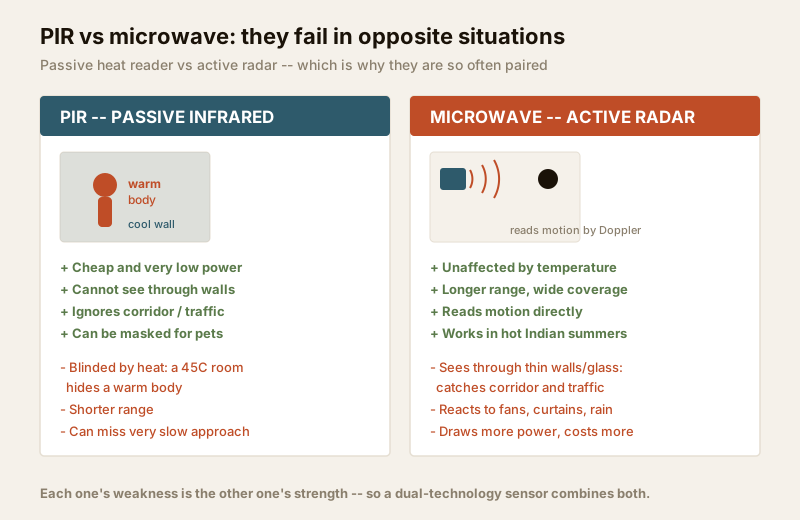
Look at the two lists side by side and something jumps out: PIR and microwave fail in opposite situations. PIR is blinded by heat but never sees through a wall; microwave ignores heat but sees through walls and reacts to fans. Each one's weakness is the other one's strength.
That is exactly why the most reliable motion sensors sold for homes and offices are dual-technology units that put a PIR and a microwave sensor in one housing and only raise the alarm when both agree there is a moving body. The corridor walker that fools the microwave gives off no heat inside the room, so the PIR stays quiet and the alarm holds. The warm sofa a PIR might misread does not move, so the microwave stays quiet. Requiring both greatly cuts false alarms while keeping real intruders caught.
The trade-off of "both must agree" is a slightly higher chance of missing something in the narrow band where one technology is genuinely struggling — but for the vast majority of Indian homes, far fewer false alarms is the better deal, because it keeps the system trusted and armed. The dual-technology sensors guide covers exactly how this "AND" logic works and when to choose it.
| You are protecting | Sensible choice |
|---|---|
| A normal room with fans, windows, AC | Dual-technology (PIR + microwave), or PIR alone if simple |
| A hot, un-airconditioned space where PIR fades | Dual-technology, or microwave with careful aiming |
| A large open hall or showroom | Dual-technology for the wide-area coverage without the false alarms |
| A home with a cat or dog | Pet-immune PIR, or dual-tech with pet tolerance — see below |
| Tightest possible false-alarm control | Dual-technology, every time |
For homes with pets, note that microwave radar will happily detect an animal moving just as it detects a person — it has no easy way to tell them apart by size the way a masked PIR lens can. That makes a plain microwave sensor a poor choice around a free-roaming cat or dog; the pet-friendly motion sensors guide explains the pet-immune PIR and dual-tech options that suit an Indian home with animals.
Placing a microwave sensor so it protects, not nags
Good placement is where a microwave sensor's whole reputation is won or lost. Because it sees through thin materials and has long range, careless mounting is what produces the corridor-and-traffic false alarms — and careful mounting is what prevents them. The goal is simple: fill the room you mean to protect, and keep the sensor's attention off everything beyond it.
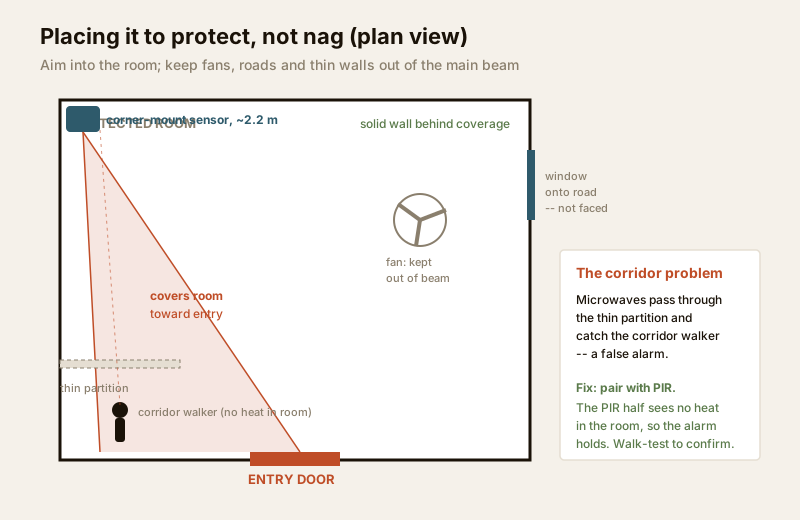
- Point it into the room, away from thin outside walls and windows. Aim the sensor so its main field looks across the interior toward the likely entry point, with a solid interior wall or the far masonry wall behind the coverage — not a thin partition, a glass front, or a window onto a busy road, where it would keep reading outside movement.
- Mind what is behind the wall it faces. A corridor, a shared stairwell, or the neighbour's active room on the far side of a thin partition are all things a microwave can pick up. Where you cannot avoid facing one, a dual-technology sensor is the honest fix, because the PIR half will refuse to confirm heat that is not in your room.
- Keep ceiling fans and AC vents out of the main beam. A fan running at full speed is constant motion. Angle the sensor so a fan or a billowing curtain is not sitting squarely in its most sensitive zone.
- Corner-mount at the recommended height. As with PIR, a corner mount at roughly two to two-and-a-half metres, tilted down to cover the room, usually gives the best whole-room coverage. Follow the specific model's datasheet for range and mounting height.
- Match sensitivity and range to the room. Most sensors let the installer tune sensitivity or range. Turning a big sensor's range down to suit a small room is one of the simplest ways to stop it reaching through the far wall.
Height mounting and any wiring back to the panel belong to your installer, but the decision of which room, which corner, and which way it faces is yours to make well — and it is the single biggest factor in whether the sensor becomes trusted or resented.
Buying notes for an Indian home
- You will rarely buy a bare microwave sensor. For a home, the practical purchase is a dual-technology PIR+microwave unit; standalone microwave detectors are more of an industrial or large-area product. Ask the installer specifically for dual-tech if a room needs microwave's heat-immunity.
- Check the frequency band and range on the datasheet, and match the range to the room rather than buying the longest-reaching unit you can.
- Mains or wired power suits it best. Microwave's higher draw makes it a natural fit for the wired and hybrid systems in the wired alarms and hybrid systems guides; on a wireless battery sensor, expect shorter battery life and check the maker's stated figure.
- Confirm pet behaviour if you have animals — a plain microwave unit will detect them.
- Layer it, do not rely on it alone. A motion sensor is the inner catch of a layered system that starts at the perimeter and the openings; the complete burglar alarm guide and the burglar alarm system selector help you see where motion detection sits alongside door and window contacts.
When to bring in a professional. You can and should decide the sensor type per room, the corner it mounts in, and which way it faces — that is exactly the planning this guide is for. Hand the actual mounting at height, the aiming-and-sensitivity commissioning walk-test, and every bit of mains or panel wiring to a licensed installer or electrician; see the electrical hub. Ask them to walk-test each sensor after fitting so you both see its real coverage and confirm it does not trip on the corridor, the fan or the road. For a whole-home design, the motion sensors overview and the burglar alarm hub tie the sensors into a complete system.
Key takeaways
- Microwave sensors are active radar: they emit a low-power microwave and read the Doppler frequency shift of the echo when something moves — sensing motion directly, unlike a PIR that passively reads heat.
- They shine where PIR fades — in Indian heat above forty degrees, in large open or glass-fronted spaces, and over longer ranges — because temperature does not affect radar at all.
- Their honest weakness is over-reach: microwaves pass through thin walls and glass, so a microwave-only sensor can false-alarm on a corridor walker, passing traffic, a fan or a curtain — a placement and pairing consideration, solved by aiming into the room and pairing with PIR.
- Dual-technology (PIR + microwave) is the usual answer — requiring both to agree cancels each one's false alarms and is the most reliable choice for almost every Indian home; see the dual-technology sensors guide.
- Placement decides everything: face it into the room away from thin outer walls, keep fans and window-onto-road views out of the main beam, match range to the room, and walk-test after install; plain microwave is a poor fit around free-roaming pets.
References
- Manufacturer datasheets (e.g. Honeywell, Bosch, Hikvision/Ajax dual-technology detectors) — verify the microwave frequency band (typically ~24 GHz K-band or ~10.5 GHz), detection range, mounting height and pet-tolerance on the maker's own specification sheet before ordering.
- Digital Personal Data Protection Act, 2023 — indoor motion sensing and the events an alarm system logs are personal data; place sensors and retain logs mindful of household members' and visitors' privacy.
- International radio-frequency exposure guidance (ICNIRP) — domestic microwave motion sensors transmit at very low power, well within continuous-exposure limits; consult the device datasheet for its stated output.
- National Building Code of India (SP 7), Bureau of Indian Standards, and local bye-laws for the electrical aspects of a mains-connected install; verify the current edition via the BIS catalogue: https://www.services.bis.gov.in/
This is an educational overview, not legal advice. Mounting at height, sensor commissioning and any mains or panel wiring are qualified professional tasks — engage licensed installers and verify any standard's current status via the BIS catalogue before relying on it.
Export this guide
Related Guides — Deep-dive reading
PIR vs Microwave Sensor (2026): Which Motion Sensor for Indian Homes?
A neutral head-to-head between passive-infrared (PIR) and microwave (radar) motion sensors for intruder detection in an Indian home — how each detects, where each false-triggers, how they cover a room, and why their opposite weaknesses make dual-technology the honest best-of-both.
SecurityFalse Alarm Prevention for Burglar Alarms in India: Causes & Fixes (2026)
Why home alarms cry wolf — ceiling fans, pets, heat, insects, weak batteries, power blips and poor door alignment — and how correct placement, the right sensors and simple upkeep keep the system trusted and armed.
SecurityDual-Technology Sensors in India (2026): PIR + Microwave, Fewer False Alarms
How dual-technology motion sensors combine a PIR and a microwave detector in one unit and only trigger when BOTH agree, cutting the false alarms that make Indian homeowners give up and stop arming the system.
SecurityRelated Tools — Try Free
Cross-Ventilation Analyzer
Estimate airflow and air changes per hour (ACH) from room size, window areas, layout, and local wind — with NBC 2016 Part 8 compliance check.
Ventilation CalculatorBurglar Alarm System Selector
Answer a few questions about your property, cabling, coverage, monitoring and power and get the right burglar alarm — wired / wireless / hybrid, self or professionally monitored — with the design non-negotiables.
Alarm SelectorWindow Treatment Selector
Curtains, blinds or a layered system? Answer five questions about your room and get a specific recommendation.
Selector