
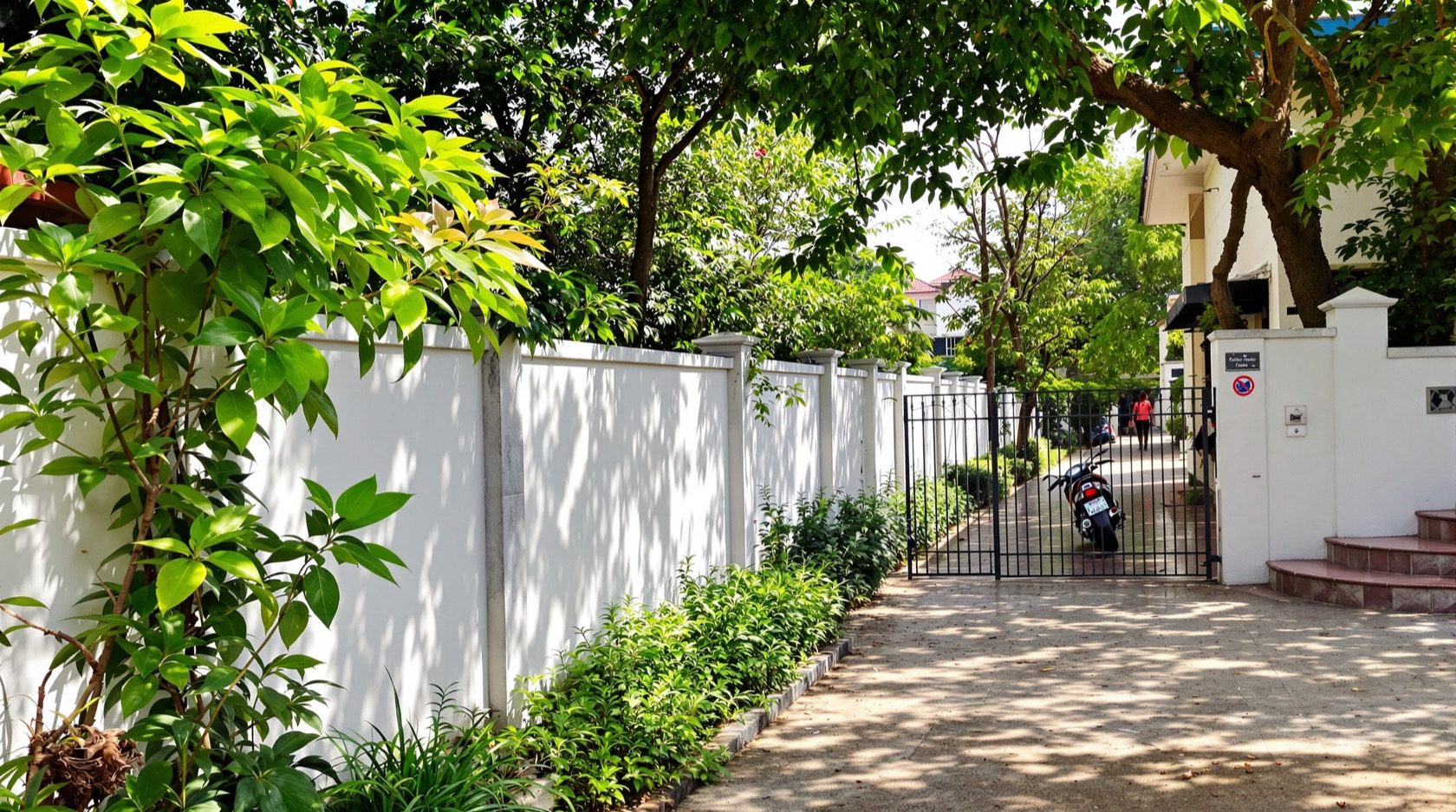
Perimeter Vulnerability Assessment for Indian Homes
How to walk the full boundary of your plot as a defender — rating wall and gate condition, spotting climb aids and blind corners, carving out a clear no-man's zone, and turning what you find into detection and delay at the outer ring.
The boundary is the first thing an intruder meets and the last thing most owners think about. We pour attention into the front door and the CCTV, then leave a compound wall that a person can step over using the municipal water connection box, a gate whose bolt has not shut cleanly in two years, and a rear corner no one can see from the house or the street. The perimeter is the outer layer of your defences — in a well-planned home it is what buys you the seconds and the warning that every inner layer depends on. This guide teaches you to assess that outer ring methodically, entirely from the defender's side, so you can find its weak points and fix them.
It is a Phase-B assessment guide within the Security Knowledge Hub and it goes one level deeper than the master risk assessment guide on a single subject: the boundary itself. Where the layered-security design guide explains why you build in rings, this guide walks you around the outermost ring with a clipboard. When you want to score what you find, the Home Security Risk Scorecard and the site-perimeter security assessment tool turn your notes into a ranked list.
Scope & safety. This is a defensive planning guide. It teaches you to spot and fix weaknesses in your own boundary — never how to climb, defeat or bypass anyone's perimeter. Nothing here should ever obstruct a fire-escape route or a gate needed for egress. Electric fencing, electric gate motors, mains-powered lighting and boundary electronics are qualified work: specify them, then have a licensed professional install and certify them, within your local bye-laws.
Why the perimeter is worth a dedicated walk
Think of security as concentric rings — boundary, building shell, interior, valuables. The boundary is the only ring an intruder must cross before committing to anything, which makes it the cheapest place to add both deterrence (it looks hard) and detection (you learn early). A perimeter that is easy to cross silently hands the intruder the two things they most want: a way in and privacy while they work.
A dedicated perimeter walk answers three questions the front-door survey cannot:
- Can the boundary be crossed easily — over, under, through or around it — anywhere along its length, not just at the gate?
- Would you know if someone crossed it, day or night?
- Once across, could they work unseen in the strip between your wall and your walls?
The boundary walk-around: segment by segment
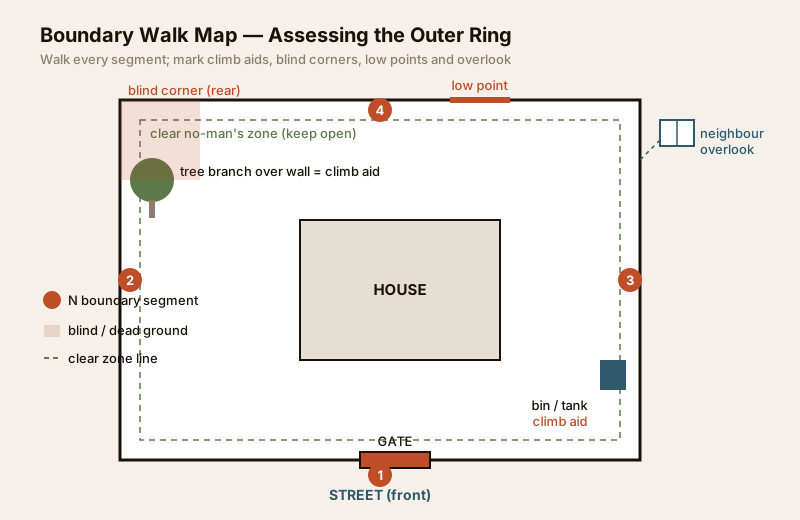
Walk the entire boundary, slowly, from the outside where you safely can and then from the inside. Do it once in daylight and once after dark — climb aids and gaps show in day, lighting and overlook failures show at night. Number your boundary into segments (front, gate, each side, rear) and rate each on the same points. Carry your phone to photograph every issue.
1. Wall and fence — height, condition, climbability
Height alone is not security, but a low or damaged boundary is an open invitation. Note the honest height relative to an adult, whether the top is easy to grip, and the condition: cracked plaster and loose coping give footholds; a leaning or settled section is weaker than it looks. A solid opaque wall stops casual view but also hides an intruder once they are over it; an open railing or grille the reverse. Most Indian plots want a mix — a solid base with an open or spiked upper section that preserves sightlines. Check for gaps and low points: a dip where the ground falls away, a service gap, a stretch of temporary fencing, a neighbour's abutting low structure.
2. Gates — leaf, lock, hinge, and habit
The gate is the designed opening, so it deserves the most scrutiny. Assess four things: the leaf (solid, rigid, or a flimsy frame that flexes), the lock (a real deadlock or a token latch, and whether the bolt actually engages its keeper), the hinges (pins that lift out, rusted or sagging, or fixed and welded), and the habit — a good gate left open all day for convenience is no gate at all. A pedestrian wicket beside the main gate is often the weakest of the set. Automated sliding gates need a manual-release and a positive lock, not just motor friction.
3. Climb aids beside the wall — the commonest own goal
This is the finding owners miss most. The wall may be tall, but anything stacked, parked or grown against it becomes a step. Walk both faces and note every one:
- Bins, water tanks, and boxes — municipal water/meter boxes, refuse bins, a stacked pile of pavers or bricks left after construction.
- Pipes and cables — a rainwater downpipe, a cable stay, an AC bracket, a bolted-on ladder rung.
- Trees and heavy creepers — a branch reaching over the wall, a mango or gulmohar with a low fork, a thick bougainvillea that doubles as a ladder.
- Parked and built structures — a car or two-wheeler parked hard against the wall, a cattle shed, a neighbour's lean-to, a construction scaffold next door.
- The wall's own features — decorative offsets, a projecting plinth, a boundary bench.
The fix is usually free: move it, trim it, or add a smooth topping so the aid no longer leads anywhere.
4. Blind corners and dead ground
Every boundary has corners and setback strips that neither the house, the street, nor a neighbour can see into. These blind corners are where an intruder crosses and then works in privacy. Mark each one and ask what removes the privacy — a light, a camera, a trimmed shrub, or opening a sightline. This connects directly to the blind-spot identification guide, which maps the same dead ground across the whole property.
5. Adjoining-property overlook
Your boundary is only half yours; the other side belongs to a neighbour, a lane, a park or a vacant plot. Note honestly where an adjoining property overlooks into yours (a first-floor window or terrace with a clear line onto your rear yard) and, more usefully, where it hands over access — a shared wall, a neighbour's terrace level with your first floor, a vacant plot that lets someone approach your rear unseen. You cannot control the neighbour's side, but you can plan your detection and planting around it. Raise shared-boundary concerns through the neighbourhood risk assessment and your RWA, never by confronting individuals.
6. Under and through — not just over
Finish by checking the two paths owners forget. Under: a storm-water gap, an eroded gap beneath a gate, a culvert wide enough to crawl. Through: a rotten fence panel, an unsecured service door in the wall, a builder's opening never closed. A boundary is only as strong as its weakest metre.
The perimeter vulnerability checklist
Work along your numbered segments and fill this in. Rate severity Low / Medium / High by combining how easy the weakness is to exploit with how much it exposes. Anything you mark High goes to the top of your action plan. This mirrors the logic the site-perimeter security assessment tool automates.
| Boundary segment | Weakness to look for | Severity | Typical fix |
|---|---|---|---|
| Front wall / railing | Low height, easy grip top, cracked coping | Med–High | Raise or top; repair coping; add open spiked upper |
| Main gate | Bolt not engaging, lift-out hinges, left open by day | High | Deadlock + keeper, fixed hinges, close-and-lock habit |
| Pedestrian wicket | Flimsy leaf, token latch | High | Rigid leaf, proper lock, self-closer |
| Side passage wall | Bins / tank / pipe as climb aid | High | Remove or relocate aid; smooth topping |
| Trees near wall | Low branch or creeper bridging the wall | Med–High | Prune branches over/near the wall; thin creepers |
| Rear / service wall | Low, unwatched, dark, blind corner | High | Light + camera; open sightline; raise if low |
| Shared / party wall | Neighbour structure gives access to first floor | Med | Detection + planting; first-floor grilles |
| Boundary base | Storm-water gap, eroded low point, culvert | Med | Grille the gap; fill / bar the low point |
| Vacant adjoining plot | Unseen approach to your rear | Med | Rear-facing sensor light + camera; thorny hedge |
| Whole perimeter | No lighting, no detection at the line | High | Motion lights + boundary sensors / cameras |
Defensible space and a clear no-man's zone
The single most powerful perimeter idea is defensible space: the strip of ground just inside your boundary should be kept clear, open and observable, so that anyone who crosses the wall is immediately exposed rather than hidden. Security professionals call it a clear zone or no-man's zone. The intruder's whole advantage is privacy; a clear zone takes it away.
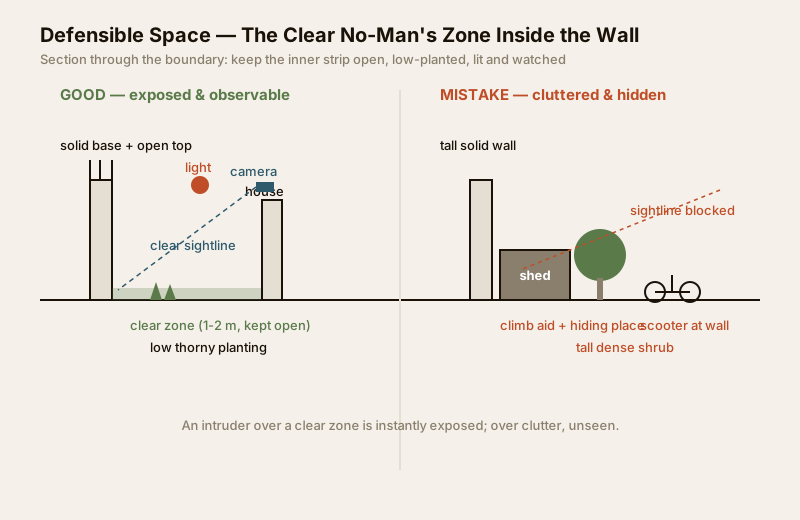
In an Indian plot the clear zone is rarely more than a metre or two — that is enough. The rules are simple:
- Keep the strip inside the wall open. No sheds, no stacked material, no parked two-wheelers, no tall dense shrubs hugging the wall — each of those is both a climb aid outside and a hiding place inside.
- Low planting only near the line. Ground cover and low, and ideally thorny, planting (bougainvillea trained low, kaner, agave) makes the strip unpleasant to cross without blocking your view across it.
- Light it and watch it. The clear zone is exactly where a motion-sensor light or a boundary camera earns its keep, because a person there has no honest reason to be there.
- Preserve the sightline from the house. You should be able to see the base of your own boundary from a window or the CCTV; the clear zone is what keeps that line open.
This is where the classic trade-off lives, discussed next.
Hostile fortress versus natural surveillance
There are two philosophies for a boundary, and the best homes borrow from both.
The hostile fortress — a high solid wall, spikes, glass shards, a forbidding face — maximises the physical barrier. Its weaknesses are real: a tall opaque wall gives the intruder complete privacy the moment they are over it, it kills natural surveillance from and toward the street, it can breach bye-law height limits, and glass-shard toppings raise genuine liability and safety concerns. It signals "something valuable here" and it looks unwelcoming.
The natural-surveillance approach — a barrier that is hard to cross but easy to see through and across — trades a little raw height for openness. An open or grille upper section, a well-lit clear zone, thorny low planting and a boundary that the street and neighbours can watch, all mean an intruder is seen rather than merely slowed. A watched boundary is often safer than a blind tall one.
| Boundary treatment | Barrier | Surveillance | Best for | Watch-outs |
|---|---|---|---|---|
| High solid wall | Strong | Poor (blind) | Privacy, noisy roads | Hides intruder once over; bye-law height; unwelcoming |
| Solid base + open/grille top | Strong | Good | Most Indian plots | Get the grille spacing right; maintain sightline |
| Railing / open fence | Moderate | Excellent | Overlooked, community streets | Little privacy; pair with detection |
| Thorny hedge (defensive planting) | Moderate | Good | Softening walls, rear lines | Needs years to grow; regular pruning |
| Spikes / anti-climb top | Adds to barrier | Neutral | Vulnerable low sections | Legal/liability limits; never on egress routes |
| Electric fence | Strong | Neutral | Farmhouses, large plots | Licensed install only; strict signage & bye-laws |
For most Indian homes the sweet spot is a solid base with an open or spiked upper section, a clear zone inside, and light plus detection — hard to cross, easy to watch, and within bye-law height. Confirm your permissible boundary height and treatment with local rules; see the building regulations and compliance guide rather than assuming a specific figure.
Rating severity: turning the walk into a score
Not every weakness deserves the same urgency. Rate each finding on two axes — how easy it is to exploit (a low undamaged section that still needs a small ladder is easier than a two-metre wall) and how much it exposes (a rear blind corner onto the service yard exposes more than a front railing in full street view). The grid below turns the pair into a priority band.
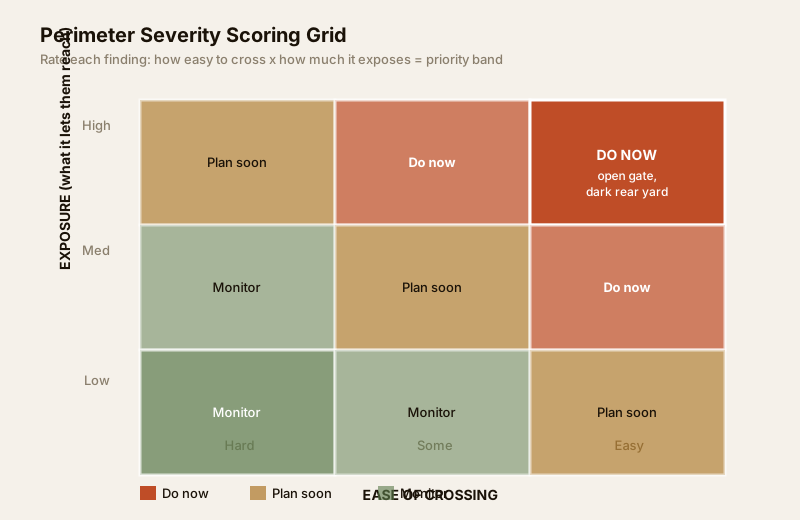
- Do now (red). Easy to cross and high exposure — an open gate onto a dark rear yard, a bin permanently against a low side wall. These are usually cheap: a habit, a bolt, moving an object.
- Plan soon (amber). One axis high — a strong but blind rear wall, or an easy-to-cross front railing in full public view. Schedule within the quarter.
- Monitor (green). Hard to cross and low exposure. Note it and revisit at re-assessment.
Weight quick, free wins to the front regardless of band: removing a climb aid, pruning a branch, and closing the gate cost nothing and often cut risk more than a new camera.
Feeding findings into detection and delay
A perimeter assessment is not finished when you know the weak points — it is finished when each weak point is assigned to delay (make crossing slower and harder) or detection (make crossing noticed early), the two jobs of an outer layer.
- Delay comes from the physical fixes: raising a low section, topping a climb-prone wall, a real gate lock, closing the storm-water gap, thorny planting in the clear zone. Delay only matters if detection and response use the time it buys.
- Detection is where perimeter findings should steer your electronics. Put motion-sensor lights and boundary cameras where your blind corners and high-severity segments are — not evenly spaced for symmetry. A camera watching the clear zone at the rear blind corner is worth three watching the well-lit front gate. Size and aim this with the CCTV camera coverage calculator, and plan how the boundary layer hands off to the door and interior layers in the layered-security design guide.
The gate, as the designed crossing, is also the natural place to assess how people legitimately enter and leave — that access-control side is covered in the entry and exit security assessment, and the wider site context in the site security assessment.
When to bring in a professional
Do the walk yourself — no one knows your boundary better. But route the powered and structural parts to qualified people: electric fencing and gate motors, mains-powered boundary lighting, CCTV cabling and any structural change to a compound wall (raising it, adding a heavy anti-climb top, or a new gate post) should be specified by you and installed and certified by a licensed professional, within your municipal bye-laws. A leaning or cracked boundary wall is a structural question first — see the structural safety guide — and a safety one before it is a security one.
Key takeaways
- Walk the whole boundary as a defender, segment by segment, once in daylight and once after dark — the gate is not the only place it can be crossed.
- Climb aids beside the wall (bins, tanks, pipes, trees, parked vehicles) are the commonest and cheapest-to-fix weakness — remove, trim or top them.
- Keep a clear no-man's zone just inside the boundary: open, low-planted, lit and watched, so anyone who crosses is immediately exposed.
- Prefer a watched boundary to a blind tall one — a solid base with an open top, a clear zone and detection usually beats a hostile fortress wall, and stays within bye-laws.
- Feed findings into delay and detection — put cameras and lights at your high-severity blind corners, not evenly for symmetry — and route powered or structural work to licensed professionals.
Score your boundary now with the site-perimeter security assessment tool and the Home Security Risk Scorecard, then browse the full security guides collection to plan each fix in depth.
This is an educational planning guide. It is strictly defensive and does not describe how to defeat any security measure. Electric fencing, gate motors, mains electrical, CCTV cabling and structural boundary changes are qualified professional work — engage licensed installers, keep every measure clear of fire-escape and egress routes, and verify the applicable National Building Code or municipal bye-law requirement for your project.
Export this guide
Related Guides — Deep-dive reading
Blind Spot Identification for Home Security in India
A defender's method to find and close the blind spots around an Indian home — the corners no camera, light or neighbour can see. Walk it by day and after dark, map each coverage gap, and fix it by re-aiming cameras, adding light, trimming planting and opening sightlines.
SecurityDoor and Window Security Assessment for Indian Homes
Go opening by opening and rate the hardware itself — leaf and frame, hinges and locks, strike plates, grilles, glazing and latches — so you can grade each door and window's real resistance while never trapping anyone behind it.
SecurityEntry and Exit Assessment for Indian Homes
How to audit every way IN and OUT of your home or building — a complete inventory of doors, gates, windows, balconies and forgotten access points, rated for how easily each could be used to get in and how well it serves escape in an emergency, turned into a hardening priority list.
SecurityRelated Tools — Try Free
CCTV Camera Coverage & Count Calculator
Estimate how many CCTV cameras you need, the NVR channels, storage in TB for your retention period, and an indicative all-in cost with GST.
CCTV CalculatorCross-Ventilation Analyzer
Estimate airflow and air changes per hour (ACH) from room size, window areas, layout, and local wind — with NBC 2016 Part 8 compliance check.
Ventilation CalculatorWindow Grill Design Selector
Pick a window grille style and material by priority — security, looks, budget, view — and estimate cost.
Window Tool