
Clean Agent Fire Suppression in India (2026): Gas Protection for Server Rooms, Archives & Switchgear
For rooms where a sprinkler would do more damage than the fire - server and data rooms, archives, control and switchgear rooms - a clean-agent gas system floods the sealed space and puts the fire out without wetting the electronics.
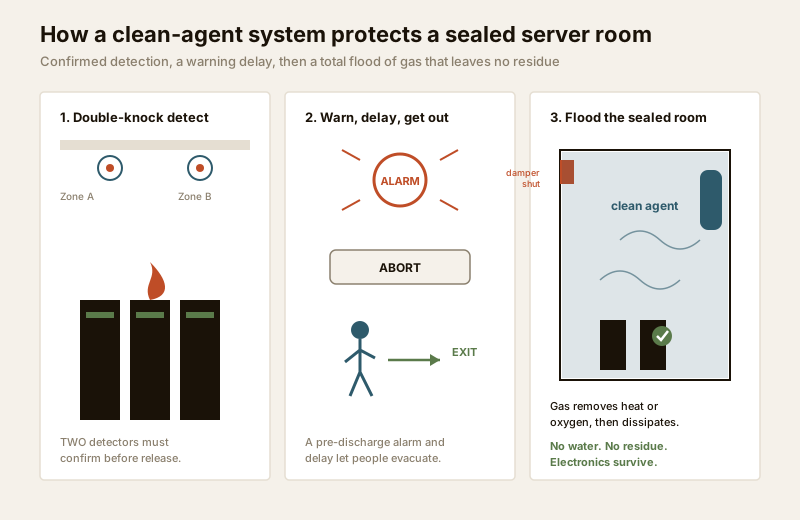
Some rooms hold things that a sprinkler would destroy as surely as the fire would. A live server rack, a rank of switchgear, a room full of tape backups, a colonial-era land record in an archive, a canvas in a museum store - drench any of these with water to put out a small fire and you have turned a contained incident into a total loss. For exactly these spaces, fire engineers reach for a different tool: clean agent fire suppression, a gaseous system that floods the whole sealed room with a gas that stops the fire and then simply dissipates, leaving no water, no powder and no residue behind. The electronics keep running; the paper stays dry; the painting survives.
This is the gaseous-suppression chapter of Studio Matrx's fire-safety library, sitting under the complete guide to fire safety in India. It is written for the facility managers, IT and estates heads, builders and consultants who own or specify these high-value spaces - so you understand what a clean-agent system is, why it is the right protection for a water-sensitive room, what makes it safe for the people who work there, and above all how to keep it actually able to fire when the day comes. It is not a design manual: the agent, the concentration, the room-integrity calculation and the whole installation are a licensed fire-protection engineer's work.
Scope and safety - read this first. A clean agent fire suppression system is an engineered, statutory installation - the agent selection, the extinguishing concentration, the room-integrity and occupant-safety calculations, the pipe and nozzle hydraulics, the detection interlock and the commissioning are all a licensed fire-protection engineer's job, designed to IS 15493 : 2021 (Gaseous Fire Extinguishing Systems) with detection to IS 2189 : 2026 and within the framework of the National Building Code (SP 7 : 2026, Part 4 Fire and Life Safety) and your Fire NOC under the State Fire Services Act and Rules. This guide helps you understand, specify and maintain such a system; it is educational guidance, not legal advice, and never a manual for designing, charging or disabling one. If a fire breaks out, one rule overrides everything: get everyone out and call the fire brigade on 101 or 112.
What a clean-agent system is - total flooding, no residue
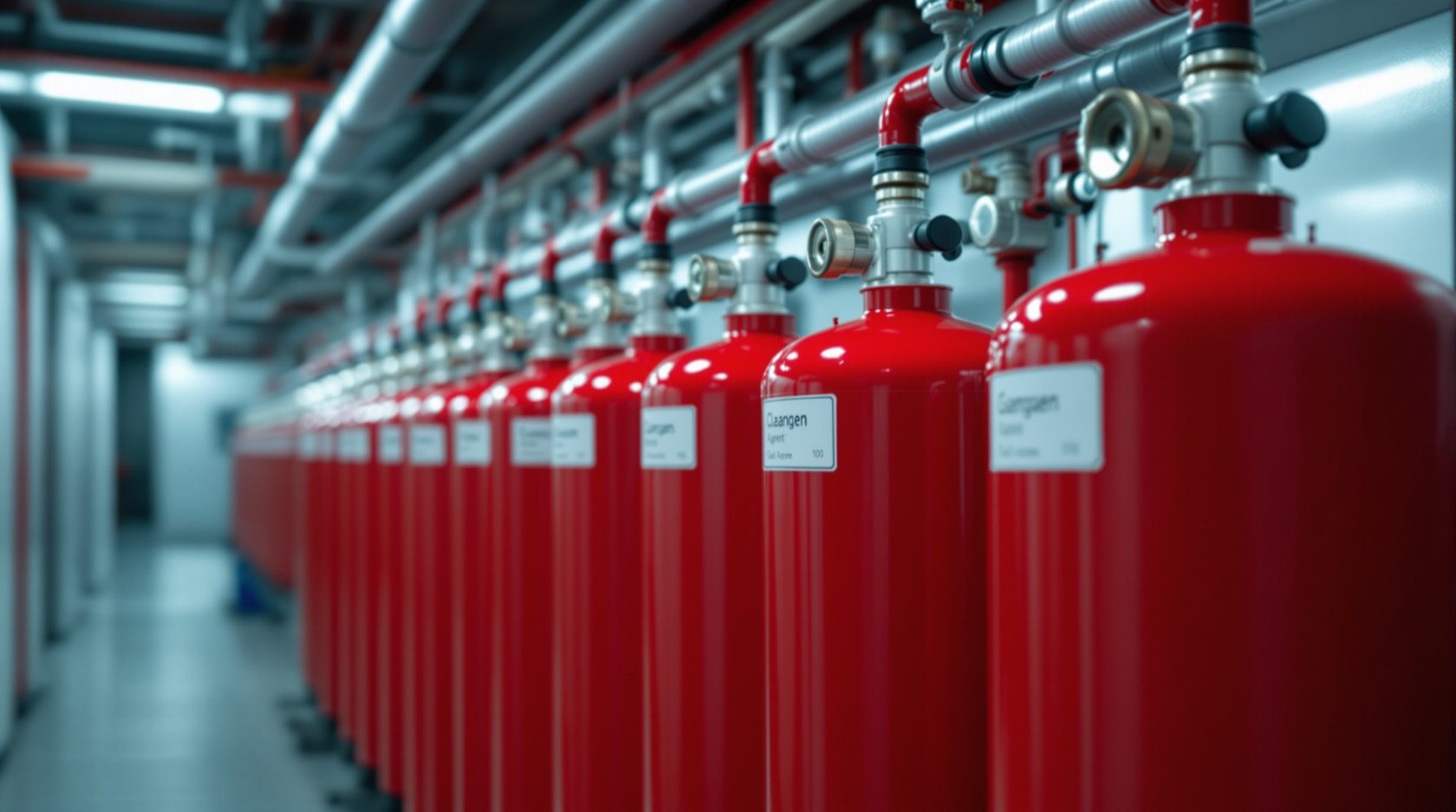
A clean-agent system does not spray a jet at the fire the way a hose or an extinguisher does. It is a total-flooding system: on a confirmed fire signal it releases a measured quantity of gas from a bank of cylinders, through fixed pipework and ceiling nozzles, and fills the entire sealed room with the agent at a designed concentration in a matter of seconds. The whole volume becomes an atmosphere in which the fire cannot continue. Because the extinguishing medium is a gas that either leaves as air is restored or is chemically inert, nothing is left on the protected assets - hence "clean".
There are two broad families of clean agent, and it matters which one a room has:
- Inert gases - nitrogen, argon, carbon dioxide, or blends of them (the IG-series, such as nitrogen-argon and nitrogen-argon-CO2 mixtures). These are natural atmospheric gases. They work mainly by displacing oxygen: they dilute the air in the room until there is too little oxygen to sustain combustion, while - in a correctly designed system - still leaving enough for a person to breathe safely for the time it takes to escape. They are stored as high-pressure gas, so they need more cylinders and higher-rated pipework.
- Chemical clean agents - the fluorinated agents. The modern one is the fluoroketone FK-5-1-12 (sold under names such as Novec 1230), a fluid that flashes to gas on discharge; the older group are the HFCs (hydrofluorocarbons, such as HFC-227ea). These work mainly by removing heat from the flame at very low concentrations, so they extinguish with far less agent and fewer cylinders than an inert gas, and at concentrations that leave the oxygen level normal.
The choice between them is an engineering decision that weighs the room volume, the occupancy, the assets, the space available for cylinders, safety margins and environmental factors - not a shopping preference. What every owner should know is that both families do the same job: put out a fire in a water-sensitive room without wetting a thing.
| Clean-agent family | How it works | Practical notes (indicative - engineer confirms) |
|---|---|---|
| Inert gases (nitrogen, argon, IG-blends) | Dilute the room's oxygen below the level a fire needs | Natural gases, no residue; need more, higher-pressure cylinders and space; lower the oxygen, so occupant-safety design is critical |
| FK-5-1-12 fluoroketone (e.g. Novec 1230) | Absorbs heat from the flame at low concentration | Very low use concentration, fewer cylinders; stored as a fluid; leaves oxygen level normal; a common modern choice |
| HFC agents (e.g. HFC-227ea) | Removes heat from the flame chemically | Established, compact; a fluorinated greenhouse gas, so being weighed against newer agents |
| Halon (legacy only) | Chemically interrupted the flame | Ozone-depleting - phased out under the Montreal Protocol; found only on old installations, to be replaced, never recharged |
Where clean agents belong - and where they do not
A clean-agent system is expensive and it protects one sealed enclosure, so it is reserved for spaces where the value of what is inside, and its intolerance of water, justify it. Typical protected spaces in Indian buildings are:
- Server rooms, data centres and hub rooms - live IT equipment that a sprinkler discharge would short out and destroy. This is the classic clean-agent application, and it ties into the wider electrical fire-safety picture.
- Control rooms, SCADA and BMS rooms - the nerve centres whose loss would blind a plant or a building.
- Telecom rooms, UPS rooms and battery rooms - energised electronics and, in the case of batteries, a specific and growing fire risk.
- Electrical switchgear and transformer rooms - live high-voltage equipment where water is both a damage and a shock hazard.
- Archives, record rooms, rare-book stores and museum stores - irreplaceable paper, film and artefacts that water would ruin as thoroughly as fire.
The common thread is a sealable enclosure of moderate volume containing high-value, water-intolerant assets, with few or no permanent occupants. Where a space is large, open, frequently occupied or cannot be sealed, a clean-agent system is usually the wrong tool - a water-based system such as a sprinkler or a water-mist installation, or portable cover with CO2 and other extinguishers, fits better. Deciding which suppression suits which space is precisely the kind of question to put to a fire engineer; the fire-suppression system selector is a useful starting frame before that conversation.
How the system fires - detection, double-knock and the pre-discharge sequence
A clean-agent system does not decide to discharge on its own or on a single detector. Because a discharge is a significant, one-shot event - the cylinders empty in seconds and must then be recharged - the release logic is deliberately cautious, and it is driven by the building's detection and alarm system.
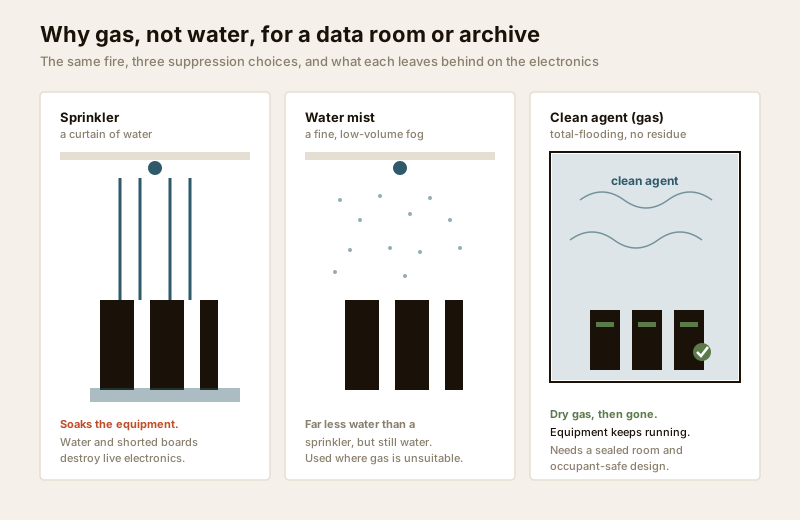
The near-universal rule is double-knock (also called cross-zoning or coincidence detection): the system waits for two independent detectors, in two separate detection zones, to both confirm a fire before it will release. One detector alone raises an alarm and a fault-free warning but will not trip the gas; it takes a second, corroborating detection to arm the release. This is what stops a single faulty or dust-fouled detector from dumping an entire cylinder bank for nothing. Correct zoning of those detectors is part of what makes the interlock reliable.
Once double-knock is confirmed, a fixed, deliberate sequence runs before any gas is released:
| Stage | What happens | Why it matters |
|---|---|---|
| First detection | One zone detects; alarm and indication, no release | A single detector never releases the gas |
| Second detection (double-knock) | A second, separate zone confirms; release sequence arms | Two independent confirmations guard against false discharge |
| Pre-discharge alarm and delay | A distinct alarm and strobe sound; a timed delay begins | Warns and gives any occupant time to evacuate before gas |
| Abort available | An abort station lets a person hold the release while investigating | A last human check against an unnecessary or unsafe discharge |
| Dampers close, fans stop | Ventilation dampers shut and air-handling stops | Seals the room so the agent can reach and hold concentration |
| Discharge | Cylinders release; the agent floods the sealed room | The fire is extinguished at the designed concentration |
That pre-discharge stage - a distinct alarm, a time delay, an abort control and clear signage - is not an optional refinement. It is the primary means by which the system protects the people who might be inside, and it is mandatory design intent for any space people can enter.
The three things that make it work and keep it safe
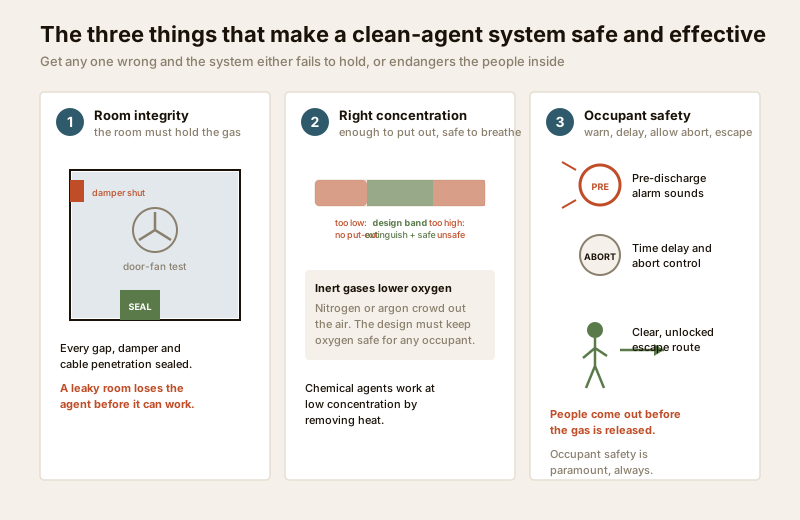
Whether a clean-agent system actually saves the room, and does so without harming anyone, rests on three engineered conditions. Get any one wrong and the system either fails to hold the fire or endangers the occupants.
1. Room integrity - the room must hold the gas
A total-flooding system only works if the room can hold the agent at concentration long enough to put the fire out and keep it out - the "hold time". A gas will leak out through every gap it can find: an unsealed cable tray penetration, a gap under a door, an open ventilation damper, a suspended-ceiling void that is not closed off. If the room leaks, the concentration falls below the extinguishing level before the fire is dead, and the fire re-establishes. The room therefore has to be built and sealed as an integral enclosure, with automatic dampers that shut on discharge, and its tightness has to be proven by a door-fan integrity test at commissioning and periodically thereafter. This is exactly where Indian installations quietly fail: a room that passed its integrity test on day one has since had cabling, air-conditioning or partitions cut through its seal by later contractors who never knew - or cared - that the room's tightness was load-bearing for its fire protection.
2. Concentration - enough to extinguish, safe to breathe
The agent has to reach a concentration that will reliably extinguish the fire, and stay within the limits that are safe for any person who might still be in the room. These two requirements pull in opposite directions and the design must satisfy both. For inert gases, the mechanism is oxygen displacement, so by design the oxygen level in the room is lowered - and the design must keep it above the level that is safe for a person for the short time they need to leave. For chemical agents such as FK-5-1-12 and the HFCs, the extinguishing concentration is low and the oxygen stays normal, but there are still safe-exposure limits the design respects. Establishing the right agent and the right concentration for the specific room, its assets and its occupancy is a calculation, not a guess, and it belongs to the fire-protection engineer.
3. Occupant safety - people out before the gas comes
Because a discharge changes the atmosphere of the room, no clean-agent system should ever release with people trapped inside. The whole pre-discharge sequence - the distinct warning alarm, the visible strobe, the time delay, the abort station, and clear, unlocked, well-signed escape routes that let a person walk out immediately - exists to make sure occupants are gone before the agent floods. Escape doors must open easily from inside, the pre-discharge signal must be unmistakable, and staff who work in or near the protected room must be trained on what the alarm means and to leave at once. Occupant safety is paramount and overrides the protection of the assets, always. This is why the clean-agent room is designed hand-in-hand with the building's overall emergency preparedness and evacuation planning.
After a discharge - and the Halon it replaced
Two facts about clean-agent systems catch owners out.
First, a clean-agent system is a one-shot device. When it discharges, the cylinders are empty. Until they are professionally recharged or exchanged, the room has no gaseous protection at all - it is, for fire purposes, unguarded. After any discharge (real fire or accidental), the immediate priorities are to establish that the fire is truly out, ventilate and make the room safe to re-enter, investigate the cause, and get the cylinders recharged and the system reinstated by the licensed contractor as fast as possible. A discharged, un-recharged system is one of the most dangerous states a protected room can be in, precisely because the equipment on the wall still looks complete.
Second, if you manage an older building you may still have Halon - the original clean agent, brilliantly effective but ozone-depleting, and phased out worldwide under the Montreal Protocol. Halon systems on legacy installations are not to be recharged; they are to be identified and replaced with a modern clean agent by a fire-protection contractor, with the old Halon recovered and handled through proper channels. If a data or switchgear room in your estate still carries green Halon cylinders, treat that as a project for the fire engineer, not a system to top up.
The honest India reality - installed is not working
The recurring theme across this whole fire-safety library is at its sharpest with clean-agent systems, because the failure is invisible until the fire. A building fits a gaseous system to get its Fire NOC for the server room, and then, over the years:
- The cylinders discharge - by accident or in a real event - and are never recharged. The empty cylinders sit on the wall for years. The room is protected by nothing, and nobody who looks at it can tell.
- Later work breaks the room seal. A new cable route, a split AC unit, a partition moved - each cut through a wall or ceiling quietly ruins the room integrity the whole system depends on, and no door-fan test is ever repeated to catch it.
- Detection is neglected. Dusty, disabled or unmaintained detectors mean the double-knock interlock may never confirm - or worse, an isolated zone leaves the room effectively undefended.
- The abort and manual controls, and the signage, decay - so the occupant-safety sequence that the design relies on no longer functions as intended.
None of this is visible on a walk-past. It surfaces only in the incident, when the room burns and the cylinders that should have flooded it are found long empty. The discipline that prevents it is the same maintenance and testing regime that every engineered fire system needs: a live Annual Maintenance Contract with a competent gaseous-suppression contractor, covering periodic detection testing, cylinder weight and pressure checks, control and abort function tests, and repeat room-integrity (door-fan) testing after any building work. "Installed" is never "working" - only maintenance and testing make it so.
Use the fire-suppression system selector to frame which protection suits a given room before you brief a fire engineer, the fire-extinguisher selector to plan the portable cover that backs up any fixed system, and the home fire-safety scorecard for the wider premises picture. For the settings where these rooms sit - the tower, the workplace - see the high-rise, office and basement fire-safety guides, and the broader electrical guides behind the risk to energised equipment.
Never leave it discharged, sealed-broken or isolated - keep it live and AMC'd. The most dangerous clean-agent room is not one without a system; it is one with a system that looks complete but is empty, leaking or switched off. Never treat discharged cylinders, a broken room seal, an isolated detection zone or a defeated abort control as acceptable - each one silently removes the protection while the hardware still hangs on the wall. Route every design, agent selection, concentration and room-integrity calculation, installation, recharge and commissioning to a licensed fire-protection engineer and contractor working to IS 15493 : 2021, with detection to IS 2189 : 2026 and within the National Building Code (SP 7 : 2026, Part 4) and your Fire NOC. What is on the owner is the discipline: keep the AMC live, retest room integrity after any building work, recharge without delay after any discharge, and never let a protected room quietly become an unprotected one.
Key takeaways
- Clean agent fire suppression protects water-sensitive rooms - server and data rooms, control rooms, telecom, UPS and battery rooms, switchgear, archives and museum stores - by total-flooding the sealed space with an inert gas (nitrogen, argon, IG-blends) or a chemical agent (FK-5-1-12 or an HFC) that extinguishes without water and leaves no residue, so the electronics and records survive.
- It fires only on double-knock, after a pre-discharge sequence - two independent detectors in separate zones must confirm before release, and a distinct alarm, a time delay and an abort station give any occupant time to get out before the gas floods.
- Three engineered conditions make it work and keep it safe - room integrity (the sealed room must hold the agent, proven by a door-fan test), the right concentration (enough to extinguish yet safe for occupants, especially with oxygen-lowering inert gases), and occupant safety (people out before discharge, always paramount).
- A discharged system is unprotected, and Halon is legacy - the cylinders are one-shot and must be recharged after any discharge; old ozone-depleting Halon systems are to be replaced with a modern clean agent, never topped up.
- Installed is not working - India's real danger is cylinders discharged years ago and never refilled, room seals broken by later cabling, and neglected detection; keep a live AMC, retest integrity after any building work, and route all design and installation to a licensed fire-protection engineer to IS 15493 : 2021, IS 2189 : 2026 and NBC Part 4.
References
- IS 15493 : 2021, Bureau of Indian Standards - Gaseous Fire Extinguishing Systems, General Requirements. The core Indian standard governing the design, agents, concentration and safety of clean-agent (gaseous total-flooding) suppression systems, including occupant-safety and room-integrity requirements. Verify the current edition via the BIS catalogue: https://www.services.bis.gov.in/
- IS 2189 : 2026, Bureau of Indian Standards - Selection, Installation and Maintenance of Automatic Fire Detection and Alarm System, Code of Practice. Governs the detection and alarm system, including the double-knock (cross-zone) release logic and the pre-discharge sequence that trigger and supervise a gaseous suppression system. Verify the current edition via the BIS catalogue: https://www.services.bis.gov.in/
- National Building Code of India, SP 7 : 2026 (the NBC), Part 4 "Fire and Life Safety" - the framework determining whether and what fire protection, including gaseous suppression for special hazards, is required for a given occupancy, height and area; the older SP 7 : 2016 edition is withdrawn but still widely quoted. Verify the current edition via the BIS catalogue: https://www.services.bis.gov.in/
- The relevant State Fire Services Act and Rules and the Model Building Bye-Laws (MoHUA) - these set when a Fire NOC and certified, maintained fire-protection systems are legally required for a given premises, and the periodic maintenance and testing obligations that follow. The Montreal Protocol governs the phase-out of ozone-depleting Halon and its replacement with modern clean agents.
This is an educational overview, not legal advice, and not a substitute for a licensed fire-protection engineer or gaseous-suppression contractor. Clean-agent system design, agent selection, extinguishing-concentration and room-integrity calculations, installation, recharging, commissioning, the Fire NOC and any statutory maintenance are qualified professional tasks - engage licensed fire professionals and the State Fire Services, and verify any standard's current status via the BIS catalogue before relying on it.
Export this guide
Related Guides — Deep-dive reading
Emergency Lighting Testing in India (2026): The Function Test, the Duration Test and the Battery That Quietly Dies
Emergency lighting is what gets people out of a building in a power cut or a fire — and it is useless if its batteries have silently gone flat. This professional guide covers what emergency lighting is, the two tests that keep it honest (the short frequent function test and the longer periodic duration test that catches dying batteries), what to test across escape routes, stairs and exit signs, the statutory test log, and the safe split of who does what.
SecuritySecurity for People Living Alone in India (2026): Calm, Practical Habits When There Is No Second Person to Notice
Living alone is an ordinary and growing part of Indian life - the student in a new city, the working single, the elder whose children are abroad, the person after a separation. It does not call for fear. It calls for a few deliberate habits, because there is no second person in the home to notice trouble, raise the alarm, or catch an accident. This is calm self-reliance, layer by layer.
SecurityFire Alarm Maintenance in India (2026): AMC, Battery Standby & Keeping It Alive
Most Indian fire-alarm systems are installed for the Fire NOC and then rot - dead batteries, painted detectors, isolated zones, a blank log book. This guide sets out what proper maintenance per IS 2189 : 2026 actually involves.
SecurityRelated Tools — Try Free
Fire Suppression System Selector
Sprinklers, hydrants, kitchen-hood, clean-agent gas or water mist? Pick what you are protecting and see the fixed suppression a fire engineer would typically consider — an orientation to a proper NBC Part 4 design, not the design itself.
SuppressionBefore vs After — Cost Reality Check
Compare what you expected to pay vs what you actually paid, category by category.
Reality CheckCross-Ventilation Analyzer
Estimate airflow and air changes per hour (ACH) from room size, window areas, layout, and local wind — with NBC 2016 Part 8 compliance check.
Ventilation Calculator