
Fire Hose Reels in India (2026): First-Aid Firefighting on Every Floor
The wall-mounted fixed hose reel bridges the gap between a portable extinguisher and the fire brigade - a permanently plumbed water line a trained occupant can use on a small, developing Class A fire while everyone else gets out.
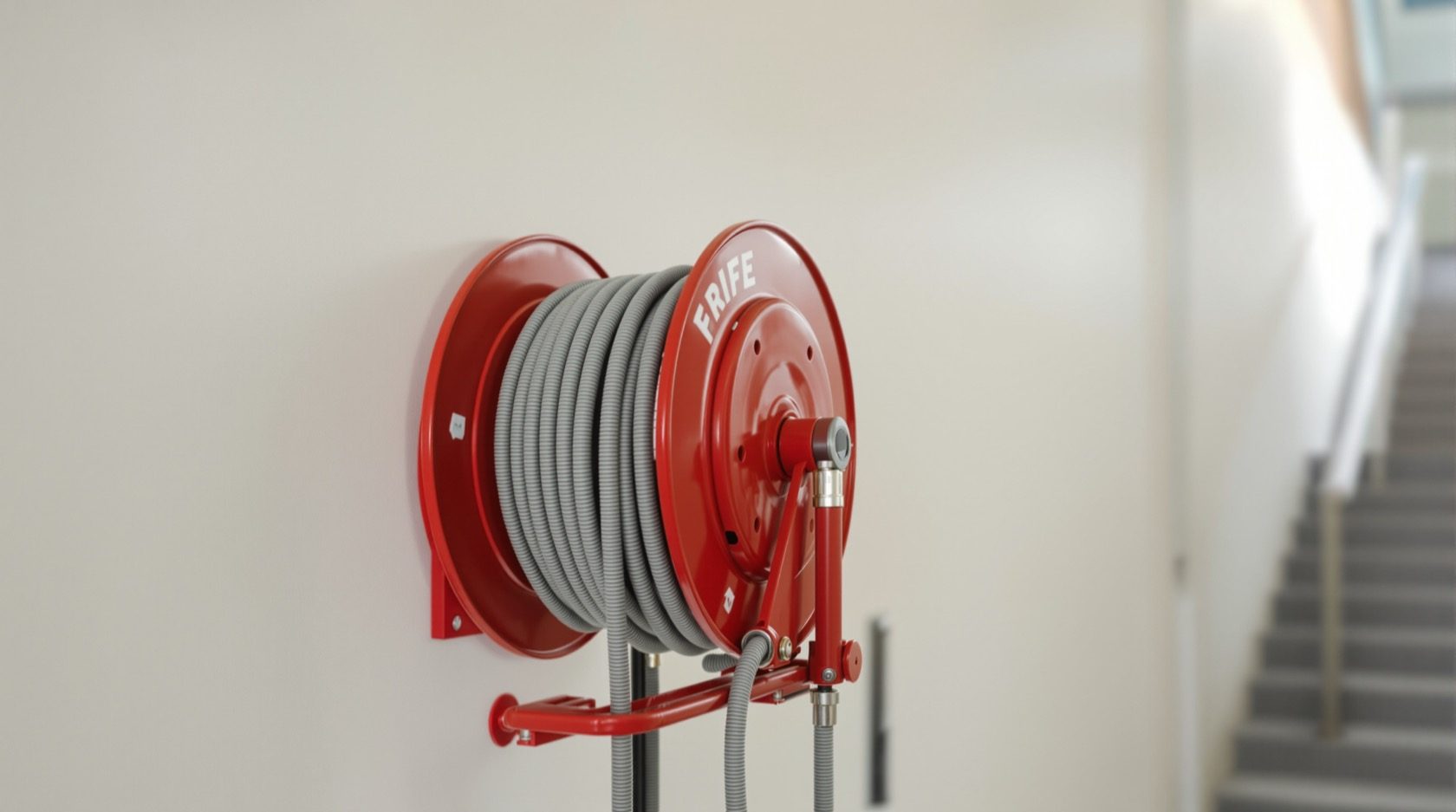
Somewhere near the staircase on every floor of a well-built Indian office, hotel or apartment tower there is a red drum on the wall, wound with a coil of narrow red rubber hose and fed by a pipe that vanishes into the wall. Most people walk past it every day and have no idea what it is or how to use it. That drum is a fixed fire hose reel - the building's first-aid firefighting point, permanently connected to the water supply, that a trained occupant can pull out and use on a small fire that has just started, in the crucial minutes before the fire brigade arrives. It is the missing middle of building firefighting: bigger and longer-lasting than a portable extinguisher, but instantly available to an untrained-in-a-hurry person in a way the brigade's hydrant lines are not.
This is the hose-reel chapter of Studio Matrx's fire-safety library, sitting under the complete guide to fire safety in India. It is written for the people who own, manage or specify a building - RWA committees, facility managers, builders, developers, hotel and hospital operators - so you understand what the hose reel is for, where the code wants it, how a trained person uses it, and, above all, its honest limits and the neglect that quietly kills it. As with everything on this floor of the library, the design and hydraulics are a fire engineer's job; your job is to understand it, keep it live, and hold the AMC to account.
Scope and safety - read this first. A building fire hose-reel installation is part of a statutory, engineered wet-riser and internal-hydrant system - designed, sized, installed, commissioned and certified by a licensed fire-protection engineer or contractor to IS 3844 : 1989 and the National Building Code (via SP 7 : 2026, Part 4 Fire and Life Safety), and tied to the premises Fire NOC under your State Fire Services Act and Rules. Whether hose reels are required, how many, and where depends on your occupancy, height and floor area per NBC - not on any single number. This guide is educational, not legal advice, and never a manual for altering the plumbing. And the overriding rule: a hose reel is for a small, early fire while others evacuate - if the fire is beyond that, leave it, get everyone out, and call the fire brigade on 101 or 112.
What a fixed hose reel actually is
A fixed fire hose reel - the code calls it a first-aid hose reel - is a permanently installed firefighting point built around four things:
- A drum (the reel itself) mounted on a bracket on the wall, which swings out on a hinged arm so the hose can be run in any direction without kinking.
- A length of semi-rigid rubber hose, typically around 19 to 25 mm bore and a few tens of metres long, wound on the drum. "Semi-rigid" matters: unlike a flat canvas fire hose that must be fully unrolled and charged before it holds shape, this hose stays round and can carry water even part-run, so one person can pull out just the length they need and go.
- A nozzle at the free end - usually a simple valve that gives OFF, a solid JET, or a wide SPRAY.
- A permanent water supply behind the drum: the reel is plumbed straight into the building's wet riser or a dedicated hose-reel main that is always charged with water at pressure, through an isolation valve. Turn the nozzle on and water is there - no priming, no waiting.
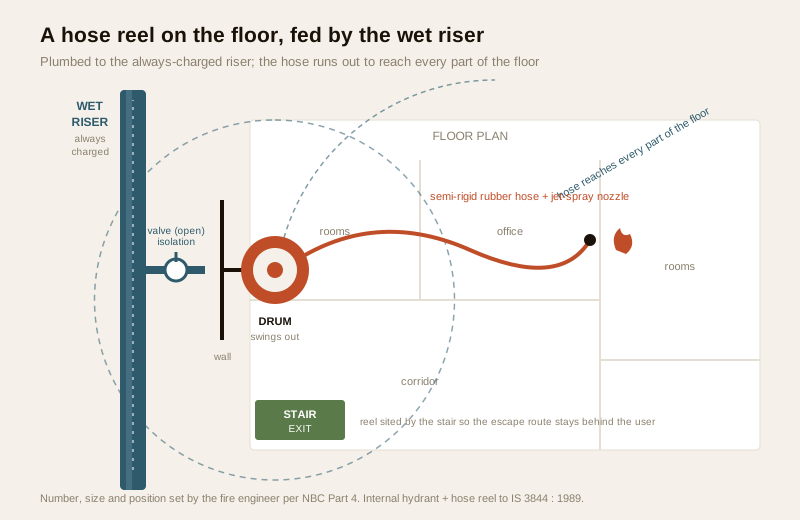
That permanent connection is the whole point and the key difference from a portable extinguisher. An extinguisher holds a few seconds to a couple of minutes of agent and then it is spent; a hose reel, fed by the building's water system, keeps delivering water for as long as the supply holds and the nozzle is open. It is the bridge between the extinguisher a person grabs off the wall and the internal and external fire hydrants and fire pumps that the brigade and trained fire teams use for a serious fire.
| Firefighting layer | What it is | Who uses it | Duration |
|---|---|---|---|
| Portable extinguisher | Hand-held, self-contained agent | Any occupant, on a tiny fire | Seconds to a couple of minutes |
| Fixed hose reel | Plumbed water line on a drum | Trained occupant / floor warden, small early fire | As long as water supply holds |
| Internal / landing hydrant | Landing valve for fire-brigade hose | Trained fire team, fire brigade | Sustained, professional attack |
| Automatic sprinklers | Ceiling heads that open over the fire | Automatic - no human needed | Automatic, until controlled |
The hose reel and the internal hydrant usually live in the same shaft, fed by the same wet riser, and are covered by the same code, IS 3844 : 1989. The reel is the part an ordinary trained occupant is expected to use; the landing valve is for the fire service. Never confuse the two, and never operate a landing valve as if it were a hose reel.
Where the code wants hose reels - and why near the stairs
Whether a building must have hose reels, and how many, is set by the National Building Code (SP 7 : 2026, Part 4) according to the building's occupancy type, its height and its floor area - it is not a single universal rule, and the fire engineer determines it for your specific building. But the design logic behind their placement is worth understanding, because it explains why they are always where they are.
The governing idea is coverage: the code wants hose reels positioned so that the hose, fully run out, can reach every part of every floor. Because the hose is a fixed length, that dictates both how many reels a floor needs and where they sit. In practice this places them at consistent, reachable points on each floor, and they are sited near the staircase or the exit for two connected reasons. First, the wet riser they feed off runs vertically through the building right by the stair core, so the plumbing is naturally there. Second, and more importantly for life safety, siting the reel by the escape route means the person using it always has the stairs at their back: they fight the fire from the safe side, with their escape route open behind them, never with the fire between themselves and the way out.
| NBC placement principle (indicative - the fire engineer sizes it) | Why |
|---|---|
| A hose reel on each floor of a building where the code requires them | Fire on any floor gets an immediate first-aid response before the brigade arrives |
| Positioned so the hose reaches every part of the floor area | No corner of the floor is beyond first-aid firefighting reach |
| Sited near the staircase or exit, off the wet riser | Plumbing runs by the stair core; the user keeps the escape route behind them |
| Number and spacing set by floor area and hose length | More or larger floors need more reels to keep full coverage |
Because the requirement scales with occupancy and height, hose reels are a routine expectation in the settings this library covers separately: the high-rise tower, the office building, the hotel, the hospital, the large apartment complex and the basement. In every case the actual number, size and position come from the fire engineer's design against NBC and the Fire NOC, not from a rule of thumb.
How a trained person uses a hose reel - Class A only
Using a hose reel is simple by design, because it must be usable by an ordinary trained occupant under stress. But the single most important part of using it is knowing when not to. A hose reel throws water, and water fights only one broad class of fire well: Class A - ordinary combustibles like paper, wood, cloth, furniture and general rubbish. That is exactly the fire it is meant for: a wastebasket, a sofa, stacked cartons, a curtain, caught early.
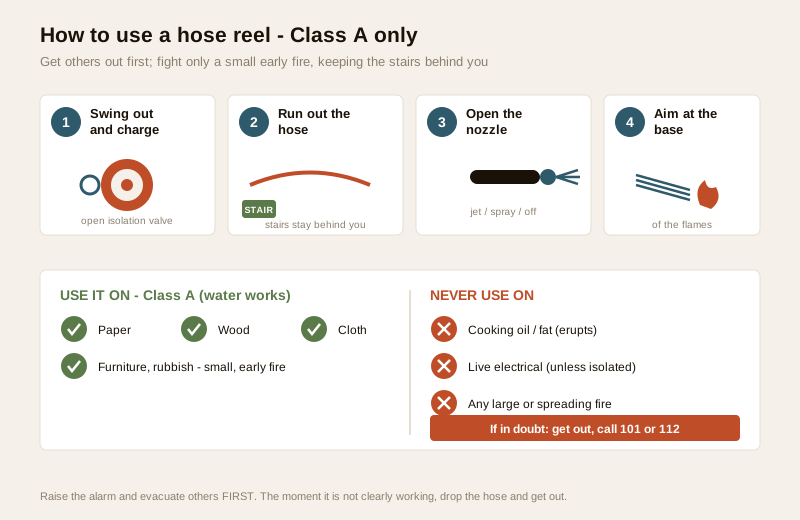
The sequence a trained floor warden follows is:
1. Raise the alarm and start people evacuating first. The hose reel is never a reason to delay getting others out. Someone raises the building alarm; people leave.
2. Swing the drum out and open the isolation valve so the reel is charged with water.
3. Run out only the hose you need toward the fire, keeping the staircase and your escape route behind you - never let the fire get between you and the exit.
4. Open the nozzle - jet for reach, spray for a wider, cooler, more protective pattern - and aim at the base of the flames from a safe distance, sweeping across the burning material.
5. The moment it is not clearly working - if the fire is spreading, the smoke is building, or you feel unsafe - stop, drop the hose and get out. A hose reel is for a small, developing fire only. The judgement to walk away is the most important skill of all.
This is where honest limits matter more than technique. Because the reel delivers water, it must never be used on:
- Cooking-oil and fat fires (Class F / K). Water on burning oil erupts violently and spreads the fire - the reason commercial kitchens use wet-chemical extinguishers and kitchen-hood suppression, and the reason a fire blanket is by the hob.
- Live electrical fires. Water conducts. A hose reel is used on an electrical fire only if the circuit has already been isolated - which is a decision, not a reflex - otherwise it is a CO2 extinguisher job. This is core to electrical fire safety and battery-room fire safety, where water is often the wrong agent entirely.
- Any fire that is already large, spreading fast, or filling the space with smoke. Past that early window the reel is hopeless and staying to fight is fatal. Get out; call the brigade.
Use the fire-extinguisher selector and the fire-suppression-system selector to think through which agent and system suit each risk in your building, alongside the reel.
The honest India reality - "installed" is not "working"
A hose reel is one of the most neglected objects in an Indian building, precisely because it is used so rarely that nobody notices when it has quietly died. It gets installed to earn the Fire NOC, and then years pass. When a real fire finally comes and someone swings out the drum, they meet one of the classic failures - and by then it is too late to discover them.
| The classic hose-reel failure | What it looks like | Why it is deadly |
|---|---|---|
| Perished, cracked or rotted hose | The rubber has aged, split or gone brittle; it bursts or leaks the moment it is charged | The one time it is needed, it delivers no usable jet |
| Seized or jammed drum | The reel will not swing out; brackets rusted, arm painted over | The hose cannot be run out to the fire at all |
| No water in the riser | The wet riser is drained, the isolation valve is shut, or the fire pump never starts | Water is fed by pressure; no pressure means no water |
| Obstructed or hidden reel | Furniture, stock or a locked cover in front of the drum | Seconds lost clearing it are the seconds that decide the fire |
| Missing or broken nozzle | Nozzle lost, cracked, or stuck open/shut | No control over jet, spray or off - or no flow at all |
The through-line is the memory-worn truth of Indian fire safety: "installed" is not "working." A hose reel that passed inspection on handover and has sat untouched for three years, its hose perishing, its riser drained during some plumbing job and never refilled, its pump in manual-off, is not fire protection - it is a red decoration that gives false comfort. The fire-pump and fire-water-tank chapters explain the water side that must be alive behind every reel; here the point is that the reel is only as good as the maintained system feeding it.
Maintenance - keeping the reel alive under IS 3844
The remedy is the same disciplined maintenance regime that runs through this whole library, applied to the hose reel and its supply, and set out for internal hydrants and hose reels in IS 3844 : 1989. It belongs in a proper Annual Maintenance Contract with a competent fire contractor, with a logged periodic-inspection routine, exactly as for the building's detection and extinguisher assets.
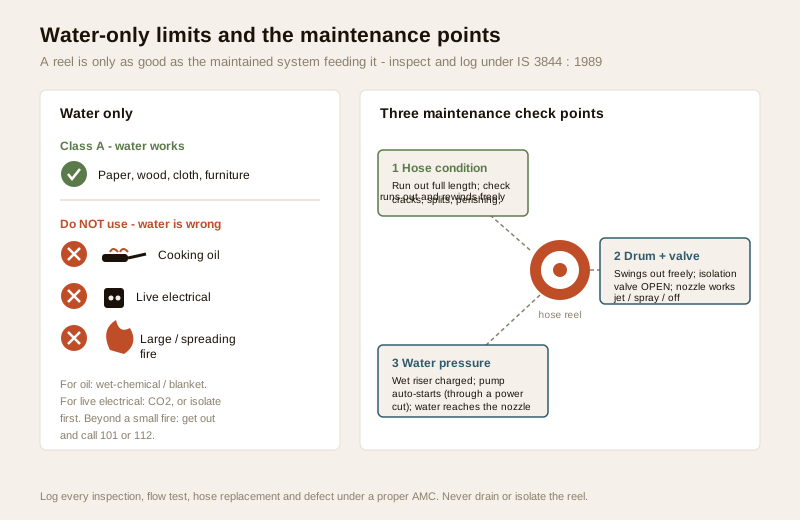
The periodic checks that keep a reel trustworthy centre on three things:
- The hose. Run the full length out and inspect it for cracks, splits, perishing, kinks and leaks; confirm it rewinds freely without jamming. Perished rubber is replaced - a hose is a consumable with a life, not a permanent fixture.
- The drum, valve and nozzle. Confirm the drum swings out freely, the isolation valve behind it is open (and stays open - a shut supply valve is a common silent killer), and the nozzle moves cleanly through jet, spray and off.
- The water supply. This is the check people skip. A reel is worthless without pressurised water: confirm the wet riser is charged, the isolation valves are open, and the fire pump and its jockey and standby arrangements actually start and hold pressure - which in India means confirming they survive a power cut, because a pump that only runs on mains is no pump at all during the outage a fire so often brings. Test flow periodically per the code so you know water reaches the nozzle, not just the drum.
Every inspection, flow test, hose replacement and defect goes in the log book, and the whole regime sits under the AMC. The apartment and office fire-safety guides show how this maintenance discipline fits the building's overall compliance and Fire NOC renewal, and the emergency-preparedness guidance covers training the floor wardens who will actually use the reel. Tie the reel into the wider water-based systems too: the sprinklers, hydrants and pumps share the water infrastructure a fire engineer designs and certifies as one system.
Never drain, isolate or block it - keep it live and AMC'd. The single most dangerous thing anyone does to a hose reel is quietly take it out of service: shutting the isolation valve during some other work and never reopening it, draining the wet riser and forgetting to refill, leaving the pump in manual-off, or letting the hose perish unreplaced. Every one of these leaves a reel that looks fine on the wall and delivers nothing when a life depends on it. The valve stays open, the riser stays charged, the pump stays on auto, the hose gets replaced on schedule, and the drum stays clear and accessible - all under a logged AMC. Any change to the plumbing, sizing or coverage is a licensed fire-protection engineer's job against NBC Part 4 and the Fire NOC, never a caretaker's improvisation. A drained or blocked hose reel is worse than none, because it makes a building feel protected when it is not.
Key takeaways
- A fixed hose reel is first-aid firefighting on every floor - a semi-rigid rubber hose on a swinging drum, permanently plumbed to the wet riser, that a trained occupant can use on a small early fire in the minutes before the brigade arrives, bridging the gap between a portable extinguisher and the fire hydrant.
- The code places them by coverage and near the stairs - NBC (SP 7 : 2026, Part 4) decides whether and how many by occupancy, height and area; the fire engineer sizes and sites them so the hose reaches every part of the floor, near the exit so the user keeps the escape route behind them.
- Water means Class A only, and only a small early fire - suitable for paper, wood, cloth and furniture; never for cooking oil, never for live electrical unless isolated, and never for a large or spreading fire; the moment it is not clearly working, drop it, get out and call 101 or 112.
- "Installed" is not "working" - the classic India failures are perished hose, a seized drum, a drained riser, a pump that never starts, an obstructed reel and a broken nozzle, all invisible until the day the reel is needed.
- Maintenance under IS 3844 : 1989 keeps it alive - a logged AMC checking hose condition, the drum, valve and nozzle, and above all the charged water supply and auto-starting pump; never drain, isolate or block it, and route all design and plumbing changes to a licensed fire-protection engineer.
References
- IS 3844 : 1989 (Reaffirmed 2020), Bureau of Indian Standards - Code of Practice for Installation and Maintenance of Internal Fire Hydrants and Hose Reels on Premises. The core code governing the fixed first-aid hose reel, its connection to the wet riser and internal hydrant, its coverage, and its inspection, testing and maintenance regime. Verify the current edition via the BIS catalogue: https://www.services.bis.gov.in/
- National Building Code of India, SP 7 : 2026 (the NBC), Part 4 "Fire and Life Safety" - the framework that decides whether hose reels and wet risers are required for a given building by occupancy, height and floor area, and that governs the fire-water storage and pumping behind them; the older SP 7 : 2016 edition is withdrawn but still widely quoted. Verify the current edition via the BIS catalogue: https://www.services.bis.gov.in/
- The relevant State Fire Services Act and Rules and the Model Building Bye-Laws (MoHUA) - these set when a Fire NOC and a certified, maintained first-aid hose-reel and wet-riser installation are legally required for a given premises, and the periodic maintenance obligations that follow.
- Manufacturer datasheets and installation manuals for the specific hose reel, hose, nozzle and isolation valve installed - the authority for hose bore and length, working pressure, service life and the reel's own maintenance schedule; always follow the equipment documentation and the commissioning contractor's records.
This is an educational overview, not legal advice, and not a substitute for a licensed fire-safety consultant or fire-protection engineer. Fire hose reels, wet risers, their hydraulic design, installation, commissioning, the Fire NOC and any statutory maintenance are qualified professional tasks - engage licensed fire professionals and the State Fire Services, and verify any standard's current status via the BIS catalogue before relying on it.
Export this guide
Related Guides — Deep-dive reading
Sprinkler System Maintenance in India (2026): Keeping a Life-Safety System Ready
A fire sprinkler system is a life-safety installation that must work on the one day it is needed — this professional guide covers the scheduled checks, statutory tests and record-keeping that keep a wet, dry or pre-action system live: water supply and pressure, valves in the correct open position, control and alarm valves, sprinkler heads kept clear, and the roles of the competent fire contractor versus the facility manager.
SecurityEmergency Lighting Testing in India (2026): The Function Test, the Duration Test and the Battery That Quietly Dies
Emergency lighting is what gets people out of a building in a power cut or a fire — and it is useless if its batteries have silently gone flat. This professional guide covers what emergency lighting is, the two tests that keep it honest (the short frequent function test and the longer periodic duration test that catches dying batteries), what to test across escape routes, stairs and exit signs, the statutory test log, and the safe split of who does what.
SecurityFire Hydrants in India (2026): Internal Wet Risers, Yard Hydrants & Fire-Tender Connection
The building hydrant system is the high-pressure water network the fire brigade fights a serious fire with - the internal wet riser and landing valves, the external yard hydrants, and the fire-service inlet that lets a tender boost it.
SecurityRelated Tools — Try Free
Acoustic Privacy (STC) Visualizer
Indian healthcare acoustic visualizer — compare wall assemblies and noise sources, see received SPL after STC attenuation, and check FGI 2018 / IS 1950 / NABH speech-privacy compliance with live dual-canvas waveform.
Acoustic ToolCross-Ventilation Analyzer
Estimate airflow and air changes per hour (ACH) from room size, window areas, layout, and local wind — with NBC 2016 Part 8 compliance check.
Ventilation CalculatorApartment Furniture Size Chart
Standard furniture dimensions for Indian apartments — sofas, beds, tables, dining, storage.
Reference Chart