
Smart Lock Cost in India (2026): Honest Price Bands and Total Cost of Ownership
What a smart lock really costs in India, from basic keypad locks to smart mortise handle-sets and deadbolts, plus the forgotten running costs, batteries, subscriptions and AMC, with worked totals for one door and a whole home.
A smart lock is one of those purchases where the sticker price tells you almost nothing. Two locks can carry the same headline number and cost wildly different amounts to own once you count the fitting, the batteries you will replace over five years, the cloud subscription buried in the app, and the service call when it locks you out. The reverse is true too: the cheapest lock on the shelf often turns into the most expensive one by year three.
This guide is about smart lock cost in India in plain rupees, honestly. It gives you indicative price bands by lock type, explains what actually drives the number up or down, and, most importantly, walks through the costs almost everyone forgets. Then it works two real totals, one main door and a whole 3-4 door home, so you can budget properly. Treat every figure here as an indicative band to sanity-check a quote, not a fixed rate, because prices move with brand, city, spec and the day's offers.
Scope & safety. This guide helps you plan and budget. It does not tell you to fit a lock yourself. The actual lock and door-hardware fitting, any mains wiring, and any fire-egress or fire-door interlock are licensed professional jobs, and a lock on an escape-route door must always keep a mechanical key override and free interior exit. Any lock that stores fingerprints, face templates, access logs or app-account data is handling sensitive personal data under the Digital Personal Data Protection Act, 2023. This is educational guidance on budgeting, not legal or engineering advice. All prices are indicative and exclude or include GST only where noted.
The two numbers that matter: capex and running cost
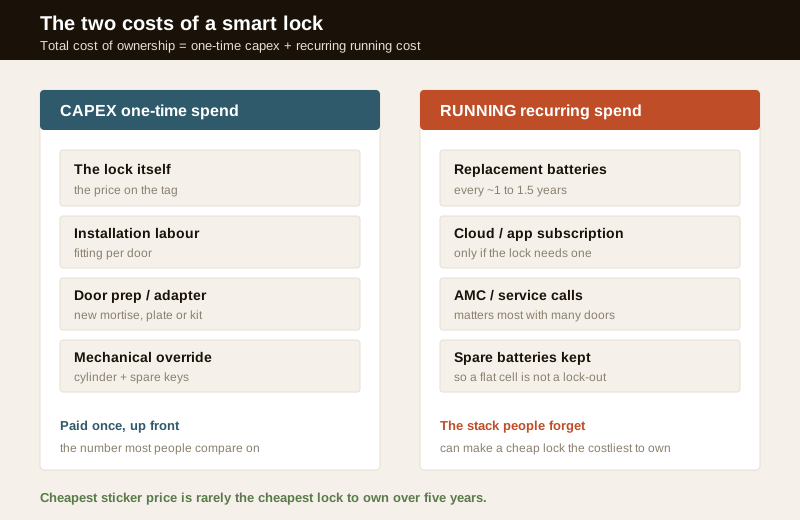
Every smart lock has two costs, and people only ever look at the first:
- Capex, the one-time spend: the lock itself, plus installation labour, plus any door preparation or adapter, plus a mechanical override cylinder or spare keys. This is the number on the price tag, roughly.
- Running cost, the spend that keeps coming: replacement batteries, any cloud or app subscription, and, for a home with several doors or a building, an Annual Maintenance Contract (AMC) or pay-per-visit service.
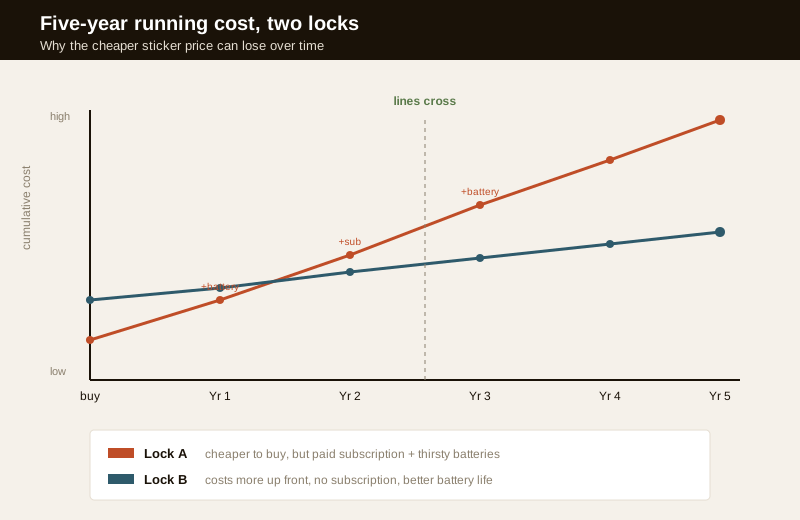
The single biggest budgeting mistake is judging a lock on capex alone. A lock that is a thousand rupees cheaper but eats a subscription and a set of batteries every year is not cheaper; it is a slow-drip bill. We will put real numbers on this in the worked examples, but hold the idea in your head from the start: cheapest upfront is rarely cheapest over five years.
Indicative capex bands by lock type
Here is where the money lands for the common categories sold in India. These are the price of the lock hardware only, before installation, and they move a lot with brand and spec, so read them as bands, not quotes. For which type actually suits your door and life, use the smart lock buying guide and the smart lock selector; this section is only about the money.
| Lock type | Indicative price band (hardware only) | What you are paying for |
|---|---|---|
| Basic PIN / fingerprint keypad lock (rim or surface fit) | ₹3,000 – ₹9,000 | Entry-level PIN and fingerprint unlock, no app, simplest build |
| Good smart mortise handle-set (multi-credential) | ₹12,000 – ₹30,000 | A proper mortise lock with handle, multi-point latching, fingerprint, PIN, card and key |
| App / Wi-Fi lock (remote features) | ₹9,000 – ₹28,000 | Adds app control, Wi-Fi or Bluetooth, remote access and logs |
| Smart deadbolt (retrofit on many Indian doors) | ₹8,000 – ₹22,000 | A deadbolt form that often fits existing single-door prep |
| Hotel-style digital lock (per door, card/RFID) | ₹4,000 – ₹12,000 per door | Hotel-style card locks sized for many similar doors |
| Small access-control setup (per door, reader + controller + strike) | ₹15,000 – ₹60,000+ per door | A proper access-control door, distinct from a standalone lock, see below |
Two things to notice. First, the ranges overlap heavily, because a feature-loaded keypad lock can cost more than a plain mortise. Second, the top row and the bottom row are not really the same product: a ₹4,000 keypad lock and a ₹40,000 access-control door solve different problems. Do not let a single "smart lock" search bar flatten that difference.
The single-door lock versus the access-control case
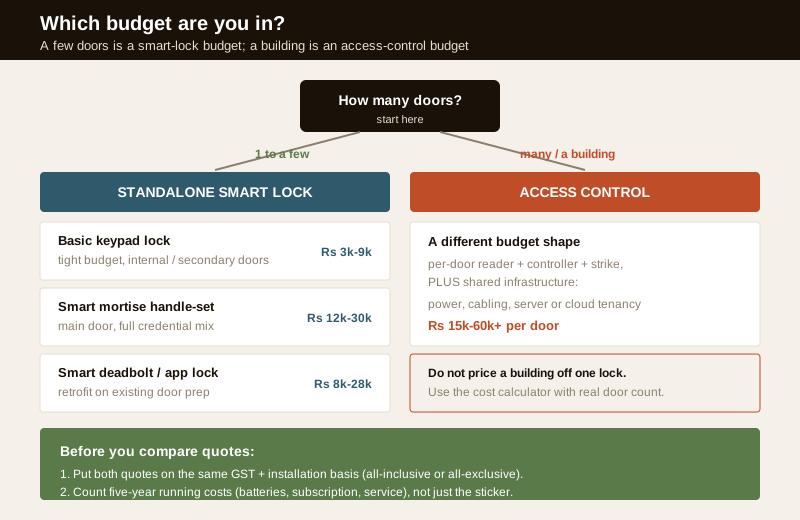
If you want one, two or three doors in a home to open by fingerprint or PIN, you want a smart lock, and the top rows of that table are your world. If you are securing a building, an office, a society gate, or many doors that must share one credential system with an audit trail and centrally granted or revoked access, that is access control, and it is a different budget with a different shape, controllers, readers, electric strikes, power supplies, cabling and often a server or cloud tenancy. It scales per door but also carries shared infrastructure, so the per-door number in the table is only part of it.
Do not price a 20-door building off a single-door lock. For the multi-door and whole-building case, read the complete guide to access control in India and the biometric access control and access control audit trails guides, and put your actual door count and features into the smart lock cost calculator to get a figure grounded in your project rather than a shelf price.
What actually drives the cost up or down
Two locks side by side, one twice the price. The difference is almost always some mix of these six drivers. Knowing them lets you decide where to spend and where a cheaper choice is genuinely fine.
- Credential mix. Every extra way to open the door adds cost. A PIN-only lock is cheapest; add a fingerprint reader, then a card/RFID, then face recognition or app unlock, and each layer lifts the price. Buy the credentials you will actually use, not the longest feature list.
- Form factor: mortise vs deadbolt vs rim. A full smart mortise handle-set with multi-point latching is a heavier, pricier piece of engineering than a deadbolt or a surface rim lock. Form is also a fit question, so check the door compatibility guide and the door compatibility checker before you fall in love with a mortise your door cannot take.
- Connectivity. A purely offline lock is cheapest. Bluetooth adds a little; Wi-Fi and true remote access add more, and sometimes a bridge/hub device on top. Connectivity is also what may drag in a subscription, covered below.
- Biometrics. Fingerprint readers vary from basic to genuinely good; face recognition costs more again. Better sensors cost more but frustrate you less, which matters because a lock that rejects your finger in the monsoon is a lock you will curse daily.
- Build quality and IP rating. A weatherproof, metal-bodied lock rated for an exposed Indian door, sun, dust, monsoon, forty-degree heat, costs more than a plastic indoor-grade unit, and is worth it on a main door. Cheap build is where "saved money" turns into "replaced in two years."
- Brand and after-sales. An established brand with local service, spares and warranty carries a premium over a grey-market import, and that premium is partly insurance: when a lock fails, the cheap import with no service channel becomes a locked-out emergency, while the branded one gets a visit.
The costs almost everyone forgets
This is the heart of the guide. The price tag is the beginning, not the end. Here are the costs that quietly stack up, and roughly what to budget for each in India.
| Forgotten cost | Typical India band | Notes |
|---|---|---|
| Installation labour | ₹500 – ₹2,500 per door | More for a retrofit needing door cutting; see installation requirements |
| Compatibility adapter / door prep | ₹0 – ₹4,000+ | New mortise pocket, plate, or an adapter kit if the lock does not match the door |
| Replacement batteries | ₹150 – ₹700 per change | AA/AAA or a rechargeable pack; frequency depends on use and lock, see power and battery planning and the battery guide |
| Cloud / app subscription | ₹0 – ₹1,500+ per year | Many locks are free; some gate remote unlock, history or extra users behind a plan |
| AMC / service (multi-door or building) | ₹500 – ₹2,000 per visit, or an annual contract | Sensible once you have several doors or a shared system |
| Mechanical override spares | ₹100 – ₹500 | Spare keys cut for the override cylinder, budget them, do not skip them |
A few of these deserve a closer look.
Installation and door prep
A lock that drops onto your existing door prep costs little to fit. A lock that needs a new mortise pocket cut, a fresh strike plate, or filling and re-drilling an old handle position costs more, sometimes as much as the fitting of a plainer lock. This is why a smart deadbolt that reuses your current single-door cylinder prep can be the cheapest route to a smart main door, and why a beautiful mortise handle-set on a door not built for one can quietly double your fitting bill. Get the fitter to quote the door prep separately, and read the installation requirements guide first.
Batteries over five years
Nearly all Indian smart locks run on batteries, and batteries are a recurring cost, not a one-off. How often you change them depends on the lock, the traffic and the connectivity, a Wi-Fi lock that phones home constantly drains faster than an offline one. Over a five-year life a single door might go through several battery changes. It is small money per change, but it is real, it is annual, and it is exactly the sort of cost a capex-only comparison hides. Plan it deliberately with the power and battery planning guide, and always keep a spare set and a mechanical key override so a flat battery is an inconvenience, not a lock-out.
The subscription question
Some locks are yours outright, buy once, use forever, no recurring app fee. Others put remote unlock, extended access history, extra user profiles, or cloud video (on lock-plus-camera units) behind a paid plan. Neither model is wrong, but you must know which you are buying, because a ₹1,200-a-year plan across five years is ₹6,000 you did not see on the price tag. Ask, before you buy: what works with no subscription, what needs one, and what happens to the lock if you stop paying? The app-controlled locks guide covers the feature side.
Worked example 1: a single main door
Say you want one good smart lock on your main door, a proper mortise-style unit with fingerprint, PIN, card and mechanical key, from a branded maker with local service, no mandatory subscription. Here is an honest five-year total.
| Item | One-time | Per year | 5-year total |
|---|---|---|---|
| The lock (good smart mortise) | ₹18,000 | — | ₹18,000 |
| Installation + door prep | ₹2,000 | — | ₹2,000 |
| Spare override keys | ₹300 | — | ₹300 |
| Batteries | — | ~₹400 | ₹2,000 |
| Subscription (none on this lock) | — | ₹0 | ₹0 |
| Occasional service call | — | ~₹300 avg | ₹1,500 |
| Total | ₹20,300 | ~₹23,800 over 5 years |
The lesson is in the shape of it: the capex is about ₹20,300, but the true five-year cost is closer to ₹23,800. The running costs added roughly ₹3,500, modest here precisely because we chose a lock with no subscription and decent battery life. Pick a cheaper lock with a mandatory ₹1,200-a-year plan and worse batteries, and the five-year total can land higher than this "more expensive" lock. That is the whole point.
Worked example 2: a whole home, 3-4 doors
Now a family securing the main door plus three internal or secondary doors. A sensible pattern is one good lock on the main door and simpler locks on the rest, not four flagship units.
| Door | Lock choice | One-time | 5-yr running |
|---|---|---|---|
| Main door | Good smart mortise | ₹18,000 + ₹2,000 fit | ~₹3,500 |
| Second entrance | App / Wi-Fi lock | ₹12,000 + ₹1,500 fit | ~₹3,000 (incl. small subscription) |
| Two internal doors | Basic keypad locks | ₹6,000 each + ₹800 fit each | ~₹1,500 each |
| Subtotal | ~₹53,900 capex | ~₹9,500 running | |
| Whole-home 5-year total | ~₹63,400 |
Two things stand out. First, spreading the spend, one flagship, one mid, two basics, keeps the whole-home number sane instead of buying four ₹18,000 locks. Second, the running costs across four doors, batteries times four plus one subscription plus the odd service call, add up to nearly ten thousand rupees over five years, which is real money and a reason to prefer no-subscription locks where you can. If you are wiring several doors, an AMC or a pay-per-visit relationship with one installer is often cheaper and calmer than four separate scrambles when something fails.
Put your actual doors, chosen lock types and features into the smart lock cost calculator for a total tuned to your home rather than these illustrative bands, and use the smart lock finder to match products to that budget.
A word on GST and how prices are quoted
Smart locks in India attract GST, and quotes are inconsistent about whether they show it. A shelf or online price may be inclusive; a dealer or project quote is often quoted before tax and then adds it. Installation labour may be billed separately again. When you compare two quotes, make sure both are on the same basis, all-inclusive or all-exclusive, or you will "save" money that reappears as tax at the end. Ask for the out-the-door figure: lock plus fitting plus tax, everything, for a fair comparison.
How to actually save money without regretting it
Cutting cost is fine; cutting the wrong cost is expensive. Safe places to economise and places not to:
- Do economise on: internal and secondary doors (basic keypad locks are plenty), the credential list (skip face recognition if fingerprint and PIN cover you), and matching the lock to your existing door prep to avoid cutting costs.
- Do not economise on: the main door's build quality and IP rating, a lock with local service and warranty, the mechanical key override, and spare batteries. These are the differences between a minor annoyance and a night locked out of your own home.
- Beware the false economy: the cheapest import with no service channel, or the "free" lock that needs a paid plan to do the one thing you bought it for. Both look cheap on day one and bill you later. This is also a security point, not just a money one, a lock with no firmware support ages badly; see the smart lock cybersecurity guide.
When to bring in a professional. Budgeting and comparing quotes is your job, and this guide is meant to make you good at it. Fitting the lock, any door cutting or mortise work, any mains wiring, and especially any lock on a fire-escape or shared-egress door are licensed jobs, get a proper installer and, for anything electrical, see the electrical hub. For a building or many doors, price it as access control, not as a pile of single locks, and get a written quote that separates hardware, labour, tax and any recurring fees so you can see the real total.
Key takeaways
- Judge a smart lock on total cost, not the sticker. Capex is the lock plus fitting plus door prep; running cost is batteries, any subscription and service, and the running side is the one people forget.
- Indicative capex bands: basic keypad ₹3,000-₹9,000; good smart mortise ₹12,000-₹30,000; app/Wi-Fi ₹9,000-₹28,000; smart deadbolt ₹8,000-₹22,000; hotel-style ₹4,000-₹12,000 per door; a real access-control door ₹15,000-₹60,000+ per door, all moving with brand, city and spec.
- A single main door realistically runs to roughly ₹20,000-₹24,000 over five years, and a sensibly-mixed 3-4 door home to around ₹60,000-₹65,000, with running costs adding several thousand rupees you must budget for.
- Cheapest upfront is rarely cheapest over five years: a lower price paired with a mandatory subscription, thirsty batteries, poor build or no local service can cost more by year three, and a lock that fails and locks you out costs most of all.
- Many doors or a building is a different budget: price it as access control, put your real numbers into the cost calculator, and always compare quotes on the same GST-and-installation basis.
References
- Digital Personal Data Protection Act, 2023 — any lock that stores fingerprints, face templates, access logs or app-account data is handling sensitive personal data; factor privacy hygiene and, for multi-door systems, data-handling terms into the true cost of ownership.
- Manufacturer specifications and price lists — verify the current price, battery type and life, IP rating, warranty terms and whether any feature requires a paid subscription on the maker's own datasheet before you buy; all bands here are indicative and move with brand, city and spec.
- Bureau of Indian Standards and the National Building Code of India (SP 7) for any door-hardware, electrical or fire-egress aspect of an installation; verify the current edition and any product certification via the BIS catalogue: https://www.services.bis.gov.in/
This is an educational overview of budgeting, not legal, financial or engineering advice. All prices are indicative bands, inclusive of GST only where a quote states so, and move with brand, city, spec and the day's offers. Lock fitting, door and electrical work and any fire-egress interlock are qualified professional tasks; engage licensed installers and verify any standard's current status via the BIS catalogue before relying on it.
Export this guide
Related Guides — Deep-dive reading
Access Control Maintenance in India (2026): Readers, Locks and Fail-Safe Egress
How to keep a card, keypad, fingerprint or face access-control system reading reliably and locking securely — and, above everything, how to test that its doors still release on a fire alarm and on power loss, so an access-controlled door never becomes a life-safety trap.
SecurityWireless CCTV Cost in India (2026): Cheap to Buy, Read the Running Costs First
What Wi-Fi and wire-free CCTV really costs an Indian home — a low, DIY-friendly install price that hides a subscription, battery and reliability bill. An honest, capex-versus-opex look at where the money actually goes over three to five years, with indicative bands and the drivers that move them.
SecurityAccess Control System Cost in India (2026): Priced Per Door, Per System, Per User
What a building-scale access control system actually costs in India — broken down per controlled door (reader, electric lock, controller, cabling and power) and per system (software, licences, integration and AMC) — with the standalone-versus-networked split, how the bill scales with the number of doors and the credential you choose, and the non-negotiable rule that escape-route doors must fail safe.
SecurityRelated Tools — Try Free
Door Lock Selector
Answer a few questions and get the right lock type — mortise, multipoint, deadbolt, privacy or smart — for any door.
Door ToolSmart Lock Door Compatibility Checker
Tell us your door build, existing lock or prep, thickness and location and find out which smart-lock form factor fits — mortise, deadbolt, rim, gate or a special case — plus the measurements to take.
CompatibilitySmart Lock Cost Calculator
Estimate smart door lock cost by access type, tier and number of doors — and compare it to a mechanical lock.
Door Calculator