
Smart-Lock Power Battery Planning in India (2026): How the Lock Is Fed and What Happens When Power Runs Out
The install-side power decision for a smart lock: battery versus wired mains, sizing a UPS so a power cut cannot lock people out, and always planning the dead-battery get-in-anyway path with a mechanical key.
Every smart lock runs on electricity, and the single question people forget to ask at planning time is the most important one: what feeds it, and what happens the day that feed stops? In India, where power cuts are routine and summer heat is hard on batteries, that is not a hypothetical. A lock that cannot be opened during a cut, or whose battery quietly died overnight, turns a security upgrade into a lock-out.
Smart-lock power battery planning is the install-side decision that sorts this out before the door is fitted, not after. It is a different job from choosing which battery lasts longest — for battery life, chemistry and swap intervals, use the dedicated smart-lock battery guide. This guide is about the choice and the contingency: how the lock is powered, and the get-in-anyway path you design around it. It sits in the Studio Matrx smart locks and access control library alongside installation requirements and door compatibility.
Scope, safety and the way out. This guide helps you plan and decide; the actual door hardware, any mains wiring and the fire-egress interlock are coordinated jobs for licensed professionals (door-hardware trade, electrician, fire-safety consultant). Two rules are non-negotiable. First, a home door must always keep a working mechanical key override plus a backup way in — the get-in path is a design requirement. Second, a lock on an escape-route door must fail-safe: it must release on power loss and on the fire-alarm signal, and getting that right is a licensed job under the National Building Code and local fire rules — see fire-egress compatibility. This is educational guidance, not legal advice.
The one decision: battery or wired
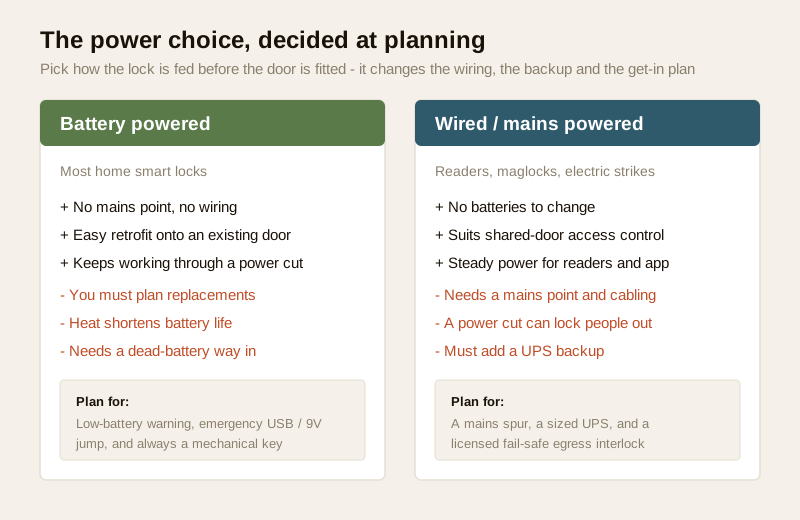
Almost every home smart lock in India is battery powered. Wired or mains power belongs to a different world — access-control readers, magnetic locks (maglocks) and electric strikes on shared or commercial doors. The two paths lead to very different install work and very different failure plans, so decide deliberately.
Battery power: the home default
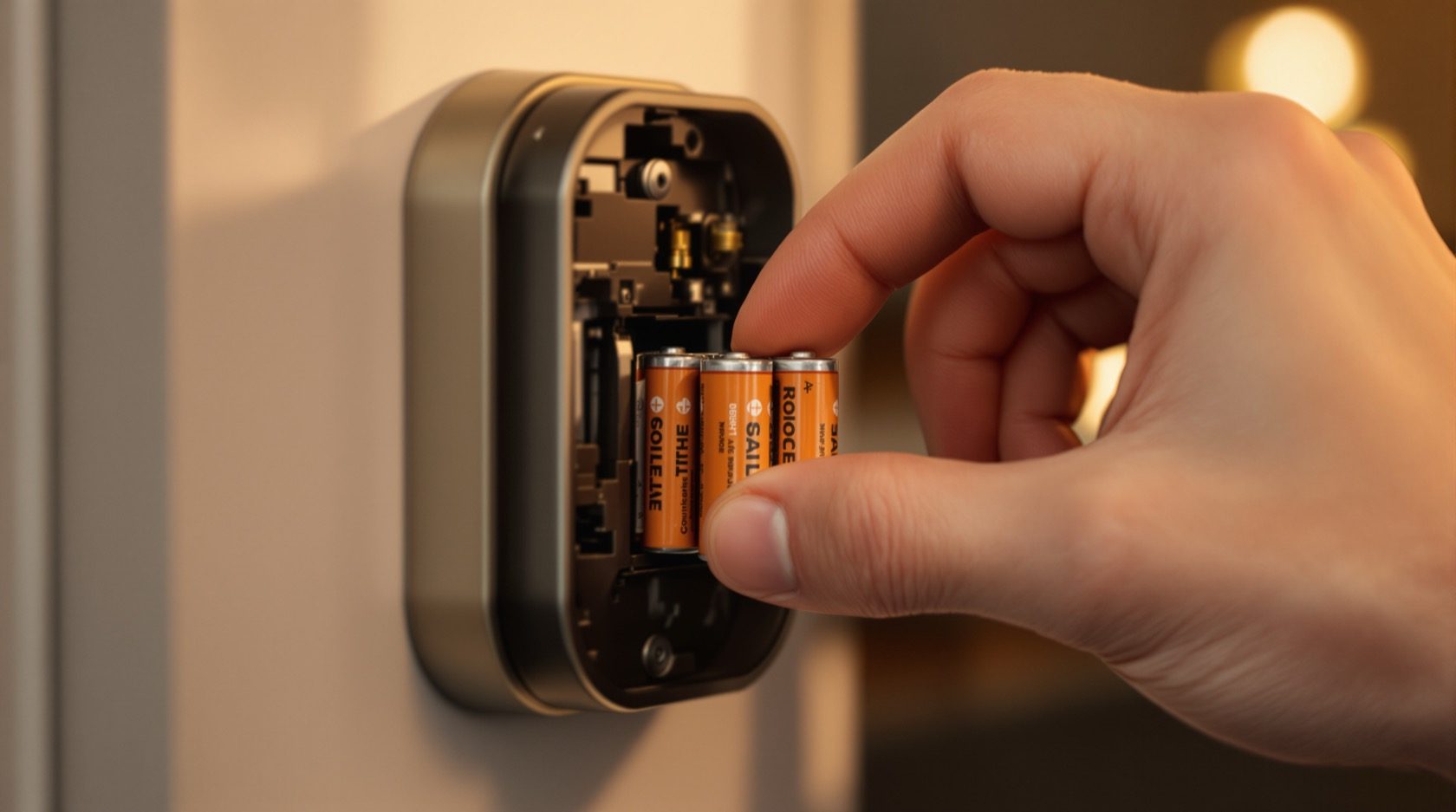
A battery lock carries its own power inside the handle or escutcheon — typically four to eight AA cells, or a rechargeable pack. Its great virtue in India is exactly the thing that trips up wired systems: a power cut does not touch it. When the street goes dark, a battery lock keeps letting you in and out as if nothing happened.
The trade is that batteries run down, and you own that problem:
- Plan the replacement rhythm. Most locks last several months to about a year per set of cells, but a lock on a busy front door drains faster, and so does one baking in afternoon sun. Note the fit date and keep spares in the house.
- Respect the heat. Indian summers push door surfaces well past forty degrees, and heat shortens battery life and can trigger false low-battery warnings. This is a battery-life topic covered in depth in the battery guide — for planning, just budget shorter intervals than the box claims.
- Design the dead-battery way in. This is the part people skip. A battery lock without a planned fallback is a lock-out waiting to happen. More on this below — it is the heart of the guide.
Battery locks suit almost all mortise, deadbolt and rim home fittings, and every credential type from fingerprint to PIN to Wi-Fi runs happily on them.
Wired / mains power: readers, maglocks and strikes
Wired power is for access control — a reader or controller that holds a door for a building, an office, a gate or an apartment lobby. Here the lock is a maglock or an electric strike energised from a mains-fed controller. There are no batteries to change, and the power is steady enough for always-on readers and app connectivity.
But wired power imports a problem battery locks never have: when the mains fails, the lock's behaviour changes. A cut can either release the door (potentially a security gap) or hold it shut (potentially a trap) depending on how it is wired — which is why wired access needs two things planned in from the start:
- A dedicated mains point run and terminated by a licensed electrician — coordinate this with the electrical hub and your installation requirements.
- A UPS or backup battery so a normal power cut does not disable the door. Sizing this is a conceptual exercise covered below.
Wired access control is its own discipline; if you are fitting readers for an office or a society, start with the access-control pillar, office access control or apartment access control.
| Planning factor | Battery lock (home) | Wired / mains (access control) |
|---|---|---|
| Typical use | Front doors, flats, villas | Lobbies, offices, gates, shared doors |
| Wiring needed | None | Mains spur + control cabling |
| Behaviour in a power cut | Unaffected, keeps working | Depends on wiring; needs a UPS |
| Ongoing task | Replace cells on a rhythm | Almost none; check UPS battery |
| Main risk to plan out | Dead battery lock-out | Power-cut lock-out or wrong fail mode |
| Backup you must design | Mechanical key + jump power | UPS runtime + fail-safe egress |
| Whose job | Door-hardware trade | Electrician + door-hardware, coordinated |
Planning the dead-battery and power-cut contingency
Whatever the power source, the design question is the same: how does a person get in (or out) when the power is gone? On a home battery lock this means planning three layers plus a backup; treat none of them as optional.
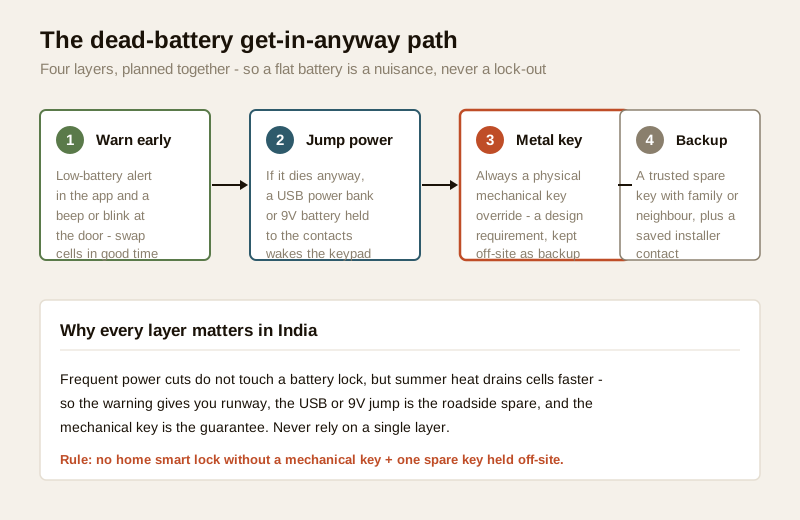
1. Low-battery warning — your runway. A good lock warns well before it dies: a notification in the app and a beep or a colour change at the keypad. At planning time, confirm the model you are buying actually pushes an app alert, and decide who in the household receives it. This is the layer that means the battery never silently dies.
2. Emergency jump power — the roadside spare. Many keypad and fingerprint locks have external contacts: a USB (often USB-C or micro-USB) port or a pair of terminals you touch a 9-volt battery to. That momentary power wakes the keypad long enough to enter your code and open. It is a get-you-in-once fix, not a fix for the flat battery — you still change the cells afterwards. Check the model has this and keep a small power bank or a spare 9V handy.
3. The mechanical key — the guarantee. This is the layer that is not negotiable. Every home smart lock should retain a physical mechanical key that opens the door with no power at all. Treat the keyway as a design requirement, not a legacy nuisance — see the mechanical key override guide. A lock sold as fully keyless needs an especially well-thought-out alternative, and for the wider planning of who gets in during any failure, read emergency access planning.
4. The off-site backup — the safety net. Keep at least one spare mechanical key with trusted family, a neighbour, or in a secure location away from the door, and save your installer's number. If both the battery and your key-in-hand fail, this is what stops a genuine lock-out.
The reason all four matter in India is specific: power cuts do not drain a battery lock, but heat does, and a warning you ignore during a busy week becomes a dead lock on a Sunday night. Layering the warning, the jump and the key means a flat battery is a five-minute nuisance, never a lock-out.
Sizing backup for wired systems: UPS runtime
For a wired access door, the equivalent of the mechanical key is a UPS (uninterruptible power supply) or backup battery that carries the door through a cut. You do not need to engineer this yourself — your installer and electrician do — but you should understand the shape of it so you can brief them and sanity-check the design.
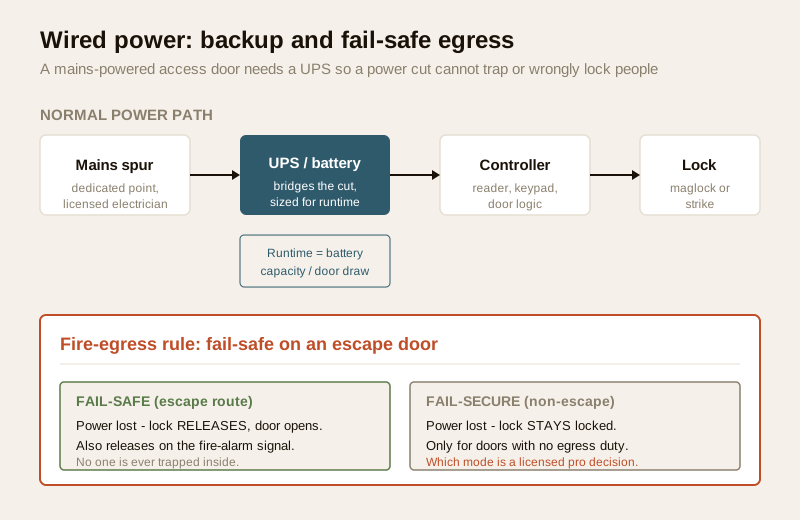
The idea is simple: runtime is roughly the backup battery's capacity divided by how much power the door draws. A door that draws less, backed by a bigger battery, lasts longer through a cut. Two things drive the sizing:
- How long a cut you must ride through. In many Indian areas a UPS that holds an access door for a few hours comfortably covers everyday load-shedding; a site with long rural cuts may need a bigger battery or a generator changeover. Decide the target runtime up front.
- What is on the backup. A single maglock draws little; a controller running several readers, a video door phone and network gear draws far more and drains a battery faster. Keep the door's essential lock and controller on the UPS and brief the electrician on total load.
| Conceptual sizing input | What it means for the plan |
|---|---|
| Target runtime | Hours you need the door to work through a cut |
| Door + controller draw | Total continuous load on the backup |
| Backup battery capacity | Bigger capacity buys more runtime for the same load |
| Recharge time | The battery must refill between cuts, not just once |
| Fail mode on total loss | What the door does when even the UPS is exhausted |
That last row is where power planning meets life safety, and it is the one you must never guess at.
When power meets fire egress
On any door that forms part of an escape route, the power plan is a life-safety matter, not a convenience one. The governing principle is fail-safe: if power is lost — the mains, the UPS, everything — a fail-safe egress lock must release so no one is trapped, and it must also release on the fire-alarm signal. A fail-secure device, which stays locked when power is lost, is only appropriate on doors that carry no egress duty.
Which mode a given door needs, how the fire-alarm interlock is wired, and how it all satisfies the National Building Code and local fire rules is a coordinated licensed job — the door-hardware trade, the electrician and a fire-safety consultant together. It is emphatically not a homeowner setting to toggle. Read fire-egress compatibility and emergency door release for the full picture, and note that even a fail-safe electric lock should be paired with a manual way out. Getting the fail mode wrong is the difference between a door that opens in an emergency and one that does not.
When to bring in a professional. You can decide the power strategy — battery or wired, the target runtime, who receives the low-battery alert, where the spare key lives. Hand the rest to licensed trades: any mains point or spur, the UPS sizing and wiring, the maglock or strike fitting, and above all the fire-egress fail-safe interlock, which is a coordinated job under the fire code — see the electrical hub and fire-egress compatibility. If a quote for a shared or escape-route door does not mention the fail mode and a backup, that is your signal the installer has not planned power properly.
Key takeaways
- Decide the power source at planning time. Battery for home doors (no wiring, survives power cuts, but you own the replacement rhythm); wired mains for access-control readers, maglocks and strikes (steady power, but needs a mains point and a UPS).
- Always design the dead-battery way in. Layer a low-battery warning, an emergency USB or 9-volt jump, and — non-negotiably — a mechanical key override, plus a spare key kept off-site. The get-in-anyway path is a design requirement.
- In India, heat is the battery enemy, not power cuts. A battery lock ignores load-shedding but drains faster in summer sun, so budget shorter replacement intervals than the box promises and see the battery guide.
- Wired doors need a sized UPS. Runtime is roughly backup capacity divided by door draw; set a target runtime for your local cuts and let a licensed electrician size and wire it.
- On an escape-route door, power planning is life safety. A fail-safe egress lock must release on power loss and on the fire alarm; the fail mode and interlock are a coordinated licensed job under the fire code — never a DIY setting.
References
- Digital Personal Data Protection Act, 2023 — access logs and any biometric templates a smart lock stores are sensitive personal data; minimise collection, keep on-device where possible and restrict access. Educational summary, not legal advice.
- Manufacturer specifications and datasheets — verify battery type and expected life, the presence of an emergency USB or 9-volt jump input, the mechanical key override, and the fail mode (fail-safe or fail-secure) of any electric lock on the maker's own datasheet before buying or fitting.
- National Building Code of India (SP 7), Bureau of Indian Standards, and local fire and electrical rules for egress hardware, fail-safe interlocks and any mains wiring; confirm the current edition via the BIS catalogue: https://www.services.bis.gov.in/
This is an educational overview, not legal advice. Mains wiring, UPS sizing, electric-lock fitting and the fire-egress fail-safe interlock are qualified professional tasks — engage a licensed electrician, the door-hardware trade and a fire-safety consultant, and verify any standard's current status via the BIS catalogue before relying on it.
Export this guide
Related Guides — Deep-dive reading
Access Control Maintenance in India (2026): Readers, Locks and Fail-Safe Egress
How to keep a card, keypad, fingerprint or face access-control system reading reliably and locking securely — and, above everything, how to test that its doors still release on a fire alarm and on power loss, so an access-controlled door never becomes a life-safety trap.
SecurityDoor Access Power Backup: Never Locked In or Out India 2026
What happens to every smart lock, maglock, strike and operator in a power cut, plus battery and UPS sizing so you are never trapped.
Home Doors & EntrancesFail-Safe vs Fail-Secure Locks: The Guide (India 2026)
Why fail-safe vs fail-secure is the single most important access-control decision, and how to get it right for every door.
Home Doors & EntrancesRelated Tools — Try Free
Access-Control Battery-Backup Calculator
Size the standby battery so an access system keeps running through a power cut, with an egress life-safety note.
Battery BackupBiometric-Capacity Calculator
Whether a biometric reader can hold all the enrolments and how many devices you need, with a 1:N speed note.
Biometric CapacityApartment Video Door System Planner
Enter flats, entrances, floors and guard desk for a first-pass building intercom plan — door stations, indoor monitors, guard station, the right architecture and an indicative cost band.
Building Planner